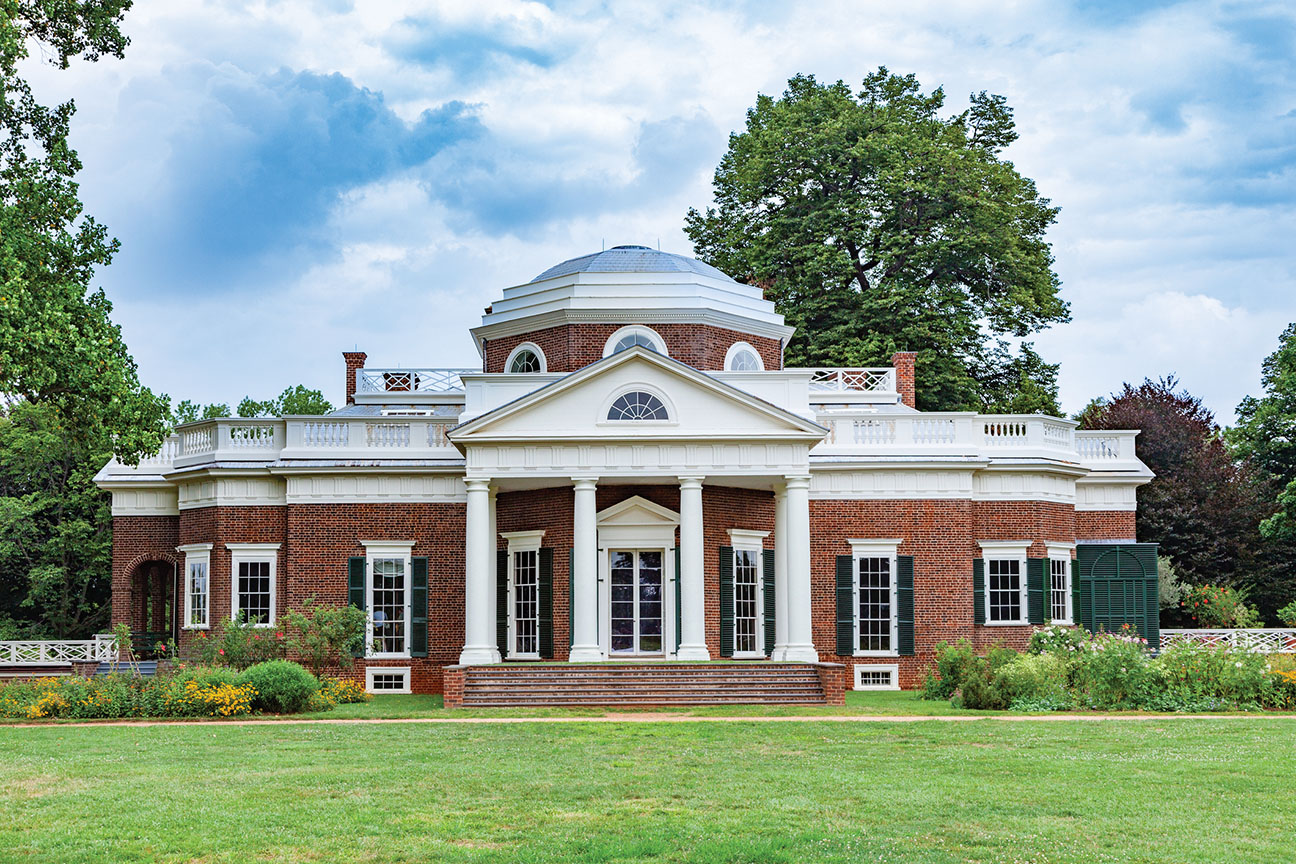
“Thomas Jefferson’s Monticello is one of the most beloved sites in America, drawing more than 300,000 visitors a year up a steep mountain road to enjoy majestic views of the Virginia Piedmont and house tours that can feel like stepping into its creator’s complicated mind” is how a May 25, 2025 New York Times story begins a 3,000 -word essay on the beloved landmark estate. What the piece neglects to mention, however, is that America’s third president’s home survived thanks to the efforts of a proud Jew thankful for freedom of religion in the United States.
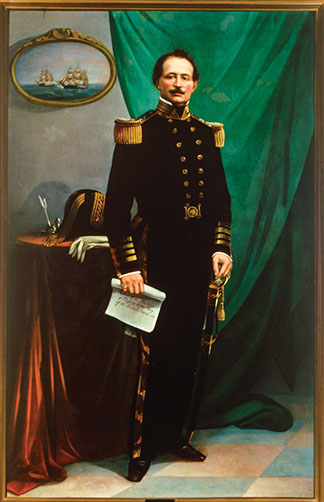
As Melvin Urofsky described in a 2001 lecture for the Thomas Jefferson Foundation, Uriah Phillips Levy (1792-1862), a U.S. naval officer, was one of the great characters in American Jewish history. “He was pugnacious, determined, eccentric, confirmed in the righteousness of his causes, an able businessman who was quite wealthy and an admirer of Thomas Jefferson.” Though he experienced antisemitism during his career, Uriah’s legacy is honored to this day by the Jewish Chapel at the Naval Academy in Annapolis, which bears his name.
Meir Soloveichik, in a 2017 essay in The Wall Street Journal, provided a brief summary of Levy’s personal history: “In 1776 a Jewish patriot named Jonas Phillips fled to Philadelphia from New York with the arrival of the British fleet. A decade later, he was well-regarded in his new city, and his daughter Rachel was set to marry a Jewish gentleman named Levy. Benjamin Rush — a famous physician, signatory of the Declaration of Independence and friend to Jefferson — attended the wedding. That Phillips had invited a prominent gentile to a Jewish ceremony, an act unthinkable almost anywhere else at the time, is a sign of the extraordinary freedom Jews had found in this new land. Rush, for his part, was entranced by the ceremony. He later wrote, ‘I was carried back to the ancient world and was led to contemplate the Passovers, the sacrifices, the jubilees and other ceremonies of the Jewish Church.’”
Rachel’s son was Uriah Phillips Levy.
Uriah’s appreciation of Jefferson was a result of the Founder’s well-deserved reputation as a champion of religious liberty — “not toleration,” Urofsky emphasized, “but liberty.”
“I consider Thomas Jefferson to be one of the greatest men in history,” Levy wrote in a November 1832 letter to John Coulter, “the author of the Declaration and an absolute democrat. He serves as an inspiration to millions of Americans. He did much to mold our Republic in a form in which a man’s religion does not make him ineligible for political or governmental life.”
Levy had travelled to France that year to study advanced naval tactics. There he met the Revolutionary hero the Marquis de Lafayette. Levy informed Lafayette that he planned on commissioning a bronze statue of Jefferson by the French sculptor Pierre-Jean David d’Angers. “There is no statue to Jefferson in the Capitol in Washington,” he explained in that letter to Coulter, “As a small payment for his determined stand on the side of religious liberty, I am preparing to commission a statue.”
Lafayette thought the idea was an inspiring one. After all, he had been friends with Jefferson for nearly half a century. So he lent Levy a portrait by Thomas Sully that he owned, for d’Angers to use as a model.
In March 1834, Levy presented the statue to the United States Congress. It still stands in the great rotunda of the Capitol, where it is the only statue paid for by private funds.
During the time the two men spent together in France, Lafayette asked Levy about the current condition of Jefferson’s old Virginia home. Levy was unsure and committed to look into the matter.
Upon his return to the U.S., Levy realized that a Charlottesville man named James Barclay had let the property decline after purchasing it from Jefferson’s daughter, Martha Jefferson Randolph. Barclay had hoped to turn it into a silkworm farm.
The estate had already begun to depreciate during the waning years of Jefferson himself. In debt, he could afford neither maintenance nor repairs. A visitor in 1824, two years before Jefferson’s passing, reported that the mansion was “old and going to decay,” and that the gardens and lawns were “slovenly.”
It turned out that Barclay was now eager to sell.
So, in early April 1834, roughly two weeks after gifting the statue to Congress, Levy bought Monticello and some acreage for $2,700.
Levy had a team of workers make repairs, clean up the interior and restore the landscaped lawns. He even fixed a seven-day clock that had been made to Jefferson’s specifications in 1793, as well as a two-wheel carriage that Urofsky quipped, “tradition, if not fact, claims to be the one Jefferson rode to Philadelphia in 1775 for the Continental Congress.”
Since his naval career kept him traveling frequently, Uriah brought his mother, Rachel Phillips Levy, to preside over the property in his absence. When she passed away, she was buried on the mountaintop not far from the house. Jefferson, too, is buried on the estate.
Uriah died in 1862. His grave is in Cypress Hills, Brooklyn, in the cemetery of the Spanish and Portuguese Synagogue, Congregation Shearith Israel. In his will, Levy left Monticello to the government of the United States. He added funds for the support of an agricultural farm there.
Alas, his timing was unfortunate. The Civil War had started, and the Confederacy seized and then sold the property. Following the war, and after a long period of litigation, Commodore Levy’s nephew, appropriately named Jefferson Monroe Levy (1852-1924), assumed ownership of Monticello.
Jefferson Levy, taking after his patriotic namesake and his uncle, served three terms as a Congressman from New York. He spent a fortune on maintaining the site, even adding hundreds of acres to the property. In 1923, he sold Monticello to the Thomas Jefferson Foundation which operates it as a museum to this day. This Jefferson is buried near his uncle. Their congregation, Shearith Israel, “the remnant of Israel,” is particularly fitting for this tale. After all, it is they who salvaged remnants from a hallowed age, and restored them to their former glory.
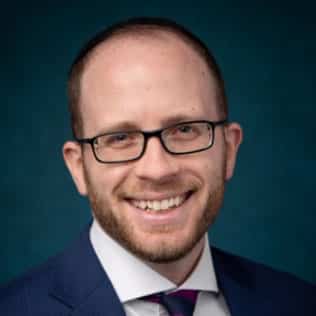
Rabbi Dr. Stuart Halpern is Senior Adviser to the Provost of Yeshiva University and Deputy Director of Y.U.’s Straus Center for Torah and Western Thought. His books include the newly released “Jewish Roots of American Liberty,” “The Promise of Liberty: A Passover Haggada,” “Esther in America,” “Gleanings: Reflections on Ruth” and “Proclaim Liberty Throughout the Land: The Hebrew Bible in the United States.”