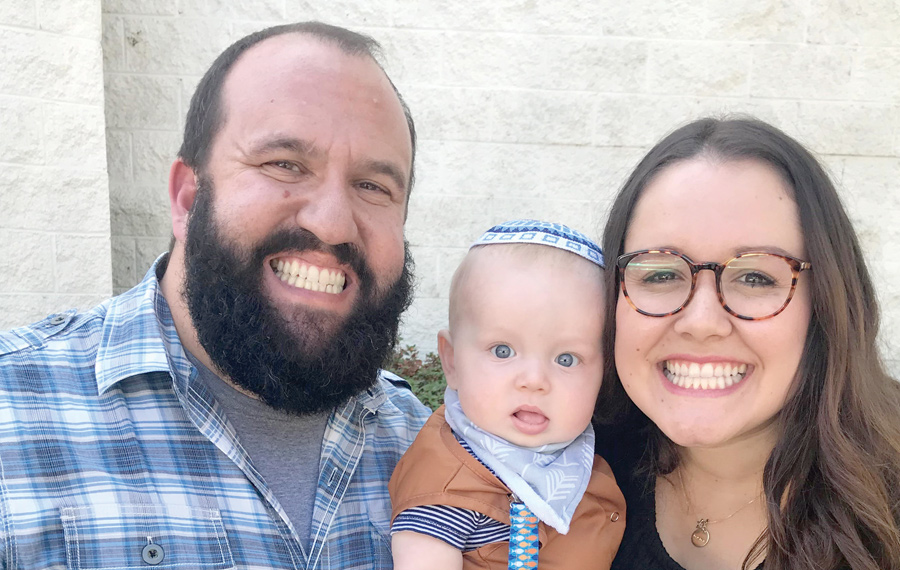
For three years, Los Angeles residents Michael Schwartzbach and his wife, Breanna, struggled to become pregnant. They went to different doctors and tried various methods of in vitro fertilization (IVF), but nothing worked.
They then discovered Dr. Nurit Winkler from the Los Angeles Reproductive Center. Unlike other doctors, Michael said Winkler was personal with them and gave them hope that IVF could work. She also told them about Hasidah, a nonprofit organization that provides grants and interest-free loans to couples with fertility issues. They applied for and received a $5,000 grant towards IVF.
“It was hard, because we didn’t know how we’d pay for [IVF] or where to go,” Michael said. “Thank goodness for organizations out there that help out couples in need.”
With the Hasidah grant, together with a loan from the Jewish Free Loan Association, help from family and a credit card, the Schwartzbachs were able to pay for the $40,000 treatments and conceive. Today, their son Rowen is 10 months old.
The Schwartzbachs are among the many couples that Hasidah has helped. The organization, which Rabbi Idit Solomon and her husband, Steven, started in 2013, has helped bring 12 babies into the world to date, with five more on the way. They give an average of $10,000 per grant, according to Idit, and founded the organization after they experienced their own fertility problems.
“But what about the people who are trying to have kids? We’re not helping them?”
— Idit Solomon
The Solomons, who live in Northern California, spent three years trying to conceive a child. “Every month was another failure,” Idit said. “It’s not like every month you start over again. It’s like you’re carrying all the wounds from before.”
At the same time, Idit was running a department of Jewish education, which supported families financially so they could lead a Jewish life. But she noticed they weren’t focusing on couples that couldn’t have kids.
It seemed like an irony that we’d spend all these resources for people with kids, but what about the people who are trying to have kids? We’re not helping them?”
The Solomons ended up having two miscarriages during the course of five IVF treatments and spent close to $100,000, some of which was covered by insurance. With the help of donor eggs, Idit carried her first children, twin daughters, and then had another daughter. Although her fertility treatments worked, she knows it’s a tough process.
“I’ve spoken to hundreds of people going through this,” she said. “It’s bittersweet work. They are extraordinarily grateful but risking their financial futures.”
With Hasidah, which translates to “stork” and has a root word that means “chesed” (loving-kindness), Idit hopes to help eliminate some of that financial burden. When deciding whom to give grants and loans to, the organization looks at three categories: medical, financial and personal. The personal aspect covers whether the couple have a Jewish vision for their family.
The Schwartzbachs, who teach at Temple Judea in Tarzana and Emek Hebrew Academy in Sherman Oaks, and recently celebrated the High Holy Days with Rowen, are doing just that. “Navigating it and figuring out how to do it all is the hardest part,” he said. “Luckily, there are organizations out there willing to help.”
Hasidah’s next round of IVF grants and interest-free loans is open until Jan. 9, 2019. and people can apply on its website.
Idit said that she is happy to give back, because she not only went through it
herself, but she knows how important it is in a spiritual sense. “In Judaism, our focus is on family life,” she said. “It’s the most amazing gift I could ever help someone with.”