Whenever one of our writers or contributors — or I myself — use the term "Jewish community," I think of Lew Wasserman. An interviewer once asked the former MCA chairman and power broker about the Jewish community here. Wasserman shot back: "I don’t know of a Jewish community. It is nonexistent."
What Wasserman meant, I assume, was that the Jews of Los Angeles don’t cohere into a single, like-minded political mass, a "structured community," in his words. And in that he was right: If 100 Martians landed beside 100 different L.A. Jews and said, "Take me to your leader," no doubt they’d end up at 50 different addresses. Maybe 100.
But to say we’re not easily led or defined doesn’t mean there’s no there there. After all, community is not something that exists apart from our creation of it, or apart from our individual efforts to connect with those around us who share the same values, interests, history. To a certain extent, you inherit community, but more importantly you help create it.
For Rebecca Amato Levy and Myrtle Karp, that creation was a lifelong endeavor.
I met Levy several years ago while preparing an article on Passover. A warm, energetic woman, she welcomed me into her daughter Mati Franco’s Beverly Hills home with a plate of precisely shaped butter cookies she had just made. Levy, then 85 years old, was the matriarch of a vast, yet tightknit, group of Sephardic Jews, and their ever-expanding families, who had lived in Rhodes. She fled in 1939, just before Hitler’s troops murdered all but 150 of the Greek island’s 2,000 Jewish inhabitants. The community she cherished was gone, but Levy worked to recreate it by passing on its food and traditions.
Two weeks before that Passover, Levy had called a friend and said, "I feel terrible."
"Is it your phlebitis?" the woman asked.
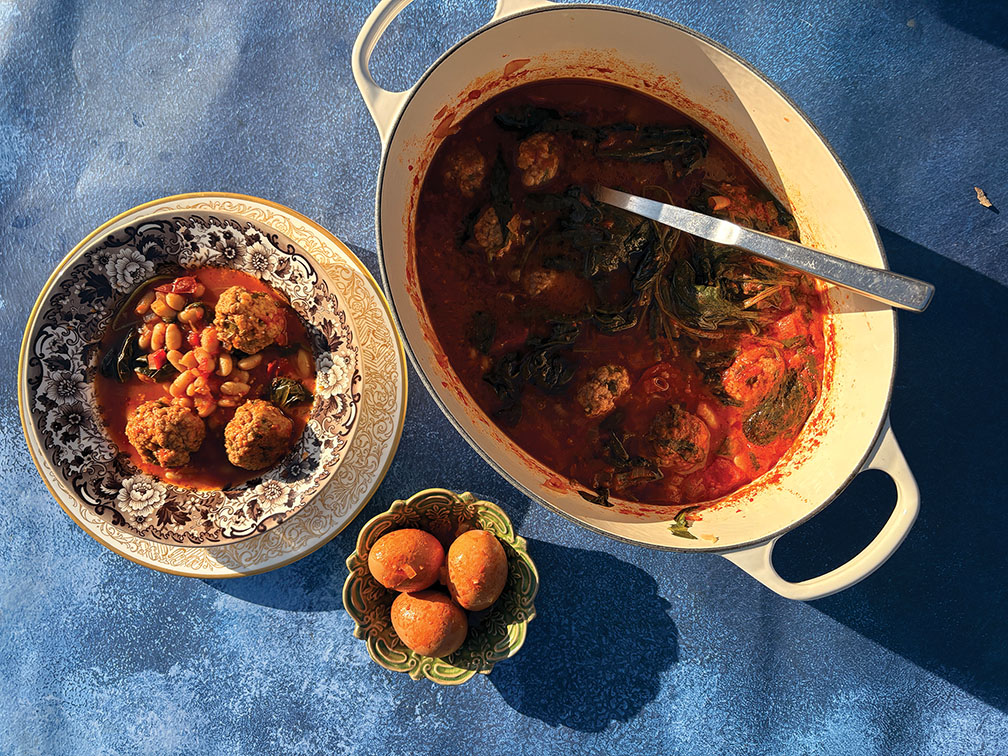
"No," Levy said. "It’s my oven." If she was unable to cook Quajado de Spinaka de Pesach for the masses, how would they acquire a taste of the Old Country?
Fluent in Turkish, Ladino, English, French, Spanish and, of course, Greek, she passed on her traditions through books and video, but mostly through example — cooking for hundreds at Sephardic Temple Tifereth Israel in Westwood, participating in an annual Rhodesli trip to Catalina, teaching the next generation the beauty of its heritage.
Myrtle Karp was a different kind of activist: intensely energetic, devoted to fundraising and organizing, and expert at both.
Her mother’s death forced her as a teenager to become the matriarch of her own family, and she lived out that role in adulthood, taking on key roles in the United Jewish Fund, Hadassah, Cedars-Sinai Medical Center and Jewish Family Service.
Women of Karp and Levy’s generation rarely led in the way a Lew Wasserman did. Their power lay in volunteerism, hard work and example. They created the structure of a community through which others could express their own Jewish identity.
Myrtle Karp died Aug. 2 at the age of 92; Rebecca Amato Levy passed away on Saturday morning, Aug. 4, at her daughter Mati’s home. She was 89. No such thing as a Jewish community? Lew Wasserman’s dictum would be Greek to both of them.
Obituaries for both women are on page 33.