There is no issue of greater concern to Israel supporters than the threat of a nuclear Iran that could destroy Israel “in a few minutes,” as Ambassador Michael Oren recently put it.
So you can bet I wasn’t going to miss a gathering of local Jewish leaders last week that aimed to “begin a conversation” on what the American Jewish community can do to help.
The gathering was off the record, which is not a problem here, because all I want to share with you is a lightning bolt that came to me after the meeting was over:
The issue of a nuclear Iran might be messy, nuanced and horribly complicated, but the next step for the Jewish community is remarkably clear.
We must convince America that a nuclear Iran is as great a threat for America as it is for Israel, and that stopping Iran from obtaining the bomb is as much in America’s interest as it is in Israel’s.
In other words, in this debate, America needs to catch up with Israel.
This didn’t seem so true a year ago, when presidential candidate Barack Obama stood at the AIPAC convention and declared:
“The Iranian regime supports violent extremists and challenges us across the region. It pursues a nuclear capability that could spark a dangerous arms race and raise the prospect of a transfer of nuclear know-how to terrorists. Its president denies the Holocaust and threatens to wipe Israel off the map. The danger from Iran is grave, it is real, and my goal will be to eliminate this threat.”
But today, the language seems to have shifted. There is an emerging school of thought that fears that America, despite all the huffing and puffing, is not ready to do whatever it takes to “eliminate” the threat of a nuclear Iran.
The Obama administration’s current policy of “engagement and possible sanctions” is seen by many critics as soft and unlikely to succeed. While the nuclear clock is ticking, President Obama, in contrast to his former forcefulness, has stated that “deadlines are artificial” and has spoken only of having “a fairly good sense by the end of the year as to whether they are moving in the right direction.”
I don’t know whether Obama has anything up his sleeve, but if I were Ahmadinejad, this recent statement from Secretary of State Hillary Clinton would not make me shake in my boots: “In the absence of some positive response from the Iranian government, the international community will consult about next steps, and certainly next steps can include certain sanctions.”
Of course, getting global players to support any kind of meaningful sanctions would itself be highly unlikely.
As professor Barry Rubin wrote in the Jerusalem Post: “Obama is neither wildly popular, nor has he made progress with the two biggest barriers to strong sanctions: Russia and China … [and] Europeans have spent years at engaging Iran. Their motives are economic self-interest … desire to avoid confrontations with Iran … [and a] belief that a nuclear-armed Iran can be managed.”
Recent statements by Clinton about a Middle East “defense umbrella” have further stoked Jewish fears about America going soft. Israeli Intelligence Affairs Minister Dan Meridor was quoted as saying: “I heard without enthusiasm the American declarations according to which the United States will defend their allies in the event that Iran uses nuclear weapons, as if they were already resigned to such a possibility…. This is a mistake.”
My point here is not to suggest that the Obama administration has decided to accept a nuclear Iran, but rather to ask this question: If the current policy turns out not to work, what if America decides that the price to “eliminate” the Iranian threat is simply too high?
Let’s face it, for Israel, no price is too high to eliminate the threat that the Jewish nation might be obliterated in “a few minutes.”
But this is not necessarily the case for America. The potential repercussions of a “last resort” military strike against Iran (whether by Israel or America) for American troops and citizens within Iraq, Afghanistan and elsewhere, not to mention possible global political and economic fallout, might make a policy of “management” more palatable to America than a policy of “elimination.”
If that’s the case, we might well be left with a sobering, fundamental conflict of interest between two great friends and allies, America and Israel.
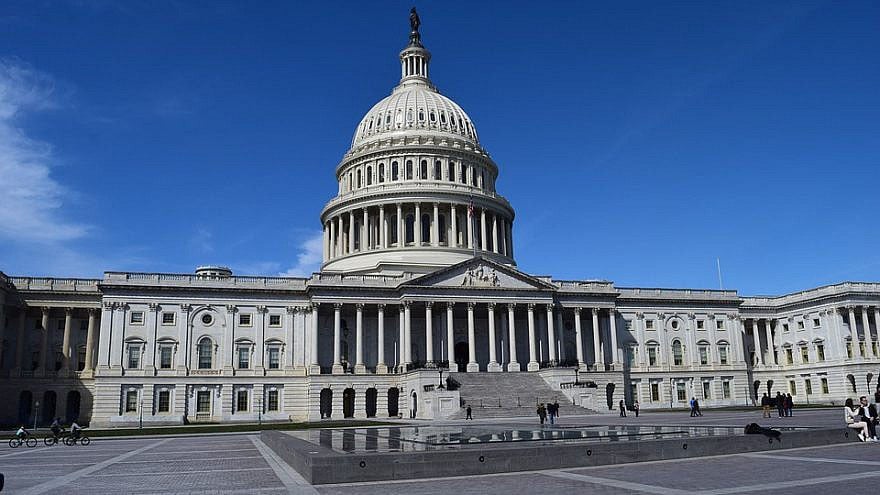
Which brings me back to my lightning bolt: American supporters of Israel must convince their country, the White House and Congress that a nuclear Iran is as much an American problem as it is an Israeli one.
Is it? I’m honestly not sure, but if anyone is interested in starting a movement, I have registered the domain name HelpAmericaStopIran.com.
Here’s a suggestion for whoever might design the site: Put a bold banner across the top that says, “The danger from Iran is grave, it is real, and my goal will be to eliminate this threat.”
And just below, name the author of those words: the current leader of the free world.
David Suissa, an advertising executive, is founder of OLAM magazine, Meals4Israel.com and Ads4Israel.com. He can be reached at {encode=”dsuissa@olam.org” title=”dsuissa@olam.org”}.