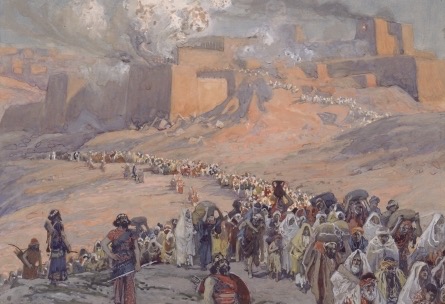
Just over 2600 years ago, Babylonian armies destroyed the holy temple in Jerusalem, ransacked the ancient Kingdom of Judah, murdered scores of people throughout the kingdom (known as “Jews” – ie, the people of Judah), and hauled off scores more as captives, to the land of Babylon.
Fifteen years ago, around this very day, I stood on the edge of the land that once was a small city in that ancient Kingdom of Judah – on the exact spot where the city guard looked from his tower into the distance and saw flames of light extinguishing in surrounding towns. The ensuing darkness signaled that the Babylonians were approaching and the end was near.
A chill went through my spine.
While the rest of the people on the tour continued walking around the ancient city ruins, I stayed glued to that spot, feeling the warm breeze on my face, looking out into the expansive distance, imagining the terror that must have shot through the city people as they awaited their fates.
Their end was my beginning: the beginning of an exiled people in Babylon, who over the millennia transformed into a thriving, vibrant community — writing the authoritative Babylonian Talmud, launching the first ever Jewish learning institutions (yeshiboth, commonly known as yeshivas), and otherwise developing a rich and unique culture full of stories, music, language, spiritual teachings, architecture, prayers, dance, scholarly works, art, and religious rituals.
After nearly three millennia, my ancestors were sent packing once again: In 1950, my family was among the 100,000 Jewish refugees from Baghdad alone – forced to flee after a surge of anti-Jewish violence throughout the Middle East and North Africa. Most of these refugees, including my family, were absorbed by the modern state of Israel. As in hokey-pokey style: One foot in, one foot out.
While my grandparents, six aunts and one surviving uncle remained in Israel, my father continued his migration to Massachusetts, where he chose to go to graduate school. There he met my mother, who had been on her way to New York from Colorado. When she’d gotten to the Massachusetts/New York fork in the interstate, however, she spontaneously decided to go north instead.
Together, they raised my sister and me as headstrong Iraqi Jews in Canada and California — teaching us the songs, prayers, religious rituals, food, personal and communal stories, Hebrew pronunciation, and a little of the language of Iraqi Jews. (I can say the most important things in Judeo- Arabic: “watermelon,” “barefoot,” “hammer,” and “my stomach hurts.”)
I went on to disseminate this knowledge across the world, over the course of two decades, as part of my ground-breaking Jewish multicultural work. Still, as tirelessly as I worked, I could not re-create Jewish life in Baghdad. I was unable to undo the violence and destruction that Iraqi Jews had faced. I was unable to bring back everything that was lost in the upheaval and uprooting. I was unable, in short, to resurrect the Iraqi Jewish community — to bring it back to life as it once was, in bold Technicolor.
What’s worse, over the past few decades, those who grew up in Iraq have been growing old and dying. Meanwhile I have been isolated from so many of these people, for a number of complex reasons. I am an exile within a family and community of exiles. So where does that leave me? Who am I? And who will I be when the older generation passes?
Throughout the Jewish community around the world, thsa b’ab is a memorial day — a day of fasting, prayer, and commemoration. It is a dark day, when people read paradoxically depressing yet triumphant stories about Jews who chose death over forced conversion, even when they had to watch their own children be killed before them. Today is also considered a day of terrible luck, replete with trembling fear, because the temple was destroyed not once, but twice on this day (the second time by the Romans, 656 years later).
I always have struggled with what exactly to do on this day. We are guided to actively induce a sense of grief and despair, so as to honor those before us and to remember being cast from freedom in our own land to captivity in someone else’s. But how, I wondered as a 14 year old in San Francisco, was I to do that, and what use was it anyhow? Actively feeling miserable and scared of moving all day long, because lordy knows what might go wrong next?
About a decade ago, I read an article by someone who suggested that this day actually should be one of celebration and honor: Yes, the temple was destroyed. Yes the kingdom was ransacked. Yes the people were hauled off as exiles. But look what’s come of it: vibrant Jewish life around the world, with the Babylonian exile reaching the far corners of the Middle East, North Africa, and Central, East, and South Asia, and the Roman exile stretching across all of Europe and the Americas.
As a Jewish multicultural educator, that spin resonated with me. Plus it was just so positive, so full of life and the pulsing rhythm of eternal change and transformation. It celebrated Jewish resilience and creativity and adaptation as a people, always surviving, always thriving, always pushing forward into new horizons.
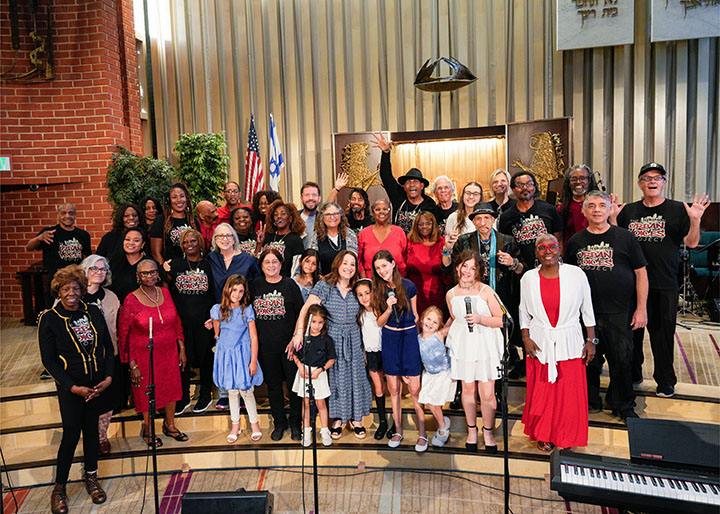
And so, I realized, it is with me personally: Iraqi Jewish life is now gone, as Judean Jewish life once was gone as well. What stands in its place, in my shoes, is a vibrant, creative, pulsating mix of East and West, old school and cutting-edge, religious and secular, traditional and feminist. I express this mashup of perspectives by writing original songs for my band, Iraqis in Pajamas, which fuses punk rock with Iraqi Jewish prayers – making me a living, breathing, invigorating 21st century incarnation of all who came before me. Just like my Jewish ancestors on the rivers of Babylon, I am the beginning of something new.
And that is cause for celebration.
For two decades, Loolwa Khazzoom served as a pioneering Jewish multicultural educator, offering programs worldwide and publishing books and articles teaching about global Jewish heritage. She now channels her Jewish multicultural passion into her all-originals band, Iraqis in Pajamas, for which she is the singer, songwriter, and bass player.