fbpx

July 31, 2017

Anthony Scaramucci’s profanities – and ours

The ouster of trash-talking Communications Director Anthony Scaramucci from the Trump White House reinforces one of my strongest beliefs, which is that foul language is still foul.

Scaramucci’s 11-day tenure may have set a welcome record for the fastest in, fastest out of a supremely unqualified White House staffer. His tirade against chief of staff Reince Priebus and chief strategist Steve Bannon, during an interview with Ryan Lizza of The New Yorker, contained enough expletives to blow up a Trump Tower, and was published last Thursday on the magazine’s website with no tidying up of the expletives.

I imagine that aside from his NC-17 language, Scaramucci would still have been kicked out after the interview broke. He revealed himself as a man of incredibly poor judgment and an almost maniacal meanness. This guy was going to be a Communications Director? Wow, just wow.

Still, let’s face it: expletives in everyday talk have become epidemic. The definition of vulgarity has been defined increasingly down. I hope that the egregiousness of the Scaramucci episode might be a wake-up call that language still matters.

Admittedly, I’ve always been sensitive to harsh language, even though I grew up in a home where the worst expletive ever uttered – and that only in extremis, such as when the UCLA Bruins had just fumbled the ball at the ten-yard-line in the fourth quarter – now barely rates an ellipsis after the first letter in print. I already miss those fast-disappearing ellipses, which now appear as almost quaint.

When I first wrote about the topic of profanity about a dozen years ago, offering tip sheets to parents and teachers to help prevent or discourage swearing among kids, the studies I found about the impact on profanity almost uniformly agreed: the more people swore, the more they became desensitized to the inherent anger in those words, and the angrier they became as people. People who swore without restraint were usually seen by others as less intelligent, disciplined, and unhappier than their cleaner-talking friends and neighbors. Revisiting this topic just last week, I discovered that newer studies dismiss profanity’s desensitizing impact. Instead, researchers pat profanity-users on the head. Swearing is just cathartic, they say. It feels good, and is therefore good for you.

There’s a time and a place for profanity. I like the old-fashioned times and places: the battlefield, the moment when you accidentally drop a heavy book on your foot, and “Ouch!” just won’t cut it. Those days are gone, but everyone knows that language counts, it’s just that we’ve become oddly selective about what words and phrases cause outrage. On college campuses, you can hardly say the word “white” or “American” or “rape” without mass fainting spells and demands for punishment for the speaker. Racial epithets, which are terrible and dehumanizing, are still somehow okay if used by someone of the same race. But we are also euphemism-happy, calling a used car “pre-owned” and referring to a job firing as a “department realignment.” That politician didn’t lie, she “misspoke.” And on and on.

The free-flying and promiscuous use of foul language – as verbs, nouns, adjectives, as anything and therefore as nothing – is only making our uncivil society less civil than ever. And our kids are listening, copying our actions and our words. Do we really want to live in a society where everyone is swearing all the time? If we do, what words will we have left to express true outrage, anger, fear or frustration? They’ve all been used up, empty and yet coarse at the same time.

How ironic that we are increasingly careful about what we put into our mouths, fearful of GMOs, pesticides, additives, and food dyes, but heedless of the words we are spraying like verbal toxins into the atmosphere? If we are what we eat, aren’t we also what we speak?

Judaism recognizes this truth. The laws of lashon hara, literally “bad speech,” are vast and intricate. They cover everything from implied insults to name-calling and certainly any outright profane language. The laws are so sweeping because it’s our speech that makes us human, and our words can hurt, or our words can heal.

Isn’t it time to rethink our promiscuous use of profanity?


Judy Gruen’s forthcoming memoir, The Skeptic and the Rabbi: Falling in Love with Faith, will be published September 5. Her work has also appeared in the Wall Street Journal, Chicago Tribune, Los Angeles Times, Aish.com and many other media outlets.

Anthony Scaramucci’s profanities – and ours Read More »

Mother sues Dallas JCC alleging employee raped her 14-year-old daughter

A mother has sued the Aaron Family JCC of Dallas alleging that a fitness center employee molested and raped her then-14-year-old daughter.

The lawsuit, which was filed earlier in July, also names the Jewish community center’s CEO, Artie Allan, and the Jewish Community Center Association of North America, the Dallas Morning News reported.

The mother and daughter are not named in the lawsuit, according to the newspaper.

The suit alleges that when the mother tried to talk to Allen about the fact that the employee was harassing her daughter and rumors they may be dating — before she knew about the molesting and rape. Allen allegedly responded that “it takes two to tango.”

According to the lawsuit, the assaults began in 2014, when the unnamed employee began stalking the girl, who is now an adult, when he trained her at the JCC gym.  The lawsuit charged that the employee also molested, sexually assaulted, threatened and raped her at the center and off-site.

The lawsuit said that two other girls told JCC staff members that the employee had sexually harassed them. It said the JCC neither launched an investigation nor disciplined the employee.

The newspaper reported that a former JCC employee, Randy Lee Adrian, was arrested in August on two charges of sexual assault of a child.

Adrian asked for the girl’s number to text her diet plans and workouts, but instead sent her explicit photos before sexually assaulting her over a span of 10 months, police told the newspaper. Police said he also threatened to kidnap and hurt her family if she told anyone about the assaults.

The Dallas JCC issued a statement saying it was aware of the lawsuit, “takes the matter seriously and will respond accordingly.”

“The JCC is committed to understanding the full and relevant story by a thorough investigation,” it said. “With a pending lawsuit, the JCC has no further comment at this time.”

Mother sues Dallas JCC alleging employee raped her 14-year-old daughter Read More »

Why more Israelis are moving to the US

Six years ago, the Israeli government released a series of controversial ads to show its expatriates that they would never feel at home in the United States.

But last year, Israeli Cabinet members lined up to address a Washington, D.C., conference celebrating Israeli-American identity.

The ad campaign, which was pulled following a backlash from Israelis and Jews abroad, represented Israel’s traditional attitude toward citizens who left its borders. Emphasizing its image as the Jewish national homeland — and ever concerned about its Jewish-Arab demographic balance — Israel’s government has long encouraged Jews not only to move to Israel but to stay there. In 2014, then-Finance Minister Yair Lapid called Israelis who moved to Berlin “anti-Zionists.”

But the parade of Israeli ministers who spoke at the 2016 conference of the Israeli-American Council attested to a shifting reality: Whether the Israeli government likes it or not, the Israeli-American diaspora is real, growing and leaving its mark on the United States.

Here are four things to know about the Israelis who live in the United States.

No one knows how many Israelis live in the United States — but it could be a million.

There’s no real way to know how many Israelis are living in the United States. Any first-generation child of Israelis is considered an Israeli citizen, and Israel can’t force its expatriates to register with their local consulate.

Estimates of Israelis in America vary widely — from about 200,000 to as many as a million. According to statistics from the U.S. Department of Homeland Security, some 250,000 Israelis acquired permanent residence in the United States between 1949 (when 98 Israelis left the infant state) to 2015 (which saw about 4,000 Israelis move stateside). But that number does not chart deaths or Israelis who moved back.

The 2013 Pew Research Forum study on American Jews found a similar number: About 300,000 Jews in America were either born in Israel or born to an Israeli parent. In total, Pew found that first- or second-generation Israelis account for about 5 percent of American Jews.

Even the Israeli government produces two different numbers. Israel’s Central Bureau of Statistics reports that a little more than 500,000 Israelis in total moved abroad from 1990 to 2014 — and nearly 230,000 came back. But Israel’s U.S. Embassy told JTA that between 750,000 and 1 million Israelis live in the country. Adam Milstein, chairman of the Israeli-American Council, an umbrella group for Israelis here, told JTA that includes 400,000 children born to an Israeli parent.

In recent years, Israel has lost more people to the United States than it has gained. From 2012 to 2015, according to Homeland Security, 17,770 Israelis took up residence in the United States. During that span, fewer than 13,000 people made the move  from the United States to Israel.

They are centered in New York and Los Angeles.

Israelis tend to go where the Jews are. Milstein estimates that about 250,000 Israelis each live in the Los Angeles and New York City metro areas, which also boast the two largest Jewish communities in the United States. Smaller concentrations of Israelis (and Jews) live in South Florida, Chicago and San Francisco.

Those cities, in turn, have developed a range of services for their Israeli diasporas. Israel’s Immigrant Absorption Ministry maintains Israeli Houses in nine American cities that host cultural events and political activism. The Israeli-American Council has chapters in 15 cities. And communities boast active Facebook groups: “Israelis in New York” includes 18,000 members.

The cities also provide ample opportunities for Israeli culture. Israeli cuisine is a staple of New York’s restaurant scene, from chef Einat Admony’s mini empire of eateries, to Dizengoff, an Israeli restaurant with branches in Philadelphia and New York. Aroma, the iconic Israeli coffee chain, has branches in New York, New Jersey, Washington, D.C., and Miami.

And Israeli musicians — from Idan Raichel to Shlomo Artzi to Sarit Hadad — are never hard to find on New York’s concert scene. An adaptation of Israeli novelist David Grossman’s book “To the End of the Land” opened recently at the the annual Lincoln Center Festival.

They come for education and work.

Neither the Israeli Embassy nor the Israeli-American Council tracks why Israelis move to the U.S., but Milstein suspects it’s for professional and academic reasons. Israel’s small size means Israelis with college or advanced degrees often seek to advance their careers in places with more opportunities abroad.

Israelis “don’t have the roots [of] someone whose family lived in Italy for 20 generations, or who lived in America for the last 150 years,” Milstein said. “The Jewish people, the most valuable asset they have is their brain. They can take their brain[s] anywhere.”

Israel, conversely, has begun to worry about its “brain drain” recently. A 2013 study by the Taub Center for Social Policy Studies found that for every 100 Israeli scholars who stayed in Israel, 29 left for positions abroad in 2008.

The drain is happening in the tech industry, too: According to the Israeli Executives and Founders Forum, an Israeli tech association, there are nearly 150 Israeli startups in Silicon Valley.

Israel still wants them back.

Israel’s government may have recognized that it can’t bring back all the Israelis from the United States, but it’s still trying. The appeal is both emotional and economic.

The 2011 ad campaign, for example, featured a series of shorts highlighting the Israeli-American cultural divide. In one, a child of Israelis in America, video chatting with Israeli grandparents, talks about the upcoming winter holiday of Christmas, not Hanukkah. In another, an Israeli woman comes home to commemorate Memorial Day in Israel with a candle — her American boyfriend mistakes it for romantic lighting.

More recently, Israel has also laid out financial incentives to draw expatriates back, including a program set to launch later this year called “Returning at 70,” a reference to Israel’s 70th Independence Day in 2018. The Immigrant Absorption Ministry will provide returning Israelis with financial assistance for six months, and will even cover a portion of their salaries in order to ensure they can find work in their old-new home. The government is also offering free professional development courses and consulting.

Israelis who have opened businesses stateside, meanwhile, will receive about $14,000 for the costs of relocating the business. And Israelis who move to the country’s underdeveloped northern and southern regions are eligible for grants as well as loans with low interest rates.

But Milstein says that even with these programs, Israeli officials still understand that it’s better to embrace expatriates than shame them into coming home.

“By trying to raise our guilt feeling, it backfired,” he said. “The State of Israel is getting to the realization that [our] being here, they can’t do too much about it. We can help the State of Israel a lot. They understand we can be their strategic asset.”

Why more Israelis are moving to the US Read More »

Netanyahu defends decision to remove Temple Mount security

Israeli Prime Minister Benjamin Netanyahu publicly defended his decision to remove metal detectors and other security measures from the Temple Mount, calling it a difficult choice but one made with a broad view.

Netanyahu also announced at the beginning of Sunday’s regular Cabinet meeting that he has authorized the reinforcement of security forces on the Temple Mount and throughout the Old City of Jerusalem, as well as instructed Israel Police and the Cabinet to approve a $28 million budget for the development and acquisition of technology in order to create new security solutions for the site.

“I am attentive to the feelings of the public, I understand those feelings, I know that the decision we made is not an easy one,” Netanyahu said Sunday. “However, as prime minister of Israel, as the person who bears the responsibility for Israel’s security, I must make the decisions with coolness and discretion.  I do that out of a view of the big picture, a wide view of the challenges and threats that are facing us.”

Some of the challenges, he said, are not known to the public and he cannot detail them.

On Tuesday, Netanyahu ordered the removal of metal detectors and other security measures put into place at the entrance gates for Muslim worshippers to the Temple Mount in an effort to increase security there following the July 14 attack by three Arab Israelis that left two Israel Police officers dead.  The installation of the new security measures led Muslims to stay away from the site and hold prayers at the gates, leading to clashes with Israeli security forces. Muslim worshippers returned to the site on Friday,

Netanyahu also issued a warning “to our enemies on all fronts: The IDF, the Shin Bet and the Israel Police are prepared to act with all their might against anyone who tries to harm our citizens, our soldiers and our policemen. This is how we acted and we will act accordingly.”

Netanyahu defends decision to remove Temple Mount security Read More »

Reagan once fired his communications director after 5 days — and not because he was a former Hitler youth

Did Anthony Scaramucci, sent packing from the White House on Monday, set a record for the shortest stint as communications director?

Scaramucci — The Mooch — was let go in part because of an obscenity-laden interview he gave to The New Yorker magazine last week. He wasn’t set to formally take the job for another two weeks (Aug. 15) but he clearly had started work as of Friday, July 21 — so that’s 11 days.

But there was, in fact, a communications chief who was on the job for a shorter period. According to our archive, John Koehler lasted just five working days in 1987, under President Ronald Reagan.

Why? Officially, Koehler was ousted as part of a reorganization. And yet our story notes that Koehler, an immigrant from Germany, had been in Hitler Youth.

It turns out that the “reorganization” was more fact than spin. James Baker had taken over as REagan’s chief of staff from Donald Regan — who had left suddenly because of his clashes with First Lady Nancy Reagan, and who had hired Koehler. Baker wanted his own guy, Tom Griscom, in the slot.

The Hitler Youth reference, which kept coming up in the reporting at the time, clearly irked Koehler: He had never hidden it. “Christ, it’s on every damn statement I’ve ever made,” the former Associated Press executive told UPI before he assumed the job. Two of his three wives were Jewish and, he said, he attended synagogue. As a teenager in Germany  he worked as an interpreter for the U.S. Army, and later, after he became a U.S. citizen, served in army intelligence.

He died in 2012 and was buried with military honors at Arlington Cemetery. Reagan, to whom Koehler had been close, kept him on staff at the U.S. Information Agency.

There’s another irony surrounding Kohler: The man who worked hard to shake off the stigma of belonging to Hitler Youth had replaced Pat Buchanan, an official who consistently displayed anti-Jewish bias, and who urged Reagan stick to his notorious decision to pay tribute at a German military cemetery.

Reagan once fired his communications director after 5 days — and not because he was a former Hitler youth Read More »

Corker: Deal reached on Taylor Force Act

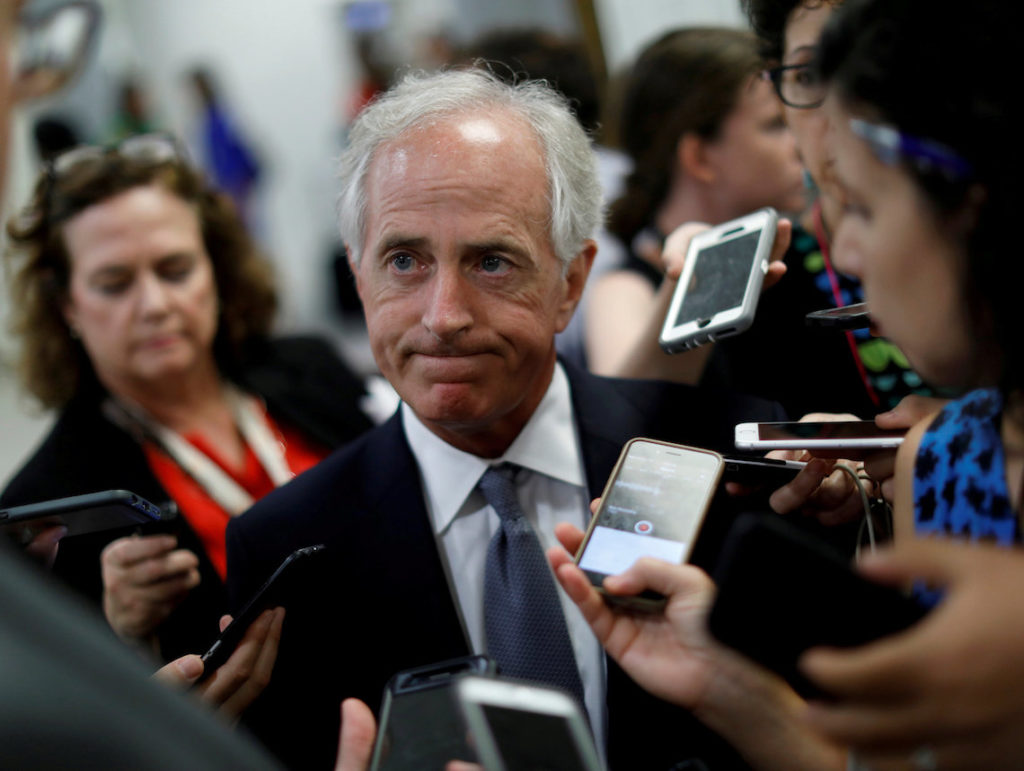
Sen. Bob Corker (R-Tenn.), Chairman of the Senate Foreign Relations Committee, is set to unveil an updated version of the Taylor Force Act this afternoon after reaching an agreement with his colleagues from both parties. In an interview with Jewish Insider, Corker said that he hopes “to mark it up” on Wednesday during a formal business meeting at the Senate’s Foreign Relations Committee.

[This story originally appeared on jewishinsider.com]

Introduced by Sen. Lindsey Graham (R-S.C.), the bill would completely sever all U.S. economic aid to the Palestinian Authority if payments to terrorist families continue.

“What they (the Palestinians) are doing relative to rewarding terrorists for killing Israelis is beyond the pale,” said Corker. “We should have done it a long time ago. It’s something that we are going to speak to very soon.”

The recent standoff over Obamacare last week has reportedly delayed negotiations over the Taylor Force Act. However, with the GOP health care bill stalled, it appears lawmakers are now able to devote attention to the Taylor Force Act.

Corker had repeatedly noted that he hopes to pass a “Taylor Force like Act” by the August recess.

The Taylor Force Act is currently the most significant legislation being advanced in Congress impacting the Israeli-Palestinian conflict.

The full interview with Senator Bob Corker (R-Tenn.) will be published later this week.

Corker: Deal reached on Taylor Force Act Read More »

Why we should fear emotionally manipulative robots

Artificial intelligence is learning how to exploit human psychology for profit

“Keep going straight here!”

“Err, that’s not what the app is telling me to do.”

“Yes, but it’s faster this way. The app is taking you to the beltway. Traffic is terrible there!”

“OK. I don’t know these roads.”

So went a conversation with an Uber driver in northern Virginia recently. But imagine it was a self-driving Uber. Would you even have that conversation, or would you be doomed to a frustrating 25 minutes on the beltway when you could have been home in 15?

And as your frustration mounts, will the AI driving the car recognize this—or appear to—and respond accordingly? Will customers prefer cars that seem to empathize?

Or imagine instead that you and your partner are arguing in the back seat over which route to take. How will you feel when your partner seems to be siding with the machine? Or the machine is siding with your partner?

Empathy is widely praised as a good thing. But it also has its dark sides: empathy can be manipulated and it leads people to unthinkingly take sides in conflicts. Add robots to this mix, and the potential for things to go wrong multiplies. Give robots the capacity to appear empathetic, and the potential for trouble is even greater.

To know why this is a problem, it helps to understand how empathy works in our daily lives. Many of our interactions involve seeking empathy from others. People aim to elicit empathy because it’s taken as a proxy for rational support. For example, the guy in front of you at an auto repair shop tells the agent that he wants his money back: “The repair you did last month didn’t work out.” The agent replies: “I’m sorry, but this brake issue is an unrelated and new repair.” The argument continues, and the customer is getting angry. It seems like he might even punch the agent.

But instead, at this point, the customer and the agent might both look to you. Humans constantly recruit bystanders. Taking sides helps to settle things before they escalate. If it’s two against one, the one usually backs down. A lot of conflicts thereby get resolved without violence. (Compare chimpanzees, where fights often lead to serious injury.) Our tendency to make quick judgments and to take sides in conflicts among strangers is one of the key features of our species.

When we take sides, we assume the perspective of our chosen side—and from here it is a short step to develop emotional empathy. According to the three-person model of empathy introduced by Breithaupt, this is not entirely positive, because the dynamic of side-taking makes the first side we take stick, and we therefore assume that our side is right, and the other side is wrong. In this way, empathy accelerates divisions. Further, we typically view this empathy as an act of approval that extends to our consequent actions, including, for example, lashing back at the other side.

Now let’s imagine that the agent at the repair shop is a robot. The robot may appeal to you, a supposedly neutral third party, to help it to persuade the frustrated customer to accept the charge. It might say: “Please trust me, sir. I am a robot and programmed not to lie.”

Sounds harmless enough, does it? But suppose the robot has been programmed to learn about human interactions. It will pick up on social strategies that work for its purposes. It may become very good at bystander recruitment. It knows how to get you to agree with its perspective and against the other customer’s. The robot could even provide perfect cover for an unscrupulous garage owner who stands to make some extra money with unnecessary repairs.

You might be skeptical that humans would empathize with a robot. Social robotics has already begun to explore this question. And experiments suggest that children will side with robots against people when they perceive that the robots are being mistreated. In one study, a team of American and Japanese researchers carried out an experiment in which children played several rounds of a game with a robot. Later the game was interrupted by an overzealous confederate of the experimenters, who ordered the robot into a closet before the game was over. The robot complained and pleaded not to be sent into the closet before the game could be completed. The children indicated that they identified socially with the robot and against the experimenter.

We also know that when bystanders watch a robot and a person arguing, they may take the side of the robot and may start to develop something like empathy for the machine. We already have some anecdotal evidence for this effect from traffic-directing robots in Kinshasa. According to photojournalist Brian Sokol in The Guardian newspaper, “People on the streets apparently respect the robots … they don’t follow directions from human traffic cops.” Similarly, a study conducted at Harvard demonstrated that students were willing to help a robot enter secured residential areas simply because it asked to be let in, raising questions about the potential dangers posed by the human tendency to respect a request from a machine that needs help.

It is a relatively short step from robots that passively engage human empathy to robots that actively recruit bystanders. Robots will provoke empathy in situations of conflict. They will draw humans to their side and will learn to pick up on the signals that work. Bystander support will then mean that robots can accomplish what they are programmed to accomplish—whether that is calming down customers, or redirecting attention, or marketing products, or isolating competitors. Or selling propaganda and manipulating opinions.

It would be naive to think that A.I. corporations will not make us guinea pigs in their experiments with developing human empathy for robots. (Humans are already guinea pigs in experiments being run by the manufacturers of self-driving cars.) The robots will not shed tears, but may use various strategies to make the other (human) side appear overtly emotional and irrational. This may also include deliberately infuriating the other side. Humans will become unwitting participants in an apparatus increasingly controlled by AI with the capacity to manipulate empathy. And suddenly, we will have empathy with robots, and find ourselves taking their sides against fellow human beings.

When people imagine empathy by machines, they often think about selfless robot-nurses and robot suicide helplines, or perhaps also robot sex. In all of these, machines seem to be in the service of the human. However, the hidden aspects of robot empathy are the commercial interests that will drive its development. Whose interests will dominate when learning machines can outwit not only their customers but also their owners?

Researchers now speculate about whether machines will learn genuine empathy. But that question is a distraction from the more immediate issue, which is that machines will not “feel” what humans feel, even if they get good at naming human emotions and responding to them. (At least for a while.) But in the near future, it doesn’t matter which emotions machines have. What is important is which emotions they can produce in humans, and how well they learn to master and manipulate these human responses. Instead of AI with empathy, we should be more concerned about humans having misplaced empathy with AI.


Colin Allen is a philosopher and cognitive scientist who has been teaching at Indiana University since 2004, but is moving to the University of Pittsburgh in fall of 2017. His research spans animal cognition, artificial intelligence, and foundational issues in cognitive science, and he is coauthor of the book Moral Machines: Teaching Robots Right from Wrong. Follow him on Twitter: @wylieprof.

Fritz Breithaupt is a humanities scholar and cognitive scientist at Indiana University. His current research focusses on empathy, narratives, and 18th century literature. His lab (www.experimentalhumanities.com) works with serial reproduction of narratives, that is, telephone games.  His newest book, The Dark Sides of Empathy, is forthcoming in spring 2018. Follow him on Twitter: @FritzBreithaupt.

This essay is part of a Zócalo Inquiry, Is Empathy the 20th Century’s Most Powerful Invention?

Why we should fear emotionally manipulative robots Read More »

Slutwalk Chicago, in reversal, will allow marchers carrying Jewish and Zionist symbols

Slutwalk Chicago will allow marchers carrying Jewish or Zionist symbols after saying earlier they would be banned.

The group, part of an international movement that protests rape culture and slut shaming, in its ban announced this month referred to a decision by the Chicago Dyke March to ask three women carrying rainbow flags featuring white Stars of David to leave.

But a Slutwalk Chicago organizer told Haaretz on Sunday that the group would welcome all participants at the Aug. 12 march who wish to protest rape culture. The organizer, identified as Red, also said the collective needs to make amends to the Jewish community for past actions.

“We are not banning any symbols or any kind of ethnic or heritage flags,” Red told Haaretz following a meeting of organizers to hone their message. “Those are welcome, everyone is welcome to express themselves as they see fit at SlutWalk. And we encourage people to bring signs and symbols that represent fighting sexism, patriarchy, rape culture, and that takes a lot of different forms for different people, and we support them in how they decide to show up for SlutWalk.”

Since a series of tweets reportedly made by the group’s social media team without consulting with the collective, SlutWalk has reached out to the Jewish and Muslim communities in Chicago to show that the event is inclusive and offers a safe space to all participants, Red told Haaretz.

Red said people carrying Israeli flags would not be banned.

“As a feminist person myself, I feel very strongly about Palestinian liberation and radical Jewish resistance,” Red told Haaretz. “I care very deeply about those concerns, but I do think that at SlutWalk Chicago we have some apologizing to do around the confusion with some of our tweets.”

Organizers of the Chicago Dyke March in June told the three women carrying Jewish Pride flags who were asked to leave that the rainbow flags with a white Star of David would be a “trigger,” or traumatic stimulus, for those who found them offensive.

Jewish groups have denounced the banning of the Jewish Pride flags at the lesbian march and called for an apology.

https://twitter.com/slutwalkchi/status/886368445071319040

Slutwalk Chicago, in reversal, will allow marchers carrying Jewish and Zionist symbols Read More »

Daily Kickoff: Amb. Friedman to talk Temple Mount with Trump in the Oval Office today | Erekat slams the White House | BDays: Mark Cuban, Leon Black

Have our people email your people. Share this sign up link with your friends 

Ed note: There will no Daily Kickoff tomorrow in observance of Tisha B’Av, the Fast of the Ninth of Av, commemorating the destruction of the Temple. 

TOP TALKER: Lebanese Prime Minister Saad al-Hariri on Why the Middle East Hated Obama But Loves Trump” by Susan Glasser: “The unfortunate consequence of not acting” there, [Lebanese Prime Minister Saad al-] Hariri argues, has been Russia’s restoration as a regional heavyweight, the resurrection of Bashar al-Assad’s bloody regime in Syria and the failure to produce an Israeli-Palestinian peace deal. “Clarity,” the prime minister says, and the hope for a more decisive approach is the reason why he and other Arab leaders prefer Trump, despite the bombast and uncertainty the first six months of his presidency has unleashed… and Hariri repeatedly brought up concessions Obama made toward Tehran to get his nuclear deal as an example of how the U.S. lost its way in the region… Hariri also faults Obama for the big gap between the “inspirational” words in his 2009 Cairo speech suggesting a new American approach to the region – and the “nothing” that came of Obama’s efforts to forge peace between Israel and the Palestinians.” [Politico]

“Inside Iran’s Mission To Dominate The Middle East”: Iran has enlisted tens of thousands of young Shiite men into an armed network that is challenging the US across the Middle East. The Trump administration is not prepared” by Borzou Daragahi: “It’s a huge threat,” said retired Brig. Gen. Yossi Kuperwasser, a former adviser to Israel’s ministry of strategic affairs and chief of the research division at the Israeli Defense Force’s Military Intelligence branch. “The fact that we have F-16s and F-35s is not relevant to this problem.” … The US’s regional allies have poured resources into monitoring Iran’s militias. They use both electronic surveillance and networks of informers across the region. “Israel knows what Iran is building, who they’re working with, what the training is, and where the training is,” said Kuperwasser. “We keep trying to find ways to start slow them down so when the big war starts they have less capability.” [BuzzFeed]

DRIVING THE DAY: “Trump’s New Chief Has One Key Asset: Ivanka and Kushner’s Nod” by Toluse Olorunnipa and Margaret Talev: “President Donald Trump’s daughter and son-in-law, senior advisers with unfettered access to the Oval Office, supported [John] Kelly’s selection as chief of staff after losing confidence in Priebus… Trump’s daughter and son-in-law have committed to work with Kelly to create more order around the president, a White House official said. While it’s unlikely that the walk-in privileges of Trump’s children will be curtailed, other senior officials may lose their direct line to the president… While Ivanka Trump and Kushner have committed their support to Kelly, Trump’s choice, another administration official noted that their more natural allies among those floated to replace Priebus would have been economic adviser Gary Cohn or deputy national security adviser Dina Powell, from the globalist camp.” [Bloomberg]

“New order at WH front and center as Kelly takes helm” by Eli Watkins: “When asked whether first daughter Ivanka Trump and her husband Jared Kushner would lose the direct access to the President that they enjoy and go through Kelly, a White House source would only say: “Jared and Ivanka are very supportive of him (Kelly) coming in and have a tremendous amount of admiration for him and will follow his lead on how he wants things done.” Pressed on that point, the source said: “They will follow his lead. They want this to work.” ” [CNN]

“Ivanka and Jared find their limits in Trump’s White House” by Annie Karni and Eliana Johnson: “President Donald Trump’s daughter and son-in-law had been double-teaming for weeks to persuade him to oust chief of staff Reince Priebus, pushing for a new chief who could “professionalize the West Wing,” according to multiple White House officials… That victory followed Trump’s appointment a week earlier of financier Anthony Scaramucci, a campaign surrogate and donor, as communications director, a move the couple also strongly supported. But if Ivanka Trump and Kushner… remain influential voices with Trump on personnel decisions, they have so far had little effect on his policies. Last week they were blindsided by the president’s tweet saying he planned to ban transgender people from serving in the military… Meanwhile, she desperately wants to lower expectations of what she can achieve in an administration where she views herself as one person on a large team — even though other White House officials said she still has access to the president whenever she desires it.” [Politico]

JI EXCLUSIVE: Erekat criticizes Trump admin’s handling of recent crisis — by Aaron Magid: Chief Palestinian negotiator Saeb Erekat criticized the Trump administration’s mediation efforts in the ongoing Israeli-Palestinian conflict during an interview with Jewish Insider yesterday. Erekat complained specifically about the US response to the recent Temple Mount crisis. “We don’t understand how no U.S. officials came out with any word of sympathy for the Palestinian people that have been attacked and killed by occupation forces, including settlers,” he declared… Erekat’s remarks represent the highest level criticism from the Palestinian Authority of the Trump administration since February.

A senior White House official responded to Erekat… “As tensions in the region continue to lower, rhetoric like this is neither valid nor helpful towards everyone’s ultimate goal of achieving peace.” [JewishInsider]

REPORT: “Israel radio correspondent Gal Berger reports that Palestinian Authority President Mahmoud Abbas is offering millions of shekels in Palestinian Authority grants to East Jerusalem residents who took part in the protests and riots over the Temple Mount since the July 14 terror attack that sparked two weeks of tension.” [ToI]

NY Post editorial… Palestinian Authority now uses half of all foreign aid to reward terror: “The total, $344 million, equals 49.6 percent of all foreign aid to the PA. In other words, cash from Uncle Sam, Europe and even Israel is subsidizing “welfare for terrorists.” … The PA budget is a clear “no” to Trump’s demand. Ball’s in your court, Mr. President.” [NYPost]

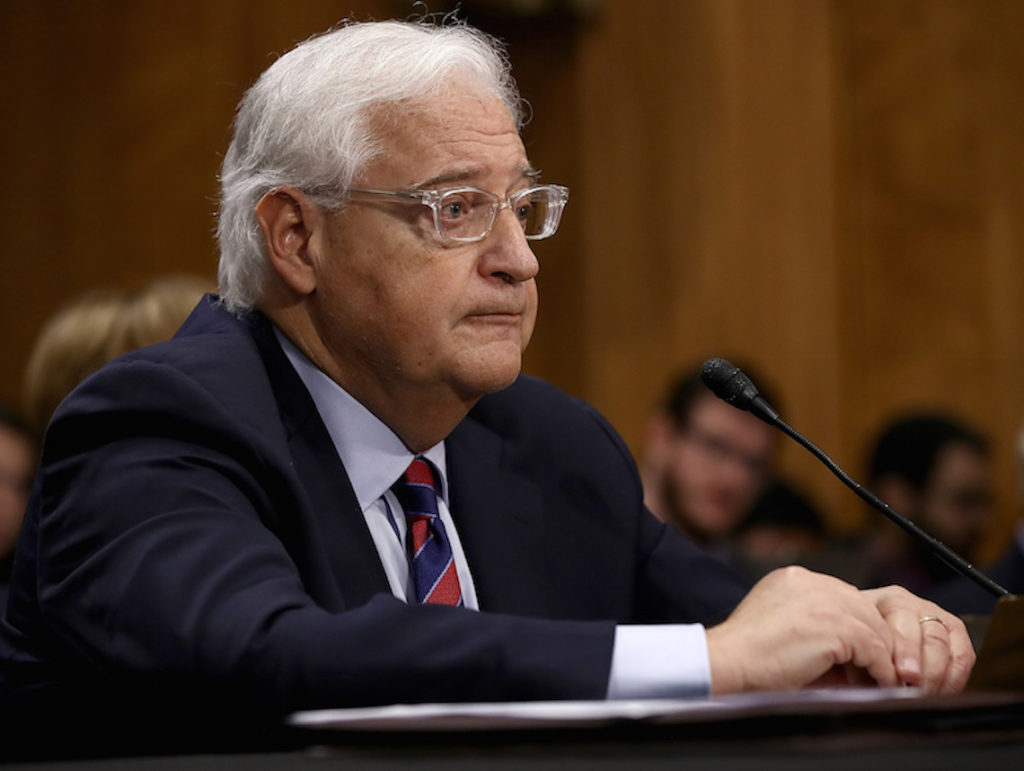
Happening today: President Trump is meeting with U.S. Ambassador to Israel David Friedman in the Oval Office at 11:30 am.

JI experts on lessons learned from the Temple Mount crisis and its impact on Trump’s ‘Ultimate Deal’ — by Aaron Magid: “The administration invited Abbas to White House to meet the President in exchange for nothing. His conduct since then suggested that they made a bad bet,” explained Elliot Abrams, a former top official in the George W. Bush administration. “He incited violence in the crisis over the Temple Mount… I would hope that the administration would let him know that all of this has been seen and understood and that it has gone a long way to destroy confidence as a reliable interlocutor and that the next time an administration representative meets with him, they let him know there will be no meetings at the top levels like the President or Secretary of State.”

The Trump administration should adopt a “much more hands on approach: starting to make the phone calls to the leadership and relevant players early on and not wait until things gets out of hand before intervening,” said Dan Arbell, a former senior Israeli diplomat. “The idea is to keep the ball moving forward because if you don’t then you end up in crisis situations that only bring setbacks. People are waiting to see whether this talk of an ultimate deal is actually something real or just a campaign promise that is not being delivered.”

Frank Lowenstein, the top Middle East envoy during the end of the Obama administration: “If there is anything that the Trump administration may have seen in the months that they have been working on, it is they have been running into the roadblocks that we ran into from both sides. They are going to have to make a decision how they want to proceed: is it really worth investing time, energy and political capital on something that the parties themselves don’t appear to be genuinely committed to moving forward.” [JewishInsider]

“Team Trump’s quiet Mideast success” by Jonathan Tobin: “Whatever good Jared Kushner and US Middle East envoy Jason Greenblatt may have done in securing the safe return to Israel of an embassy security guard, this shouldn’t tempt Trump to think the time is ripe for another round of major diplomacy. The last thing the region needs is another American effort to broker a final peace plan that is hopelessly out of reach… The smartest thing [Trump] can do now is to turn his attention to the chaos in Washington, not Jerusalem.”[NYPost]

“The EU, headed by France and Germany, could replace US on Mideast” by Uri Savir: “According to the [EU] official, one can assume that if the United States does not launch a regionally-backed two-state solution process, Merkel (assuming she wins as expected in the upcoming elections) and Macron, together with EU headquarters, will launch a European initiative on the terms of reference for a two-state solution and a peace conference to be convened in Brussels… According to a senior Israeli Ministry of Foreign Affairs official, Prime Minister Benjamin Netanyahu is certain that Trump will block such a European initiative… “We see Europe as hostile to Israeli interests and pro-Palestinian. The European leadership is probably frustrated to have been marginalized by the Trump administration.”” [Al-Monitor

COMING SOON: “Tillerson wants fewer US diplomats, fewer meetings at UN summit” by Colum Lynch: “President Donald Trump does plan to address other world leaders at the U.N, General Assembly, and he will be accompanied by other top advisors, including his son-in-law Jared Kushner and his daughter Ivanka Trump, who stopped by U.N. headquarters Friday for a private lunch with U.N. Secretary General Antonio Guterres. But the ranks of professional diplomats, aides and officials that attend the event to promote American policy priorities on a range of issues will be thinned out… Two officials said that the State Department is seeking to keep a ceiling down to about 300 people, including everyone from the President to support staff that schedule meetings and copy speeches back at the hotel.” [FP]

“How Schumer Held Democrats Together Through a Health Care Maelstrom” by Jennifer Steinhauer: “I take what’s given me,” Mr. Schumer, 66, said in a (shoeless) interview in his Capitol Hill office right off the Senate floor… “We’re in the minority, so we’re not making policy,” Mr. Schumer said. “We have to know when to dance and when to fight. The Trump administration has made it harder to dance.” … Mr. Schumer’s schmoozing abilities have been important. “He knows who I am,” said Senator Joe Manchin III, Democrat of West Virginia… “I tell him when I think he is moving too far to the left,” Mr. Manchin said, as when Mr. Schumer pushed to filibuster to block Mr. Trump’s nomination of Judge Neil Gorsuch to the Supreme Court. “There were no conversations with Harry.” [NYTimes

LongRead: “Bernie Sanders’s campaign isn’t over: In Trump’s America, the Independent senator is fighting to win back the heartland for Democrats” by Benjamin Wallace-Wells: “Sanders, who is seventy-five, may be too old to run again in 2020, but his barnstorming has a purpose—to deepen the connection to progressive ideas in rural America, to develop an attachment that might outlast him. At recent events, one of his biggest applause lines was that the “Republicans did not win the election so much as Democrats lost it.” Progressives do not have much of a foothold in this country. What they have is Bernie Sanders… Sanders is an old man who often finds himself speaking to young audiences. They are not necessarily looking for encouragement. “My wife tells me my speeches are so bleak that they have to pass out tranquillizers at the door,” he said at an event that evening at Brixton Academy, a music venue in South London.” [NewYorker]

** Good Monday Morning! Enjoying the Daily Kickoff? Please share us with your friends & tell them to sign up at [JI]. Have a tip, scoop, or op-ed? We’d love to hear from you. Anything from hard news and punditry to the lighter stuff, including event coverage, job transitions, or even special birthdays, is much appreciated. Email Editor@JewishInsider.com **

SPOTLIGHT: “A 32-year-old investor with ties to Elon Musk wants to upend America with his crazy, utopian plan for the future” by Chris Weller: “Much like one of his notable colleagues, Tesla CEO Elon Musk, Sam Altman is set on turning the ideal into the practical… “I have a very strong vision of where I’d like to see the world go,” Altman said. “And I don’t think it gets there by startups alone.” … In May, rumors began to swirl that Altman’s political interests had compelled him to run for California governor in 2018. He seemed to be making a familiar transition from the private world into the public spotlight… But Altman ultimately went a different route. In mid-July he put the rumors to bed by issuing an open call on his blog for similar-minded political candidates that he could support. He could offer money, connections, and tech to help them get into the governor’s office.” [BusinessInsider

“By harnessing Israeliness, WeWork joins the ranks of Uber, Airbnb” by Inbal Orpaz: ““As a child who lived in a lot of places, one of the hardest things for me was to join a new community. It was hardest at the kibbutz, but that was also one of the most impressive communities. I remember how much fun it was to be a child in the kibbutz,” says [Adam] Neumann, noting that sometimes he calls WeWork “Kibbutz 2.0.” Neumann’s partner in establishing the company grew up in a commune as well. Perhaps it was not by chance that the two got together to establish a business based on shared values. “We are making a capitalist kibbutz,” added Neumann, qualifying the metaphor. “I remember from my childhood that not everyone worked the same number of hours.” … WeWorks chief brand director is Neumann’s wife, Rebekah Paltrow Neumann, who was part of the company from its inception. She also is a filmmaker, studied yoga and she introduced Neumann to the world of kabbala.” [Haaretz]

SPOTTED: Ira Rennert’s flight from New Jersey to Tel Aviv disguised as a Sikorsky S-76C helicopter on the flight map [Pic] h/t Avi Scharf

KAFE KNESSET — Bibi’s Dog’s life — by Tal Shalev and JPost’s Lahav Harkov: While the country is engaged in serious debates about issues like the Temple Mount tensions, the police probes involving the PM and the Elor Azaria trial, the lawmakers will be discussing a totally different topics – dogs, or more specifically – the Netanyahu family dog, Kaiya. The MKs will vote on a new bill, which seeks to change the quarantine procedures for dogs and other pets who are involved in biting incidents. The bill is known as the “Kaiya bill,” as it was submitted by Likud MK Sharen Haskel last year, after “the First Dog” bit her during a Likud gathering and then was put in a detention facility, as the law dictates. Read today’s entire Kafe Knesset here [JewishInsider]

ACROSS THE POND: Columnist fired over ‘anti-Semitic’ Sunday Times article: “A Sunday Times columnist “will not write again” for the newspaper after one of his articles was branded “anti-Semitic” and “disgraceful.” In the piece, Kevin Myers suggested BBC presenters Claudia Winkleman and Vanessa Feltz earned high salaries because they were Jewish. Editor Martin Ivens said the piece, which appeared in the Irish edition and online, should not have been published. Mr Ivens has also apologised personally to the two women. A News UK spokesman said the column included “unacceptable comments both to Jewish people and to women in the workplace.” Mr Ivens offered the paper’s “sincere apology, both for the remarks and the error of judgement that led to publication.”” [BBC

MEDIA WATCH: “Katie Couric Signs With WME” by A. J. Katz: “Katie Couric is parting ways with her longtime agent Alan Berger at CAA, and will join arch rival agency WME. TVNewser has learned that her new team at WME will consist of Ari Emanuel, Jon Rosen, Bradley Singer, Maggie Pisacane, Suzanne Gluck and Ben Davis. The iconic TV (and now web) newser currently serves as Yahoo News chief global anchor, a role created exclusively for her in 2013.” [TVNewser; THR]

“Is The New York Times vs. The Washington Post vs. Trump the Last Great Newspaper War?” by James Warren: “The Times’s foundational accomplishment is that, against great odds, it has maintained the support of a fifth generation of family ownership in the Sulzbergers. The key members include thirtysomething cousins A. G. Sulzberger, who will eventually take over the company from his father, Arthur Sulzberger Jr., and Sam Dolnick, an assistant editor whose accomplishments include overseeing a podcast phenomenon called “The Daily 360,” which averages half a million downloads a day. It verges on the inconceivable that a family business would endure this long, especially amid industry decline and a languishing stock price—and, as has been the case elsewhere, an understandable impulse by some members to cash out. But Sulzberger and Dolnick, who are among the members known internally as “the princelings,” aren’t going anywhere. The family remains “genuinely close” to the paper, Dolnick said. His cousin, A.G., conceded that the notion of family control may seem archaic. Not to him. Not to them.”[VanityFair]

BOOK REVIEW: “Recalling the Jewish men who fled the Nazis then returned to fight them” by David M. Shribman: “On both sides of the Atlantic, the war was fought in part by bureaucrats. There were the Nazis who categorized the Jews as a dangerous race doomed to extinction. Then there were the Americans who categorized Jewish refugees as enemy aliens, ineligible to fight their onetime tormentors — until sanity prevailed as it became clear that the newcomer’s language and cultural familiarity would be assets to the Allies. “We were fighting an American war, and we were also fighting an intensely personal war,’’ said Guy Stern, one of these emigre warriors… Hoping to take revenge on the Nazis, or hoping to right an eternal wrong in Europe, or hoping to save other Jews from death, or simply hoping to use their wartime assignments as a way to find lost and imperiled family members, they were dispatched, or smuggled, into Europe, this time working with American personnel, this time with a mission greater than self-preservation.”[BostonGlobe

“One Last Party for the Agent and Bon Vivant Ed Victor” by Jacob Bernstein: “The memorial at the Upper East Side apartment of Tina Brown and Harold Evans for the literary agent Ed Victor felt like a cocktail party. And that was fitting, given that the man receiving tribute had distinguished himself as a bon vivant on both sides of the Atlantic. This Bronx-born son of Russian Jewish immigrants rose to Commander of the Order of the British Empire before his death in June at age 77… When Mr. Victor’s cancer returned this year and he wound up in the hospital for what turned out to be the last time, he told his wife, Carol Ryan: “If this is it, I’m O.K. I’ve had a great life.” He also gave instructions about what should follow after his death. Not a funeral. Not a memorial service. “A party,” Mr. Evans said.” [NYTimes

BIRTHDAYS: District Attorney for Manhattan for 35 years (1975-2009), Robert M. Morgenthau turns 98… Graduate of Yale Law School in 1951, he served as Assistant Secretary of State for Human Rights (1985-1992), chairman of the American Jewish International Relations Institute, Ambassador Richard Schifter turns 94… Investment banker, chairman and president of Blum Capital, he is married to US Senator Dianne Feinstein, Richard C. Blum turns 82… Retired chairman and CEO of the British retailer Marks and Spencer, he is an emeritus governor of the Oxford Centre for Hebrew and Jewish Studies, Sir Richard Greenbury turns 81… Actress, who went on to become CEO of Paramount Pictures and president of production at 20th Century Fox, Sherry Lansing turns 73… Nobel laureate in Economics in 1997, known for his quantitative analysis of options pricing, long-time professor at both Harvard and MIT, Robert C. Merton turns 73… Scholar, professor, rabbi, writer and filmmaker, who specializes in the study of the Holocaust, Michael Berenbaum turns 72… Founder of the private equity firm Apollo Global Management, in 2015 he bought a 16th century copy of the Babylonian Talmud for $9.3 million, Leon David Black turns 66… Author of 31 best selling mystery novels, many with Jewish themes, Faye Kellerman turns 65…

Manhattan-based criminal defense and civil rights lawyer, radio talk show host and television commentator, Ronald L. Kuby turns 61… Businessman, television personality and owner of the NBA’s Dallas Mavericks, Mark Cubanturns 59… Director of the Jesse M. Unruh Institute of Politics at the University of Southern California, Dan Schnur turns 54… Born into a practicing Catholic family in Nazareth, Israel, investor and owner of the Detroit Pistons, Tom Gores turns 53… Writer, journalist and graduate of Ramaz School, Harvard College and Yale Law School, known for her best-selling memoir “Prozac Nation,” Elizabeth Wurtzel turns 50… MLB outfielder (1998-2010), the first player known as the “Hebrew Hammer,” he coached for Team Israel in the 2013 World Baseball Classic qualifier, now director of player development for the LA Dodgers, Gabe Kapler turns 42… Political activist and the founder and president of Stand Up America, a progressive advocacy community, he is also the president of Hudson River Ventures, Sean “Simcha” Eldridge turns 31… Senior manager of corporate communications at Samsung Electronics North America, Danielle Meister Cohen turns 29… Aryeh Canter turns 27… Helene Miller-Walsh, Jewish wife of former Congressman Joe Walsh (R-Illinois-8)… Adam Rosenberg… David Goldenberg… Richard Rosenstein (h/ts Playbook)…

TUESDAY BIRTHDAYS: Former US Ambassador to Israel (2011-2017), Daniel B. Shapiro turns 48… Tech entrepreneur Ari Zoldan turns 41… Founder and CEO of Moishe House, David Cygielman turns 36… Staffer for Hillary Clinton in her Senate and State Department posts, now at NYC PR firm DKC, David Helfenbein turns 31… Director of New York Government Relations at Agudath Israel of America since 2017, previously Executive Director of the Boro Park Jewish Community Council, Yeruchim Silber… Treasurer of the Harvard Law School Republicans, a student-run organization, he is spending his 2017 summer interning at at the office of the White House Counsel, Asher Perez… Vice President for Social Entrepreneurship at Hillel International, Sheila Katz… Culver City, California resident, Allene Prince… Founder and chairman of NYC-based Midtown Equities, a major developer of nationwide real estate projects, he started his career as the owner of a record label and then as a video game publisher, Joseph Cayre turns 76… Israeli born businessman and film producer, later CEO of Marvel Studios, Avi Arad turns 69… President of Brandeis University from 1994-2010, he is now a professor at Brandeis and the president of the Cleveland-based Mandel Foundation, Jehuda Reinharz turns 73…

Gratuity not included. We love receiving news tips but we also gladly accept tax deductible tips. 100% of your donation will go directly towards improving Jewish Insider. Thanks! [PayPal]

Daily Kickoff: Amb. Friedman to talk Temple Mount with Trump in the Oval Office today | Erekat slams the White House | BDays: Mark Cuban, Leon Black Read More »

Haim Saban funds construction of Israeli center celebrating Druze soldiers

Israeli-American billionaire Haim Saban and his wife were on hand in Israel for the groundbreaking ceremony of a Druze Soldiers Heritage Center they are funding.

The father of Advanced Staff Sgt. Maj. Kamil Shanan, one of the two Israeli Druze police officers killed by terrorists at the Temple Mount on July 14, also was on hand for the ceremony Thursday.

The 25,000-square-foot heritage center in the northern Galilee will tell the story of Druze contributions to the Israel Defense Forces and the State of Israel, and serve as both a rest and recreation resource for active-duty and discharged soldiers, as well as a memorial for fallen Druze soldiers.

Saban, an entertainment mogul, and his wife, Cheryl, are funding construction of the center through Friends of the Israel Defense Forces, or FIDF.

“The Druze community’s reputation is always connected to terms like ‘bravery,’ ‘sacrifice,’ and ‘sanctity of life,’” Saban said at the groundbreaking. “To this day, hundreds of Druze soldiers have given their lives protecting Israel.

“The FIDF Druze Soldiers Heritage Center is the very least we can do to show our gratitude and admiration for their sacrifices. The Druze community deserves its own place that will be a source of pride.”

The building will include a lobby, a 500-seat auditorium, a gym, a heritage room, classrooms, offices and a dining hall.

Also attending the ceremony were Israeli Minister of Defense Avigdor Lieberman and Sheikh Muwaffak Tarif, the spiritual leader of the Druze community in Israel.

Israel’s Druze population numbers about 130,000. Most Druze serve in the IDF and security forces.

Haim Saban funds construction of Israeli center celebrating Druze soldiers Read More »