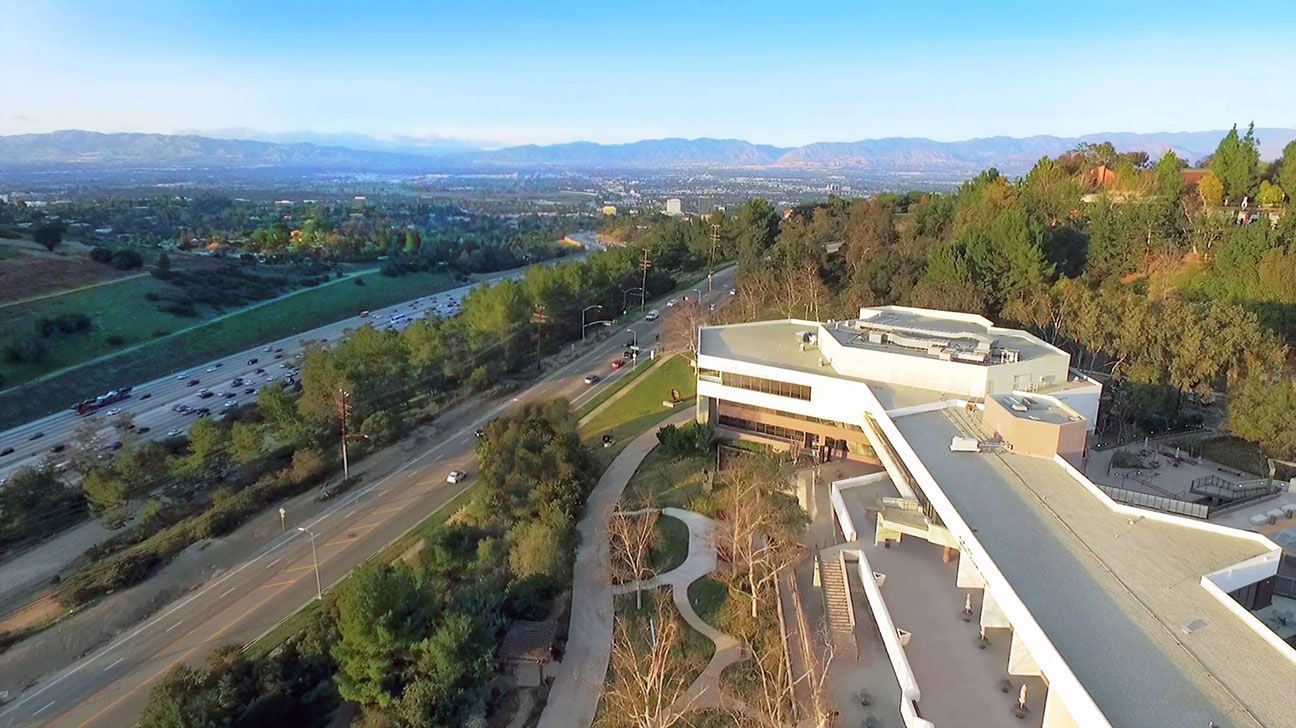
Jews have an irrational attachment to real estate, especially fabulous, glamorous real estate like the top of fabled Mulholland Drive, where the American Jewish University first broke ground in 1977.
Now that AJU has announced it would sell all or part of that valuable real estate, our community has been buzzing about whether the AJU property will “stay Jewish,” as if the 23-acre campus is a Jewish single looking to marry outside the faith.
But instead of asking, “Will it stay in Jewish hands?” I’d like to suggest we ask a more familiar question, “What’s good for the Jews?” In this case, “What’s good for the L.A. Jewish community?”
Instead of asking, “Will it stay in Jewish hands?” I’d like to suggest we ask a more familiar question, “What’s good for the Jews?” In this case, “What’s good for the L.A. Jewish community?”
Let’s start with a cold fact: As far as the community goes, the current location is a burden. It’s hard enough in this town to attract a crowd when you have free dessert and valet parking in Beverly Hills. Traffic and parking are the eternal twin kvetches of Angelinos. Even if the AJU hosted terrific events for the community, how many Jews will want to regularly schlep on the dreaded 405 to get there?
In fairness, no one expected in 1977 that L.A. freeway traffic would mushroom like an avalanche in the Himalayas. But it has. And it is a fundamental reality that must play a decisive role in reimagining AJU’s next chapter.
Over the next few weeks and months, we’ll probably hear about Jewish groups getting together to try to keep the AJU property in “Jewish hands.” My emotional side is sympathetic to that sentiment, but my more pragmatic side tells me: The location is still a burden!
Outside of people enrolled in schools or programs who have no choice but to schlep, most Jews will think two, three or four times before attending anything on the mountaintop.
Here’s the reality: The mountaintop has huge real estate value but low communal value. It’s no one’s fault. It is what it is.
Which brings us back to the essential question: What’s good for the L.A. Jewish community? Is it better to have Jewish institutions locate themselves on the mountaintop, just so we can say “it’s still in Jewish hands,” or is it better to take that enormous capital and create spaces throughout the community—in L.A. and the Valley—that will become bustling centers of inspirational Jewish life?
If the plan is to take the money and invest only in online, that would be a blunder. If the only real estate investment is to upgrade the Brandes-Bardin campus that is nearly two hours away for most people, that also would be a blunder.
But if we follow this simple guideline—what is best for the community—the rest follows naturally. As a starting point, the AJU board can set up a creative task force with local influencers to come up with great and innovative ideas that will get Jews back into Jewish spaces.
The timing couldn’t be better, as we’re coming out of two years of COVID hibernation where the biggest enemy of the Jewish world has been sweat pants. What we need now, as urgently as ever, is to come out of our caves and meet IN PERSON, preferably without masks.
The virus has turned out to be the ultimate excuse to undermine communal Judaism. “I don’t want to risk my life, so I’ll stay in my sweats and do all my Jewish stuff online.” No matter how amazing the online programming is, that is not a vision for a warm and thriving community. The virtual life is not the real life.
AJU doesn’t need to choose. It can do both online and offline very well. The problem is that human nature pulls us to the convenient. It’s fool’s gold.
Because of the anticipated injection of major capital, AJU will be in a much stronger position than other organizations who have been forced by financial hardship to focus on digital. AJU doesn’t need to choose. It can do both online and offline very well. The problem is that human nature pulls us to the convenient. It’s fool’s gold. We must go out of our way to make sure digital wizardry doesn’t submerge communal Judaism.
Indeed, getting Jews out of hibernation and reconnected to real-life Judaism is the #1 challenge of our community. To make it happen, we must minimize the excuses, from “I don’t want to schlep on the freeway” to “I’m afraid to catch COVID” to “This Jewish event looks boring.”
I can understand the impulse to stay away from such immense “street” challenges, especially when the digital alternative is so alluring. But the level of difficulty is precisely why it’s so valuable. If AJU wants to best serve the community, it needs to head for the streets where the people are.
That is the new mountaintop it must climb.