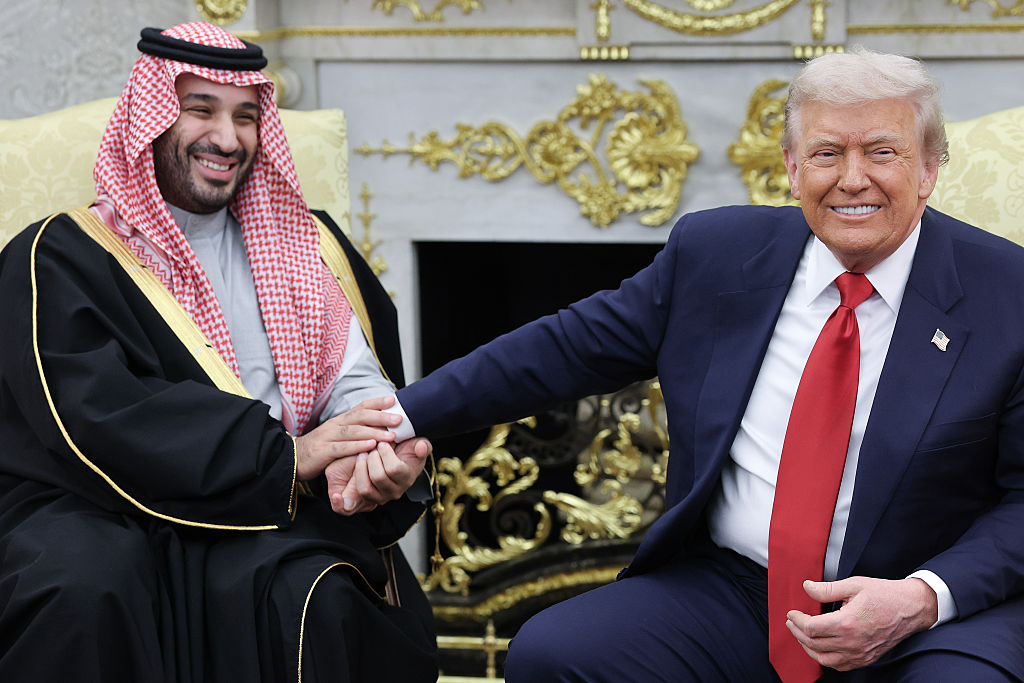
When Saudi Arabia’s Prime Minister Mohammed bin Salman recently visited Donald Trump at the White House, their public conversation focused primarily on military, energy and technology partnerships between their two countries. There was a brief dustup when a reporter had the temerity to ask about the murder of journalist Jamal Khashoggi by Saudi government agents, given that the CIA has determined that MBS ordered the assassination. Trump dismissed the question by noting that Khashoggi was a controversial figure and that “things happen.”
All but lost in the controversy over Khashoggi’s death and the questions surrounding Saudi Arabia’s newly-enhanced military arsenal was how this strengthened alliance would impact the safety and security of Israel. But an early review suggests that Trump’s deal with MSB could potentially threaten Israel’s safety on multiple fronts.
The first challenge relates to Israel’s diplomatic relationship with Saudi Arabia. Prior to the Hamas terrorist attacks on the Jewish state and its people 25 months ago, it appeared that the Trump-shaped Abraham Accords would soon be expanded to include Saudi Arabia, representing an important step toward the normalization of Saudi-Israeli relations.
But the post-Oct. 7 landscape is dramatically different, and Saudi leaders have made it clear that the establishment of a Palestinian state is now a requirement before their relationship with Israel can be formalized. Ahead of the visit, Trump had hinted that he wanted the Saudis to agree to sign onto the Abraham Accords and it was widely expected that he would provide the Saudi military with a significant weapons upgrade in exchange for the diplomatic progress with Israel. Israel also sought to urge the U.S. to condition the sale of American F-35 stealth fighter jets to Saudi Arabia on Riyadh agreeing to join the Abraham Accords.
Saudi Arabia, however, got its fighter jets without committing to any forward steps regarding Israel. This represented a major shift in U.S. policy toward the Saudis: the Trump Administration has now decoupled its military support for Saudi Arabia with corresponding improvement in the Saudi-Israel relationship.
This particular brand of aircraft is one of the prizes of the U.S. arsenal, which creates another potential problem for Israel. After another controversial arms sale to Saudi Arabia back in the 1980s, President Ronald Reagan committed to provide Israel with a “quantitative military advantage” over its neighbors. That pledge was later solidified into law, specifically stating “that proposed U.S. arms sales to other Middle Eastern countries must include a determination whether those sales would “adversely affect Israel’s qualitative military edge.”
Now that advantage is no longer as clear. The White House would not answer questions as to how many F-35s Saudi Arabia would be allowed to purchase, and Trump told reporters that the capabilities of the jets sold to the Saudis would be “pretty similar” to the models provided to Israel.
“Israel will be very happy,” Mr. Trump insisted, when asked about these issues. “Israel is aware, and they’re going to be very happy.”
There were also concerns about the weapons sale throughout Washington, as members of both parties of Congress and defense analysts at the Pentagon have warned that Saudi Arabia could share some of the relevant technology with China. (Riyadh has hinted that it would reach out to China for military support if the U.S. had been unwilling to agree to the arms sales.)
MBS himself has reiterated that he would like his country to join the Abraham Accords, but he first wants a “path” to a Palestinian state. Netanyahu and most other Israeli political leaders have repeatedly refused to consider such a possibility. But the allure of long-sought regional peace – and the ambiguity of terms like “path” – suggest that a two-state solution may became part of the discussion before too long.
The Saudis have reportedly signed a memorandum of understanding with the Palestinian Authority to modernize its education system to check extremism and reform its personnel management to reduce corruption, making a rebuilt Gaza less prone to covert payoffs to terrorists. Such steps could eventually make the path to a two-state solution more tolerable for Israel. But not anytime soon.
Dan Schnur is the U.S. Politics Editor for the Jewish Journal. He teaches courses in politics, communications, and leadership at UC Berkeley, USC and Pepperdine. He hosts the monthly webinar “The Dan Schnur Political Report” for the Los Angeles World Affairs Council & Town Hall. Follow Dan’s work at www.danschnurpolitics.com.