I attended public schools all my life, but was always drawn to other Jewish kids as friends. I suppose it was an invisible force field of spiritual connection, even though none of us kept kosher or were religious in a traditional sense. In the 10th grade, though, I became close with an Italian-Catholic senior named Kyle. Handsome and engaging, Kyle and I often had lunch together on the grass under a shady tree, talking about books, politics, and life.
One day, Kyle met me in our usual spot under the tree and appeared nervous. After stammering a bit, he invited me to go out on a date. At 15, I was so naïve that his question shocked me. In my mind we were just buddies and could never be anything else. Despite my family’s lack of ritual observance, I would never have dated a non-Jew.
When I explained that I could not go out with him, Kyle reacted angrily. He fumed that religion was nothing more than tribalism, even accusing me of bigotry. My heart thudded during his tirade, because I had never seen this angry side of him. Yet with every word, Kyle reinforced my certainty that my Jewish identity was nonnegotiable.
This strong sense of Jewish identity was a gift, and by no means inevitable. My maternal grandparents, the Cohens, were religious immigrants from Europe, somber from their harsh experiences with antisemitism in Ukraine and Poland. They were filled with almost grim determination to instill Jewish values into their grandchildren to ward off assimilation, but they couldn’t see that their lack of joy in their Jewishness made it mighty tempting to reject their path.
On the other hand, my paternal grandparents were proudly atheist/agnostic. Their home didn’t even have a Kiddush cup on a display shelf, even as a token for old times’ sake. Their lives felt more expansive, lively, eclectic, and enticing.
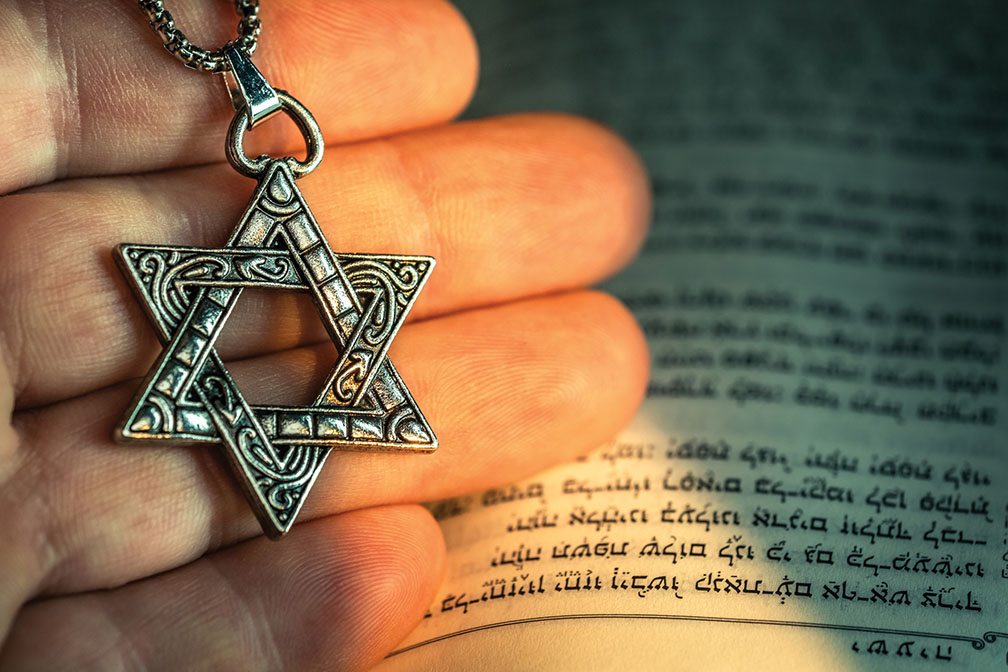
And yet when I watched papa Cohen chant Kiddush on Friday night in his fine Shabbat suit, I felt glimmerings of holiness in the air. After lighting our family menorah, he sang “Maoz Tzur” with dignity and pride. This, too, touched me. He stood next to the four-foot-high wooden Star of David that my mother wrapped each year in shiny aluminum foil, a string of shimmery blue and white letters spelling “Happy Hanukkah!” taped to the mantlepiece. Our Hanukkah display was almost hokey in its simplicity, but I sensed eternity when the little candles shone their light across our small living room.
After my older brother died in a car accident when he was 17 and I was nine, grief lay like a dark cloud over our lives. The kind teachers, staff, and rabbi at our Conservative shul gave me comfort and nurtured me in a way that wasn’t available at home from my loving, but grieving parents. I wanted to be at shul more than at home, and joined the youth groups. When I outgrew them I became a youth group advisor and assistant Hebrew school teacher. I didn’t know much Torah, but I equated Judaism and shul with warmth and fulfillment.
As a teen, I saw how assimilation was pulling most other young Jews I knew away from whatever slivers of Jewish tradition their families practiced. I began to share my Cohen grandparents’ anxieties about this downward spiral. Papa Cohen had become a highly respected Conservative rabbi and devoted his life in America to Jewish education, scholarship, and counseling. I felt his pain at seeing this slippery slope, the acute disappointment of realizing that the liberalized Judaism he believed would have staying power in a tantalizingly free society was failing.
In my senior year at UC Berkeley, I came home to Los Angeles during Sukkot and went to shul with papa Friday night. At the kiddush afterward, papa put one hand gently but firmly on my shoulder and steered me from where I was standing on one end of the sukkah to the other end, parking me in front of one of his friends.
“Meyer, this is my granddaughter. She is the editor of the Jewish newspaper at Berkeley!” Papa was himself a prolific writer for Jewish newspapers and made this announcement with such a beaming expression and bursting pride that I became choked up. I was driven to pursue Jewish journalism out of my own ambition, but it was also deeply important to me to show papa that I would continue to carry the light of Judaism forward. I was the only one of his surviving four grandchildren involved in Jewish life, and I would not let him down.
Five years after Papa died, I was a newly married baalat teshuvah. I had committed to a level of religious observance that would have appalled my Rosenfeld grandparents, but thrilled — if not startled — my Cohen grandparents. Choosing a Torah life was the most wrenching decision of my life, despite a lifetime of positive Jewish involvement. I feared the constraints of so many mitzvot, of losing friends, even of losing my individuality. Yet having experienced the compelling truth and joy of this life, and not wanting to be washed away in a tide of assimilation, I voted for a level of Jewish commitment that I knew would have staying power.
My grandparents now have 17 great-great-grandchildren, 13 of them being raised in Shomer Shabbat homes. Two — Dov Ber and Chana Ettil — are named after papa and nana Cohen, whose dedication to Yiddishkeit lives on. Each child adds another light in our family’s figurative menorah. Each child has been named for an ancestor, fulfilling the fervent hopes and dreams of those who came before.
Judy Gruen is the author of “Bylines and Blessings,” “The Skeptic and the Rabbi,” and other books. She is also a book editor and writing coach.