fbpx

December 19, 2024

Time to Hug a Fellow Jew

It is a savage crime that haunts the Jewish people to this day. And it never should have happened.

Joseph’s brothers, enraged by envy, decide to murder him, only to change course at the last minute and sell him into a lifetime of slavery.

Joseph certainly had provoked them; he was clearly his father’s favorite, and a braggart. To top it all off, Joseph had bad-mouthed the brothers to Jacob. The brothers hated him for all of this. And all of this comes to a tragic climax when Joseph visits his brothers as they are tending to their sheep in the fields.

The brothers didn’t realize that a different Joseph was on his way to see them. If you read the Torah carefully, there are clear hints that this was no ordinary visit, but rather an attempt at reconciliation.

Jacob, who loves Joseph dearly, is the one who dispatches Joseph into the hands of the brothers. The Torah (Genesis 37:13-14)  says:

And Israel said to Joseph, “Are not your brothers feeding the flock in Shechem? Come, I will send you to them.”


So he said to him, “Here I am.”


Then he said to him, “Please go and see if it is at peace with your brothers and at peace with the flocks, and bring back word to me.”

A careful analysis of the text reveals that Jacob is sending Joseph on a peace mission. First, as Seforno notes, if all Jacob wanted was a report, he could have sent a servant, not Joseph. In addition, Jacob uses the word “na” “please,” a word that in the biblical context indicates a special request. Joseph in response to Jacob, says “Hineni” “Here I am.” This term is used seven times in the Bible, all in missions of great importance, including the Akeidah and Moses’ appointment by God. The word “shalom” “peace,” is used twice in Jacob’s request. And this is exactly what was lacking between Joseph and his brothers, who could not speak to Joseph “in peace.” Jacob is telling Joseph that it is time to fix the rift with his brothers.

Joseph takes this mission seriously. He searches in the fields for his brothers. Despite getting lost, he is not ready to give up.  When Joseph asks someone for directions, he says: “I am seeking my brothers.” This short phrase speaks volumes, a cry for peace that will echo through the ages.

But Joseph is too late. The brothers decide to murder Joseph “from a distance,” well before he arrives. Joseph never gets a chance to make peace.

Rabbinic literature magnifies this crime, and implicates the sale of Joseph for many later misfortunes including the exile in Egypt, Haman’s decree, and the destruction of the Second Temple. In the Midrash Eleh Ezkerah, the execution of ten distinguished Rabbis by the Romans in the first and second centuries is seen as God’s punishment for sale of Joseph. The ten brothers had committed a capital crime, kidnapping; and in their place, ten great rabbis were executed.

The sale of Joseph becomes Judaism’s original sin, the ground zero of sinaat chinam, internecine hatred. Yes, there are many other examples of fraternal violence in Jewish history. King David’s family features a murder, a rebellion, and an execution; in the Hasmonean dynasty, warring siblings are almost a tradition. But Jacob’s sons are different. They are not just brothers, they are symbols of the future tribes of Israel; their battles are a premonition of civil wars to come.

And the Jewish people, small and dispersed, cannot survive such strife. As Lincoln put it: “A house divided against itself cannot stand.” Jewish unity is an existential necessity.

In the early 1800’s most Jews were traditional, what we would call today “Orthodox.”  But the twin forces of The Enlightenment and Jewish Emancipation changed the religious landscape; and only a century later, most European and American Jews had either abandoned tradition or embraced Conservative and Reform Judaism.  Others, notably Bundists and some Secular Zionists, abandoned Judaism; they saw Jews as a people, not a religion.

Some Orthodox Jews saw these changes as religious treason. Rabbi Moshe Sofer argued that Orthodox Jews should completely separate themselves from those in the Reform community; marriages between members of the two communities should be forbidden. The Chatam Sofer’s student, Rabbi Moshe Schick, offered a more disturbing metaphor, saying that in multiple areas, the Reform community should be treated as non-Jews in the eyes of Halakha. Neither saw Jewish peoplehood as central.

But others took a very different approach. Rabbi Naftali Tzvi Berlin, the head of the famed Volozhin Yeshiva, was asked about a similar plan for religious Jews to cut themselves off from secular Jews; he responded that “this advice is as harsh as a sword to the body of the nation and its survival.” One must hold on to both the Jewish religion and Jewish people at the same time.

This approach is a solitary one. On one side of the Jewish world are those who hold on to a common national identity but have left Orthodox Judaism. On the other are those who hold tight to religious tradition but want to divide the Jewish people by divorcing themselves from those who are not Orthodox. Only a few continue to hold on fully to Orthodoxy and peoplehood at once.

And those who do so are the lonely brother, who doesn’t fit in either camp. They watch the other brothers quarrel and pull apart, and do everything they can to hold them together. All too often, the lonely brother feels misunderstood by everyone. Yet they remain the only Jews who can say that their contacts list includes people from the Satmar and Reform communities; they are the ultimate connectors of the Jewish people.

The lonely brother undertakes his mission with a deep sense of purpose. Rabbi Joseph B. Soloveitchik, in his essay Kol Dodi Dofek, explains that two foundational covenants created the Jewish people: the covenant of fate and the covenant of destiny. The covenant of fate was enacted in Egypt, a place of shared suffering and shared redemption; it is here that one becomes a nation with a shared history. The covenant of destiny was enacted at Mount Sinai, when the Jews took upon themselves the mitzvot and joined in a shared spiritual destiny. And Jewish identity comprises both covenants, and combines religious and national identities at once.

One can imagine that Jewish solidarity is just pragmatism, that banding together is necessary for survival; or perhaps it is just based on sentimentalism and nostalgia. But it is much more than that. Rav Tzadok of Lublin explains that to declare “I am a Jew” is in and of itself a profound religious act. Even the most secular of Jews is continuing Abraham and Sarah’s mission; by standing proudly with the Jewish people, they too are embracing this holy history as their own. Embracing secular Jews is not a calculating arrangement to maximize mutual protection; to love these courageous souls is truly spiritual.

During the last fifteen months, the Jewish people have come together like never before; and for a short time, we were all playing the role of the lonely brother, standing in the center to hold the different segments of the community together.

Crisis can do that. And it has in the past.

In 1944, Rabbi Aharon Kotler was visiting Rav Yaakov Yitzchok Ruderman at his home in Baltimore. It was Friday, and the two great Roshei Yeshiva, leaders of the Haredi community, were talking in the kitchen. The postman knocked on the door, and came in to deliver the mail; and in Yiddish he said to them: “Ah gutten shabbos helige rabbonim” “good shabbos holy rabbis.” It should be noted that a postman couldn’t be an observant Jew at that time; one had to work on Saturdays. Nevertheless, Rabbi Kotler got up and hugged the postman. After the postman left, Rabbi Ruderman asked Rabbi Kotler why he did that. Rabbi Kotler responded: “how can you not jump to hug a Jew during these terrible years, when there are so few of us?” Rabbi Ruderman immediately ran out to hug the postman as well.

The last 15 months have been terrible; our only comfort comes from being able to hug each other. But we should not take it for granted. Even after this crisis passes, we need to continue to call out “I am seeking my brothers.”

And we really need to do so, even when it’s not a crisis. Because there are so few of us, and it’s always time to hug a fellow Jew.


Rabbi Chaim Steinmetz is the Senior Rabbi of Congregation Kehilath Jeshurun in New York.

Time to Hug a Fellow Jew Read More »

‘September 5’ About Covering Munich Terrorist Attack Is One of the Best Films of The Year

The story of the 20th Olympic Games in Munich, has been told many times. There’s

“21 Hours at Munich,” a depiction of what happened in on Sept. 5, 1972 as the terrorist group, Black September took a group of Israelis hostage; a documentary, “One Day in September,” which broaches the broader context of the Israeli-Palestinian conflict, and Steven Spielberg’s “Munich.” And videos of ABC’s coverage of the tragedy can be found on YouTube.

The new film “September 5” is a powerful and claustrophobic film that centers on the ABC Sports control room in Munich and the people who thought they simply cover sports and not matters of life and death. This means the whole film hinges on the ability of the actors to make an audience feel tension. Jewish actor John Magaro plays Geoffrey Mason, ABC Sports’ executive producer, who helped run the show on Sept. 5 with Roone Arledge (a flawless Peter Sarsgaard) as they faced some moral and ethical questions.

Magaro delivers his lines with the perfect balance of urgency and restraint;  he asks if they are allowed to show someone who has been shot on live TV, and asks if the terrorists inside the Israeli rooms have TV’s and can see what is being broadcasted, including Bavarian police dressed up as athletes with guns.

“These cops have no idea what they’re doing,” Mason says.

It was a good decision to have the real archival footage of Jim McKay. When it is reported that the hostages are saved Mason tells McKay to say “as we’re hearing” but McKay would eventually say “they’re all gone,” when it was confirmed that the initial reports were incorrect and all 11 Israelis were murdered.

Leonie Benesch does a fine job as Marianne Gebhardt, atranslator who is a composite character,  while ABC journalist Peter Jennings is played well by Benjamin Walker.

This is not a political film. The only moment where it touches on politics is when Jennings says they might not want to call the hostage-takers terrorists, but they ignore his advice and they call them terrorists.

Mason upset about the call, even though others also referred to them that way, referring to it as a “catastrophe” yet he gets praise from his boss. Through archival footage, we see the absurdity that people were playing ping pong not far from where the Israelis were being held hostage.

“September 5” has some moments that feel reminiscent of Paul Greengrass’ excellent “United 93.” Non-actor Ben Sliney, at the time an air traffic controller, plays himself (he is also the man who on Sept. 11, 2001, his first day as the Federal Aviation Administration’s National Operations Manager grounded all flights).

“September 5” is one of the best films of the year, largely due to Magaro, Sarsgaard, and in a smaller role, Ben Chaplin, who shines as Jewish producer Marvin Bader. Directed by Tim Fehlbaum, there is no wasted motion or dialogue and this is a powerhouse of a film.

Magaro spoke after a screening at Manhattan on Dec. 16.

He didn’t know that the sports team covered the attack and about 900 million people were watching around the world.

Magaro said he met Mason in real life in preparation for the role and added that he was an extra in “Munich.”

“Goeff would say they had no time to think, they were just doing their job, there was no time for emotion,” Magaro said. “I think as a young producer just trying to do the best you can especially in this situation, none of them had been through this before. These are sports broadcasters. They’re kind of innocent in a way … as a journalist you kind of want to be first and sometimes you make mistakes in that pursuit the be the first one out there with that information.”

He hopes audiences will “walk away from this and examine a hyper sensationalized world of journalism now especially around tragedies, maybe our own desensitized nature when it comes to these kinds of events and our own consumption. That’s the philosophical question that Tim is trying to pose … History was on a collision course with something like this being shared globally and it just so happens that it was the crisis when the scale tipped.

“(I hope audiences) will walk away from this and examine a hyper sensationalized world of journalism now especially around tragedies, maybe our own desensitized nature when it comes to these kinds of events and our own consumption.” – John Magaro

“The dollar is what matters,” he said, noting that news agencies go for ratings.

‘September 5’ About Covering Munich Terrorist Attack Is One of the Best Films of The Year Read More »

‘The Collected Poems of Delmore Schwartz’: A Poet’s Life in Full

I’ll admit I came to “The Collected Poems of Delmore Schwartz” (Farrar, Strauss and Giroux, $50) with some trepidation. James Atlas’ masterful biography “Delmore Schwartz: The Life of an American Poet” was literary catnip to at least one young Jewish writer. I quickly devoured everything I could find by Schwartz. Reading him helped me understand my father, the son of Russian immigrants who grew up in the Bronx. To my undergraduate mind, Schwartz was not just underrated, but the greatest Jewish American poet of the first half of the 20th century. (The greatest Jewish American poet of the latter half? Allen Ginsberg … and Bob Dylan.)

And therein lies the problem. I haven’t read Schwartz much since college; rereading books I loved in my 20s carries with it the risk that they might not resonate with the older Steven Mirkin. I can’t look at a copy of Thomas Wolfe’s “Look Homeward, Angel” these days without cringing. (In the other direction, I find my appreciation of Isaac Bashevis Singer grows with every year I add on to my age. My distaste for Saul Bellow has remained unchanged.)

In Schwartz’ case, the verdict is a little more complex. I’m still moved by his first book, “In Dreams Begin Responsibilities,” published in 1937, when Schwartz was only 25. It contains his two most anthologized poems, “The Heavy Bear” and “In the Naked Bed, in Plato’s Cave,” but is wonderful from start to finish. In the language — abstract, musical, referencing culture both high and low, and written with ambitions to high modernism — you can echoes of the voices of his parents (and my grandparents) — Eastern European American Jews. “The Ballad of the Children of the Czar’s” sing-song rhythms, simple diction and two line stanzas can seem almost simple. But they grow darker, from “The children of the Czar/Played with a bouncing ball//In the May morning, in the Czar’s garden,/Tossing it back and forth” to “I am my father’s father/You are your children’s guilt.//In history’s pity and terror/The child is Aeneas again.”

The book was a success, and made him a literary star, garnering praise from, among others, Alfred Kazin, T.S. Eliot and Ezra Pound (the latter two not known for having much good to say about Jews). In addition to his poetry and short stories, he was a respected literary critic and a popular lecturer. Known to be a great conversationalist, he was an in-demand dinner party guest at the center of a group of New York intellectuals, many of them associated with The Partisan Review (where he was the first poetry editor), and many of them Jewish.

Schwartz’ first book was a success and made him a literary star, garnering praise from, among others, Alfred Kazin, T.S. Eliot and Ezra Pound (the latter two not known for having much good to say about Jews).

He was never to repeat that success. His translation of Rimbaud’s “A Season in Hell,” was widely panned, as was his next, the first book in what he considered his magnum opus, “Genesis.” It’s here where his work (and life) turn south.

“Genesis” is one of those poems that is more attractive in concept than in execution. An autobiographical bildungsroman told by Hershey Green (like Schwartz’ other autobiographical stand-ins, given names that resemble their creator’s: Half Yiddishkeit, half Yankee Doodle) in blank verse, interrupted by a group of spirits who comment on Hershey’s story. The problem is that the spirits quickly turn boring, more the couple next to you talking throughout the movie than their intended Greek chorus. Hershey’s story is one known to many Jewish families: An arduous trip across the ocean, money problems between prosperous and penurious brothers, the birth of children, troubled marriages. It climaxes when the seven-year-old Hershey — like Schwartz — is dragged by his mother to a restaurant where she confronts her husband and his mistress.

After the book’s poor reception, Schwartz’ mental state deteriorated. Stuck in a bad marriage himself, he started abusing alcohol and drugs. He would get teaching jobs and lose them, blaming his problems on other writers. (A man with a mordant sense of humor, Schwartz coined the phrase “even paranoids have real enemies.”) He was prone to violence, which led to his being committed (at the urging of Saul Bellow) to New York’s Bellevue Mental Hospital.

The main discovery in “The Collected Poems” are excerpts from the unfinished second book of “Genesis.” Sadly, they feel like the work of someone who lost any control of the material. Some feel closer to diary jottings than poems. There are paeans to Charles Lindbergh undercut by “’I hardly paid attention to the flight,’/Said Hershey Green, ‘much more engaged in what/The Giants are doing. But thanks,/thanks anyway.’”

The 100 pages of previously uncollected and unpublished poems are a similarly mixed bag. “The Sad Druggist,” contains lines as fine as anything he wrote: “What a comfort clothes are! like love and sleep/They charge with poise and they hide the self/From its pitying interest and its darting glances.” While the first lines of  “Stopping Dead from the Neck Up”: “Whose booze is this, I ought to think I know./I bought it several weeks ago,”  do not inspire confidence in what follows.

Until the end, Schwartz retained his charm and charisma and as a teacher could still inspire a class. One of his students in the early 1960s was Lou Reed, another nice Jewish boy who spent the rest of his life trying to live up to his early success, who dedicated two songs to Schwartz: “European Son (to Delmore Schwartz),” by The Velvet Underground, an amped-up freak out that Reed later claimed he dedicated to Schwartz because it had the fewest lyrics, “and Delmore hated rock lyrics,” and “My House,” from arguably his best solo album, 1981’s “The Blue Mask,” a lovely, meditative paean to Schwartz, whose “proud and regal name Delmore” announced itself on a Ouija board.

Schwartz died on July 11, 1966, suffering a heart attack in the Times Square flop house where he rented a room. His body was unclaimed for two days. “There were no readers of modern poetry at the morgue,” Bellow writes of Von Humboldt Fleisher, the title character of “Humboldt’s Gift,” whose fictional life closely followed Schwartz’ actual one. Even before his actual death, Schwartz’ star had dimmed. In “City Poet,” Brad Gooch’s biography of  Frank O’Hara, Schwartz is mocked by O’Hara — on a panel of “New Poets” in 1952 — as a “clown.”

While not the wholesale restoration of Schwartz’ reputation is wants to be, “The Collected Poems of Delmore Schwartz” is a fascinating volume; a poet’s life in full. But readers new to Schwartz might be better advised to seek out “In Dreams Begin Responsibilities” and move onto this once their interest is whetted. Anything that gets readers to discover Schwartz is a good thing.

‘The Collected Poems of Delmore Schwartz’: A Poet’s Life in Full Read More »

Forgotten Dreams – A poem for Parsha Vayeshev

They answered him, “We each had a dream, but there is no one to interpret it.” So Joseph said to them, “Surely interpretations belong to God! Please tell me your dreams.” ~ Genesis 40:8

I wanted to tell you about a dream
I had recently but I forgot what it was.

I think my wife was in it, which makes sense
as she is the source of all my dreams.

I remember my eyes opening and
the last images flickered away.

I need to tell this to someone, but
it was gone before I finished the thought.

It wasn’t one of those obvious ones where
well, I don’t remember those either.

I am forgetting more and more.
It could be a condition. I have no content

to tell the interpreters. I don’t even have
an interpreter. Does Google Translate

handle dreams? I need a technicolor
superstar to tell me what’s going on.

Joseph went from pit to pit. Shared all
the answers the divine put in his head.

And still, they forgot about him.
For a while anyway. Until the water went away.

And the butler remembered everything
I had forgotten. Oh, dreamer,

tell me my fortunes, my misfortunes even.
Some of the lottery numbers would help.

I need to know where to go from here.


Rick Lupert, a poet, songleader and graphic designer, is the author of 28 books including “God Wrestler: A Poem for Every Torah Portion.” Visit him at www.JewishPoetry.net

Forgotten Dreams – A poem for Parsha Vayeshev Read More »

SWU Festival of Lights Gala, Erev Yalda Launch Event, Jewish Educator Awards Luncheon

The StandWithUs (SWU) Festival of Lights gala was held Dec. 15 at the Fairmont Century Plaza, with hundreds of attendees turning out to support the pro-Israel education organization.

The evening honored John Ondrasik, lead singer of band Five for Fighting and an activist who, though not Jewish, has shown strong support of Israel. Upon receiving the SWU Guardian of Israel Award, Ondrasik spoke of recent trips to Israel, including his experience performing at Hostage Square in Tel Aviv. 

Actress, social media influencer and activist Montana Tucker emceed and was also recognized by SWU leadership with the Guardian of Israel Award. Tucker, who is Jewish, got her start on TikTok posting fun and playful dance videos. Since Oct. 7, she has used her immense platform on Instagram, where she has more than 3.2 million followers, to voice support. Her efforts have focused on raising awareness about the hostages, including Americans, still being held by Hamas.

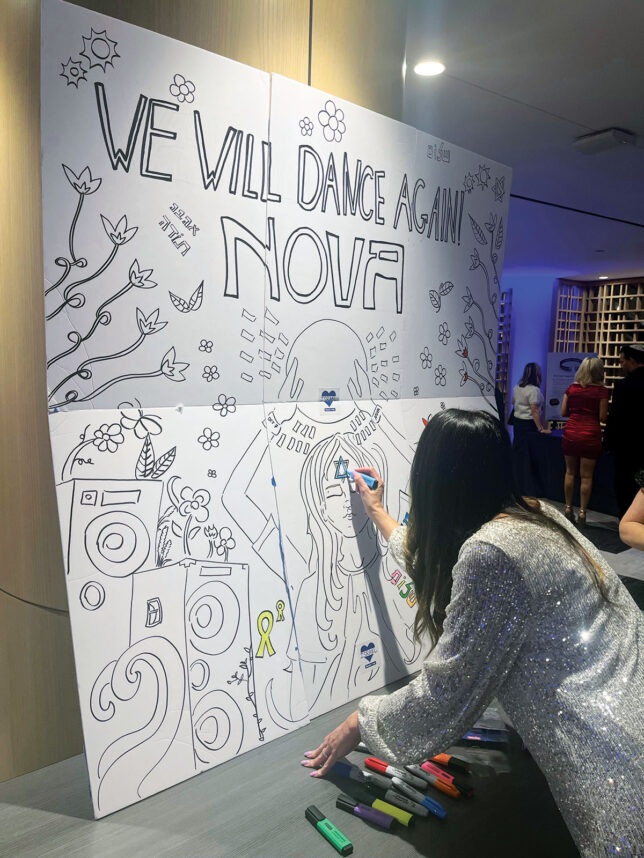
Pre-program activities at the StandWithUs Festival of Lights gala included a “We Will Dance Again” art installation. Photo by Ryan Torok

Actress and activist Patricia Heaton, known for her role on sitcom “Everybody Loves Raymond,” was a special guest. In the aftermath of Oct. 7, Heaton founded O7C, a coalition of Christians and Jews standing together. She, too, was honored by SWU.

Eylon Levy, a social media influencer and former Israeli government spokesman, served as the evening’s keynote speaker. The U.K.-born Levy has become one of the most prolific backers of Israel during the country’s multifront war. 

The evening kicked off with a kosher gourmet dinner reception, catered by Pat’s. A silent auction featured artwork, memorabilia and luxurious getaways. Comedian Dan Ahdoot—whose credits include Netflix’s “Cobra Kai”—performed and garnered laughs from the audience as he joked about Jewish stereotypes, recent visits to Israel and Jews arming themselves amid the current rise in antisemitism. Ahdoot recently visited a gun range, he said, where it resembled a Chabad. 

Along with Ondrasik, the evening feted University of Miami student Betty Srour, a SWU campus liaison, and Eli Tsives, a student leader at UCLA and former SWU intern Kenneth Leventhal.

Speakers included SWU CEO Roz Rothstein; Consul General of Israel in Los Angeles Israel Bachar and philanthropist Naty Saidoff. Saidoff and his wife, Debbie, are longtime SWU supporters.

SWU focuses on empowering college, high school and middle school students in the fight against antisemitism. 


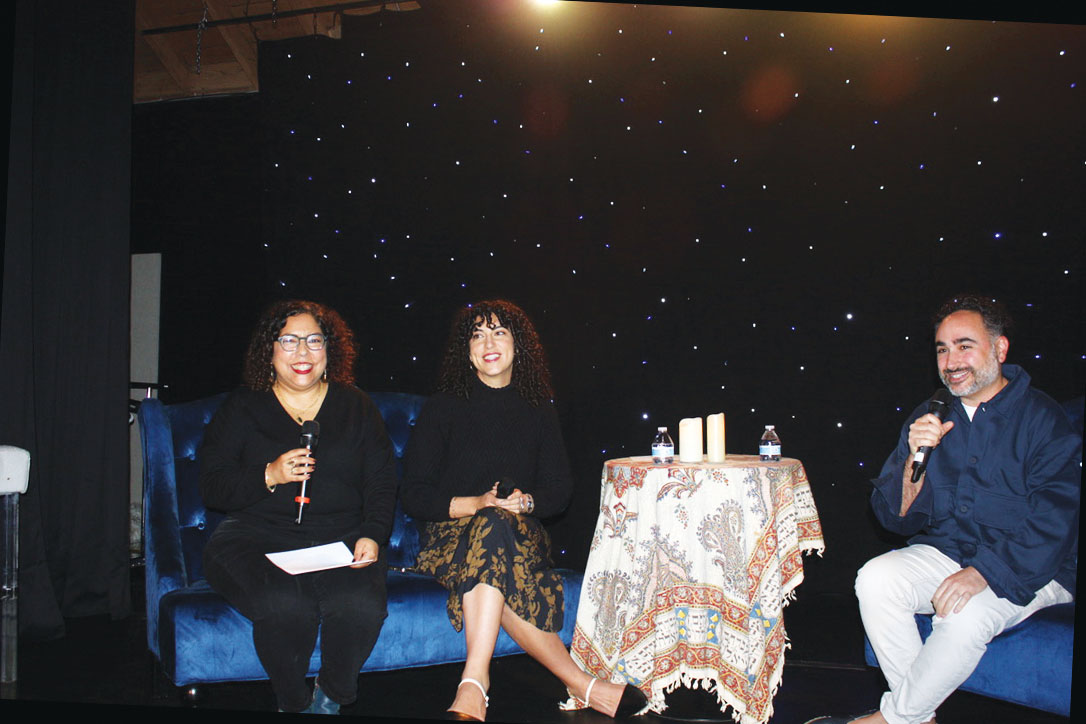
Tannaz Sassooni, Rachel Sumekh and Sahba Shayani participate in a panel at the “Erev Yalda” launch event. Courtesy of Erev Yalda

Iranians of all faiths have long celebrated “Shab-e Yalda,” or the winter solstice, which marks the longest night of the year. The Jewish month of Kislev also marks a period in which nights grow longer, and Hanukkah is meant to illuminate the physical and metaphoric darkness through meaningful ritual and remembrance.

The juxtaposition of ancient traditions and light in the depth of darkness was at the heart of a Dec. 5 launch event called “Erev Yalda: Reimagining the Ancient Persian Winter Solstice Celebration,” held at the Cat’s Crawl theater in Hollywood. “Erev Yalda” was conceived by Los Angeles-based food writer Tannaz Sassooni and entrepreneur Rachel Sumekh. Featuring words that fuse together Hebrew and Persian holiday references, “Erev Yalda,” which is also a short film and digital resource kit, was sponsored by Reboot Studios, the funding and production arm of Jewish arts and culture nonprofit Reboot.

During the event, Sumekh and Sassooni screened their film, which features actress and producer Michaela Watkins, actress and playwright Tara Grammy, Israeli comedian Noam Shuster-Eliassi, journalist Rob Eshman, and Black and Persian comedian Tehran Von Ghasri. UCLA professor of Persian language Sahba Shayani moderated a Q&A with Sassooni and Sumekh.

In her remarks, Sumekh described Erev Yalda as “a living ritual, a way for Iranian Jews to build new traditions and share them with others in a way that respects the past but feels resonant today.”

— Tabby Refael, Community Writer


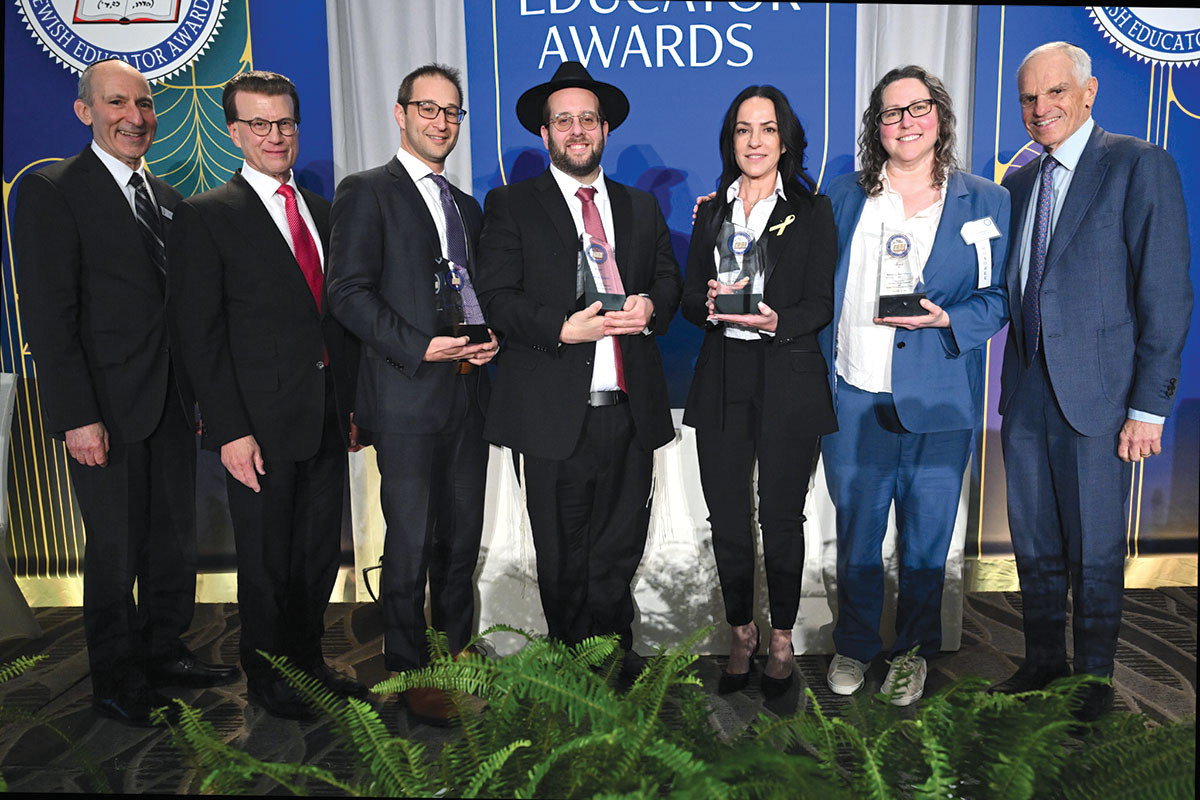
Builders of Jewish Education Executive Director Gil Graff; Lowell Milken, founder of the Jewish Educator Awards; JEA recipients Rabbi Ari Schwarzberg, Rabbi Yossi Elefant, Einav Telem and Rebecca Moray; and Milken Family Foundation Executive Vice President Richard Sandler. Courtesy of Milken Family Foundation

Recipients of the 2024 Jewish Educator Awards (JEA) celebrated during a Dec. 10 luncheon at the Luxe Sunset Boulevard Hotel, with educators from across the denominational spectrum, from the most Orthodox to the most secular, turning out. 

The event drew more than 200 attendees. Among them was Milken Family Foundation Executive Vice President Richard Sandler, who gave a presentation about each of this year’s honorees.

“What is more enjoyable than honoring our heroes, our Jewish educators,” Sandler said.

This year’s honorees were Rabbi Yossi Elefant, Yeshiva Ketana of Los Angeles; Rebecca Moray, Brawerman Elementary School of Wilshire Boulevard Temple; Rabbi Ari Schwarzberg, Shalhevet High School, and Einav Telem, Valley Beth Shalom Day School.

Each received an award of $15,000.

The JEA — an initiative of Milken Family Foundation and Builders of Jewish Education — recognizes Jewish day school teachers in Los Angeles who have exhibited quality in their teaching, professional leadership, engagement with families and the community and potential for even greater contribution to the development of children.

SWU Festival of Lights Gala, Erev Yalda Launch Event, Jewish Educator Awards Luncheon Read More »

How Jacob Offered Esau a Trojan Horse

Amitai once thought his grandma was a wrestler,
since she had watched her grandson Darius wrestle,
not realizing that she’s far more like a Tesla,
by her poetic husband driven while he’s sessile,
and following all her directions for the rhymes he writes,
guided no less by Tanakh than his ménage’s muse,
and Amitai, whose flippant comments fuel his flights
of fancy about jolly geriatric ancient Jews,

as jolly as the hiddushim I’ve composed concerning modesty
Genesis ascribes to Jacob and to camels that were given
by him to Esau when returning from his odyssey,
hoping to be by the twin he feared like Danaos forgiven,
and himself hardly willing to go with him to Seir,
his goal the land of Israel, which was his home,
more literally than for Darius, Amitai, and Gershon Meir
who wrote this in less time than Esau needed to build Rome.


Gen. 32:16, listing the gifts that Jacob offered Esau when returning to the land of Israel from Mesopotamia, where he had established a family in his uncle Laban’s domain, writes:

גְּמַלִּ֧ים מֵינִיק֛וֹת וּבְנֵיהֶ֖ם שְׁלֹשִׁ֑ים פָּר֤וֹת אַרְבָּעִים֙ וּפָרִ֣ים עֲשָׂרָ֔ה אֲתֹנֹ֣ת עֶשְׂרִ֔ים וַעְיָרִ֖ם עֲשָׂרָֽה׃

30 milch camels with their colts; 40 cows and 10 bulls; 20 she-asses and 10 he-asses.

The Torah Temimah (Barukh Halevi Epstein) explains this verse in a accordance with Yerushalmi Ketubot 5:7. This states the reason the Torah does not mention male camels but only mentions female ones is because camels are modest animals and do not have intercourse in places where they can be seen. The term is a Janus one, the first word denoting weaning, a process in which milk is withheld, whereas the second word denotes provision of milk. The Janus nature of Jacob’s gift to Esau foreshadows his refusal to travel with him to Seir (Gen. 33:12-16).

Perhaps this explains the modesty of Jacob that is mentioned in the next story. Gen 32:25 states:

וַיִּוָּתֵ֥ר יַעֲקֹ֖ב לְבַדּ֑וֹ וַיֵּאָבֵ֥ק אִישׁ֙ עִמּ֔וֹ עַ֖ד עֲל֥וֹת הַשָּֽׁחַר׃

Jacob was left alone. And a figure wrestled with him until the break of dawn.

The Talmud learns this less from this verse, as the Torah Temimah points out, quoting Hullin 91a:

From his verse a wise man (Torah scholar) can learn that he should not leave his home at night while he is alone.

I think that the connection between the two events may be that they both involve modest descriptions of sexual behavior. In Gen. 32:26, an angel wounds Jacob sexually while wrestling with him, leading to an injury of what is commonly identified as his sciatic nerve, but is actually his male member, as I point out in Legal Friction (pp. 159, 255, 454, 468).

“Timeo Danaos et dona ferentes” is a Latin phrase that means “I fear the Greeks even when they bring gifts”. It is a warning to not trust enemies, even when they seem to be offering something enticing. The phrase is from Virgil’s Aeneid, where it is spoken by the Trojan priest Laocoön in reference to the Trojan Horse.


Gershon Hepner is a poet who has written over 25,000 poems on subjects ranging from music to literature, politics to Torah. He grew up in England and moved to Los Angeles in 1976. Using his varied interests and experiences, he has authored dozens of papers in medical and academic journals, and authored “Legal Friction: Law, Narrative, and Identity Politics in Biblical Israel.” He can be reached at gershonhepner@gmail.com.

How Jacob Offered Esau a Trojan Horse Read More »

A Bisl Torah~Be the Miracle

Sinai Temple recently hosted Montana Tucker, acclaimed singer, songwriter, dancer, and proud Israel activist. The granddaughter of Holocaust survivors, Montana uses her large social media platform (14 million followers) to share their story and combat antisemitism in ways that are impactful and accessible.

And then October 7th happened.

She explained to our congregation that she could hear her grandfather in her mind. There was no other choice but to put her entire being into fighting anti-Zionism and find ways to dispel myths, misconceptions, and stereotypes.

Through conversations with people of all ages and creative, brilliant dance videos that tell the stories of October 7th, and a heartbreaking documentary that reveals the testimonies of Israeli children (The Children of October 7th), she designs an environment in which a person can’t help but say, “Tell me more.”

The letters on the dreidel are the same in Israel as the Diaspora, except one. In the Diaspora, the letters convey the phrase, “A great miracle happened there.” Meaning, the miracle of Hannukah happened in Israel. In Israel, the letters convey the phrase, “A great miracle happened here.” I see the dreidels in the Diaspora as a challenge. We must work together here to ensure that miracles happen there. Montana is a living embodiment of a miracle maker.

Let’s follow her example. May our actions and words enable us to see miracles there. May this Hannukah in Israel be filled with victory, light, and an abundance of miracles.


Rabbi Nicole Guzik is senior rabbi at Sinai Temple. She can be reached at her Facebook page at Rabbi Nicole Guzik or on Instagram @rabbiguzik. For more writings, visit Rabbi Guzik’s blog section from Sinai Temple’s website.

A Bisl Torah~Be the Miracle Read More »

A Moment in Time: “Chanukah – Transforming the Ordinary into the Limitless”

Dear all,

Last year during Chanukah, I snapped this photo (while Ron was driving). Over the year, I’ve looked at this as a reminder that at the darkest time of year, we do all we can to harness light.

We do this with our Chanukiah, increasing the light each of the eight nights.

We do this with our loved ones, finding reasons to laugh and smile.

We do this for our community, volunteering for organizations that need our help.

We do this for humanity, donating to causes that can use our resources.

As we approach this season, it will take just a moment in time for your light to make a difference – and to transform the ordinary into the limitless.

Ron, Maya, Eli, and I wish you and all you love a season of incredible joy!

With love and shalom,

Rabbi Zach Shapiro

A Moment in Time: “Chanukah – Transforming the Ordinary into the Limitless” Read More »

Print Issue: The Soul of America | Dec 20, 2024

CLICK HERE FOR FULLSCREEN VERSION

Print Issue: The Soul of America | Dec 20, 2024 Read More »

From Popstar to Podcaster ft. Margarita Lyadova (aka People Jew Wanna Know)

Back this week, Marla shares updates on the guy she’s been seeing and her upcoming birthright staffing trip. Libby talks about she helped partake in a surprise proposal and her fun travels witha  Camp Nai Nai Nai cruise, and how she feels that recently with multiple friends, there’s been something in the dating air.

Their guest this week is Margarita Lyadova of ‘People Jew Wanna Know’ (so be sure to head over to her podcast after to listen to our episode). She starts off with her dating update of the week, and quickly gets into the details of growing up in Ukraine before it was fully developed. She talks about the things that really shocked her when her family immigrated to America, like free water everywhere and being able to drink tap water in many places. They then talk about her child stardom in Ukraine and what it was like growing up Jewish there. Margarita then shares the importance of how to treat immigrants and help them retain their dignity. Marla then inquires from Margarita to go deeper into what it really means to seek asylum in the U.S. and what the process looks like. They also talk about how Jewish organizations work to help Jews in need within their community even when they’re total strangers. Margarita then gets into the creation of ‘People Jew Wanna Know’ and some of her favorite guests. The trio then gets into the most fun topic of the episode – dating! They then end witha game of ‘Cute or Cringe.’


Check out @peoplejewwannaknow on Instagram! And don’t forget to checkout their newest episode!

From Popstar to Podcaster ft. Margarita Lyadova (aka People Jew Wanna Know) Read More »