Bibi has his swagger back.
Supporters and opponents of the Israeli prime minister will disagree on whether that’s a good or a bad thing, but there’s no question that Benjamin Netanyahu, after almost precisely one year of uncharacteristic self-doubt and uncertainty, is back to his old self. Of course, some will see this as necessary confidence and others as reckless arrogance. But either way, it’s clear that the shift in Israel’s military focus from the war against Gaza to an intensified offensive against Hezbollah and possibly a larger conflict with Iran has given Netanyahu a certainty and sureness in his public appearances that had been noticeably lacking for the last 12 months.
Netanyahu was noticeably off-balance in the weeks and months after the Hamas terrorist attack. It took him more than a week to meet with the hostages’ families, a step he would have instinctively taken in the past. He kept an unusually low public profile, and while he has refused to accept responsibility for the massacre, he has offered a series of subdued and seemingly reluctant apologies over the months. Even while his political support has gradually climbed back almost to pre-Oct. 7 levels, this is not the Bibi that Israelis have been accustomed to seeing over the last 30-plus years.
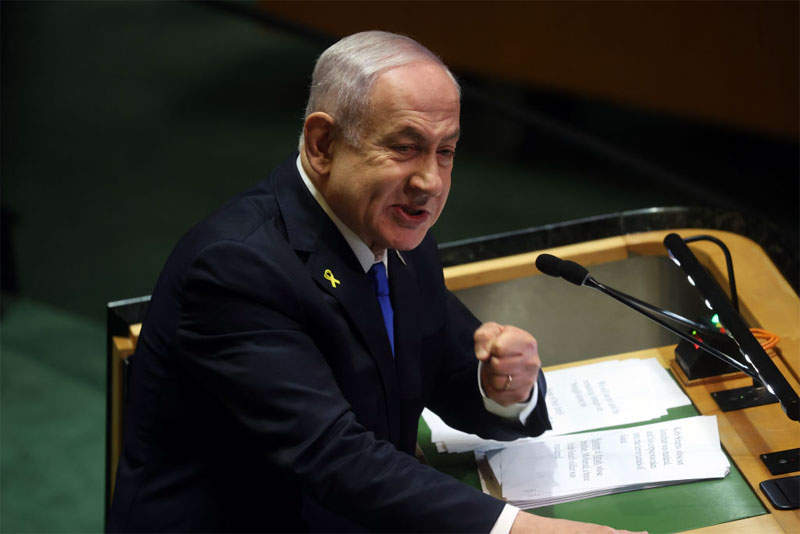
But the shift in Israel’s military priorities from Gaza to its northern border has clearly invigorated Netanyahu: His restored bravado over the last few weeks has been impossible to miss. It was especially apparent in his recent speech to the United Nations General Assembly, where he referred to that body as a “swamp of antisemitic bile” and then continued:
The shift in Israel’s military priorities from Gaza to its northern border has clearly invigorated Netanyahu: His restored bravado over the last few weeks has been impossible to miss.
“The singling out of the one and only Jewish state continues to be a moral stain on the United Nations,” he said. “It has made this once-respected institution contemptible in the eyes of decent people everywhere.”
His language toward Iran that day was even more forceful. “If you strike us, we will strike you,” Netanyahu said. “There is no place in Iran that the long arm of Israel cannot reach, and that’s true of the entire Middle East.”
Netanyahu’s nowhere-to-run-nowhere-to-hide rhetoric was not an empty threat. It was followed by a major expansion of the Israeli military’s offensive against Hezbollah, starting with the dramatic attack on their members’ pagers and two-way radios, then by the assassination of the group’s leader Hassan Nasrallah and the brushoff of an Iranian missile launch.
These military successes has left Iran in an extremely vulnerable position, with Hamas pinned down in Gaza tunnels and a decapitated Hezbollah severely weakened, raising speculation that Israel may launch further attacks against Iran’s energy infrastructure and possibly even against the country’s nuclear facilities. Public support for Israel, both domestically and internationally, is on much sturdier ground in these conflicts than in Gaza. Most Americans had never heard of Hamas before the invasion: Iran’s reputation as a long-time foe is more familiar. And at home, without the debate over the hostages to divide the Israeli public, the battles with Hezbollah and Iran are far more clear-cut and enjoy much broader backing.
Some of Netanyahu’s renewed attitude may also be a sign of relief, as last week’s decision by New Hope party leader Gideon Sa’ar to rejoin Netanyahu’s coalition eases the pressure on the prime minister to rely quite so heavily on the right-wing parties that have propped him up since he returned to office in 2022. Sa’ar only brings a handful of seats with him, but while it does not eliminate the power that ultra-conservatives such as Finance Minister Bezalel Smotrich and National Security Minister Itamar Ben-Gvir have been granted in the current government, it gives Netanyahu some needed breathing room and potential flexibility in the way he prosecutes these wars going forward.
This past year has been a profoundly disorienting experience — for Netanyahu, for the Israeli people and for Diaspora Jews around the world. This new set of challenges is deeply dangerous, but it feels much more familiar. That sentiment will greatly strengthen Netanyahu both internationally and domestically as he prepares for his next set of challenges.
Dan Schnur is the U.S. Politics Editor for the Jewish Journal. He teaches courses in politics, communications, and leadership at UC Berkeley, USC and Pepperdine. He hosts the monthly webinar “The Dan Schnur Political Report” for the Los Angeles World Affairs Council & Town Hall. Follow Dan’s work at www.danschnurpolitics.com.