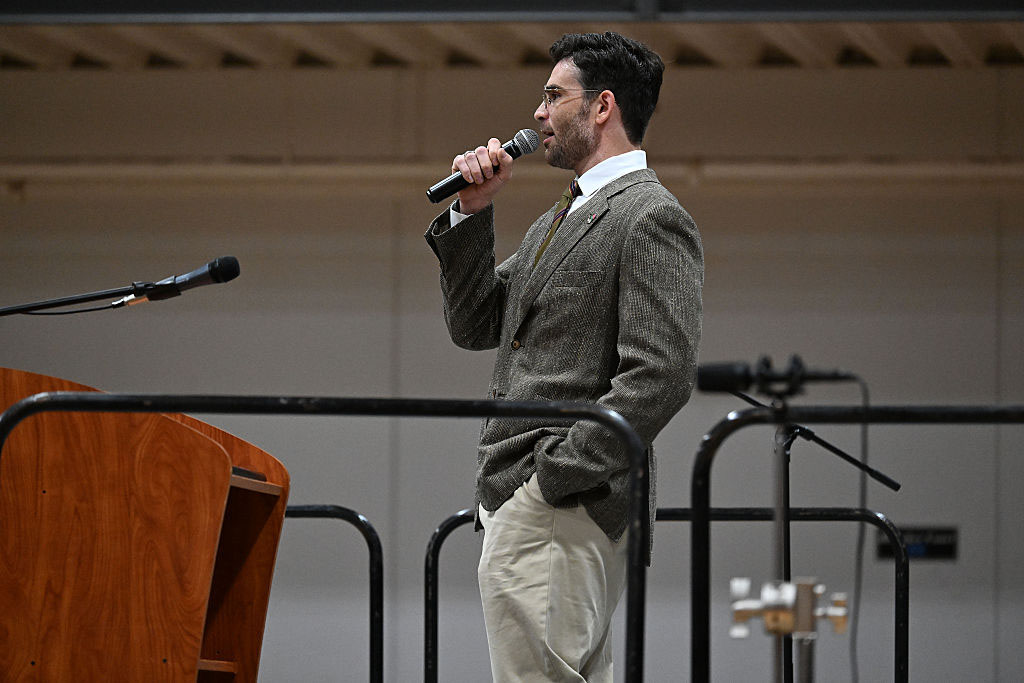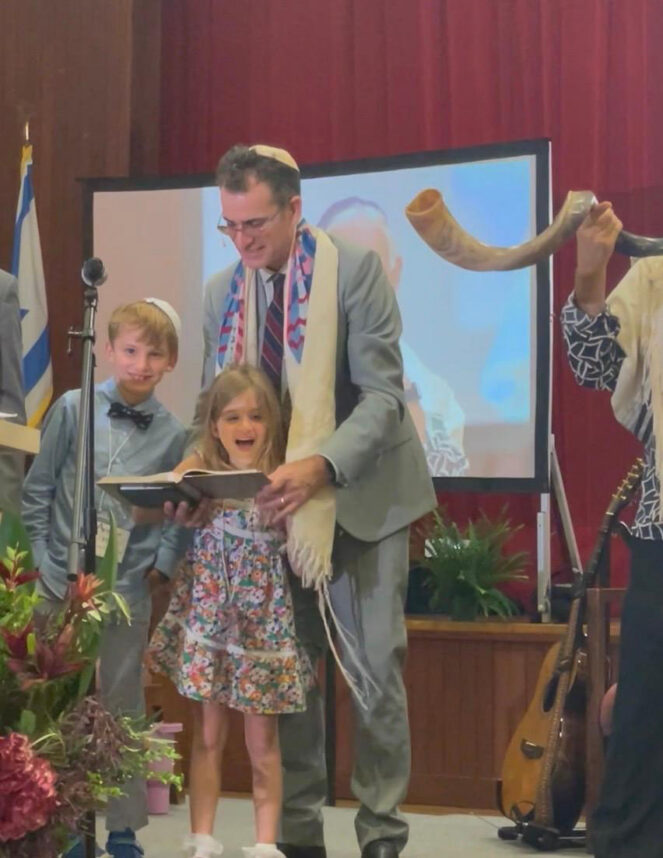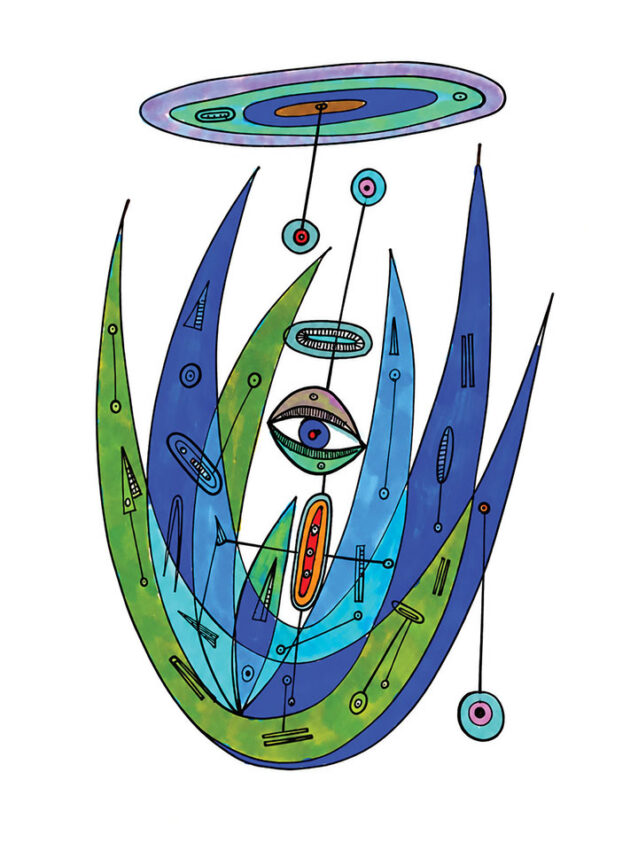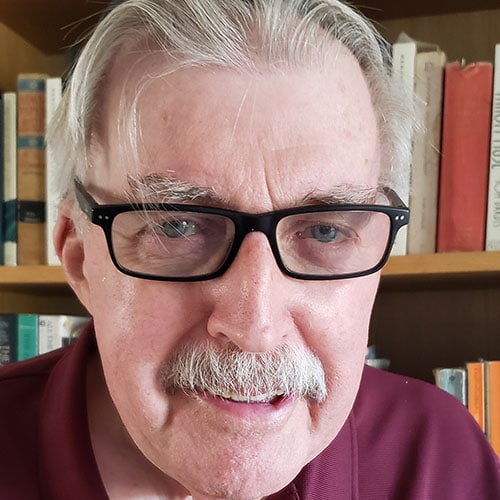
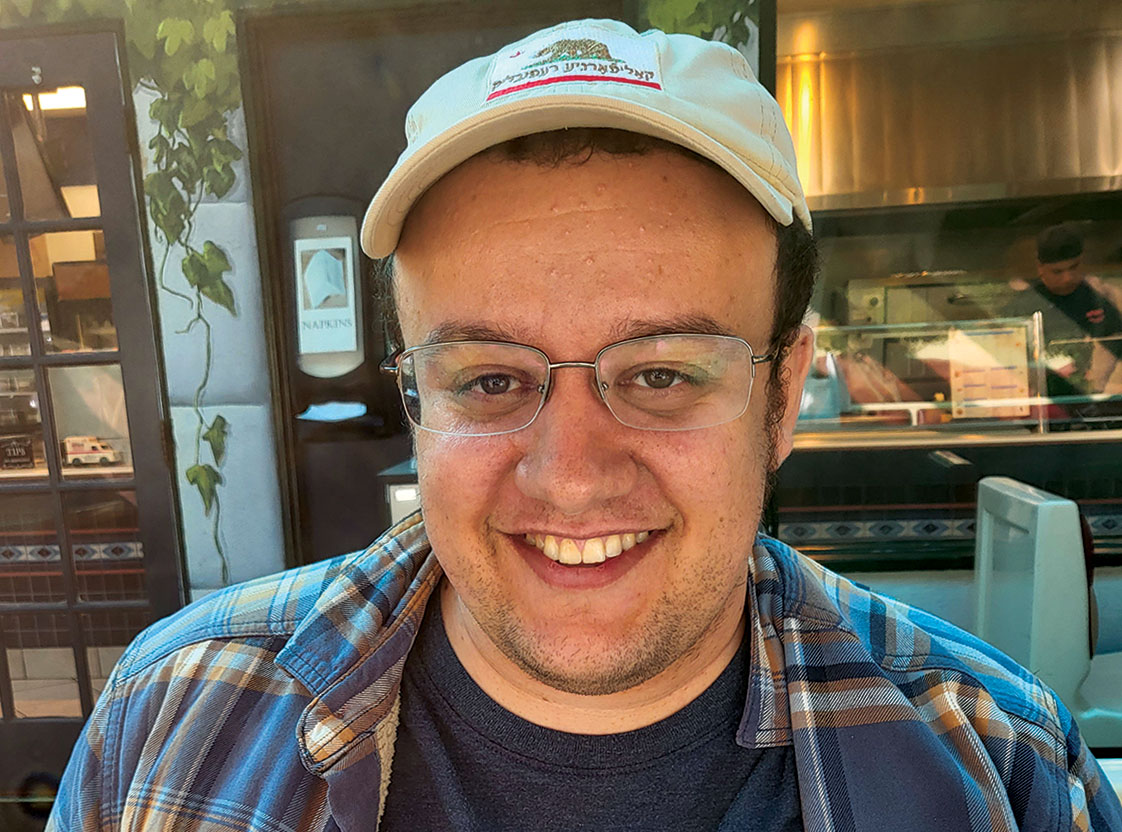
Growing up, Rabbi Zach Golden didn’t want to be a rabbi at “a normal shul.” It was more than just talk: he founded Der Nister, the first Yiddish synagogue in Downtown Los Angeles. Der Nister is Yiddish for The Hidden, and that’s an apt description – the shul is located on the 14th floor of a building on Spring Street near Wilshire Boulevard.
The seed for Der Nister was planted when he attended American Jewish University’s Ziegler School of Rabbinic Studies, where he would schmooze with his classmate Henry Hollander, owner of a Jewish bookstore in San Francisco. “One day,” Golden told The Journal, “I said, ‘Why don’t you bring your bookstore to Los Angeles and [we’ll] put a synagogue in it?’”
Since Jews his age (he’s 33) were more culturally oriented than traditional, Rabbi Golden did not believe a traditional shul would attract them. “I thought the way the old shtetls would have it: Let’s bring culture and religion back together so that there is no serious division between the two. Many synagogues, he said, have cultural programming. Many cultural centers have religious programming. But he was envisioning “a deeper fusion.” He also noted that people often turn to religion as a source of healing, which works because of its depth and beauty.
Why Downtown? Rabbi Golden asked explained that when he was a high schooler at Long Beach Millikan (his family moved to LA after time in Madison, Wisconsin — where he was born — and Canada), he would take the A Line to Downtown — partially out of boredom, partially out of curiosity. A proponent of public transit in general, but especially for environmental reasons, once he started walking around, he realized that Downtown is unique in its density and usage of public transit. “I always loved taking people Downtown, walking around, figuring every nook and cranny,” he said. He also took note of the large new places such as Staples (now Crypto.com) Center that were opening in the area.
A few years later, Golden and Hollander were about to graduate and scouted out Downtown spaces for their bookstore-shul. Somehow, Golden said, “Henry found this historic bank building (at 639 S. Spring St.). He got a deal good enough for this entire 14th floor. I said to Henry, ‘You don’t know how lucky you are. Even though it is chaotic here, this is the beating heart of Downtown in terms of pure energy.’
His friend, he said, didn’t understand that books can be a beautiful backdrop for people to be attracted. “He didn’t believe people would be attracted, that in Los Angeles there is a set of trends where people like hidden things. Deeper than that, I have seen all of his books that span the length of Jewish civilization, religious and secular, Yiddish, Hebrew and every other language – that people would feel a deeper sense of belonging – whether or not they could read.”
And Rabbi Golden believed Jewish life “needed a closer reconciliation between culture and religion.” While in rabbinical school, he traveled across Europe, visiting Jewish communities. He saw that people were “extremely comfortable” putting together culture and tradition. “I saw the blueprint of how it’s worked abroad,” he said. “Yiddish is part of that equation.”
Yiddish, he believes, provides healing and grounding. “Putting those two together,” Rabbi Golden reasoned, “gives people the ability to find healing in the Jewish tradition without needing to feel dependent on someone for it.”
His own Judaism is a mixed bag.
His mother’s family was Orthodox; his grandfather was an Orthodox rabbi in Montreal and the first Hillel rabbi at McGill University. On his father’s side, there was “a sort of secular family” but deeply, culturally Jewish. “There was a lot of religious background in my life. I grew up going to Conservative synagogues. I also spent a lot of time with Orthodox and ultra-Orthodox family. It was the religious life of my mom and the culturally informed life of my dad. We kept Shabbat strictly. I went to two different Chabad schools. After fifth grade, I was in public school.”
He learned a lot of Yiddish both from his bubbe and from Cantor David Kane (at Temple Beth Shalom, but the latter “taught me how to feel Yiddish.”
What attracted him to Yiddish? He calls Yiddish a second language but not a foreign language. “Even though I speak Yiddish worse than I speak English, all the cultural associations stick with it. So I feel more free to express myself, how I feel, how I am, in Yiddish. Ask anyone who is subjected to me speaking in Yiddish to them,” Golden said. “My passion and energy levels multiply by three – against my control and will. I want people to share in that experience.”
“Even though I speak Yiddish worse than I speak English, all the cultural associations stick with it. So I feel more free to express myself, how I feel, how I am, in Yiddish. Ask anyone who is subjected to me speaking in Yiddish to them. My passion and energy levels multiply by three.”
While Der Nister is a volunteer enterprise at this point, tutoring in Yiddish and Hebrew are the rabbi’s main income sources. “I also am sort of a cantorial soloist,” he says after serving for the High Holy Days in Wilmington, N.C., and at UCLA Hillel.
Fast Takes with Rabbi Golden
Jewish Journal: What is your favorite childhood memory?
Rabbi Golden: Our family used to take long trips, and New Mexico was my favorite destination. I love the desert.
J.J.: What was your best recent meal?
RG: I hadn’t eaten all day, running around getting ready for our Tu B’Shevat, and I had a mozzarella stick that was really good.
J.J. What is your favorite holiday?
RG: Yom Kippur. It’s not just leading it but going through it even though you are nervous as all heck. It’s total rapture.