fbpx

March 6, 2025

Losing Our Fear of Good News

One of the side effects of spending many years in the advertising business, as I did, is that certain thoughts percolate in your mind whether you like it or not. They often relate to winning and losing.

This thought in particular has been bothering me: Why is it that the more money and resources we put in our fight against antisemitism, the worse it gets? If this fight against Jew-hatred were a business, we’d be in Chapter 11. Instead, we just add new chapters.

I’ve been part of those chapters, and for good reason. If my people are attacked — whether on a college campus or in the media or anywhere else — my first instinct is to fight back. It’s a fight that infuses my life with meaning.

There is, however, a weird downside to that fight. By necessity, we must constantly talk about what we’re fighting against: the hate. We talk about it so much, in fact, that we rarely ask ourselves: Are we losing something with all this hate talk?

In advertising, we distinguish between what we say and what we communicate. So, when we talk about the hate against Jews, are we unintentionally communicating that Jews are worthy of hate? Given that things keep getting worse, is it possible that all that noise about hate is only drumming up more hate?

We need to open our minds to the possibility that the louder we make our fight, the happier we make the haters. Nothing brings them more satisfaction than the prospect that our incessant talk about fighting hate will backfire; that it will encourage more people to wonder whether there’s something “special” about Jews that is worth loathing.

Which brings us to another great principle in advertising: “We’re so busy measuring public opinion that we forget we can mold it.” Jews have become expert at measuring public opinion against Jews and terrible at molding it.

One reason is that we rarely share good news about Jews. We’re so caught up fighting the bad news we seem to be afraid of good news.   

But good news is our superpower. It’s what girds our confidence and completes our story. It’s what nurtures our resilience and gives us hope. We’ve survived for so long not by highlighting our victimhood but by striving for success. 

Jew-haters would love nothing better than to keep Jews in the mud of bad news — to frame us as people who must constantly defend ourselves, people always fighting a losing battle. 

It’s a popular expression these days to “manifest” one’s aspirations. Whatever we’re looking for — a soulmate, career success, better relationships, etc. — we try to manifest that reality with the right mindset.

Jews have done very well reinforcing the perception that Jews are hated. Maybe it’s time to manifest a reality that makes Jews look not like victims but like winners.

Like, for example, the reality that the great majority of Americans are actually fond of Jews. Or that most Jews are doing very well and even thriving as proud Jews, proud Zionists and proud Americans.

Being victims doesn’t mean we need to act like victims. Antisemitism has gone up, yes, but who says we must amplify that reality? Why not manifest a reality and adopt a body language that make us look strong rather than weak?

Losers talk; winners win. This means Jews should focus only on fights we can win. Complaining and condemning are not victories; winning a court case is. When Jew-haters break the law or harass Jews, or when universities fail to protect their Jewish students, we win when they pay a price. When we correct lies in the media, or when we fight for more security, we also win. Those are no-brainers.

What is not a no-brainer is to include good news in our arsenal– to associate Jews with success and our haters with failure. After all, shouldn’t the hater merit the stench of a loser?

In short, the haters will never turn into losers until we turn into winners. And it’s high time Jews started winning. I learned that in advertising.

Losing Our Fear of Good News Read More »

Smoke – A poem for Parsha Tetzaveh

Aaron must burn incense on it when he kindles the wicks of the lamps in the afternoon—a continual offering of incense before God throughout your generations. ~ Exodus 30:8

When I discovered incense, in the wilds of the
Venice Beach Boardwalk, as a young man in,
probably, the late eighties, I didn’t know

it had something to do with me. It seemed like
an exotic Eastern artifact (I hadn’t yet embraced
my people’s penchant for the East.)

Table after table, in what felt like a million miles
of tables, of expert incense sellers, occasionally
broken up by a booth selling sunglasses –

the product, wrapped in aluminum foil, ready for me
to take my shekels and send me home to discover
my inner priestly class. My mother was a Cohen.

So, for all I know, Aaron had been waiting for me
to come along this whole time. I brought some home
I tried it out, and Judaism is still here –

I must have been doing something right.
Incense is the only smoke I’ll allow in my holy of holies
as my mother spent her life retreating from civilization

in a cloud of tobacco. She had no idea she came from
the foot of the mountain, that her ancestor
was the chief holy operator. At least she

didn’t know to word it like that. She had her suspicions.
We wrote them off as paranoia and proceeded to
live our lives with one eye towards sadness

and the other towards the world yet to come.
I just want to make a pleasing fragrance for the Lord.
I remember that phrase from somewhere else.

There’s so much I remember, from my own physical life,
from generations before my feet touched this ground.
So much of it, gone up in smoke.


Rick Lupert, a poet, songleader and graphic designer, is the author of 28 books including “God Wrestler: A Poem for Every Torah Portion.” Visit him at www.JewishPoetry.net

Smoke – A poem for Parsha Tetzaveh Read More »

Jewish Groups File Antisemitism Complaints Against Three California Schools

The Louis Brandeis Center for Human Rights Under Law, in partnership with other Jewish groups, filed federal complaints against three California schools on March 6 alleging that the schools failed to adequately address antisemitic incidents on their campuses.

The three schools are Scripps College (which is part of the Claremont Colleges consortium), Cal Poly Humboldt and the Etiwanda School District. The complaints, filed to the Department of Education’s Office of Civil Rights, alleged that the three schools violated Title VI of the Civil Rights Act for ignoring “severe antisemitic harassment and discrimination,” according to a press release.

The complaint against Scripps, which the Brandeis Center filed in conjunction with the Anti-Defamation League (ADL) and Arnold & Porter Kaye Scholer LLP, alleges that one anonymous student, who is not Jewish, was subjected to antisemitic comments because she wears a Star of David, an Israeli pin, and regularly attends Hillel and Chabad events. Some of the comments she has been purportedly subjected to include being told that it’s “immoral” for her to go to those events “because Jewish people support Israel” and that Jews are “rich and control the media.” She also has lost friends over going to those dinners. When the student emailed the college about the antisemitism she experienced, a meeting was arranged with two administrators, but no action was taken, per the complaint. Another student allegedly resigned from her place of employment, which is redacted from the complaint, because she was afraid of being targeted over her Zionist identity. When a professor reported her resignation and kept her anonymous, an assistant vice president in Human Capital/Risk Management said that an investigation could be conducted if the student were to come forward, but ultimately nothing was done.

The complaint also discusses the college’s decision to temporarily close The Motley Coffeehouse, a student-run café owned by the college. The complaint alleges that the café’s student staff hung a Palestinian flag on the wall, but requests to hang an Israeli flag on the wall were ignored. Additionally, the complaint states that the café closed itself off to everyone but the Claremont Students for Justice in Palestine (SJP) chapter to mourn Hezbollah leader Hassan Nasrallah, who was killed in an Israeli strike in September 2024. But staff allegedly ignored a request for their space to be used to commemorate Jewish suffering. The college repeatedly requested that the coffeehouse agree to an “open call” of submissions from the community to address concerns that not all students’ identities were being represented; the coffeehouse never agreed to the request.

Subsequently, Scripps closed down the coffeehouse on Oct. 5, but provided vague rationale as to why. The result, according to the complaint, was that antisemitic conspiracy theories permeated throughout the school, blaming pressure from Zionists or Jewish donors. When the college reopened the Motley, there was no condemnation of these antisemitic conspiracy theories, only an acknowledgement that there were “differing perspectives” on why it was closed.

The complaint also noted that when anti-Israel protesters occupied Carnegie Hall on the Pomona College campus on the one-year anniversary of the Oct. 7, 2023 massacre, not only did Scripps not announce any punishments of their students who were involved, they supported their students’ appeals against Pomona banning them from the Pomona campus. Some Jewish students skipped classes on the anniversary because they were afraid of being outed as Zionists if they followed anti-Israel protesters in their planned walkout that day.

The complaint against Cal Poly Humboldt, which the Brandeis Center filed in conjunction with Jewish on Campus, centers around antisemitic incidents targeting the university’s Chabad chapter. The complaint details how at a September club fair on campus, a student shouted that the Jewish students were “baby killers, genocide supporters and land stealers; the student grabbed items off the table and blocked other students from approaching the table with his intimidating rhetoric and by placing his body in front of the table. The perpetrator also inserted himself physically between the rabbi and students who were engaged in discussion, thereby blocking further conversation.” When a student reported the incident to the Dean of Students and the Associate Dean of Students, both of whom were at the fair, the latter individual allegedly “told the Jewish students that they should leave the fair, thereby depriving them of the same educational opportunities as other students and student clubs to participate in and enjoy the fair.”

“Upon information and belief, the university failed to discipline the perpetrator,” the complaint states. “Instead, it issued a two-way no-contact order between the Jewish students at the table and the perpetrator, thereby sending a message that the Jewish students were also to blame. The university took no further action to protect Jewish students and prevent antisemitic harassment from recurring; as a result, antisemitic incidents at Cal Poly continued and escalated in severity.”

On the one-year anniversary of the Oct. 7 massacre, the Chabad chapter set up a table to commemorate the anniversary; in response, anti-Israel students purportedly drew a circle around the table in chalk and called it the “Zio Corner,” referencing an antisemitic slur popularized by David Duke. Some of the anti-Israel students also threw red paint at the table; one them hit two Jewish students with a red substance. Jewish students implored administrators to call the police, but were allegedly rebuffed. Campus police also allegedly refused to come when they were called.

Additionally, on Oct. 16, the etrog was stolen from the Chabad’s sukkah. When it was reported to the Dean of the Students, the dean allegedly replied that the sukkah should be taken down every night to preemptively stop other thefts from occurring. The next day, anti-Israel students held a teach-in close to the sukkah on “Palestinian resistance,” featuring a pro-Hamas speaker who referred to the Oct. 7 massacre as “resistance” and “anti-colonial struggle.”

“The event included anti-Semitic speeches that were broadcast with amplified sound, in violation of University policy on time, place and manner restrictions,” the complaint states. “During the event, participants taunted Jewish students by chalking inflammatory antisemitic messages near the Sukkah, including ‘Go away Nazis,’ ‘Death to America,’ and ‘Zionists are all homophobes.’” The complaint adds that “at least five administrators, including the Dean and Associate Dean of Students, were present at this “teach-in,” but they failed to take any action to enforce school policies against amplification and chalking in unapproved locations.”

The complaint regarding the Etiwanda district, which the Brandeis Center filed in conjunction with the ADL and StandWithUs, involves a Jewish student in the seventh grade at Etiwanda Intermediate School being allegedly bullied, harassed and discriminated against by other students. According to the complaint, the Jewish student, who wore a Star of David necklace, had attempted to move a praying mantis in September that scared the other students, when another student tried to hit the insect with a stick while it was cupped in her hands. The student then began spinning with her arms outstretched toward the Jewish student, hitting her multiple times. After staff at the school told the student to stop hitting her, the student then told the Jewish student to “shut your stupid Jewish a— up.” The Jewish student proceeded to use her leg to try get the student away from her, only to have the other student start choking her and pinned her against a table. The Jewish student was able to push the other student, but her face was red and was coughing profusely.

The Jewish student’s alleged attacker was not suspended by the district, nor was the incident classified as a hate incident.

The following month, the Jewish student was assigned to a group to perform a skit in class; the skit was scheduled to be performed on Rosh Hashanah, so the Jewish student was excused from class that day and completed a written packet instead of performing of the skit. The group did not perform the skit that day. When the Jewish student informed the group that she would not have to perform the skit, another student replied: “This wouldn’t be an issue if you weren’t Jewish.” Separately, a different student asked if the Jewish student was in fact in Jewish, and when she affirmed that, the student insisted that she hear a Hitler joke despite her protestations. The school’s response: the teacher moved the Jewish student to a different seat, resulting in her being even more isolated from her classmates.

“While an increasing number of schools recognize that their Jewish students are being targeted both for their religious beliefs and due to their ancestral connection to Israel, and are taking necessary steps to address both classic and contemporary forms of antisemitism, some shamefully continue to turn a blind eye,” Brandeis Center Chairman Kenneth L. Marcus said in a statement. “The law and federal government recognize Jews share a common faith and they are a people with a shared history and heritage rooted in the land of Israel. Schools that continue to ignore either aspect of Jewish identity are becoming dangerous breeding grounds for escalating anti-Jewish bigotry, and they must be held accountable.”

ADL Vice President of National Litigation James Pasch said in a statement, “ADL and our partners will not sit idly by as Jewish students are attacked for their identity – from our college campuses to our K-12 schools, our educational institutions have an obligation to protect their Jewish students and ensure that all its students receive an education free of harassment and discrimination. Students and parents continue to reach out to ADL, Brandeis and StandWithUs through our expanded K-12 helpline, and we will continue to use administrative filings and the courts to ensure the safety of all Jewish students.”

“Too many of our nation’s young minds are being corrupted by the disease of antisemitism,” StandWithUs CEO and Co-Founder Roz Rothstein said in a statement. “It is the duty of K-12 educators and administrators to provide the necessary education to inoculate them — not indoctrinate them. As long as students continue to find themselves on the receiving end of anti-Jewish hate and bigotry from their peers or teachers, and their appeals to administration continue to fall on deaf ears, we will continue to show up and support them in holding their schools accountable.”

“Too many of our nation’s young minds are being corrupted by the disease of antisemitism … It is the duty of K-12 educators and administrators to provide the necessary education to inoculate them — not indoctrinate them.” – Roz Rothstein

A spokesperson from Cal Poly Humboldt told The Journal that the university “is reviewing the federal complaint and will, of course, fully cooperate with the Office of Civil Rights in any investigation. Hatred or discrimination in any form, including anti-semitism, is contrary to our core values. The University unequivocally condemns all acts of hatred, bigotry, and violence, and we are committed to keeping safe our students, staff, and faculty of all religions. We will continue to work together to foster a learning and working environment where we can all feel safe, included, and respected.”

Scripps College and the Etiwanda district did not immediately respond to The Journal’s requests for comment.

UPDATE: Charlayne Sprague, superintendent of the Etiwanda district, told The Journal in a March 7 email: “We take our duty and obligation to provide all our students with a safe and welcoming learning environment very seriously. While we have yet to receive the letter from the Brandeis Center and cannot discuss any specific instances involving students by federal and state law, we can state that the Etiwanda School District, its dedicated teachers, and trained staff do not tolerate antisemitism or racism in any form. We also condemn anti-Semitism in all its forms.  Etiwanda is committed to taking all necessary actions, including discipline where appropriate, to address and ameliorate discrimination and harassment based on actual or perceived Jewish shared ancestry or ethnicity. Anti-Semitic bullying, harassment, and targeting of Jewish students because of their Jewish ancestral and ethnic identity is contrary to Etiwanda’s institutional values and nondiscrimination and conduct codes and is unacceptable.

“We have instituted policies to thoroughly investigate all claims of hostile acts and take appropriate action. We uphold these practices to maintain the core values of civility and dignity for everyone on every campus.”


Jewish Groups File Antisemitism Complaints Against Three California Schools Read More »

Jewish Community Foundation Names Chair, Ceremonies Honor Bibas Family

Local business leader Mark Schwartz was named the new chair of the Jewish Community Foundation of Los Angeles. With this appointment, Schwartz is now the lay leader of an organization that distributed—along with its 1,400 donor families—more than $200 million in grants to 3,600 nonprofits locally, nationally and in Israel last year.

A recent ceremony held during a Foundation board of trustees meeting featured Schwartz taking the gavel from outgoing Foundation Chair Evan Schlessinger.

According to the Foundation, Schwartz is a dedicated community activist with 25 years of involvement in the Foundation’s philanthropic work. He is an accomplished entrepreneur and respected business leader who has contributed his financial acumen and strategic expertise to the Foundation’s grantmaking initiatives and investment management.

“For many years, The Foundation has been a trusted partner in my family’s philanthropy,” Schwartz said in a statement. “It is an honor to step into this role and help guide an organization that is deeply committed to strengthening the Jewish community in Los Angeles and the community at large.”

Schwartz and his wife, Lisa, a City of Beverly Hills Commissioner, are strongly committed to tikkun olam, according to the Foundation’s leadership.

“Mark’s entrepreneurial spirit, strategic vision and deep commitment to philanthropy make him an exceptional lay leader for The Foundation’s next chapter,” the Foundation’s CEO and President Aaron Lerner said. “His expertise in financial stewardship and community engagement will help propel our mission forward, ensuring that we continue to make a meaningful and lasting impact in our Jewish community and beyond.”

Under Schwartz’s stewardship, the organization plans to further its mission of empowering Jewish philanthropists and strengthening the community.


Hundreds participated in a Beverly Hills candlelight vigil for the Bibas family, including those pictured here. Photo by Orly Halevy

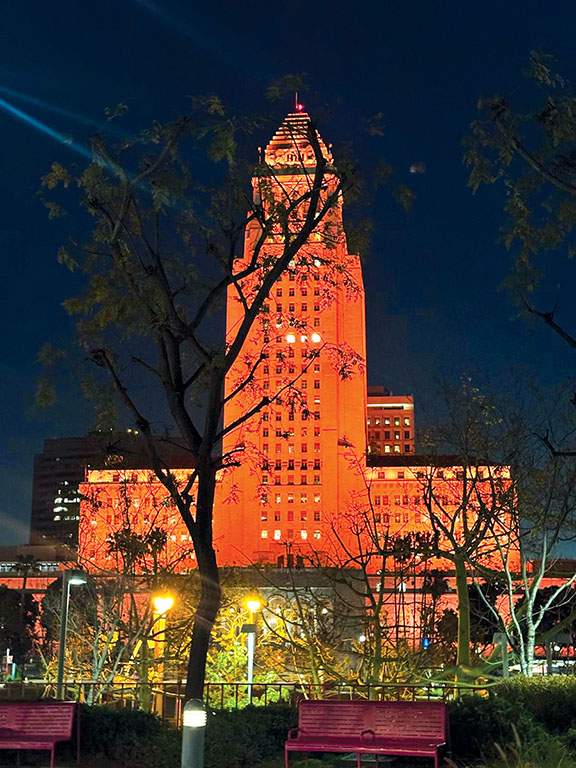
A candlelight vigil was held on Feb. 26 in front of the Beverly Hills sign in memory of Shiri Bibas and her two young children, four-year-old Ariel and nine-month-old Kfir Bibas, who were brutally murdered by Hamas while in captivity. At the same time, Los Angeles City Hall was illuminated in orange, a color that became associated with the family due to the children’s red hair.


Beverly Hills City Hall

Hundreds of people attended both ceremonies, which coincided with the family’s funeral in Israel and stood as a symbol of unity, resilience, and the unwavering commitment to honoring the lives lost to senseless violence.

In Beverly Hills, attendees arrived holding Israeli flags and portraits of the youngest hostages taken by Hamas.

The initiative in downtown Los Angeles was spearheaded by Councilmember Bob Blumenfield, with support from Councilmember Katy Yaroslavsky’s office. The event was attended by Consul General of Argentina, Héctor María Monacci. A prayer was offered by Rabbi Josh Aaronson of Temple Judea in Tarzana.

“The Bibas family became a symbol of the grave tragedy of the massacre of Oct. 7,” said Israeli Consul General Israel Bachar. He also expressed gratitude to the City of Los Angeles for standing in solidarity with the Bibas family, the hostages, and the people of Israel. 

Los Angeles joined other cities across the world, including Berlin, Paris and New York, in lighting up monuments to show solidarity with Israel and the Bibas family.

– Ayala Or-El, Contributing Writer

Jewish Community Foundation Names Chair, Ceremonies Honor Bibas Family Read More »

Rabbi Pini Dunner Leads Protest Against Qatari Influence at Maybourne Hotel in Beverly Hills

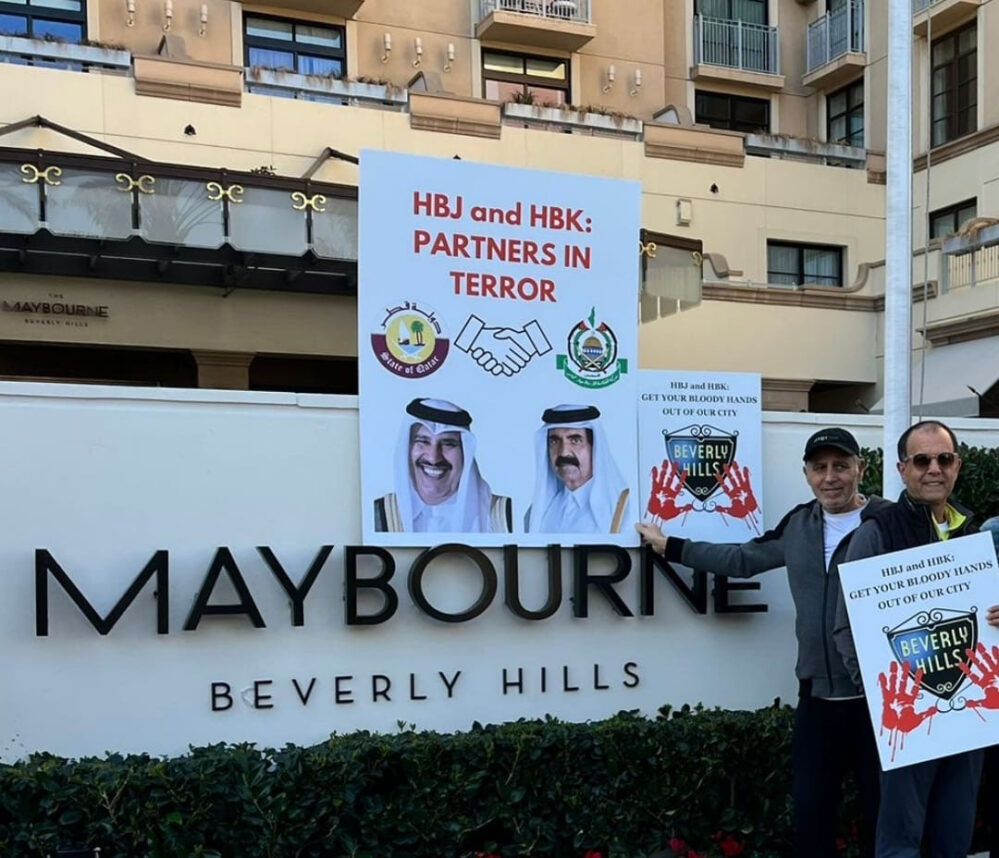
On Feb. 16, Rabbi Pini Dunner stood outside the house of former Qatari Prime Minister Hamad bin Jassim bin Jaber Al Thani (known in short as HBJ) with a small group of people, holding a handmade sign that read: “A man who funds terrorism lives here.”

A few days before, he stood with the same group of people outside the Maybourne Hotel in Beverly Hills, which was purchased in 2019 by the Maybourne Group. The hotel, formerly known as the Montage Hotel, is owned by the Qatari royal family. Dunner finds this outrageous, and since Oct. 7, has made it his mission to ensure people are aware of the hotel’s connection to Qatar and its financial ties to Hamas.

“This is HBJ from the royal family of the Al Thani family, the royal family of Qatar,” said Dunner, pointing at a placard with a photo of the former prime minister. “Qatar pretends to be mediators, the honest brokers of the Middle East. But you know who they are? They are the funders and supporters of terrorism. All they are interested in is creating havoc and chaos in the world and then pretending to resolve it.”

The rabbi of Young Israel of North Beverly Hills is a man on a mission: he wants to raise awareness, and he wants the Qataris out of Beverly Hills. Talking to The Journal following the protests, he said that people are not well aware of the connection between Qatar and Hamas and how they support this terrorist organization. Therefore, Dunner says, every time a guest stays at the hotel or celebrates their wedding or bar mitzvah there, they’re indirectly helping fund Hamas.
“Once you see it, you can’t unsee it. The problem is that most people don’t see it. They [Qatar] build a narrative around themselves that they are wonderful people, the mediators between Hamas and Israel, and people have fallen for it. It’s quite unbelievable and scary. It shows you that if you know how to manipulate your image, you can sell anything.”

Dunner himself admitted that his synagogue once held a function at the Maybourne. It was back in 2021, and someone told him that the hotel was purchased by Qatar. He put it in the back of his mind, but then after Oct. 7, it made him see the absurdity of the Arab country playing a role in the negotiations between Israel and Hamas.

Dunner wrote a letter to the Beverly Hills City Council asking why Qatar is allowed to conduct business in town — the same country that invited Hamas to Doha and began funding Hamas in Gaza.

A small group of around two dozen protesters stood outside the luxury hotel in Beverly Hills, with signs that read, “This hotel supports terrorism,” alongside a picture of a Hamas terrorist. Other signs labeled members of the Qatari royal family as “accomplices in terrorism” and claimed their hands were stained with blood.

Beverly Hills City Councilmember John A. Mirisch, who participated in the protest, condemned Qatar’s anti-Jewish racism and its funding of terrorist organizations, including Hamas and the Muslim Brotherhood. “Qatar is using the Al-Jazeera network to spread terrorist propaganda,” Mirisch said.

“Qatar allows a disgraceful treatment of the hostages upon their release and this, coupled with the fact that every bullet fired by Hamas, every tunnel in Gaza and every rocket fired at Israel is financed with Qatari money,” said Dunner. “We are not willing to accept the presence of terror supporters in our city. There is no difference between the state of Qatar and members of the Qatari royal family.”

Dunner’s protest is a quiet one; he doesn’t mind the small number of people who join him in his quest. His battle is waged primarily on social media and through the press. Still, he is frustrated that Qatar is considered an ally of the U.S. and holds significant power thanks to its financial strength.

“I may not have the power to make sweeping political changes,” he said, “but I can tweet. And if a few thousand people see it, then more and more will start paying attention. Awareness leads to action, and eventually, we will get results.”

People paint Iran as the greatest threat, but Qatar is a much greater threat.” – Rabbi Pini Dunner

“They are puppet masters,” said Dunner of the Qataris. “All the chaos on campus is paid for by Qatari money. People paint Iran as the greatest threat, but Qatar is a much greater threat. I have a friend who is a minister in the Conservative government. I called him up and said that the U.K. should be taking measures against Qatar and he said it would be more difficult to extricate Qatar from the U.K. than Brexit. They own 20% of the London Stock Exchange, they own Harrods, they own British Airways, they own Sainsbury’s, which is like Ralphs, they own billions of pounds’ worth of property, they own politicians because they give them cash — you can’t believe these people’s reach.”

Dunner hopes that the Qatari will sell their hotel, but not only that. “Their assets should be confiscated, their visas revoked,” he said. “Most of all, I want the narrative to change. People need to wake up to who they really are.”

Rabbi Pini Dunner Leads Protest Against Qatari Influence at Maybourne Hotel in Beverly Hills Read More »

Michael Gutter’s Fight against Antisemitism in ‘Never Again Still Means Never Again’

Michael Gutter’s book, “Never Again Means Never Again,” began as a raw, unfiltered response to antisemitism — full of frustration, anger and explicit language. It was a no-holds-barred examination of where hatred stems from and a passionate call for awareness and action. 

However, a few months after its publication, Gutter decided to take a step back. He republished the book with a more restrained tone, removing coarse language to reach a broader audience. This new edition is titled “Never Again Still Means Never Again.”

“I’m frustrated. Jews are being blamed for the same bulls—, over and over again,  things that are so easy to fact-check, yet people still don’t know the truth,” Gutter said in a phone interview with The Journal.

Gutter began writing the book in December 2021, well before the events of Oct. 7. He said that if he had written it after that, his tone would have likely been even angrier. But even then, he was already questioning what had happened to the idea of Never Again. 

“We vowed that history would not repeat itself, that we would not tolerate antisemitism and those who seek to destroy us. So what happened?” he asked.

“We vowed that history would not repeat itself, that we would not tolerate antisemitism and those who seek to destroy us. So what happened?“

In his view, younger generations are failing to uphold that vow. “My generation isn’t honoring those words. We are losing our Jewish identity in the U.S. quickly and people don’t seem to care or realize it.”

Gutter also questioned the effectiveness of major Jewish organizations. He noted that the Anti-Defamation League (ADL) has  In 2023, the Anti-Defamation League (ADL) reported a total of 8,873 antisemitic incidents across the United States, marking a 140% increase from the 3,698 incidents recorded in 2022, raising concerns about whether their efforts are truly making an impact. 

Although he has never personally experienced antisemitism, Gutter’s frustration grew as he saw it in the news and on social media. Rather than improving, the situation seemed to be getting worse.

“I remember one night I was watching a documentary about Nazi Germany and I got so angry. The next day, I heard about that a—hole who murdered 11 people at a Pittsburgh synagogue and my blood was boiling. I said, ‘That’s it, I need to write a book.’ So I grabbed a pen and paper and started writing. I finished it in 10 months.”

Instead of seeking a publisher, Gutter self-published the book, taking on the responsibility of promoting it himself. His goal is to set the record straight, break misconceptions about Jews and highlight their contributions to the world. The book covers topics such as the rise of Hitler, “Mein Kampf,” the Israeli-Palestinian conflict and the significant number of Jewish Nobel Prize winners worldwide. “Forty percent of Nobel Prize winners are Jews,” he said. ”I wrote about how, in every place Jews have settled, in every country they’ve lived in, they have only made it better.”

Gutter was particularly shaken by the reaction on college campuses following the Oct. 7 attacks. He watched videos of Jewish students locking themselves in a library out of fear and was appalled by how university presidents and institutions responded. On a global scale, he was equally stunned. Instead of condemning the attacks, many people showed support for the aggressors.

“I couldn’t believe how the world had turned its back on Israel. If the same number of people had been killed in the U.S., it would translate to 49,240 murdered, raped, burned alive, including babies. What has Israel done to deserve this?”

Through his book, Gutter wants readers to understand that Jews are not the enemy, not the oppressors or colonizers they are often portrayed as. He believes that education is the key to changing perspectives. In his introduction, he writes that he wrote the book ”for those who need it most, the individuals involved in any type of hate group.” 

While he acknowledges that the chances of a neo-Nazi or KKK member reading it are slim to none, he hopes that maybe one of their family members will pick it up and share it with them. ”Maybe, some way, somehow, it gets in front of an antisemite looking for facts to support why they hate Jews and other minorities. I believe once they start reading, they’ll easily spot their own ignorance.”

He also urges Jewish readers to take the situation seriously. “My fellow Jews need to read this book. I don’t think they truly understand how fast we are losing our religion and culture in the United States. We are not that far away from having only one synagogue in a lot of states.”

“Never Again Still Means Never Again” is available for purchase on Amazon. 

Michael Gutter’s Fight against Antisemitism in ‘Never Again Still Means Never Again’ Read More »

Cryptofood and Crypto-Information

Most people pay far less attention to  the foreground of their  presence than
the background of their past, the largely blurred lives they have led,
their history a background that behaves just like a fan
which blows the details of the foreground present from almost everybody’s head.

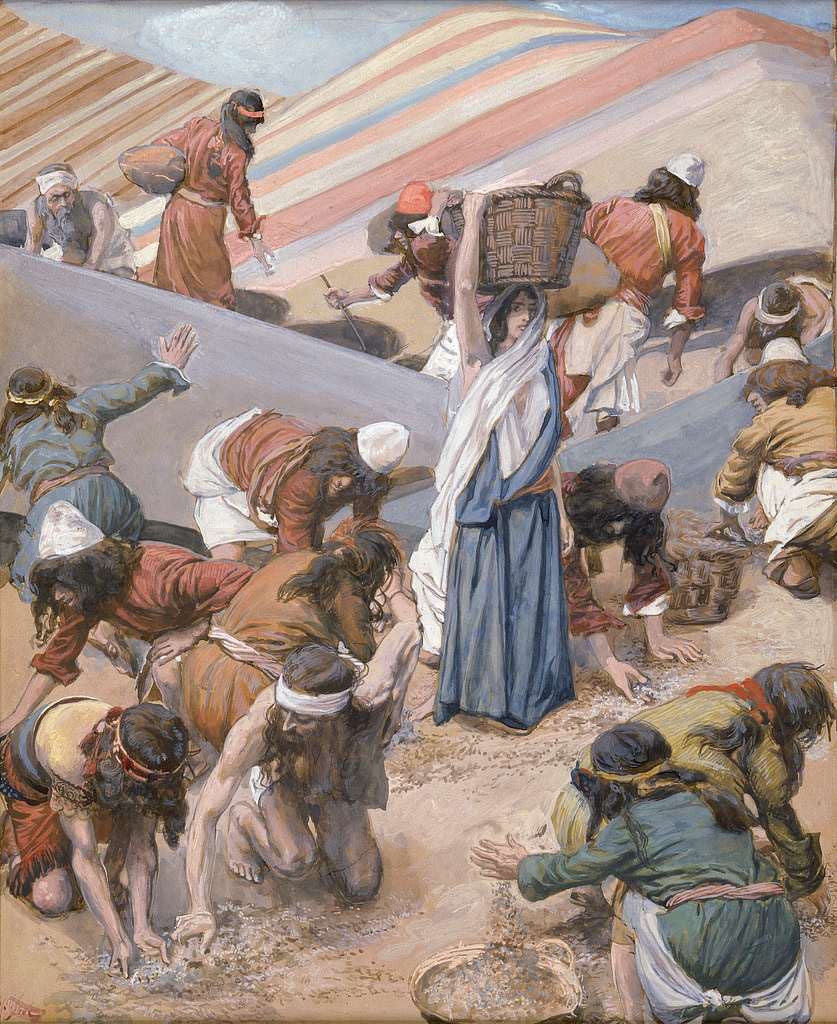
The manna in the wilderness was like a crypt-
o food, whose abundance needed  to be controlled by laws
and regulations like those of the Sabbath ,which I now decrypt
as warnings about dangers that abundance when unregulated can cause.

Attention, though, may be become distracted
by treating data the same way too many people trade
Kremlin-generated crypto-history that’s not retracted
By awareness of the need to be by disinformation’s lies dismayed.


Gershon Hepner is a poet who has written over 25,000 poems on subjects ranging from music to literature, politics to Torah. He grew up in England and moved to Los Angeles in 1976. Using his varied interests and experiences, he has authored dozens of papers in medical and academic journals, and authored “Legal Friction: Law, Narrative, and Identity Politics in Biblical Israel.” He can be reached at gershonhepner@gmail.com.

Cryptofood and Crypto-Information Read More »

A Bisl Torah~Let the Costume Linger

The Jewish calendar beckons adults and children alike to start choosing their costumes. As Purim is around the corner, Amazon carts fill with masks, capes, wands, and crowns. Purim is a holiday of surprise, a reminder that what we expect might completely be upside down by the end of the night. It’s a holiday where for a few hours, you can choose to be anyone or anything that involves a different costume or mask.

Will you be Queen Esther, embodying courage and grace? Perhaps you’ll choose Mordecai, embracing the qualities of reliability and determination. Or maybe you’ll be something entirely different like a robot, dinosaur, or referee, pining for the characteristics of creativity and curiosity. While costumes allow for escape, they also sometimes reveal which aspects we might want more of…a chance to explore being brave, fearless, funny, clever, or silly.

The name Esther is said to mean either “hidden” or “star.” Put together, the holiday of Purim teaches there is a hidden light within each of us waiting to be revealed; a quality yet to be seen but exists, nonetheless. This just might be the year where your boldness, sensitivity, humor, or (you fill in the blank!) is needed the most.

Let your costume linger and the qualities that accompany. God is constantly working to help us bring our inner light out into the world. Let your light shine.

Shabbat Shalom


Rabbi Nicole Guzik is senior rabbi at Sinai Temple. She can be reached at her Facebook page at Rabbi Nicole Guzik or on Instagram @rabbiguzik. For more writings, visit Rabbi Guzik’s blog section from Sinai Temple’s website.

A Bisl Torah~Let the Costume Linger Read More »

A Moment in Time: “The Four Most Important Questions in the Torah”

Dear all,

This past weekend, our Confirmation Class travelled to Washington DC to take part in the Religious Action Center’s L’taken Social Justice Seminar. They studied issues central to Reform Judaism and then lobbied before the offices our of elected leaders.

Over the course of the weekend, they learned to understand how their voices can and do make a difference. When I think about it, their focus boiled down to the four most important questions in the Torah:

  1. “Where are you?” This is what God asked Adam after he ate from the fruit in the Garden of Eden. God knew where Adam was physically. But the question for all of us is: “Where I am in my life/ where is our country right now?”
  2. “Where is your brother?” This is what God asks Cain after he murders his brother, Abel. Once again, God knows the answer. But we ask ourselves the extent of how we care for our family members and friends, neighbors and strangers.
  3. “Am I my brother’s keeper?” This is Cain’s response to God’s question above. Again, what is the extent to how far we can/ must go for our community?
  4. ”Who am I?” This is Moses’ reaction when God tells him to go before Pharaoh. The question for us is: “Does my voice really matter?”

Whether we are lobbying to make change in our country or trying to better understand our reason for existing on earth – these four questions are central to our finding meaning. And while the answers may be eternal, it takes just a moment in time to ask each one.

I was so proud of our teens, as they asked these questions of themselves – and then went on the change the future.

With love and shalom,

Rabbi Zach Shapiro

A Moment in Time: “The Four Most Important Questions in the Torah” Read More »

Print Issue: Removing Our Masks | March 7, 2025

CLICK HERE FOR FULLSCREEN VERSION

Print Issue: Removing Our Masks | March 7, 2025 Read More »