fbpx

October 9, 2024

Teshuva in a Time of Darkness

This is the first Rosh Hashanah since the passing of my beloved father, Dr. Benjamin Gentin. I dedicate these words in his memory.

Teshuvah – the process that is a central feature of the month of Elul and the High Holy Days – is, as we know, a radical call for personal introspection and self-examination. But if we think about what teshuvah leads to practically, in most cases, it leads to adjustments in our behavior, in how we live our lives. Few of us are going to emerge from the process of teshuvah this year – from the Yamim Noraim, the Days of Awe – as wholly transformed individuals with strikingly different approaches to life or with significant changes to our behavior. 

Instead, if we’re successful, our teshuvah will lead to us becoming somewhat more refined human beings and somewhat more committed Jews: We will be more sensitive to others, more thoughtful, kind and compassionate; we’ll be better listeners, more attentive to mitzvot, more generous. And we will move away from anger, selfishness, insensitivity and the other traits that undermine our ability to be the people that we, deep down, want to become. So realistically, the changes that we will experience will be subtle. They will be adjustments, enhancements, to who we are right now.

If we’re successful, our teshuvah will lead to us becoming somewhat more refined human beings and somewhat more committed Jews.

When we look back at the year we’ve just experienced – a year whose profound sorrows and sufferings are continuing – we can reasonably ask the question: What difference does it really make if I am a little bit or even a lot less selfish, a little or even a lot more generous, when today, eight young soldiers were killed on the Lebanese border? When yesterday, seven people were murdered in Yafo? These were beautiful young people. A newly married woman. A young mother with her baby. We cannot escape the reality that we live in a brutal, barbaric, savage world where people who hate us succeed in causing untold heartbreak and tragedy. In such a world, what possible difference can it make for me or you to work on refining our personalities and gradually adjusting our characters as we aspire to be somewhat better people in the coming year?

When I reflect on this difficult question, the person who comes to mind for me is Rabbi Kalman Kalonymus Shapira, zt’l. Rabbi Shapira was the Piaseczna Rebbe, later the Rabbi of the Warsaw Ghetto, where he delivered drashot (sermons) throughout the war every Shabbat afternoon, notwithstanding that his family was dying around him, his congregation and his Hasidim were being deported and murdered in Treblinka. Rabbi Shapira never wavered in offering his words of chizuk and nechama, words of strength, comfort, inspiration and hope. Before he himself was taken away and murdered by the Germans, Rabbi Shapira was approached by a secular historian, Dr. Emanuel Ringelblum, who asked whether he could place Rabbi Shapira’s drashot in a milk canister that would be buried under the Warsaw Ghetto and perhaps, discovered by people sometime in the future.

I’ve wondered over the years what Rabbi Shapira must have thought as he handed those drashot over to Emanuel Ringelblum, knowing that neither of them would survive the war, knowing that the entire Jewish world of Eastern European Hasidism that was Rabbi Shapira’s life mission was disappearing before his eyes. I wonder whether Rabbi Shapira thought: What is the point of me delivering these drashot at all when I see what is happening around me? And what possible point could there be in having these drashot buried in a milk canister with the virtual certainty they will never be discovered in the future?

In the 1950s, a Polish worker found that milk canister when Warsaw was being rebuilt after the war and miraculously, those drashot were published in the reborn State of Israel in 1960 under the title “Aish Kodesh,” Holy Fire. Rabbi Shapira’s drashot are viewed today as one of the most significant and inspirational works of Jewish philosophy in the 20th century.

We don’t know what the impact and the implications are, or will be, when we do teshuvah in a world drowning in evil and hatred. When we do teshuva in a time of darkness. But every step we take to adjust who we are, to do mitzvot and to refine ourselves, every positive action we take as we work to become different people — great and holy people — is another page we are handing to Emanuel Ringelblum. Another page that will lie buried in the darkness until it is destined to rise through the charred earth and emerge – white fire on black fire – pouring with light.

Chativa v’chatima tova.


Pierre Gentin lives in Westchester County, New York.

Teshuva in a Time of Darkness Read More »

When Wrong Was Silenced

Deafening. The world’s silence.

Anywhere we turned on the aftermath of Oct. 7, there was an eerie, disconcerting quiet as if a great shroud of silence had enfolded the earth.

Voices worldwide simply went mute succumbing it seemed to the newest strain of aphonia maxima or in plain English, the   sudden loss of one’s vocal chords seriously impairing one’s ability to speak. It seemed the cold blooded massacre of over 1,200 Israelis and horrific en masse rape of Jewish women and girls was not enough of a cause célèbre for leaders or human rights advocates around the world to find the courage to speak in a show of solidarity, of outrage.

On a deeper and perhaps more subconscious Freudian level, we witnessed a disturbing sort of unspoken approbation in some parts of the world toward arrogant, superior little Israel finally getting what they deserved. And on the Arab streets a sickening, outright jubilatory mood celebrating the horrors of Oct. 7. Candies and sweets were passed around … while battered and bloodied young Israeli women were dragged by the hair, thrown into terrorist vehicles and taken hostage to underground dungeons, places so dark and terrible our own imagination dreads to conjure.

Post-Oct. 7 the world suddenly adopted a warped Escher like perception of the facts where, like in his famous drawings – reality and fantasy fused and mingled in a way few if any could tell one from the other. 

Right and wrong were wilfuly reversed and completely distorted to reflect the heinous antisemitic agenda of the morally unencumbered. The vociferous and ignorance challenged thousands of Jew hating activists occupied entire streets and erected ” solidarity encampments ” on College campuses here in the U.S. and across Europe. In gestures of utter scorn and disregard photos displaying faces of the hostages were ripped and thrown away by passers by — their very humanity disposed of, discarded on the pavements on our lives.

In this grotesque new theater of the absurd, victim and executioners roles were blurred and then methodically, unscrupulously reversed — one becoming the other overnight. Hamas executioners were praised and glorified while Israel and the IDF were vilified for having the audacity yet again to fight back and wage an existential war against a ruthless, Godless enemy.

Jews had now entered an altered reality where nothing that was would ever be again. Devastated and dumbfounded we found ourselves moving in a strange new realm unknown to us, engulfed in a maelstrom of emotions rushing through us raw, unchecked. Disbelief, incomprehension, pain, anger, sadness, grief — washing over us again and again. And above all that ever present gnawing feeling in our gut, that primal and righteous rage at God for allowing yet again such pure evil to happen to Jews, this time in their very own land of Israel.

The world soon learned these crimes were videotaped “ live” as they happened by the rapists themselves so as to later gloat about their maniacal deeds, the sickening video reels — unbearable as they are to view — speak for themselves. And so the tragic fact remains, it’s memory now carved with tears in our hearts and souls – there WAS an Oct. 7. A day when light gave in to darkness, when horrors could no longer be named, when words pathetic and small seemed void of meaning. Everything after that a blur, emotional, psychological, visceral.

In the face of the most sadistic acts perpetrated on Israelis at the hands of Hamas terrorists, human rights organizations  and women rights movements around the world fell silent. Instead of shock, empathy and blistering outrage we witnessed a sickening display of indifference which in the face of such evil, was quite sobering. A painful new reality was dawning on our collective Jewish psyche which echoed and reverberated for Jews around the world. This was the burning salt rub on a freshly gaping wound, translating into a cynical somewhat complicit global shrug as if to say: This is what Wars are, and sometimes they involve rape, and then again these were just Jews …

Instead of shock, empathy and blistering outrage we witnessed a sickening display of indifference which in the face of such evil, was quite sobering.

This was not just a war. Not in any sense of the word literal or otherwise. This was a long time planned, well thought out, premeditated SLAUGHTER. A gleeful, demented, frenzied orgy of violence and death unleashed on unsuspecting, defenseless, unarmed men, women, elderly, children and babies.

This was not just rape. What took place at the rave party and in the kibbutzim was not “just” rape but something far more depraved, sadistic. Unimaginable suffering and pain perpetrated on defenseless women of all ages, beloved daughters, mothers, grandmothers whose bodies were violated, mutilated and even desecrated after being used for the most vile of acts.

These were not just Jews. They were human beings each with their own dreams, their own vision of a better world.  Peace loving families who wanted nothing more than to live in peace with their Palestinian neighbors just a few miles away, making the conscious choice to live in these border Kibbutzim to fulfill that very purpose. And yet, they were slaughtered, sacrificed on the bloody altar of hatred. In their homes, in their beds, at the kitchen table, in their cars, while dancing at dawn on golden desert sands …

To have remained silent in the face of such monstrous horrors was an abdication of one’s moral duty as human beings. A defamation of the memory of those whose lives were savagely snuffed out and are no longer able to scream an earth shattering ” J’accuse ! ” at their executioners.

A few European leaders eventually voiced solidarity with Israel, traveling to Israel to visit the Kibbutzim, witness for themselves what happened on a bright, beautiful Shabbat morning when death, sudden and violent came calling. For Jews around the world and those like myself with an emotional umbilical cord to Israel having lived there my teen age years, it seemed too little, too late.

A mere pittance in the giant, unforgiving and lasting shadow of such nameless horror. 

Such immeasurable wrong


Annette H. Sabbah is a Los-Angeles based multi-media artist, designer and writer.

When Wrong Was Silenced Read More »

Why So Long?

As the first anniversary came and went, it was no longer possible to deny the extended duration of the conflict. Israel has seen long wars before – the 1948 War of Independence and the 1967 War of Attrition are examples — but typically, Israeli conflicts have been shorter. 

As the current struggle unfolds, few in Israel anticipate a swift conclusion. The prevailing expectation is for the conflict to extend several more months, if not years. Thus, at the next Oct. 7, in 2025, we might still be questioning the war’s endpoint.

Wars drag on for multiple reasons, but often because no decisive victory has been achieved, and because the parties involved believe continued fighting might yield a more favorable outcome. They also drag on when leaders do not have the courage to say enough. And they drag on under the influence of “loss aversion.” That’s the reluctance to accept the idea that past sacrifices may be in vain and the war is lost.

Prof. Gadi Heimann of Hebrew University illustrated this nicely in his book “Fear, Regret, and Wishful Thinking: Why Leaders and Nations Choose War.” He recounts how during World War I, the severe toll of the British blockade pushed Germany into naval engagements. “Initially reluctant to risk their navy, the Germans shifted from risk aversion to loss aversion, deciding to confront the British at sea.” The resulting Battle of Jutland was a tactical victory for Germany. However, this was a pyrrhic victory as the German navy ultimately failed to break the British blockade.

Who, then, declares a war lost? Who tells the Germans that they lost World War I, or the Japanese that they lost World War II? Who pulls the IDF out of Lebanon after two decades of guarding a security perimeter? Who informs the Ukrainians — or the Russians — that a protracted war ends without victory? These are questions that confront not only nations but also groups like Hezbollah and Hamas, challenging them to consider the option of reaching a settlement and move to a period of recovery, as they prepare for the next round of conflict.

For them, reaching such conclusions is not straightforward, because of loss aversion but also due to other factors. From the perspectives of players such as Iran, Hezbollah, or Hamas, Israel might not seem a prospective victor but rather a country mired in a never-ending conflict. Such interpretation demands careful consideration by Israeli decision-makers. They must consider the possibility that Israeli strikes, however forceful, might not lead to concession or ceasefire. An adversary unafraid to lose territory or account for casualties is a formidable one. An adversary that has no public opinion to worry about in the way democracies do can prolong the fight even when there’s nothing for him to gain. 

Why does the war persist? Primarily because the enemy remains undefeated and unyielding. Yet, when we ask the Israeli public about such a thing, it’s more interesting to question our own side: Could Israel have acted differently to shorten the war (not just to end it prematurely by surrender, which is certainly possible but not the intended strategy)? In a survey conducted by JPPI various reasons for the conflict’s extension were presented to Israelis, Jews and Arabs alike, with many foreseeing a lengthy continuation — months or even years.

So, what do they think is a reason for the long war? A consensus among many is that the government has been too slow in decision-making, implicating it in the protraction of the war. This sentiment is not unique to critics of the government. It is shared by many coalition supporters, some of whom believe that an earlier offensive in Lebanon could have been beneficial. Ironically, Israelis also believe that international pressure, intended to hasten the end of the conflict, may have contributed to its prolongation through delays and ineffectual diplomacy. The operation in Rafah is a clear example of such delay. The U.S. pressured Israel to reconsider its intention to enter the refugee camp, delaying the action, but did not preventing it. The attacks in Lebanon are another example. Almost a year was wasted on futile American diplomacy. During that year, Israel acted with its hands tied. The Americans succeeded in delaying the action, but the benefit of this success is questionable.

The most troubling finding in the JPPI survey relates to the possibility that “the war has been prolonged because the coalition has a political interest in prolonging it.” A majority of the public agrees or somewhat agrees with this claim. This implies that most Israelis assume that decision-makers mix political, partisan interests when they deal with the most sacred decisions concerning life and death. Naturally, this finding is inherently tainted with political bias, and this is both saddening and disturbing.

The most troubling finding in the JPPI survey relates to the possibility that “the war has been prolonged because the coalition has a political interest in prolonging it.” A majority of the public agrees or somewhat agrees with this claim. 

Pause for a moment and consider the chilling implication of that statement: More than half of Israelis think the war is being prolonged because the coalition has a “political interest” in prolonging it. One hopes they responded to the question without much reflection on its meaning. One hopes that if they thought about the question for another moment, they would come to the conclusion that they are mistaken. Of course, assuming that they are mistaken.

Something I wrote in Hebrew

There are troubling signs that more Israelis wonder about the future of Israel. Here’s something I presented this week:

We asked: “When you think about your child’s future in 10 to 20 years, how do you think Israel will be? Will it be ‘better than it was in the past,’ ‘as good as it was in the past,’ or ‘worse than it was in the past.'” About half said it would be as good as in the past or better. The majority of those who are not sure if it’s good for their children to stay in Israel, come from the other half. So, as you’d expect, there is a direct link between what Israelis think about the future of the country they live in and their desire to stay, or to see their children stay. This connection has various branches and characteristics, which you can probably guess. There are gaps between supporters of the coalition and supporters of the opposition, gaps between secular and religious Israelis, gaps between the more and the less educated. Furthermore, a relatively high percentage of Israelis who have “recently” started a process of obtaining a foreign passport say that perhaps it would be better for their children to live elsewhere. These are Israelis who have already taken a first practical step.

A week’s numbers

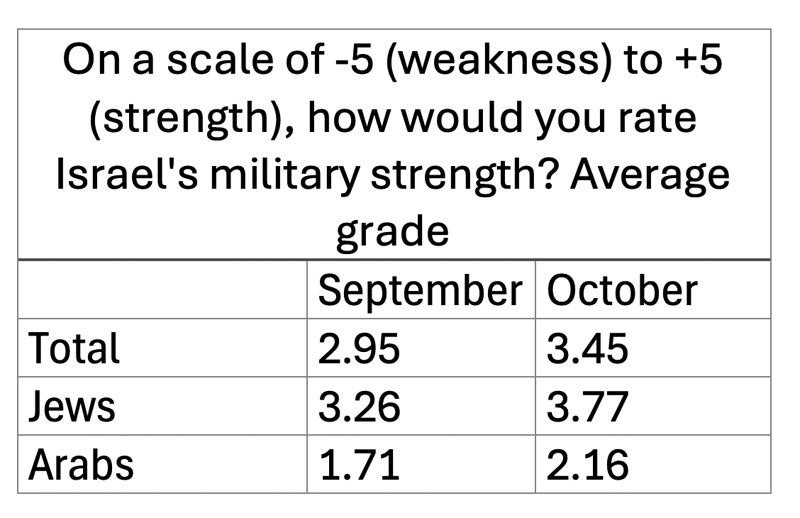
The operational successes in the campaign in Lebanon are reflected in a rapid change and sharp rise in the public’s assessment of Israel’s military might.

A reader’s response

David Rosen writes: “You should be worried about Kamala winning in November. She’s not a friend.” My response: 1. Worrying is our second nature. 2. A “friend” is difficult to define. 3. Israel is going to have to adjust to a Harris administration. It might prove to be a challenge, but it’d still be the new reality in which we all operate.


Shmuel Rosner is senior political editor. For more analysis of Israeli and international politics, visit Rosner’s Domain at jewishjournal.com/rosnersdomain.

Why So Long? Read More »

Grief Kidnapped: How Anti-Israel Hate Groups Stole Oct. 7th from Jews to Press Their Disinformation Against Israel

To view previous dispatches, click here.

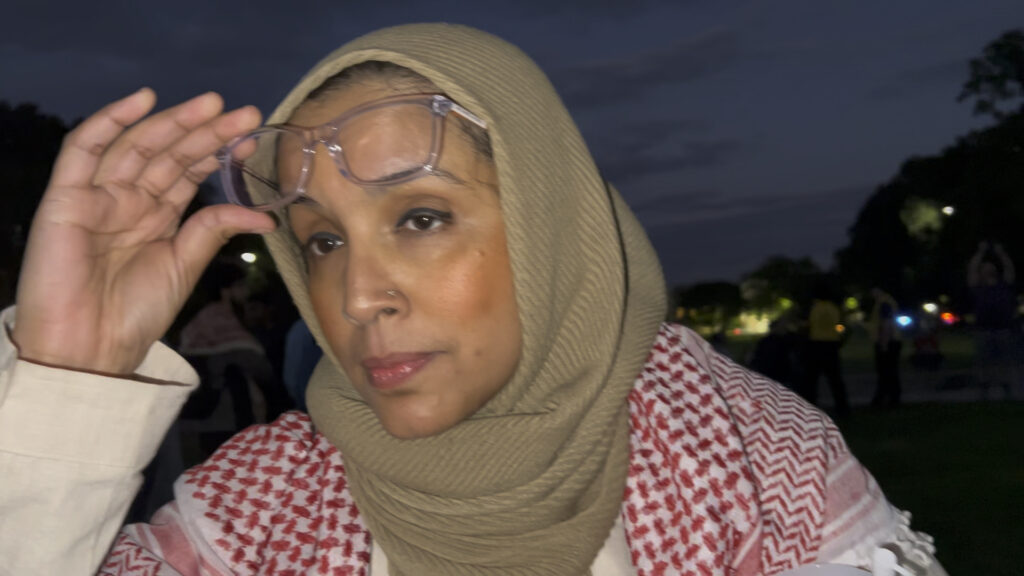
COLLEGE PARK, Md. – Here, on a grassy knoll called McKeldin Mall, at the University of Maryland, a lone figure with a red-and-white checkered keffiyeh over her shoulders slipped quietly through a crowd of about 200 students gathered for an “interfaith vigil” on the anniversary of the brutal October 7th massacre of Israeli Jews and others by Hamas militants.

“Zainab?” I asked, recognizing her immediately.

She turned around, lifted her eyeglasses from the bridge of her nose, and inspected me with a slow, deliberate once-over, there, near the intersection of Regents Drive and Chapel Lane.

As I identified myself to her, she responded with a curt, “I have no comment,” snapping her glasses back into place and gliding away like a  ringmaster commanding this stage of protest theater—unbothered.

Of course, the bespectacled woman and the organization she represents—the Council on American-Islamic Relations, or CAIR—have had a lot to say since the massacre of Jews on October 7. 

She was Zainab Chaudry, the director for the Maryland chapter of the Council on American-Islamic Relations, and it was her organization that won a federal court ruling in U.S. District Court for the District of Maryland, granting the local chapter of Students for Justice in Palestine the right to host its “interfaith vigil” at the University of Maryland on October 7, despite protests from Jewish students and groups who felt it was insensitive to choose that specific day. 

Last December, her boss, Nihad Awad, the organization’s Palestinian American cofounder, even proudly stated that he was elated about the Oct. 7th attacks, telling a meeting of American Muslims for Palestine, “I was happy to see people breaking the siege and throwing down the shackles of their own land and walk free into their land, which they were not allowed to walk in.” Even the New York Times published a headline that the “White House disavows” the remarks by the CAIR leader.

In town from Los Angeles, where she has been a clinical psychologist for 30 years specializing in the treatment of trauma, Orli Peter, a friend, absorbed the scene and was appalled. 

“The fact that this demonstration was held on October 7th, the day of the largest massacre of Jews since the Holocaust, is purposeful,” said Orli, who started a nonprofit, Israel Healing Initiative, after the attacks last year to bring trauma treatments to Israeli and Arab survivors of the attacks. “And what it does is interrupt the grief of Jews around the world. It tries to steal attention from what was done,” she explained, referring to the massacre by Hamas terrorists.
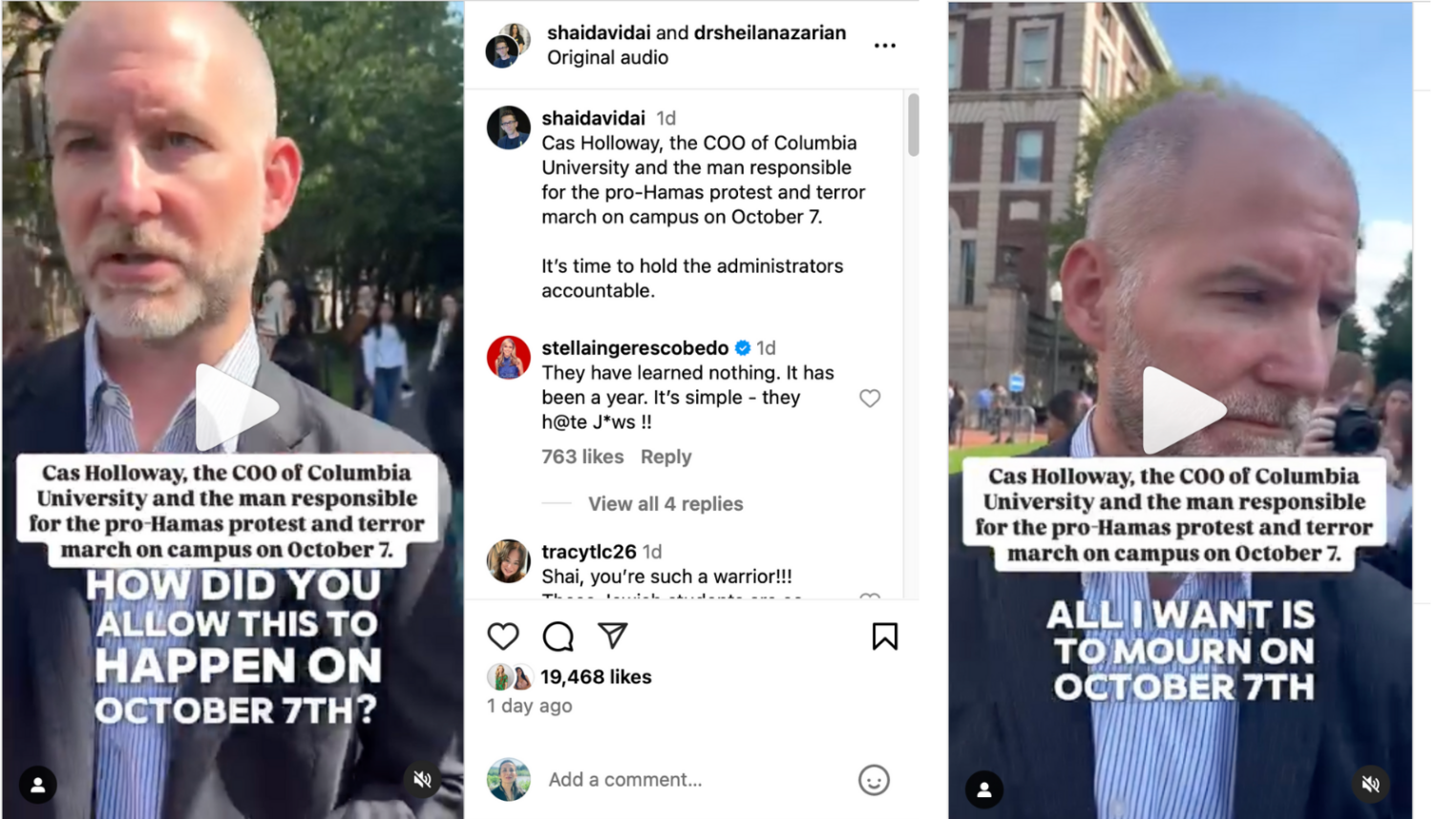
Indeed, at Columbia University, Shai Davidai, an assistant professor and Israeli, introduced Cas Holloway, the chief operating officer at Columbia, to a new international student of neuroscience from Israel, Moriah, who asked Holloway questions over the din of anti-Israel activists assembled on campus, like at the University of Maryland. 

“What do you expect me to do?” she asked, in a video Shai posted to Instagram. “We came here to mourn today…All I want to do is mourn on October 7th…It’s like the Holocaust.”

Holloway responded flatly: “I’m very, very sorry.”

Pressed, Holloway said: “I heard you, and I have to go.”

Back at the University of Maryland, Orli looked around at the anti-Israel protest and said: “It doesn’t just erase what happened on October 7th. They’re doing an extra step by trying to not allow the grief to happen, to not allow humanity to connect with the tragedy of what happened there.”

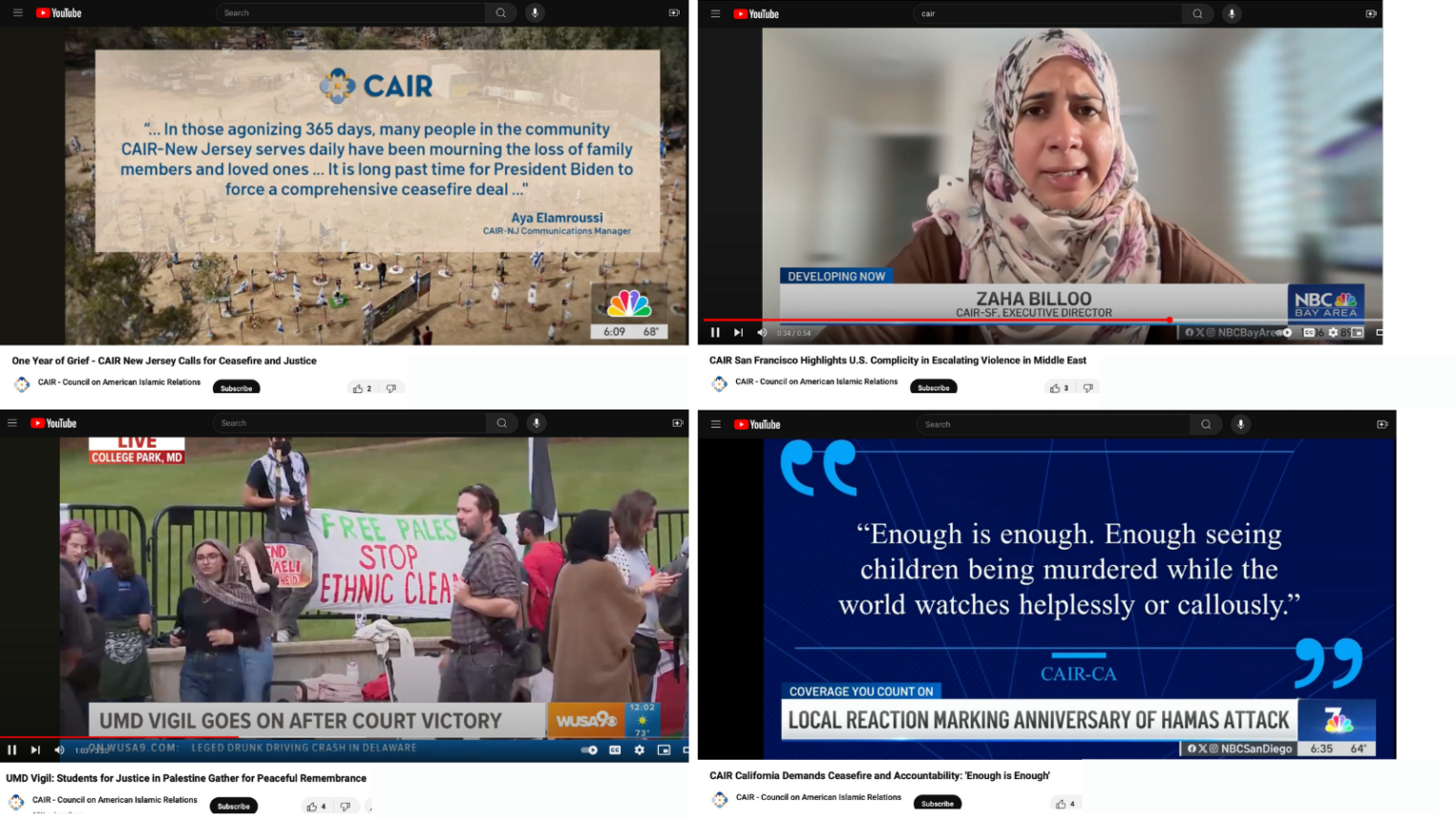
Sure enough, in the days since the anti-Israel protests on Oct. 7, the Council on American-Islamic Relations has posted the media hits it received nationally – from a local D.C. channel on the University of Maryland “interfaith vigil” to New York’s Channel 4 news and San Diego’s local NBC affiliate –  for its “one year of grief.” From CAIR’s San Francisco area chapter, executive director Zahra Billoo lamented a year of “genocide” by Israel on her local news hit. This past year, Zahra mourned Israel’s killing of Hamas leader Ismail Haniyeh, an architect of the October 7th attacks, memorializing his “martyrdom” in a social media post.
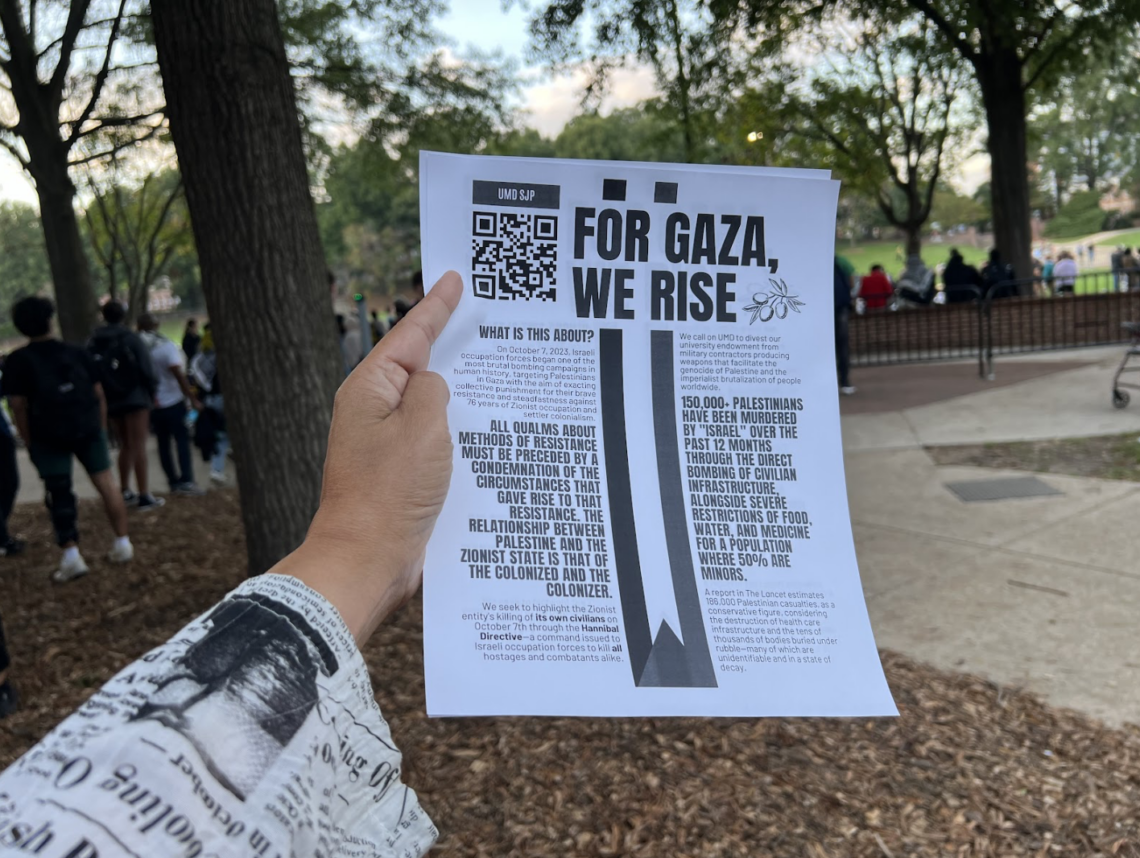
‘FOR GAZA WE RISE’ 

In position on the ground on the University of Maryland campus, CAIR’s Maryland chapter leader, Zainab, walked by a table with a pile of fliers that made it clear what the “interfaith vigil” was about. 

The flier read: “FOR GAZA WE RISE.”

It continued: “WHAT IS THIS ABOUT? On October 7, 2023, Israel occupation forces began one of the most brutal bombing campaigns in human history, targeting Palestinians in Gaza with the aim of exacting collective punishment for their brave resistance and steadfastness against 76 years of Zionist occupation and settler colonialism.”

The leaders of Students for Justice in Palestine opened the “interfaith vigil” with a familiar chant: “Free free Palestine!” 

The crowd echoed the chant that has reverberated across the world since the Oct. 7th attacks: “From the river to the sea, Palestine will be free.”

There was no doubt in this crowd where “Palestine” would be located: modern-day Israel. 

And there was no confusion what it would be “free” of: Jews.

Holding the flier, Orli, the trauma psychologist, said:  “And they actually lie here on this pamphlet…They actually say that on October 7th, Israeli occupation forces began one of the most brutal bombing campaigns in human history. There are so many lies just in that half-sentence right there.” 

She went on: “Israeli forces did not start bombing on October 7th. That happened afterward, as retaliation. So that’s why they’re having to lie in order to validate that they’re doing this on October 7th.”
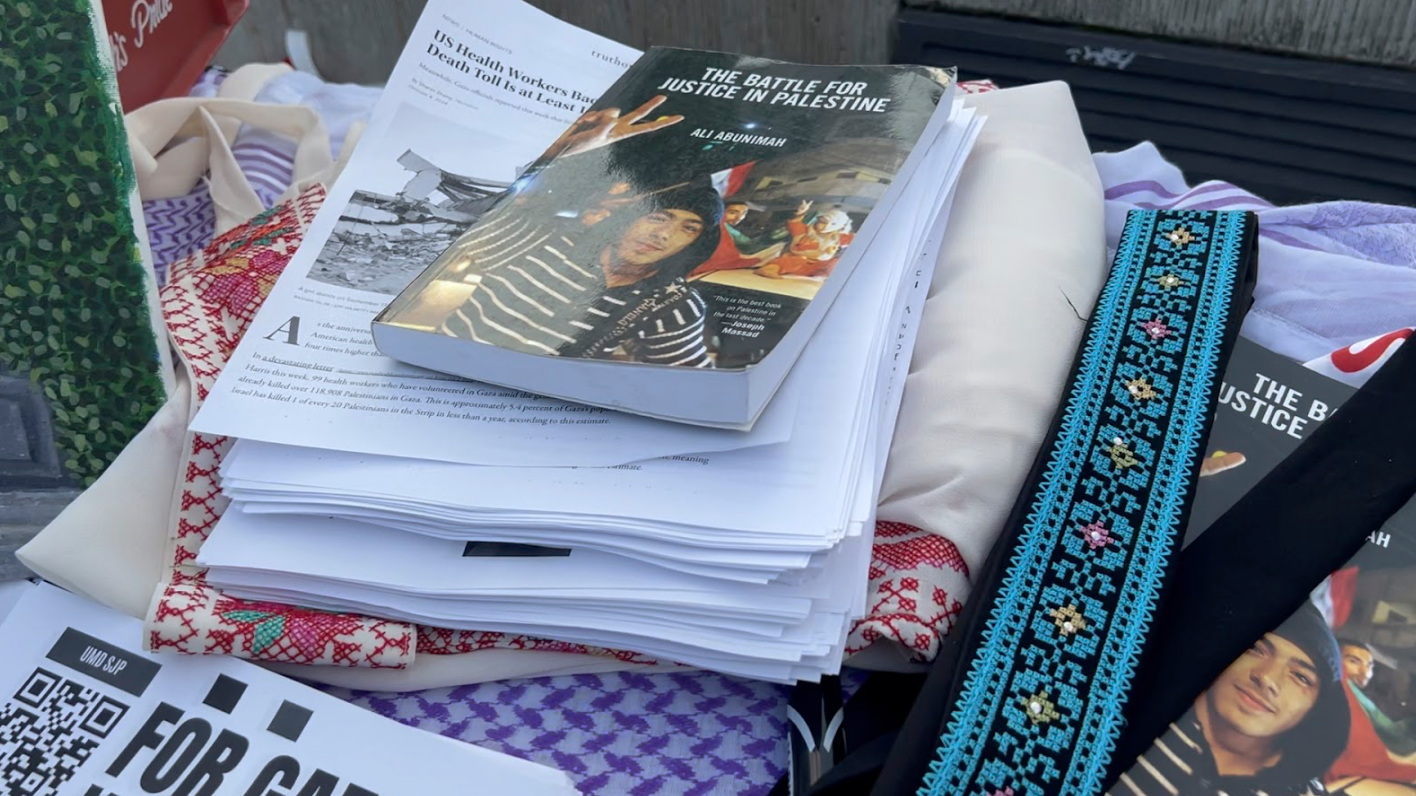
‘One State’ Called Palestine That Is ‘Shared’ with Jews

On a table nearby were two anti-Israel books by Ali Abunimah, editor of Electronic Intifada, which has spewed hate against Israelis and Jews for decades. One of the books, One Country, published as far back as 2007, argues for “one state” that is “shared” by “two peoples,” Palestinians and Jews, with, of course, a “right of return” of Palestinians to modern-day Israel, leading to the demographic outnumbering of Jews and erasure of the only Jewish country in the world, while 57 Muslim-majority nations sit as members of the Organization of Islamic Cooperation.

Abunimah is a friend of Hatem Bazian, the Palestinian American from Nablus in the West Bank and cofounder of Students for Justice in Palestine and American Muslims for Palestine, two of the leading organizations in anti-Semitic, anti-Israel hate. 

These friendships over several decades are not coincidental; they are part of a coordinated and strategic campaign to sway public opinion against Israel and destroy the state of Israel.
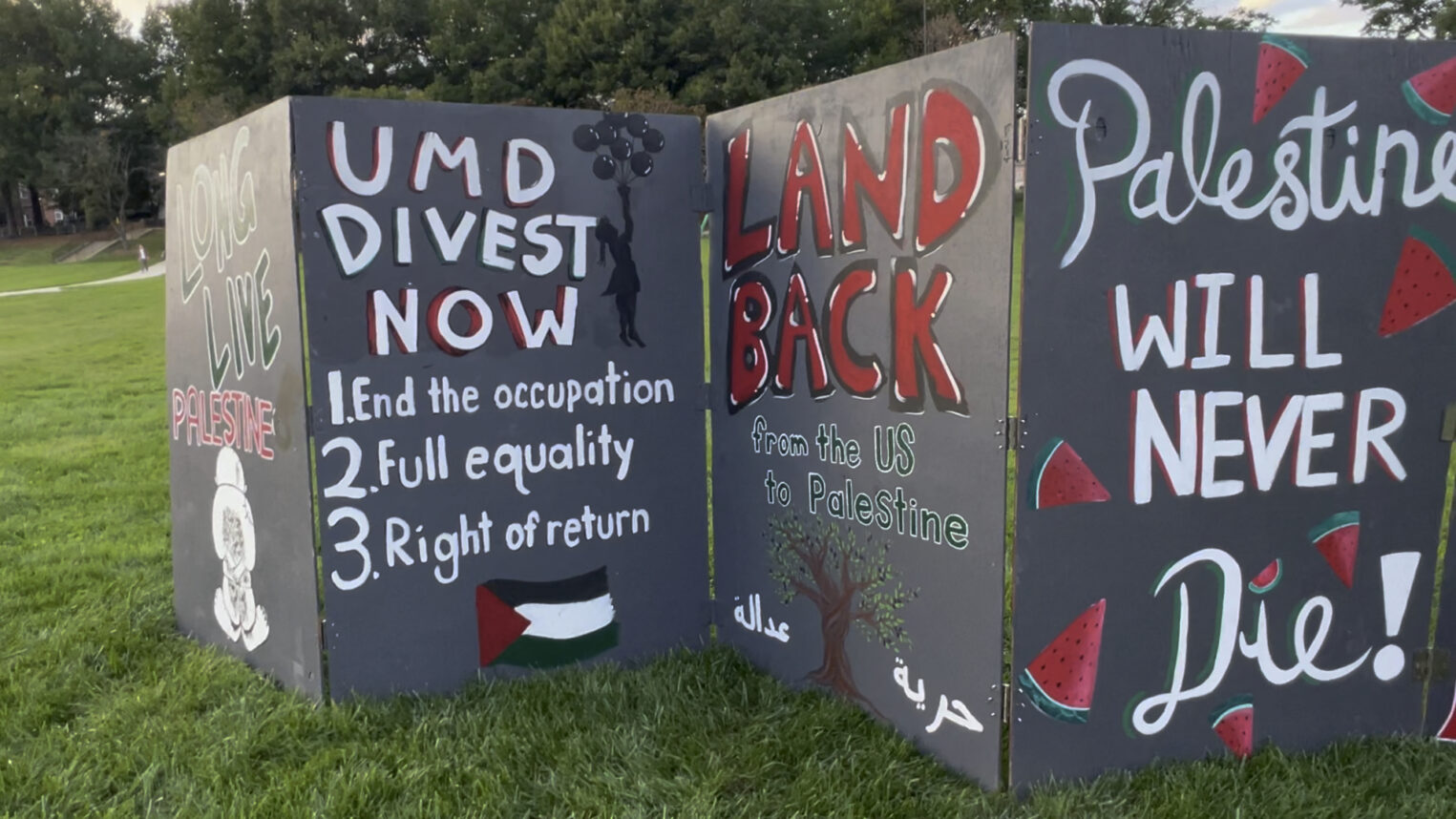
‘Right of Return’ with ‘Equality’

In accordion-style signs behind the small platform of a few inches that speakers stood on, the “one-state” message was clear. 

The No. 1 demand: “End the occupation,” which one of the “interfaith vigil” cosponsors, Jewish Voice for Peace, has said means ending the state of Israel. 

The No. 2 demand: “Full equality,” with the No. 3 demand of “Right of return” of Palestinians to the area on the map that is now modern-day Israel and the “equality” in votes and citizenship in a one-state “solution” that will be called “Palestine.” 

One of the student leaders stepped forward to set the stage for this political theater. 

“We are gathered here today for one reason and one reason only, to honor our martyrs and rise in solidarity with Gaza, Lebanon, Syria, Yemen, and all people currently oppressed by the Zionist entity,” she said.

A young man stood and read the names of those who died after Oct. 7. None of them were the Jews murdered by Hamas.
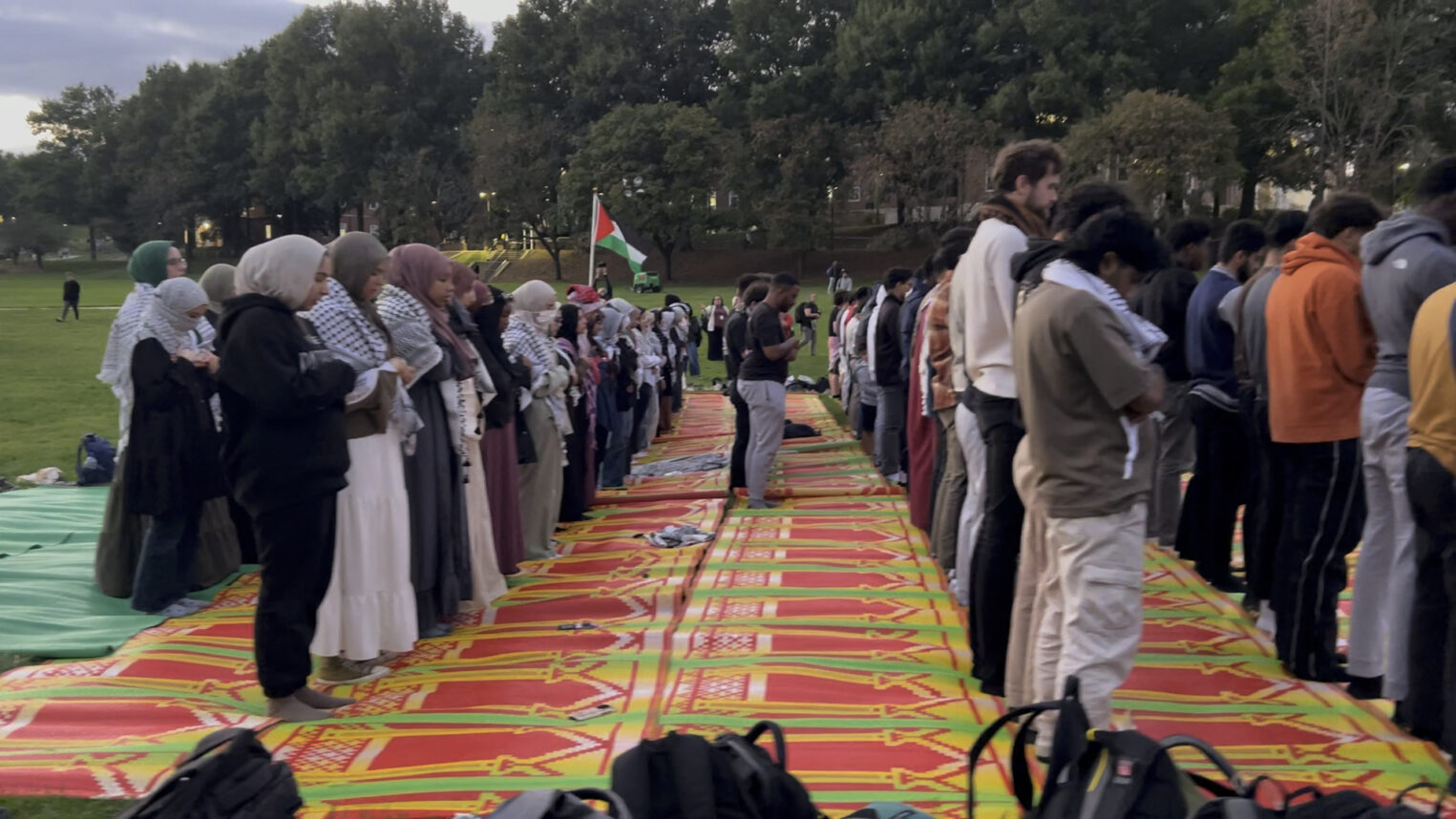
Unholy Alliance of the Islamists with ‘Liberals’

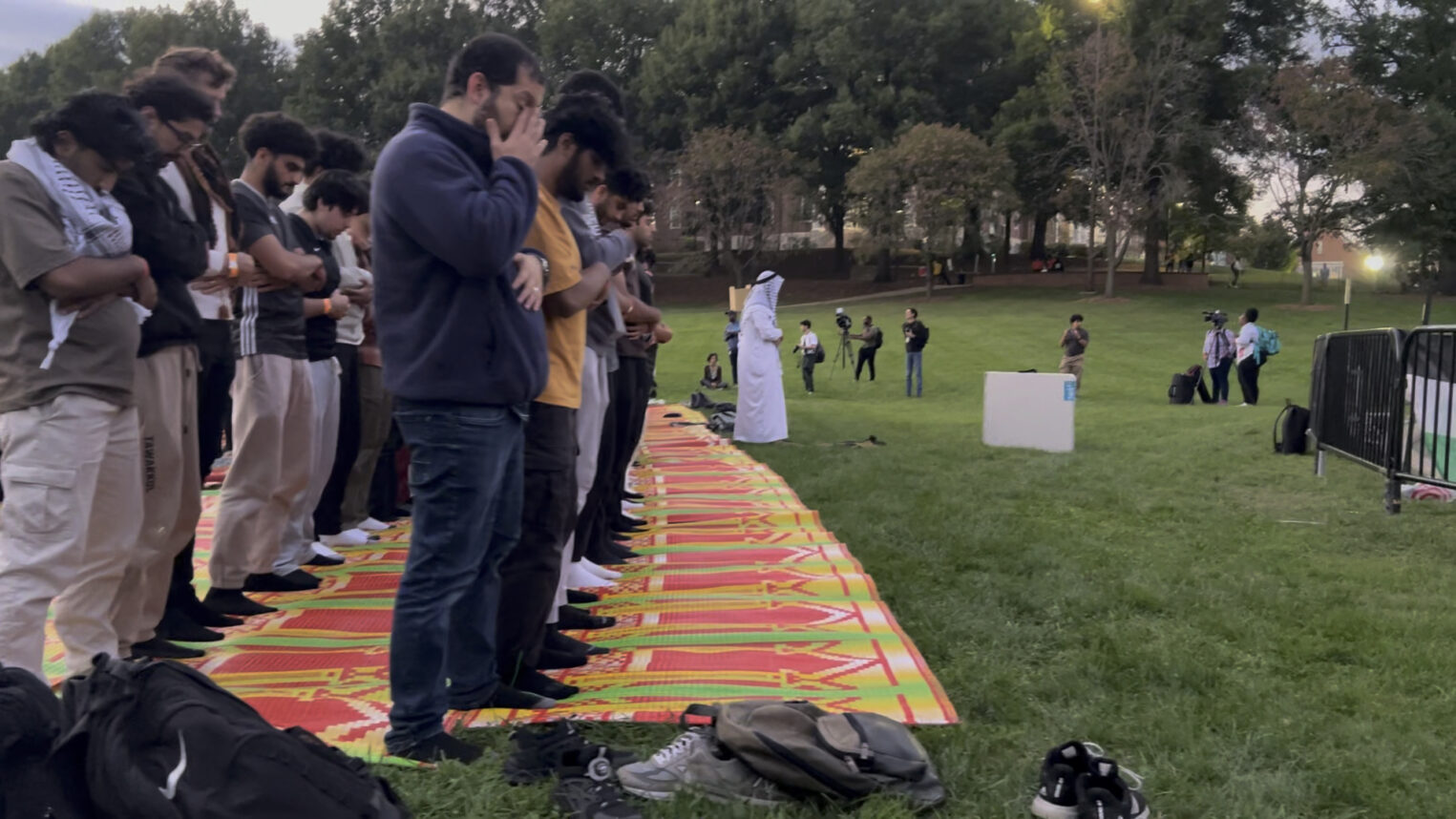
The activists broke for the sunset maghrib prayer, led by a man clad in a white thawb, or gown, popular in countries like Saudi Arabia, and black-and-white keffiyeh with black cord, or agal, holding the headscarf in place. Here the illiberal interpretation of Islam that many of them practice played out, showing the contradictions of their unholy alliance with far-leftists, feminists and LGBTQ activists. 

While the anti-Israel network deploys young women as the frontline face of protests, from Chicago to College Park, none of the women asserted their right to pray in parallel sections to men or even in the front rows of congregations, the women practicing the religiously conservative interpretation of Islam, lining up dutifully behind the men for the prayer. 

As a Muslim feminist, I advocated for the right of women to pray in parallel sections and even the front rows of mosques, helping organize a prayer in 2005 where a woman, Amina Wadud, led men and women in a prayer. Even Qatar’s religiously orthodox Al Jazeera media channel wrote about the prayer, leading to fatwas condemning us from the far corners of the Muslim world, including former Libyan dictator Muammar Qhadafi.

When I went to the Council for American-Islamic Relations for support, trying to win the right to just walk through the front door of my hometown mosque in Morgantown, W.V., its spokesman and cofounder, Ibrahim Hooper admonished me: “We’re the Council for American-Islamic Relations, not Islamic-Islamic relations.”

Now, in the 21st century, these young women activists dutifully took their space behind the men.
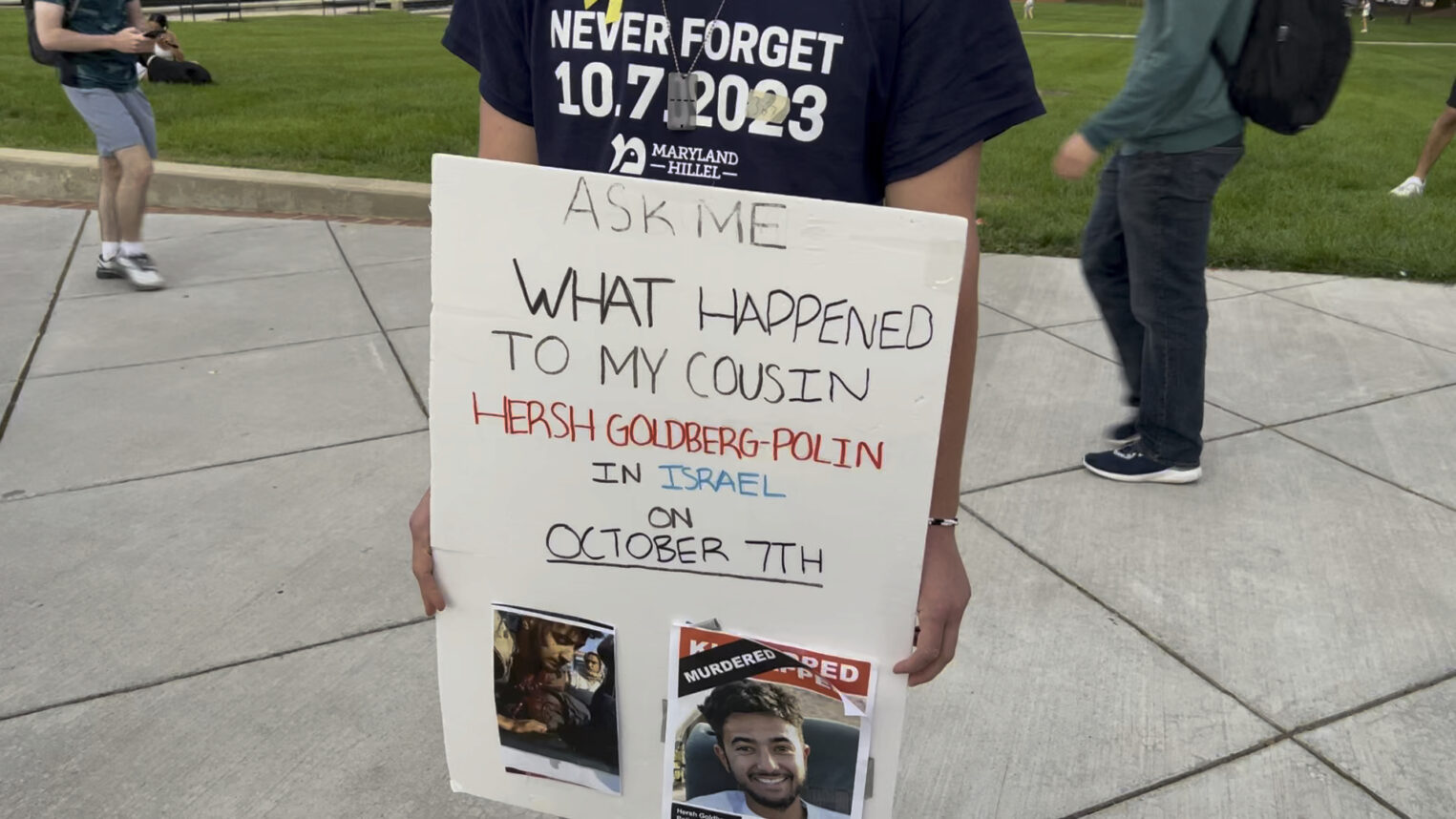
‘Ask me what happened to my cousin Hersh…’

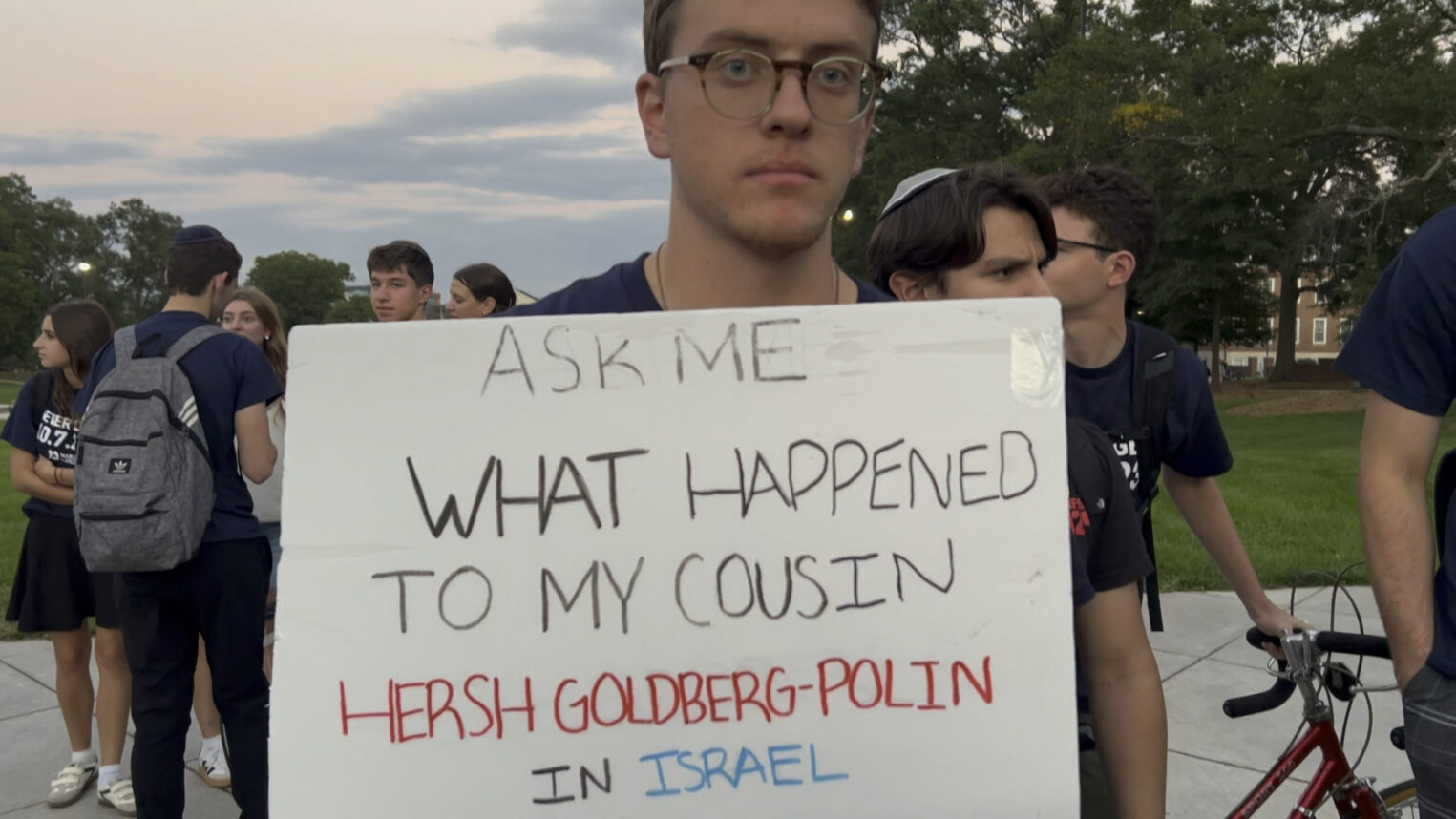
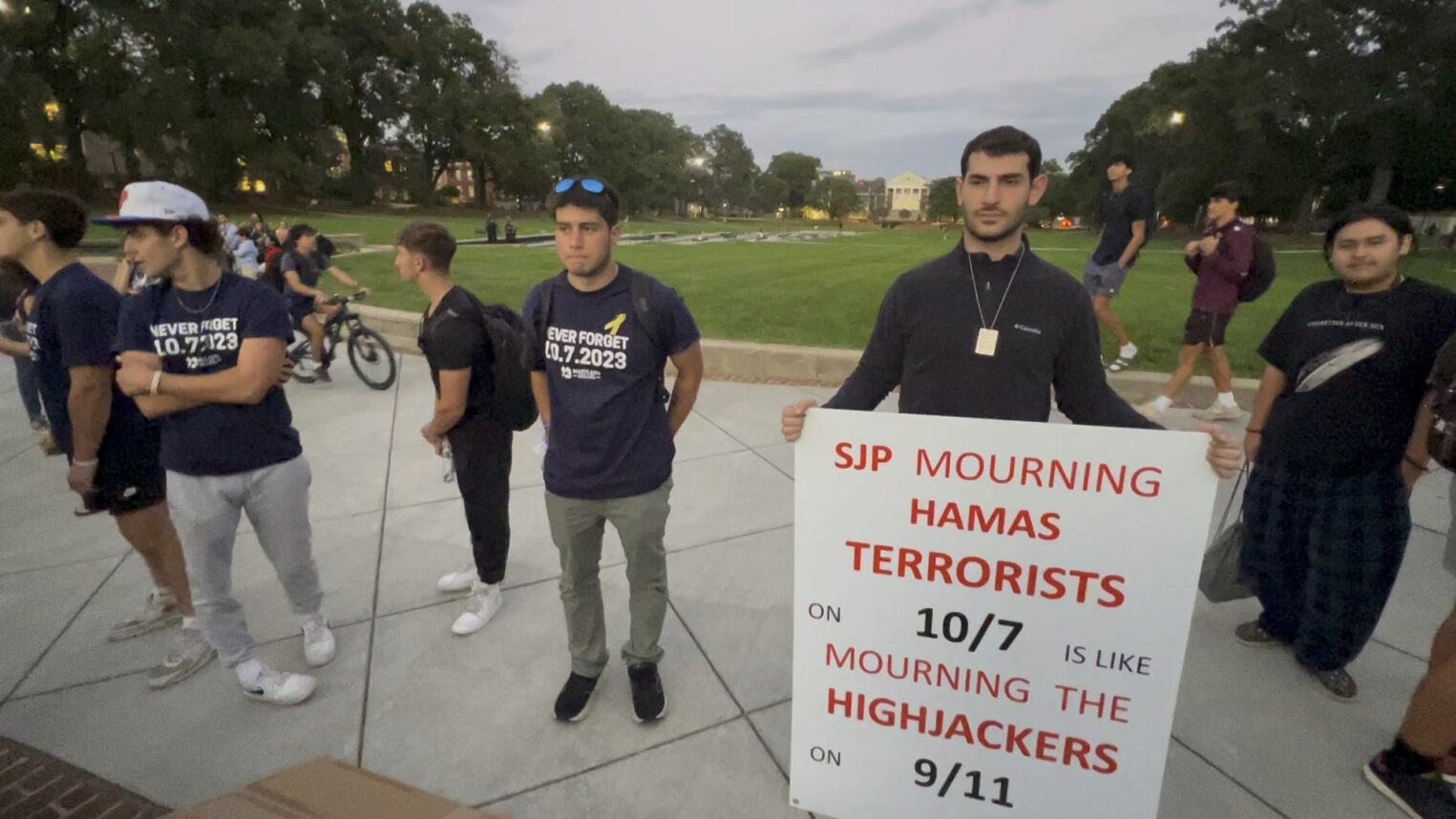
On a sidewalk outside the lawn cordoned off for the “vigil,” a small group of about 10 Jewish students arrived in a quiet counterprotest. They wore blue t-shirts that read, “Never forget 10.7.2024.”

Among them was Eytan Pomper, 22, a bespectacled senior at the University of Maryland studying kinesiology. He carried a simple handmade sign: “Ask me what happened to my cousin Hersh Goldberg-Polin in Israel on October 7th.” His posters had two photos of his maternal first cousin—the son of his mother’s brother—who was kidnapped on October 7 and murdered.

Soft-spoken, Eytan said he didn’t begrudge the anti-Israel protesters if they wanted to protest on any other day, but this day, marking the anniversary of a massacre by Hamas, “was insensitive.”

Nearby, a Jewish American friend and University of Maryland junior, Uriel Appel, wore a replica of a dog tag to represent the hostages still in Hamas custody and carried another sign directed at the callous strategy of Students for Justice in Palestine, noting: “SJP mourning Hamas terrorists on 10/7 is like mourning the hijackers on 9/11.”
Field Guide for ‘Anarchists and Insurgents’

These events are not just about hijacking grief, but they are also intentionally designed to hijack any sense of safety or security that Jews and others may feel in the world. 

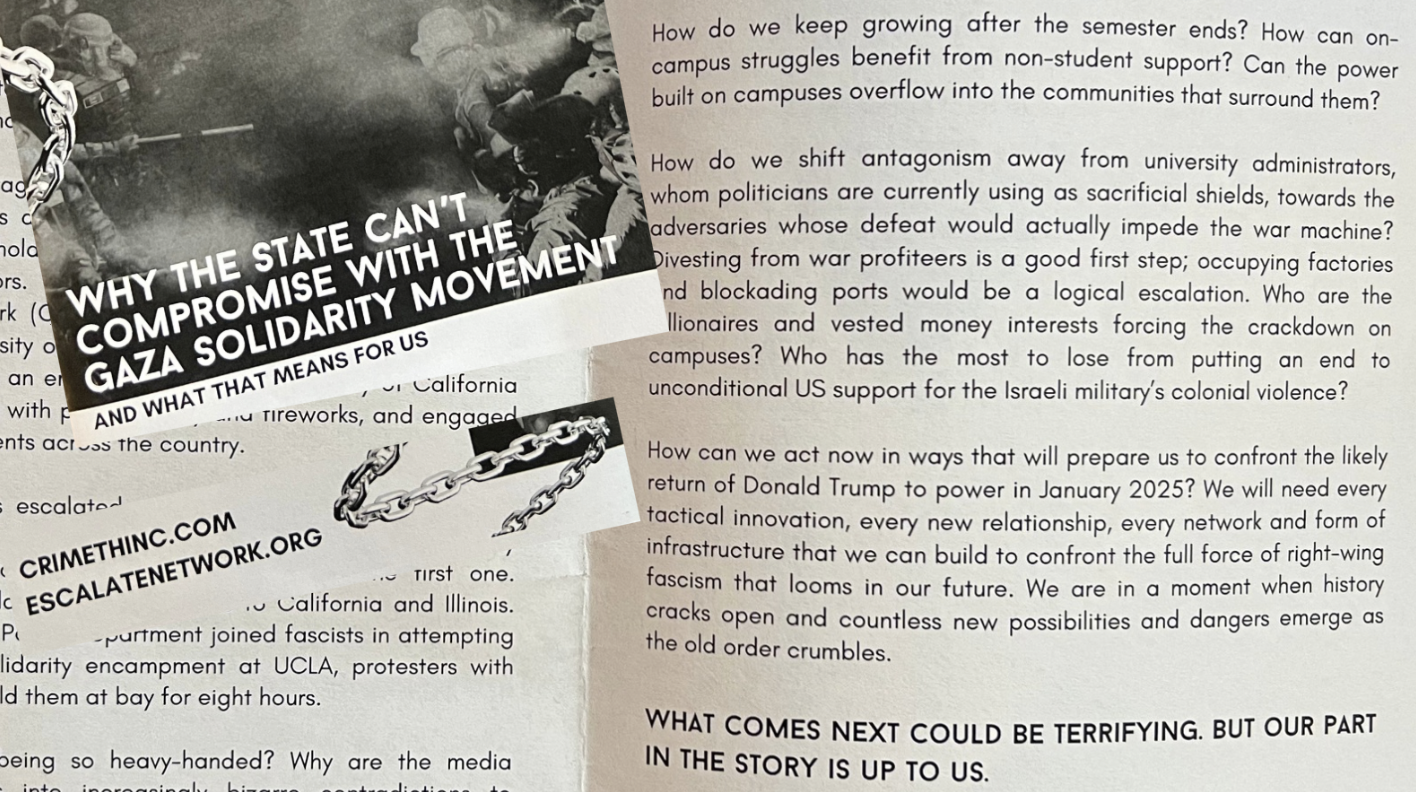
At one table at the University of Maryland, students left a 14-page pamphlet titled, “Why the State Can’t Compromise with the Gaza Solidarity Movement and what that Means for Us.” One of the coauthors of this document is CrimeThinc.com, a “rebel alliance” of “anarchists and insurgents,” with an “Anarchist FAQ,” “Anarchist Library” and list of “Anarchist bookfairs.” The other coauthor is EscalateNetwork.org, formed after the riots at Columbia University, with an online guide to “Occupations and Tactics” and a “Do-It-Yourself Occupation Guide. 

In reporting for the Pearl Project, a nonprofit investigative reporting project dedicated to the memory of my friend and Wall Street Journal colleague, Danny Pearl, kidnapped and murdered in Karachi, Pakistan, 2002, I have investigated the 1,000-plus organizations that are waging a “global intifada,” or resistance on campuses, and discovered that at least one-fourth of them are self-described communists, socialists, Marxist or Leninist organizations. I launched this work with a study of the 200-plus groups that marched against Vice President Kamala Harris at the Democratic National Committee in Chicago, mocking her as “Killer Kamala” for not forcing a ceasefire on the war by Israel against Hamas.

Their ideological agenda raises the specter of nefarious objectives by foreign governments, including Russia, Iran and China, and I am creating a Malign Foreign Influence Index, so the public, parents, policy makers, students and others can understand their goals, funding and malign agendas.

The pamphlet carried dire warnings: “…either the US empire must be dismantled or the conscience of a whole generation must be destroyed.” It ominously cautioned, “What comes next could be terrifying. But our part in the story is up to us.”
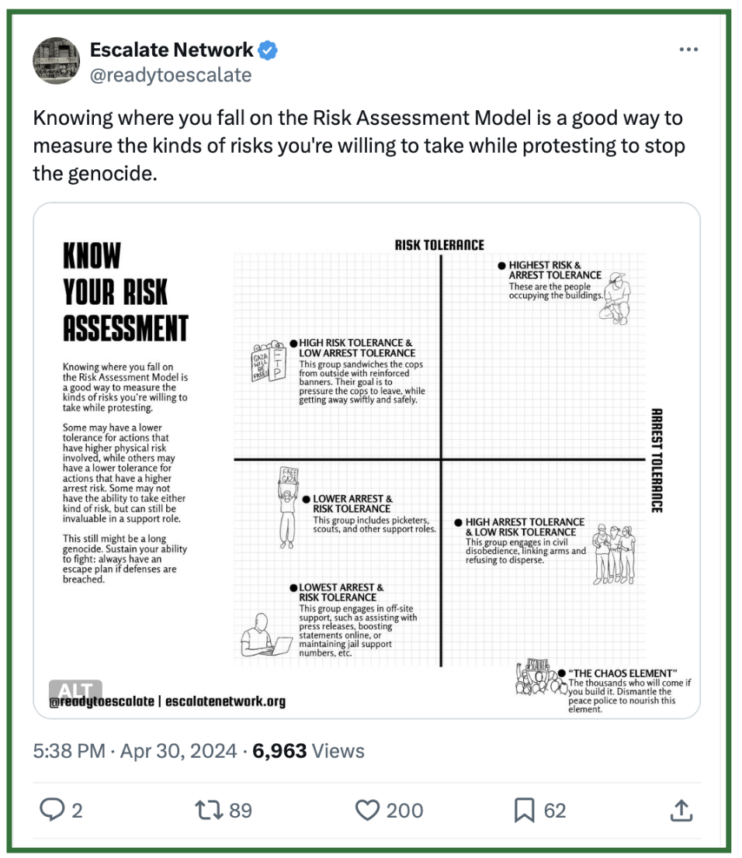
‘Know Your Risk Assessment’ Matrix

The pamphlet also included a “risk assessment” matrix for students to gauge the level of personal safety they were willing to sacrifice for the cause. The least risky option, labeled “The Chaos Element,” involved “thousands” of students challenging police officers. One step higher on the risk spectrum was “engaging in civil disobedience, linking arms and refusing to disperse.” At the top of the graph were activists with “high risk tolerance & low arrest tolerance,” instructed to “sandwich the cops from outside” during building occupations, using “reinforced banners.” The highest risk, requiring both “high risk & arrest tolerance,” was for “people occupying buildings.”

Despite the clear call to radical action, the pamphlet attempted to reassure students, insisting there was “no shame” in “being afraid for your safety.” It encouraged students not to prevent others from employing riskier tactics: “If you are not prepared for the risks that you perceive to be associated with a particular tactic or strategy, do not attempt to prevent others from employing it or pursuing it.”

This document, filled with strategies for civil disobedience and borderline violent action, was yet another disturbing layer to an event ostensibly about peace and solidarity. It demonstrated that, for these activists, this “vigil” was not about human rights or dialogue—it was about recruiting and radicalizing students for future confrontations with “the state” and Israeli supporters.

Across the world, a network of organizations associated with the Council on American-Islamic Relations and other anti-Israel groups organized similar events designed to disrupt the grief. 

The presence of an official from the Council on American-Islamic Relations at this vigil revealed what the scene confirmed: this wasn’t a spontaneous “interfaith vigil.” It was a carefully orchestrated campaign against Israel.

The flier continued with further disinformation: “All qualms about methods of resistance must be preceded by a condemnation of the circumstances that gave rise to that resistance. The relationship between Palestine and the Zionist state is that of the colonized and the colonizer.” 

It even propagated the falsehood that Israel had enacted the “Hannibal Directive”—a fabricated claim that Israeli forces issued a command to kill hostages and combatants alike during the October 7 massacre.
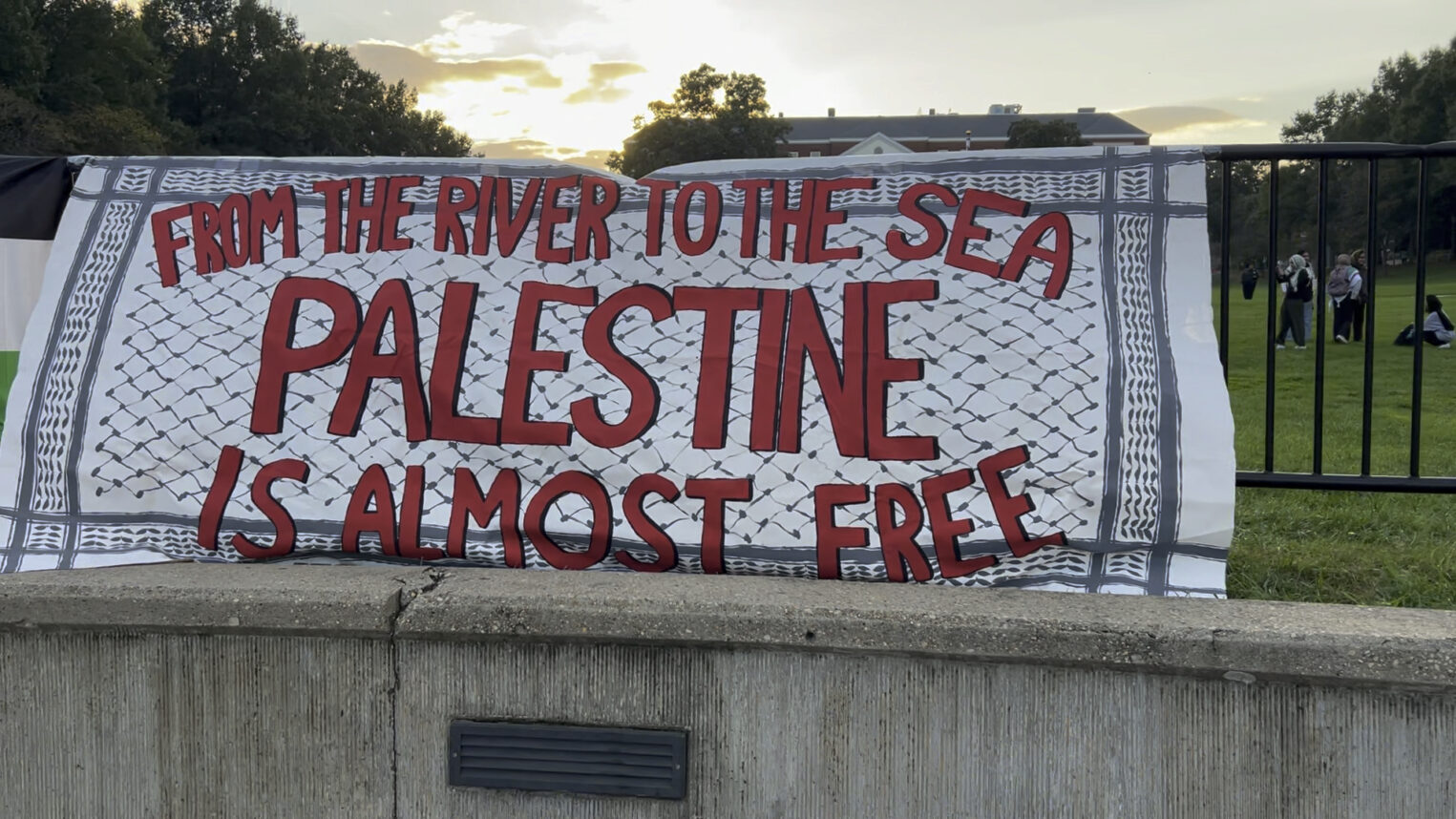
Flipping the Script 

The strategy at play here was clear: flip the script. Instead of allowing the world to focus on the tragedy that befell innocent Israelis, groups like Students for Justice in Palestine and the Council on American-Islamic Relations sought to portray Israel as the aggressor. 

Their banner, “From the river to the sea Palestine is almost free: wasn’t just a call for Palestinian liberation. It’s a call for the destruction of Israel.”

This kind of rhetoric isn’t just inflammatory—it’s dangerous. 

While protected by America’s free speech liberties, the October 7 “interfaith vigil,” with its blatant lies and anti-Israel slogans, was another wound in the broader struggle for truth. By staging such events on the very anniversary of a massacre, anti-Israel activists aren’t simply protesting—they are weaponizing Jewish trauma to further their own narcissistic cause.

This cruelty was reflected in the media’s coverage. While Jewish students quietly protested the vigil’s insensitivity, the evening news focused on the anti-Israel demonstrators, giving airtime to their misleading narratives.
Winning at Shame Jiu-Jitsu

For Jews around the world, October 7th should have been a day to remember, to mourn, and to heal. Instead, it was co-opted by those who seek to erase their suffering and replace it with their own agenda. For example, a rally supporting Israel at the Washington Monument struggled to draw attention. 

Indeed, in the battle for public perception, Israel and the Jewish community are losing ground. Groups like Students for Justice in Palestine and the Council on American-Islamic Relations are waging a war of disinformation, and the truth is getting lost in the noise. If we don’t recognize and confront these tactics, the victims of October 7th will be erased, and their killers’ narrative will prevail. That is the disinformation strategy of anti-Israel leaders and their sympathizers.

At the rally at the Washington Monument, speakers, including a couple, Laralyn RiverWind and Chief Joseph RiverWind, members of the Georgia Tribe of Eastern Cherokee and the Arawak Taino tribe of modern-day Puerto Rico, passionately defended Israel’s right to exist. Joseph has learned he is Sephardic Jewish through an ancestral lineage from Spain. 

In the global media coverage their message was lost in the din of anti-Israel protests dominating the headlines but the human connection with the RiverWinds was lasting for Orli, who went from the Washington, D.C, remembrance of Oct. 7 to the College Park denial and manipulation of the day of massacre. 

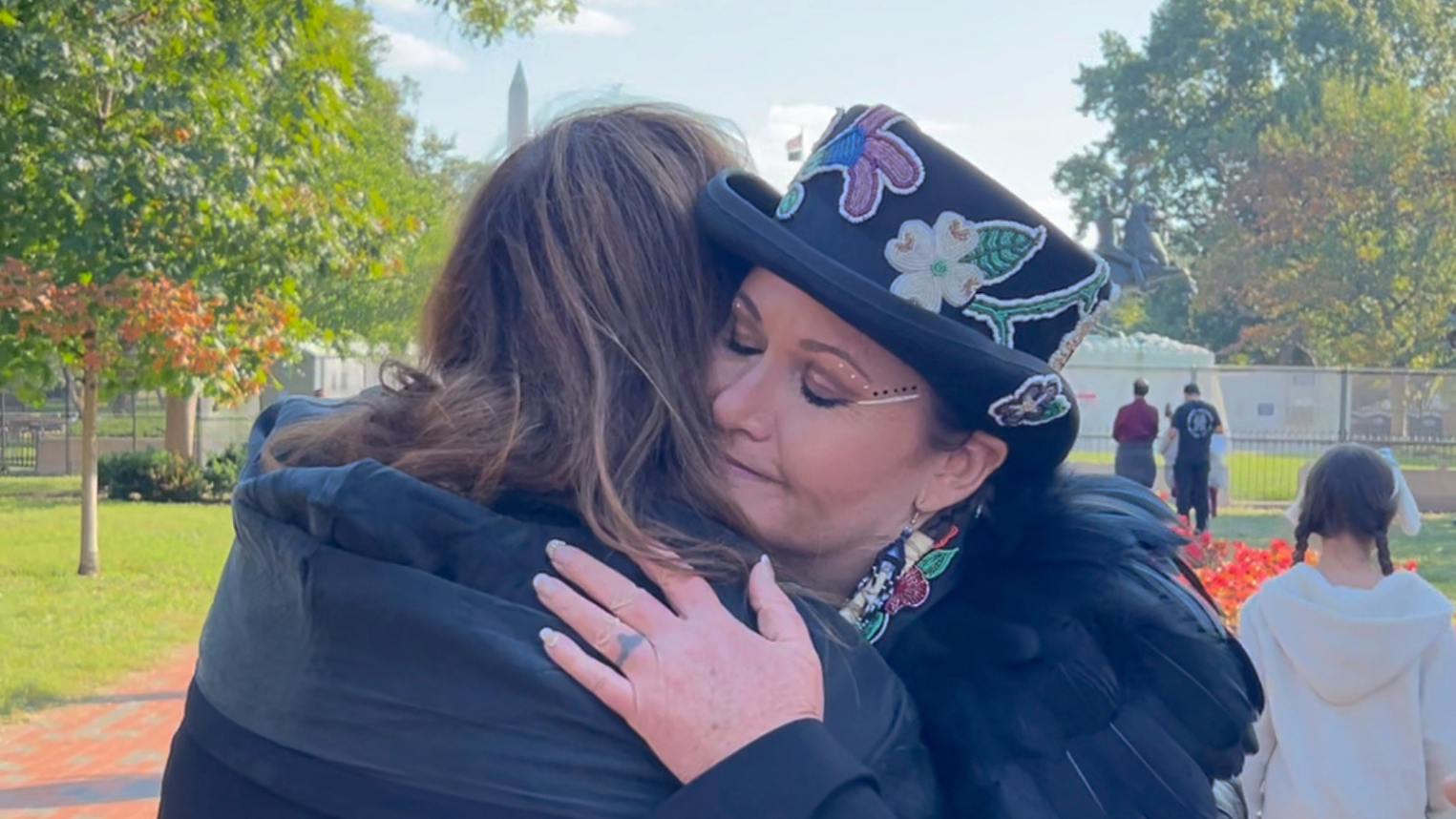
Outside the White House, Orli embraced Laralyn in a shared connection over issues of trauma and healing. 

“We will find healing,” she said.

That night, as Orli supported Jewish students at the University of Maryland, Chief Joseph and Laralyn went to the Anthem theater a few miles away in Southwest Washington, D.C, where about a dozen anti-Israel protestors heckled Jewish Americans headed inside for an “evening of remembrance” for the victims of the October 7th attacks.

Some of the anti-Israel activists wore red paint to replicate blood spilled on their clothes to blame the Jewish Americans in the crowd for the deaths of Palestinians. One filmed the Jewish Americans as they stood in line, the camera zooming in on their faces, to seemingly intimidate them. 

In an effort that I call shame jiu-jitsu, Laralyn first turned her back on the protestors. That’s when she saw the crestfallen faces of Jewish Americans standing in line, looking sad, despondent and seemingly helpless to the taunts, one wide-eyed young girl gripping her grandmother’s hand firmly for safety. 

At that moment, Laralyn whipped around to face the anti-Israel protestors.

“These people are grieving and you are going to come here with your lies and protest them?” she asked, indignant.

Beside her, her husband, Joseph, also challenged the protestors for their callousness. 

Laralyn pointed her finger at each one of the protestors and hand-delivered to each one of them firmly, one after the next, the message that they last expected to hear: “Shame on you! Shame on you! Shame on you!”

The anti-Israel protestors averted her gaze and looked away. In that moment, Larylyn flipped the script on the anti-Israel hate and swept inside the theater to join Jewish Americans in a space where they were able to express something that the protestors had attempted to interrupt: grief.


Asra Q. Nomani is a former Wall Street Journal reporter and the founder of the Pearl Project, a nonprofit journalism initiative named for friend and colleague, Daniel Pearl. If you want to support her continued coverage with dispatches from the road, please donate to the Pearl Project at this link. Asra can be reached at asra@asranomani.com and @AsraNomani on the X platform and other social media platforms. She invites your tips, suggestions and feedback. She can also be reached at 304-685-2189. To read her collection of dispatches, go to JewishJournal.com/Dispatches.

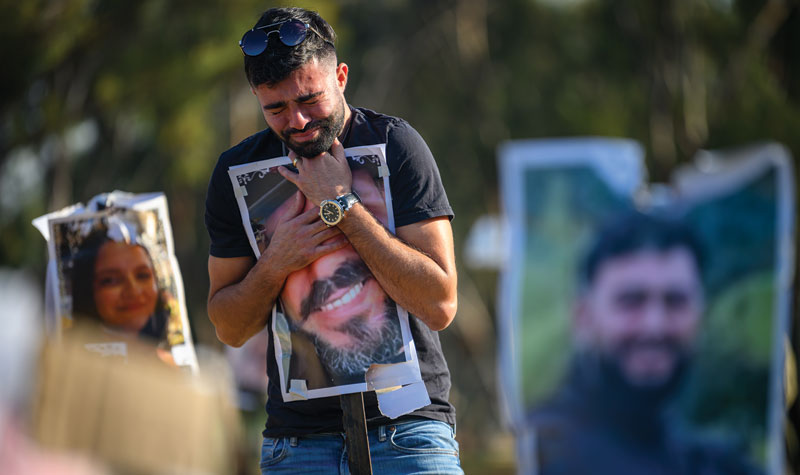
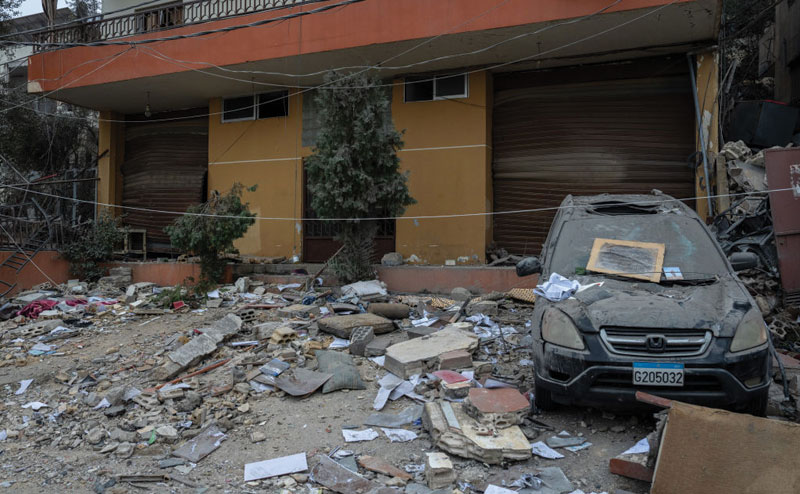
Grief Kidnapped: How Anti-Israel Hate Groups Stole Oct. 7th from Jews to Press Their Disinformation Against Israel Read More »

‘October 7’ Play Held at UCLA

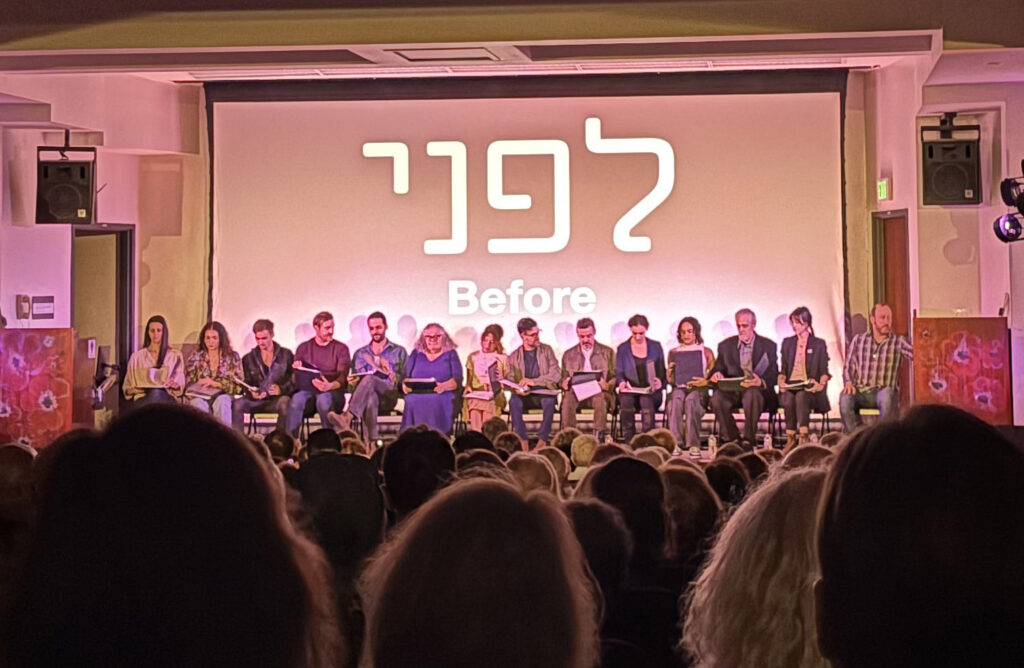
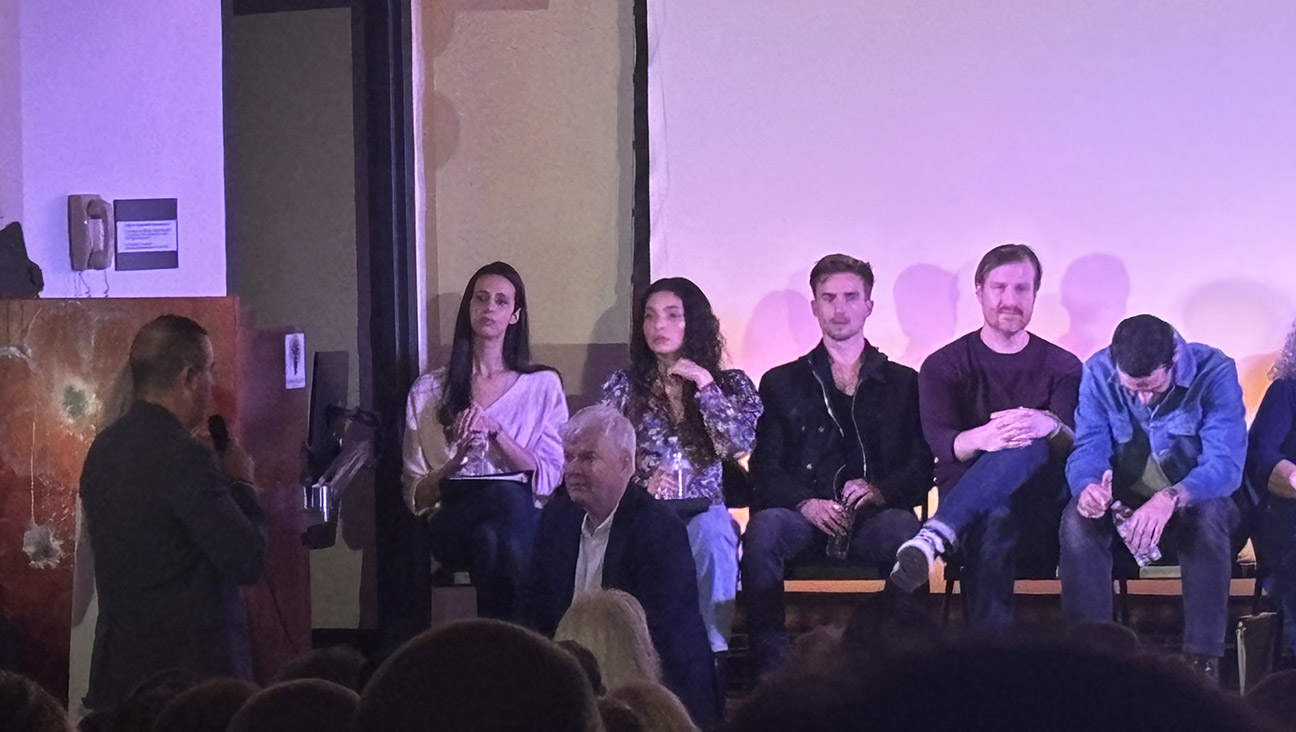
“October 7: In Their Own Words,” a new play using the testimony of survivors of the Oct. 7, 2023 massacre was performed at UCLA Oct. 7, commemorating the one-year anniversary of the massacre.

The performance, a staged reading of the play, packed the 324-seat Lenart Auditorium.

Written by Phelim McAleer and Ann McElhinney, a husband and wife team of Irish Catholic journalists, and directed by Jeff Maynard, is subtitled “A Verbatim Play,” uses word-for-word recreations of interviews conducted by McAleer and McElhinney. The performance struck a chord with the audience  –– gasping when it was revealed that some Hamas terrorists were wearing faux Israel Defense Force (IDF) garb, and laughing when the survivors weaved in some humor into their testimonies in face of the trauma they endured, and gave the play an emotional standing ovation.

In the Q&A that followed the play, McAleer explained that he and his wife were in Ireland when the massacre occurred, and they noticed “how quickly people wanted to talk about Oct. 8 rather than Oct. 7” and that “as journalists we just saw… a massive international story on Oct. 7” that wasn’t being covered. “We were determined to tell those stories and preserve those stories.”

They were so determined, they traveled around Israel for three months and interviewed 20 survivors for the play; they whittled the testimonies down to 14. McElhinney said it was the first time they had been to Israel and pointed out that 30,000 people have moved to the Jewish state following the massacre, which prompted applause from the audience. “I actually get it,” she said.

Hillel At UCLA Executive Director Dan Gold, who moderated the Q&A, asked about the play’s New York debut in May and pointed out that the Jewish community has been asking who has their back. McAleer replied that “a lot of religious Christians” attended the New York showing of the play and that “it’s not easy being a Jew these days.” He blamed “identity politics,” which he described as the phenomenon “where you put one group as good people and one group as bad people and eventually they have to make a decision about you.”

Dan Gold moderates the Q&A, with Phelim McAleer pictured third from left. Photo by Aaron Bandler

McAleer added that “not many people have your back, that’s just the way it is. You have to do it on your own … you have to keep telling the truth.”

“Not many people have your back, that’s just the way it is. You have to do it on your own … you have to keep telling the truth.” – Phelim McAleer

He added that no mainstream media outlet covered the play’s performance in New York, contending that “the field of journalism is not in a good place at the moment.” McAleer asked how anyone could be “pro-Gaza or pro-what they did” after seeing the play, as the play consists of “lived experiences.” McAleer recalled listening to National Public Radio (NPR) on the way to UCLA, and that he heard the radio station describe the anniversary of the massacre as being the “anniversary to the beginning of the Gaza War” — audience members gasped at this — and NPR then interviewed someone from the Gaza Strip.

“There’s a lot of fear,” argued McAleer. “Younger journalists don’t want to cover it, the older journalists do but they’re afraid they’ll get hassled or fired.”

McElhinney said that she and McAleer have heard people say that they learned more about the massacre from the play than from anywhere else. One of the critiques they have received about their play is that only the Jewish community will see it; McElhinney’s response to that critique was that Jews “needs to see it so they know they are seen by two Irish Catholics.”

Some of the actors also had an opportunity to speak during the Q&A. Israeli TV personality Adi Ben Ezra portrayed an Israeli named Shani, who relayed her experience of the massacre to Ben Ezra as if “she was going to get groceries.” She said Shani is “trying to recover, she’s having a hard time.” Ben Ezra is Israeli and served in the IDF as a special operations officer (which was met with applause) and said she was “honored to be here tonight and share [Shani’s] story.”

Kevin Weisman (“Alias”), who portrayed an off-duty, out of uniform police officer, Itamar Illouz, said that he connected with Illouz over WhatsApp and was sent an “incredible wealth of videos” including “ring camera footage of the things that are described in the play,” such as when Itamar hid on top of a family’s house. Weisman said that listening to Illouz’s stories seemed “cinematic” and that “he had an incredible amount of energy as he was telling these stories” but Weisman could tell that Illouz was still recovering from the trauma he endured.

Joshua Bitton (“The Pacific”) lost three family members in Kibbutz Be’eri during the massacre and two others were taken hostage and later released during the second round of prisoner-hostage exchanges. When Bitton got the email asking if he’d be interested in performing in the play, he “aggressively” wrote back that he wanted to be part of the play. “I have to do this.”

Ghadir Mounib, an Egyptian actress who played Yasmin, a Muslim doctor, recalled being in Egypt on Oct. 7 and 8 last year and it blew her mind that everyone’s immediate response was to side with the Palestinians. She recounted that in Egypt, people were selling Palestinian flags on the side of the road and that her stepfather was about to buy one, until Mounib insisted that if he were to get one then he would need to get an Israeli flag as well. Her stepfather ended up not buying either flag. Mounib expressed her appreciation to McAleer and McElhinney for including an Arab Muslim’s story in the play because it’s important that people know that there are Arab Muslims who are trying to help and that “it’s not us and them.”

In the days leading up to the performance, anti-Israel activists on social media threatened to disrupt the play. Assistant Director of UCLA’s Event Office Bill Sweeney reminded everyone before the play began that the university is committed to freedom of speech, which includes hosting events and the right to protest. He acknowledged that the content of the play is “sensitive” and that given the “context of world events” it could spark disagreement. He stressed that the event cannot be disrupted — the audience applaused — and that if there was a disruption, a warning would be issued and those involved escorted out and may even be subject to arrest. The play occurred without incident.

Hillel’s Gold introduced the play and called the evening “an important night for our community.” A year ago, Israel and the Jewish community at large “had their whole lives and whole world shaken by the terrorist attack by Hamas.” Since then, the UCLA “campus [has] faced an unfathomable campus climate” where Jewish students have become uncomfortable in expressing their Jewish identity and connection to Israel.

Gold said that at the same time as the play, around 500-600 pro-Israel students were “holding a powerful vigil of unity and sorrow” at Bruin Plaza. But the play is important because “it’s the best way we can honor the victims and hear their voices one more time on this anniversary.” He added that he couldn’t “think of a time where one night only meant so much.” Gold thanked the students “for being brilliant and resilient even if many of them aren’t in the room right now with us.”

‘October 7’ Play Held at UCLA Read More »

In Israel, Every Day is October 7. In the U.S., Every Day is October 8.

Ever since witnessing an ecstatic pro-Hamas celebration in Times Square just 24 hours after the deadliest day for Jews since the Holocaust, I thought nothing could surprise me. Then to commemorate the one-year anniversary of those atrocities, the Guardian published an essay by Naomi Klein titled, “How Israel has made trauma a weapon of war.”

“What is the line between commemorating trauma and cynically exploiting it?” Klein asks. “Between memorialization and weaponization? What does it mean to perform collective grief when the collective is not universal, but rather tightly bound by ethnicity?”

As someone who encountered gruesome videos of Hamas’s “cynical exploitation” and “weaponization” of Israelis’ trauma exactly a year ago, watched as terrorists referred to terrified Israelis in the South — those who just happened to be most likely to oppose “settlements” — as settlers and dogs, and heard firsthand from people who witnessed livestreams of family and friends held at gunpoint, most of them murdered or taken hostage, I found the premise grotesque.

It was particularly appalling because beyond the therapeutic effect of creating artwork, the cri de cœur that motivated the art installations from Tel Aviv to American college campuses, “kidnapped” posters across the globe, the Nova Exhibition, online maps of the massacres, and documentaries about October 7, is the denials of the trauma itself. And the feeling that since that horrific day, we have been abandoned. That we are profoundly alone. That every day in Israel is October 7th.

Given the depth of depravity of what happened that day, some Jews initially believed the world would finally stand with Israel. I didn’t. But I did think that everyone would at least condemn the atrocities. I couldn’t have been more wrong. Israel has faced obscene denialism and false accusations while young people across the globe celebrate monstrous barbarism and valorize those who perpetrated it. Jews across the world have the sense that the “universal collective” to which we thought we finally belonged has thrown us out and turned its back.

Where is the world’s outrage? Where is the world’s empathy? Where are the calls for Hamas to return our stolen souls? Where is the Red Cross? Where are the organizations and so-called allies with whom we stood, we marched, we campaigned? It’s #MeToo unless you’re a Jew.

American college students have borne the brunt of the rise in antisemitism. Days after the massacres, rapes, and kidnappings, when antisemitic student groups like Students for Justice in Palestine (SJP) used images of motorized hang-gliders to advertise their anti-Israel demonstrations, I wanted to believe that they didn’t know what really happened. When they used the same image to advertise celebrations of their “resistance” and “martyrs,” marking the one-year anniversary, they no longer had an excuse. “Happy October 7th everyone!” at least one school’s SJP posted on Instagram. They all refer to the massacres by the name the terrorists use for it, “Al Aqsa Flood.” To mark the anniversary, the openly pro-Hamas student group “Within Our Lifetime” (WOL) organized demonstrations, calling them “Students Flood NYC for Gaza.”

Last semester, Columbia University student activist Khymani James publicly declared, “Zionists don’t deserve to live,” and “be grateful that I’m not just going out and murdering Zionists.” His anti-Zionist student group, Columbia University Apartheid Divest (CUAD) issued an apology for his remarks. This year, the group apologized to him for its “so-called apology,” which, they declared, “does not represent Khymani or CUAD’s values or political lines.”

That was apparent when CUAD celebrated a recent terrorist attack at a light rail station in Tel Aviv/Jaffa. Terrorists murdered 7, including the young mother of a baby, and wounded at least 16. The group referred to the horrors as a “bold attack” and a “significant act of resistance” that “reached deep into the heart of settler-colonial territory, further destabilizing the Zionist regime’s claims to security…”

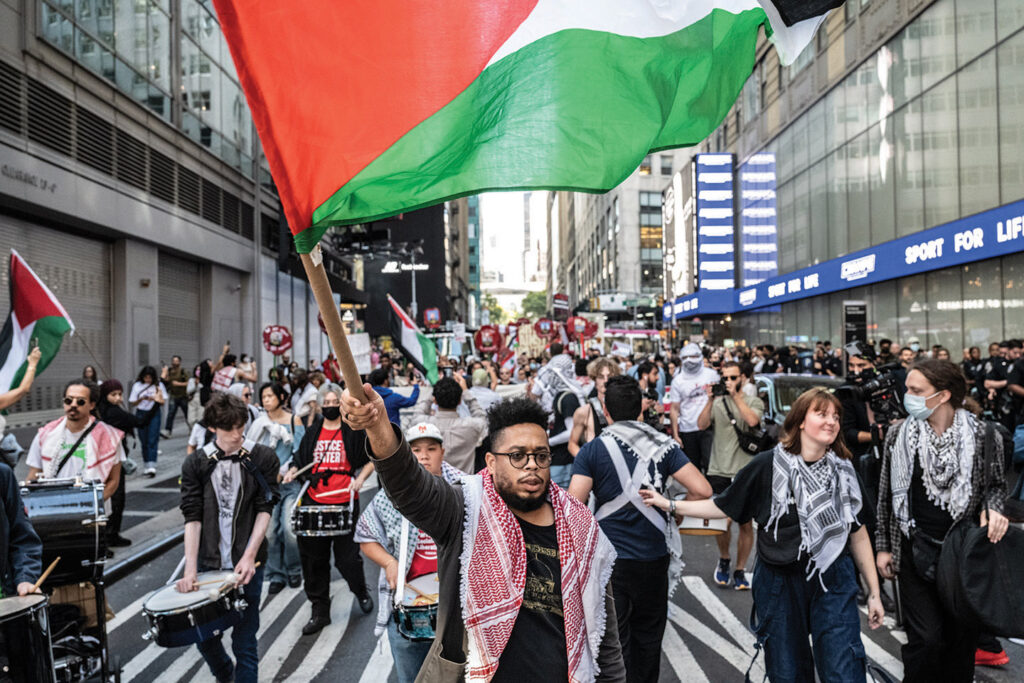
Almost a year after going to the October 8 Times Square demonstration, I went back to the scene of the crime. This time, there were signs glorifying not just Hamas, but Hezbollah. There were also more activists, more keffiyehs, more police, and more of the same familiar chants calling for the eradication of Israel and the destruction of the Jewish people.

“There is only one solution: intifada revolution.” (Bonus points for harking back to the Nazi “final solution.”) “Palestine,” if they got their way, would extend “from the river to the sea,” making everything within Israel’s current borders as Jew-free as the Palestinian territories. If you thought they wanted an end to the shootings, stabbings, beheadings, suicide bombings, rapes, tortures, kidnappings, burning people alive…etc., you’re sadly mistaken. “Globalize the intifada.” “Long live the intifada.”

To hear the media tell it, though, especially when demonstrators add “ceasefire now” to their chant list, they’re “anti-war activists.”

This year, while students across the country attempted to hold anniversary vigils for the victims of October 7, terrorist-sympathizers celebrated the same events within earshot. As if that weren’t enough, anti-Zionist posters now include images of red anemones, the symbol of Israel’s South — where the atrocities happened. This is especially galling because survivors of October 7 see the red anemone as a symbol of their connection to the land. Many now have tattoos of the flower to remind themselves of resilience, possibility, and hope.

Relatedly, a chant that stood out to me as I left the Times Square anniversary celebration is “Hey hey, ho ho; Zionism has got to go.” Maybe because it seems banal compared to the others, it doesn’t get much attention. But in some ways, it’s more illuminating. We all know that for terrorists and their supporters, intimidation, harassment, and unimaginable violence is their love language. “From the river to the sea” is a threat. “Intifada” is a call to arms. But “Zionism has got to go is something else.

Our connection to our ancient, biblical, historical, and permanent home is intolerable to those who hate the Jews. Perhaps that’s why student-jihadis now appropriate not just the date of the worst massacre of Jews in most generations’ living memory, but’ symbols too: In addition to red anemones, there seems to have been a proliferation of Anti-Zionist charms and t-shirts sporting maps of Israel.

That our connection to the land predates the birth of Mohammed, that we are the prototypical indigenous people and our presence in the land has been continuous, that we acquired the land through purchases and other legal means, that the majority of Israelis have relatives who were ethnically cleansed from Arab countries, that the only non-colonial, non-imperial sovereign power that has ever existed in that land was, and is, Jewish, and that the State of Israel came about in exactly the same way as countries that don’t face delegitimization campaigns, all puts the lie to the antisemitic conspiracy theory that Jews are “white settler-colonialist” robbers and thieves sent from Europe who stole land rightfully owned by ethnic Palestinians in 1948 — a time when there was no such designated ethnic group.

The Zionist-hating chant illustrates how antisemitic terrorists intend to take more from us than our land. They want to rob us of our hopes and dreams, too.

Maybe that’s why we always end up singing Hatikva when confronted by those who wish to destroy us — as if to say, “you might take our ability to live in peace today, but we won’t let you take our hopes and dreams.” As long as the heart within the Jewish soul yearns, and toward the East, an eye looks to Zion, our hope is not yet lost. Our hope is two thousand years old: To be a free people in our land, the land of Zion and Jerusalem.

A day before Klein’s poisonous piece, the New York Times published a fawning article about a student-founder of WOL, one of the anti-Zionist organizations behind many of the activities that make campuses hostile to Jews. “Pro-Palestinian Group Is Relentless in Its Criticism of Israel, and It Isn’t Backing Down,” the headline reads. The goal of WOL, to be clear, is to destroy Israel “within our lifetime.” Calling that “criticism of Israel” is like referring to the defacing of priceless artwork as “criticism of Monet.”

WOL “has galvanized pro-Palestinian activists who are calling for the end of Israel,” the subtitle reads, “and [are] facing accusations of antisemitism.” The message seems to be: Let’s be reasonable. They don’t hate Jews. They just want to destroy the home of more than half of them — the one country where Jews aren’t a minority. Can you believe they’re accused of being anti-Jewish? The poor dears.

In the past year, I noticed a chant I don’t remember hearing before. It’s in Arabic, and it means “from water to water, Palestine will be Arab.” Anyone who thought this would finally put an end to the nonsensical claim that “From the river to the sea, Palestine will be free” wasn’t about the destruction of Israel might be right. It seems we’re all on the same page now: It is a call for the annihilation of Israel.

But get with the program; calling for the destruction of Israel is now merely “criticism.” To quote from Dr. Strangelove: Our source is the New York Times. 


A social psychologist with a clinical background, Dr. Paresky, an Associate at Harvard University, serves as Senior Advisor to the Open Therapy Institute and Advisor to the Mindful Education Lab at New York University. In addition to The Jewish Journal, her work appears in Psychology TodayThe GuardianPoliticoSapir, The New York Times, and elsewhere. She has taught at Johns Hopkins, the University of Chicago, and the United States Air Force Academy, and writes the Habits of a Free Mind newsletter. Follow her on Twitter at @PamelaParesky

In Israel, Every Day is October 7. In the U.S., Every Day is October 8. Read More »

Getting Ready to Conjure My Father on Yom Kippur

With Yom Kippur looming Oct. 11-12, I brace myself for extended bouts of standing and sitting during synagogue services, plus the extra blessings and sermons (sorry, Rabbi!), drawn-out choral passages, silent meditations, fund-raising appeals and self-reflection – all while going on empty from a 25-hour fast.

Not that I would dream of tuning out on Judaism’s holiest day, especially mindful of the lives lost, damaged and hijacked since the last Yom Kippur pre-Oct 7.

I’ll certainly try my best to take stock of my misdeeds from the past year and commit to a more righteous one ahead. But atoning is still a slog, gladly left behind the moment I hear the last blast of shofar and take my traditional first bite of post-fast pretzel.

There is one moment in the long day of observance that I actually look forward to, thanks to the Lev Shalem prayer book used by our Conservative Manhattan shul. On page 291, as a sidebar insert to the memorial service, is a poem that beautifully captures the brevity of life and power of memory that are such an integral part of the highest holiday, and of being Jewish.

It’s called “Though I Stared Earnestly at My Fingernail” by an accomplished Brooklyn-born writer named Merle Feld, who, while examining the cuticle of her right forefinger as she rides a New York City bus, conjures the physical presence of her father.

“I remembered how clean and short he kept his nails,” she writes, “and suddenly there was the whole man reconstituted…standing before me, smiling broadly his face flushed with pleasure.” In that fleeting second of merely checking out her nail chugging along on a city bus route, Feld is “overtaken by a longing very close to love.”

While I dutifully recite the prayers and chants of Yom Kippur, Feld’s poem transports me to a different time and place. My father, who died aged 91 in 2010, bequeathed me many traits – a strong work ethic, devotion to routine and family. But he also “gifted” me his fingers – long, knobby and flattened at the tips, with nails that look like they’d been pounded by a mallet. Coming upon Feld’s fingernail muse on page 291 always prompts me to gaze at my own stretched-out hands, instantly summoning my dad – towering, hair-perfect, strong. And right beside me.

There we are in our Tree of Life synagogue in Pittsburgh circa 1963, as he guides me to the proper place in the text or nudges me to stand, as I watch the red neck creases in the men around me from their starched white shirts. He slips me a mint, whispers to my mom and then davens in old-school Hebrew pronouncing “t’s” like “s.” When he straightens his pant leg after sitting down I focus on his permanently dislocated right ring finger, an injury I would repeat many years later. If he catches me looking at the crooked joint, he’ll shoot me a wink.

I stare at the lofty stained-glass windows and flip ahead in the bound siddur to check how many pages remain before we’re released. Sometimes I buzz out until my dad elbows me to attention, with an expression that says, This is where it’s at, kid. He limits my escapes to the bathroom and corridors of our temple. After service concludes, he holds my hand as we head up the carpeted aisle and exit the sanctuary, his wedding band sticking into my palm. I wouldn’t think of letting go.

I stare at the lofty stained-glass windows and flip ahead in the bound siddur to check how many pages remain before we’re released. Sometimes I buzz out until my dad elbows me to attention.

The poet Feld savors her father’s transient visit, but of course she can’t prolong it any longer than one can hold a rainbow. “Just as suddenly he was gone,” she writes, “and though I stared earnestly at my fingernail I failed to bring him back.”

I understand her frustration. No sooner than my father arrives on the wings of my aging fingers I know his hologram-like spirit will dissipate into the air. I pray I’m around when page 291 returns next year.


Allan Ripp runs a press relations firm in New York. 

Getting Ready to Conjure My Father on Yom Kippur Read More »

A Great Opportunity for the Simon Wiesenthal Center

The retirement of famed Nazi hunter Efraim Zuroff from the Simon Wiesenthal Center brings an era to an end. Zuroff, who was instrumental in creating the first exhibit at the Simon Wiesenthal Center in Los Angeles went on to be an Israel-based researcher for the Office on Special Investigation of the Justice Department before returning to the Wiesenthal Center where he assumed the mantle of Simon Wiesenthal as the premier Nazi hunter of his generation. His retirement coincides with the aging out of his task. We now are some 79 years from the liberation of the Nazi death camps and assuming that the perpetrators were above 18, the youngest of them is now 98 and even those who do not believe in heaven would hope that there is scorching place in hell for them.

Others will write well deserved tributes to Zuroff’s indefatigable efforts to use his skills as a historian and his audacity as an activist to bring these criminals to justice. They were global and they were effective and his work should be honored. 

As one who has created archives, my concern is with his papers, which contain invaluable historical information and must be preserved for future generations.

Permit me to only cite three examples among many:

Ephraim Zuroff (Photo by Morris MacMatzen/Getty Images)

Zuroff’s papers include the best collection of documents on Lithuania war criminals, a subject he followed assiduously and wrote about most prolifically.

His papers include the documents relating to Aribert Heim, MD, the Nazi physician at Mauthausen.

They also contain the global results of Operation Last Chance, that include Nazi war criminals in 14 countries including Latin America, where information is otherwise scarce.

These papers rightfully belong to the Simon Wiesenthal Center, which has supported his efforts for the past 38 years. Yet, because in all its greatness the Wiesenthal Center is not a research center with scholars routinely using its archives, I have an audacious request to make of the Center. 

Please make these papers available at a major research center. Take out all the institutional correspondence and leave only the scholarly papers. The choices are natural: Yad Vashem in Jerusalem.  the Jewish National Library also in Jerusalem, the United States Holocaust Memorial Museum in Washington, or even the Simon Wiesenthal Center in Vienna where Wiesenthal’s papers are held. Scholars come to do their research and future scholars will look back on this time and ask what was done – and not done – to bring the perpetrators to justice. What obstacles did Nazi hunters face? Who were their allies and who were their enemies? What was the role of the United States? What was the role of Israel? What was the role of the perpetrator countries and the host countries in which the criminals later found a haven?

Zuroff did his work in three distinct eras. He began his work well after the Nuremberg trials of the 1940s, after the Eichmann trial of 1960, and after the Frankfurt Auschwitz trial of the 1970s. He began during the Cold War, during Communism. He then worked during an era where there were newly emerging democratic countries who were willing, some for the first time, to consider their own histories, within limits, even truthfully. And in recent years he worked when nationalistic fervor in some countries was making heroes of national leaders regardless of their record regarding Jews during World War II, encountering clashes between nationalistic memories and historical reality. His book “Our People: Discovering Lithuania’s Hidden Holocaust,” written with Ruta Vanagate about their journey to sites of the Holocaust by Bullets in Lithuania is but one example. Vanagaite’s fate: her books were banned, her colleagues abandoned and scorned her. And his fate as one of the most hated men in Lithuania is instructive.

Readers of his papers will also encounter some unpleasant Jewish truths. Indifference on the part of some Jewish leaders, ambivalence on the part of Israeli leaders who were reticent to confront some nations lest they disturb diplomatic relations and national interests. All of these will be important for scholars to research as they look back dispassionately and with some distance on the events of our time.

They will also discover how a dogged activist can use historical knowledge and contemporary media to stir interest in seeking justice, the lessons to be learned, and actions to be copied or avoided.

They will also discover how a dogged activist can use historical knowledge and contemporary media to stir interest in seeking justice, the lessons to be learned, and actions to be copied or avoided.

In short, the Simon Wiesenthal Center, which supported his activities for so many years, has one final obligation to history and its own historic role: first preserve these records. 

It would be most gracious if they were to make them available to a research institution where scholars could freely access them.

I am reminded of the Mishnah in Pirkei Avot. Rabbi Tarfon said: “You are not required to finish your work, yet neither are you permitted to desist from it.” Zuroff’s work is not finished, he will continue in a private capacity or in some future public role, but if his papers are preserved and accessible, then others can also continue his work.

A Great Opportunity for the Simon Wiesenthal Center Read More »

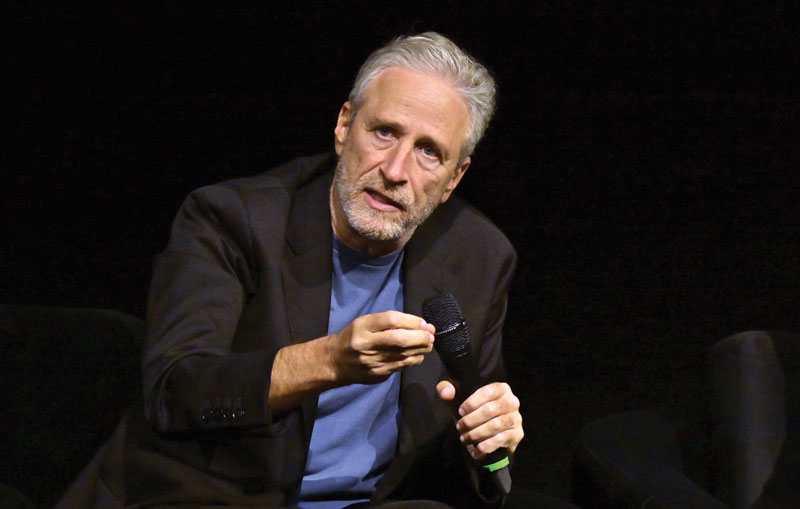
Jon Stewart – ‘Wantonly’ Attacking Israel and Misunderstanding the Lessons of WWII

One week after beepers assigned to 3000 terrorists exploded all over Lebanon and 3 days before Nasrallah, the arch-terrorist leader of Hezbollah, was killed by Israel in a targeted assassination, John Spencer, Chair of Urban Warfare at West Point, was on Chris Cuomo’s show. During his discussion with Cuomo, Spencer said:

People have lost their mind on who are terrorists and who are defending their civilians.”

Sadly, this statement aptly describes Daily Show host Jon Stewart, as exemplified by many of his ahistorical segments on Israel.

Perhaps none more so than Stewart’s September 23, 2024 segment on the Daily Show called the “Futile Crescent” – where Stewart equated Israel’s democratically elected government with the Iranian terrorist proxies on Israel’s southern & northern borders (Hamas & Hezbollah).

Stewart claimed that Israel has no basis for militarily responding to what Israel’s Prime Minister characterized as Hezbollah’s “wanton” rocket & missile attacks on Israel, because – according to Stewart – “what was Israel doing if not wanton rocketing of other nations.”

There are many issues with this “blame Israel” analysis (which anyone with knowledge about the history of the Arab/Israeli conflict should appreciate):

First, on October 8th, Hezbollah attacked Israel without provocation – other than Israel’s existence. Hezbollah admitted at the time that it did so in “solidarity” with Hamas’ unprovoked, literally “wanton,” & very intentional mass-murder, rape, mutilation, & kidnapping October 7th attack.

Second, Israel doesn’t “wantonly” bomb. Israel attacks military targets. And before it does so, if those targets are in civilian areas (as both Hamas and Hezbollah embed their fighters & weapon systems – including rocket & missile launchers – amongst & under civilian infrastructure), then whenever it reasonably can, Israel warns the civilians  to evacuate, often giving them hours and sometimes more than a day to get out of harms’ way.

Third, as John Spencer (and practically every military expert in the free world) has repeatedly noted, no country in the history of modern warfare has done more to avoid civilian casualties than Israel since it began its operation to end Hamas leaders’ ability to make good on their threats to repeat the Oct. 7th massacre “again & again” until Israel is destroyed.

Fourth, thanks to Israel’s unprecedented efforts to avoid civilian casualties, the civilian to combatant casualty ratio in Gaza is the lowest in modern history. Practically 1:1 (as compared to the worldwide average of 9:1 and even the USA’s, Britain’s & France’s casualty rates for their wars in the 21st century – which have averaged 3:1).

Plainly, Stewart didn’t let these facts intrude on his anti-Israel segment. After accusing Israel of being the moral equivalent of Hezbollah with its “wanton rocketing,” Stewart ridiculed what one reporter described as Israel’s effort to achieve “de-escalation through escalation,” as Stewart quipped that this strategy could also be “called the footnote to WWII.”

That complaint by Stewart is illuminating, as it reveals a deep flaw in Stewart’s ideas about Israel and its enemies. The notion that war with dictatorships – which are determined to destroy democratic countries – can be avoided by the democracy agreeing to stop fighting or by it sufficiently appeasing those dictatorships.

While Stewart referenced WWII in his diatribe, he plainly didn’t learn its most important lesson. The lesson that when one side is led by dictators animated by a rapacious and deeply racist/antisemitic ideology, there is no compromise that can prevent the dictatorships from continuing to try and conquer/destroy. Seemingly channeling “Horseshoe Theory” as he made light of the “escalations” that led to WWII, Stewart sounded adjacent to a Tucker Carlson revisionist historian claiming the USA and Britain could have avoided WWII by simply making more concessions to Nazi Germany.

What Stewart does not appear to understand, or care to acknowledge, is that since October 7, Hezbollah – without provocation – has fired over 9000 rockets & missiles at Israel and caused anywhere from 80,000 to 100,000 Israelis to be displaced from their homes for nearly one year. A situation no sovereign nation can tolerate.

Stewart also doesn’t appear to understand that the casualties in Israel from Hezbollah’s relentless and (actually) “wanton” barrages of rockets & missiles are relatively low because, unlike both Hamas & Hezbollah, Israel enables its civilians to leave areas under attack. And Israel, unlike Iran’s terror proxies, uses its soldiers and weapon systems to protect its civilians, while Hamas & Hezbollah use their civilians to protect their fighters and weapons.

One part of Stewart’s ahistorical segment was perhaps most dangerous – particularly given the popularity shows like his have with a significant segment of the Democratic Party.

During this latest anti-Israel attack, Stewart made it clear that he wants America to try and force Israel into ending the war. Meaning, Stewart wants America to pressure Israel into surrendering to the idea of Hamas’ leaders continuing to control Gaza, as well as to accepting that Hezbollah can continue to be able to rain rockets on Israel whenever it wants, as it amasses terrorists on Israel’s border (in clear violation of UN Security Council Resolution 1701) – in order to be able to perpetrate in Israel’s north – the same massacre Hamas perpetrated in Israel’s south. A plan to invade Israel’s Galilee, which Hezbollah has been quite open about for years.

It is no small matter that Stewart’s latest diatribe attacking Israel – occurred after more than 11 months of diplomatic efforts to try and get Hezbollah to stop firing rockets at Israeli citizens – clearly failed. Despite Israel tolerating the intolerable for over 11 months, Stewart blamed Israel and America for the war with Hezbollah “escalating” by addinghere’s the worst part. the country that is providing all the bombs to the Middle East seems to have no idea when these bombs would be used …”

Is it possible Stewart thinks America is providing to Hamas and Hezbollah the approximately 20,000 rockets and missiles these openly genocidal terrorist groups have fired on Israel since October 7, 2023?

Is it possible Stewart doesn’t know that Iran is supplying bombs to Hezbollah and Hamas (and that Hezbollah and Hamas are in the “Middle East”)?

Of course, none of these are possible. Stewart must know that Iran – a country whose tyrannical leadership is sworn to both Israel’s and America’s destruction – is providing around half of the “bombs” in this conflict. Nevertheless, Stewart sees no reason to apply any pressure on Iran or its proxies to stop the fighting or for Iran to even stop arming groups like Hamas and Hezbollah.

Stewart ignores the Iranian dictatorship that is behind Israel’s wars with the terrorist regimes on both Israel’s northern and southern border. Claiming to care for humanity, Stewart wants America to stop Israel from fighting. More aptly, from fighting back. Or even more aptly, from even being able to fight back. In that way, Jon Stewart sounds a lot like the American far-right critics of Churchill before 1941, who from the relative safety of America, called Churchill a warmonger, and demanded that the US stop supporting Britain in its war against Nazi Germany.

Of course, from the relative safety of his 45-acre home in New Jersey, Stewart can make mendacious calls for Israelis to stop fighting back and to just agree to Iran’s terror proxies controlling land directly on Israel’s border. But for the overwhelming majority of Israelis, particularly those whose ancestors were among  the over 850,000 Jews ethnically cleansed from Arab-controlled dictatorships, and for the hundreds of thousands of Israelis whose ancestors survived the Holocaust, it is clear what not fighting back, particularly in the MENA, means: The very thing Hamas’ leaders all promised after October 2023 – repeated attacks like October 7th – until Israel is destroyed.

But, if “Never Again” is to mean anything, it must mean that we never again listen to appeasers and apologists for fascist tyrants committed to mass-murdering Jews, even if they tell good jokes like Jon Stewart.

It also means that when our enemies say they plan to kill us, we should take them at their word. In 2002, Nasrallah, gave a speech talking about the blessing of having all the Jews gather in Israel, because it will save Jihadists the trouble of chasing the Jews all over the world in order to kill them. After giving that speech, Nasrallah continued to create a proxy army and murder for Iran, as he repeatedly promised a relentless war to destroy Israel.

Today, thanks to Israel listening to the majority of its citizens and not to the Jon Stewarts of the world, Nasrallah and most of his Jew-hating gang of tyrants are dead. Just as America & Britain were right to insist on either the destruction or the unconditional surrender of the Nazis before ending WWII, Israel must continue to insist on either the destruction or the unconditional surrender of Hamas and Hezbollah. Anything else, will just defer the current war, and all its terrible costs in blood & treasure, to another round of fighting. History has made that clear, as have the words and actions of Israel’s enemies.


Micha Danzig served in the Israeli Army and is a former police officer with the NYPD. He is currently an attorney and is very active with numerous Jewish and pro-Israel organizations, including Stand With Us and the FIDF, and is a national board member of Herut North America.

Jon Stewart – ‘Wantonly’ Attacking Israel and Misunderstanding the Lessons of WWII Read More »

The Jewish Mosaic

Representations of Jewish culture in American popular culture typically take the form of bagels and cream cheese and matzah ball soup from Eastern Europe, not the Yemenite kubaneh bread and spicy chili schug of my grandma and my childhood, or the foods and cultures of other Middle Eastern and North African Jews, or of Jews from other parts of Asia and Africa. 

The majority of North American Jews are of European Ashkenazi origins, and the typical college student in this country — such as those I teach — typically experiences and imagines Jews in this way. But these representations are limiting and inaccurate. We need to understand ourselves and help others understand us as a diverse people containing multiple and intersecting ethnic and racial identities. 

In a global Jewish population of about 16 million individuals there are several hundred thousands of Ethiopian Jews; over three million Jews originating in North African countries including Morocco, Tunisia, Algeria, Libya, and Egypt; several million with Mizrachi Middle Eastern/Southwest Asian heritage hailing from Syria, Lebanon, Bahrain, Yemen, and Iraq; as well as large communities from Iran, India and Central Asia. In several American and Canadian cities there are large communities of Jews from non-European backgrounds – such as Persian Jews in Los Angeles. There are Syrian and Middle Eastern Jews from Yemen and North Africa and Bukharan Jews from the Central Asian countries of Uzbekistan, Tajikistan, Turkmenistan, and Kyrgyzstan in New York City; Latino Jews in Miami and Los Angeles; Sephardi Jews hailing from Spain, Turkey, and Greece in Seattle; and Moroccan Jews in Montreal.

Of course, being Ashkenazi of European origins does not protect Jewish people from being targets of hate crimes – as is often mistakenly assumed. Jewish people face social, professional, and other forms of prejudice and discrimination on the basis of Jewish identity.  Visibly Jewish individuals – whatever their ethnicity – are particularly at risk of abuse. This includes Orthodox and Ultra-Orthodox Jews whose dress and kippa head covering makes them instantly recognizable as Jews. It also includes Jews who wear a Star of David or other form of Jewish expression and visible identification, irrespective of their expressions of Jewish religious observance.That is true today and has been true through centuries of persecution of Jewish people in Europe and other parts of the world, where Jews were persecuted primarily for being a religious and ethnic minority, as well as being perceived as a separate race. 

Historically, Jewish experiences of persecution impacted Middle Eastern and North African Jews in ways that are not commonly understood in the United States and Canada. Anti-Jewish Nazi persecution reached the Jews of Libya, Algeria, and Tunisia during the Holocaust. Over 800,000 Jews from North Africa and Middle Eastern countries faced persecution, expulsion, dispossession and displacement over several decades of communal calamity between the 1940s and the 1970s and became refugees. 

Many Jewish communities experienced violence and mass killing in the form of pogroms, such as Iraq’s Farhud in 1941. Similar massacres took place primarily in the 1940s and 1950s in Yemen, Morocco, Algeria, Syria, Egypt and other parts of the Middle East and North Africa with large Jewish communities.

All of these experiences of inequality, injustice, persecution and flight created profound forms of harm and loss to Jewish people and their legacies are deeply felt today. 

In the United States there are Asian Jewish, Black Jewish, and Latino Jewish communities as well as Native American Jews. These communities are growing, and the American Jewish community is and continues to be one increasingly characterized by diversity and multiplicities of identities.

Rabbi Angela Buchdahl, for example, who leads the Central Synagogue in New York City, is Korean American. 

Rabbi Jacqueline Mates-Muchin, the Senior Rabbi at Temple Sinai of Oakland, is Chinese American.

Samson Nderitu Njogu, a Kenyan, is a rabbinic intern at San Francisco’s Beth Shalom synagogue while studying at the Ziegler School of Rabbinic Studies in L.A. 

Shoshana Nambi, a Ugandan from the Abayudaya community, is an assistant rabbi at Congregation Beth Am of Los Altos in the Bay Area. 

Michael Twitty is Black and Jewish and has written extensively about those intersecting identities and how they relate to food cultures.

The African American mayor of San Francisco, London Breed, has recently spoken about her Jewish heritage at a Bay Area Moishe House. 

The new President of Mexico, Claudia Sheinbaum, is a Jewish Latina. In many congregations and communities in the United States Jews who identify as Latin American serve as rabbis and lay leaders, such as Rabbi Roly Matalon of B’nai Jeshurun in New York City. 

There are some countries, including France and Israel, where Jews from North Africa and the Middle East make up the majority of the country’s Jewish population. Indeed, the majority of Jewish Israelis hail from North African and Middle Eastern countries as well as Ethiopia, Iran and India. 

There are still other countries where the entire Jewish population is Latino or Lusophone, such as Argentina, Uruguay, Peru, Colombia, Venezuela, Chile, Mexico and Brazil. 

More than 700,000 Jews are Hispanic. Approximately half of them live in the United States, where their community continues to grow. In the United States, Jewish Puerto Ricans have long lived in Puerto Rico and contributed to it. Some Jews found refuge from the Holocaust in the Dominican Republic. 

To do justice to the diversity of the Jewish experience and the Jewish people and to be inclusive of Jewish people, American universities and American society need to recognize that Jewish Americans and Jewish people globally are ethnically, racially, historically and culturally a mosaic. Recognizing and appreciating Jewish diversity and the extent to which Jews are people of color will not end hate against Jews, anti-Jewish stereotypes and abuse, and racist exclusion of and discrimination against Jewish people on the basis of their Jewish beliefs, identity, origins, and practices. Anti-Jewish bigotry is a painful, long, and deeply embedded part of American and Canadian society and culture on college campuses and well beyond. 

Its recent increase in prevalence and intensity reveals that like a virus it can become largely dormant in its severity for extended periods of time – even for decades – only to return with disturbing force and harmful consequences to Jewish people first and foremost, as we are now experiencing. It also negatively impacts American and Canadian society as a whole and the liberal democratic principles of freedom, equality, justice, and human dignity which are necessary for insuring the rights of minorities and all citizens.

Recognizing and celebrating Jewish diversity is an important first step to greater understanding the experiences of Jewish people and their many different cultures and ethnicities historically and today, and how Jewish people both manifest diversity and contribute to it.


Noam Schimmel is a Lecturer in Global Studies with an emphasis on human rights at University of California, Berkeley. 

The Jewish Mosaic Read More »