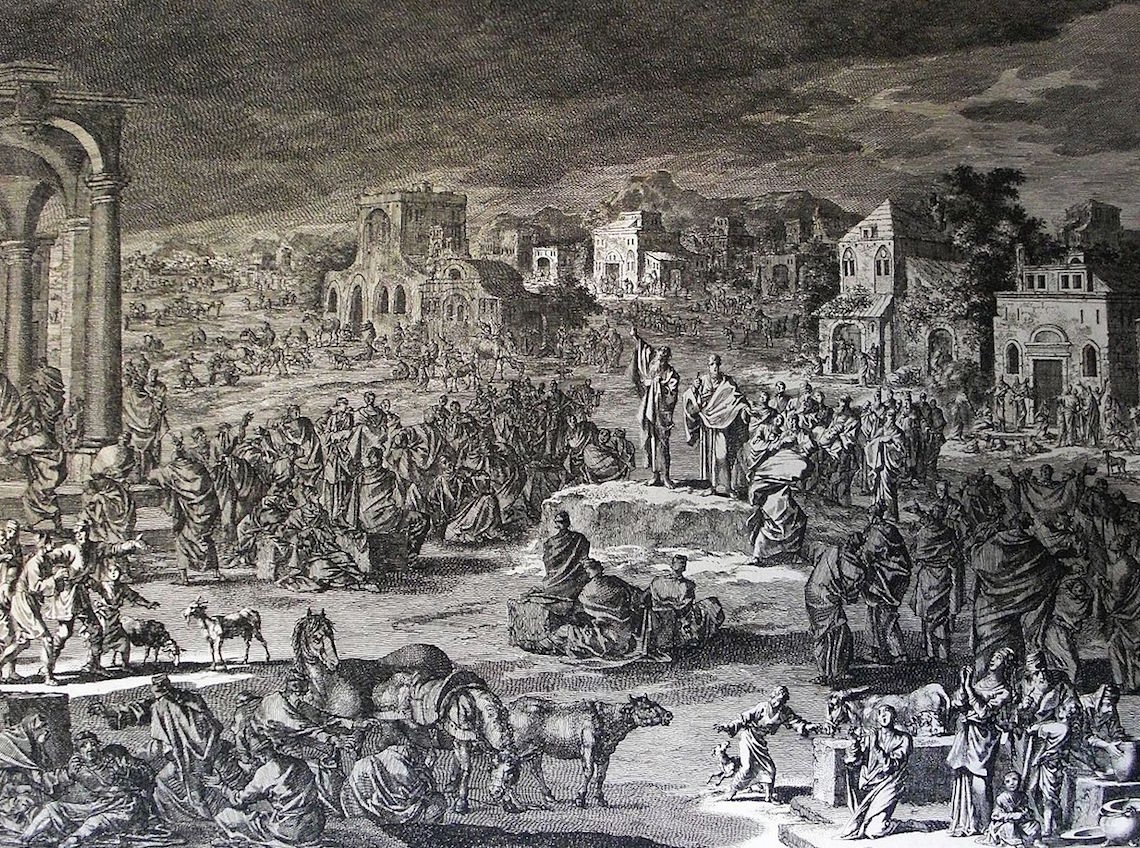
Good stories begin with the words, “Once upon a time.” They take place in a single point in history, a moment that is remembered and retold. Great stories happen in an eternal present, a drama that we enact with our lives. The Exodus is one of the latter, as the haggadah tells us, “In each and every generation a person is obligated to see themselves as a personal participant.”
I learned the difference between these two kinds of stories from professor Michael Walzer, whose book “Exodus and Revolution” (1985) I return to each year before Pesach. In it, Walzer recalls attending a service at an African-American church in Montgomery, Ala., in 1961 while researching the sit-ins and Freedom Rides of that era. The pastor sermonized on the Exodus, and Walzer came to understand that the story isn’t owned by Jews; it belongs to people of many faiths who have used it to describe their own yearnings for liberation.
Walzer explains that all of the cultures and movements that have drawn inspiration from the Exodus have come to understand its three core principles:
First, “wherever you are, it’s probably Egypt.” In every society, there are elements which are oppressive, tyrannical, “Egyptian.” Often they are well hidden behind a false façade of normalcy.
When I was an undergraduate at UCLA, my younger brother visited me. At that time, he was a teenager obsessed with designer sneakers. When I asked what he wanted do in Los Angeles, he said he wanted to visit Rodeo Drive and check out boutiques featuring shoes that retailed for thousands of dollars. I obliged, and we spent an hour walking the streets of Beverly Hills, peering in windows. When I couldn’t take it any longer, I drove him from 90210 to downtown’s Skid Row. I made him get out of the car and walk around, roaring at him: “You think Rodeo Drive is Los Angeles — this is Los Angeles!”
While the memory of my college freshman political “wokeness,” now makes me want to cringe, I recognize in it a hint of Walzer’s teaching. Los Angeles has presented itself as Eden — the paradise of palm trees where the sun always shines. Of course, we know that underneath this thin veneer lies incredible brokenness — homelessness, hunger, violence and profound inequality. I suspect ancient Egypt probably wasn’t so dissimilar. The Exodus story teaches us how to look deeper and recognize the oppression that often exists right before our eyes.
“We are one another’s marching partners on the journey from Egypt to Promised Land.”
Walzer’s second principle is “There is a world more attractive, a better place, a Promised Land.” If the only thing that we draw from our narrative is that the whole world is Egypt and always will be, then we have no incentive to try to make it better. Yet, the Exodus story is one of an escape from a brutal reality. The world as it is isn’t the world as it must always be, and so it’s worthwhile to struggle and even suffer to bring about the change we envision.
How do we do that? Walzer answers with his final rule: “The only way to the Promised Land is through the wilderness, there is no way to get there but by joining together, and marching.”
As director of the Miller Introduction to Judaism Program, each year I meet more than 300 students who are exploring the role that Judaism might play in their lives. I tell them all that, for me, Walzer’s final rule is the job description of every Jew. We are one another’s marching partners on the journey from Egypt to Promised Land. We are all responsible for helping one another to make it across. Months later, when I sit in on their beit dins, I often hear them talk about that moment as one of the decisive ones in their journey to becoming Jewish.
This year, like every year, we’ll gather to tell our sacred story, which didn’t take place “once upon a time,” but rather “in each and every generation.” We are still very far from the Promised Land, but with marching partners like the ones who will fill our seder tables, we have a pretty good chance.
Rabbi Adam Greenwald is the director of the Miller Introduction to Judaism Program at American Jewish University.