Kids Try Traditional Passover Foods
Kids Try Traditional Passover Foods
Kids Try Traditional Passover Foods Read More »

Kids Try Traditional Passover Foods
Kids Try Traditional Passover Foods Read More »
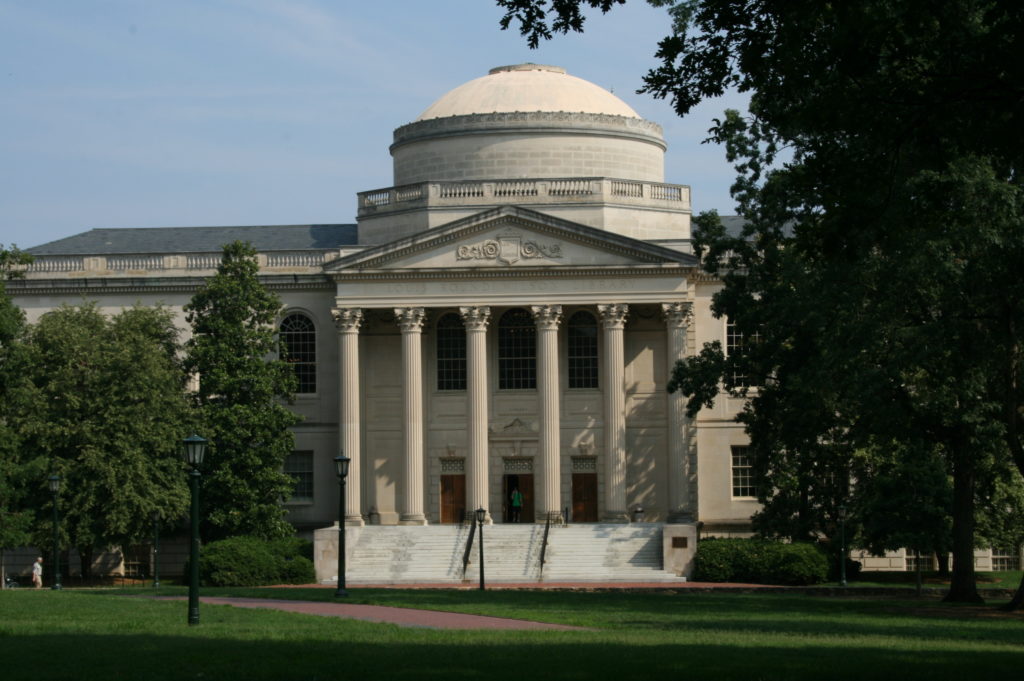
Rep. George Holding (R-Ga.) asked the Department of Education (ED), in an April 15 letter, to investigate if a $235,000 federal grant went toward an anti-Israel conference that was held at the University of North Carolina in partnership with Duke University.
On April 12, UNC Chancellor Kevin Guskiewicz issued an apology after a video came to light of rapper Tamer Nafer singing at the conference “I’m in love with a Jew” at the Conflict Over Gaza: People, Politics and Possibilities conference from March 22-24 at UNC. The conference was co-sponsored by the Duke-UNC Consortium for Middle East Studies, which had received a $235,000 grant in 2018.
Holding argued in his letter to Education Secretary Betsy DeVos that “the conference had a radical anti-Israeli bias.”
“Examination of the official program reveals that several of the conference’s speakers are actively involved in the Boycott, Divestment and Sanctions (BDS) movement,” Holding wrote. “Prior to the event, local religious and community organizations, academics and citizens wrote the universities expressing concerns that the conference lacked balance and appeared designed to promote a radical agenda. Apparently these concerns were ignored, with no mainstream speakers or panelists included in the three-day conference.”
Holding added, “If these reports are accurate, I have difficulty understanding why tax dollars should be spent on such an activity.”
Holding then listed a series of questions, including whether or not the ED has policies that prevents grants from going toward “organizations promoting a biased anti-Israeli agenda,” if any of the presentations promoted the BDS movement and/or glorified “acts of violence” and if any of the grant money went toward the conference.
“If the reports of extensive anti-Israeli bias are true, is that grounds to revoke the remainder the federal grant awarded to the Duke-UNC Consortium for Middle East Studies?” Holding asked.
Katie Younger, director of Global Relations at UNC Global, told the Journal in an email that $5,000 from the grant was used toward the conference.
ED Press Secretary Liz Hill told the Journal in a statement via email, “We have received the Congressman’s letter and are reviewing it.”
More in-depth coverage of the conference can be found here.
Education Dept. Asked to See If UNC-Duke Grant Went Toward Anti-Israel Conference Read More »

A Moment in Time: How Will YOU Make this Night Different from all other Nights? Read More »

The Passover seder is the most celebrated Jewish ritual in the world for the same reason “Avengers: Endgame” sold a record number of pre-sale tickets and likely will break all existing box office records: storytelling.
Everyone loves a good story. Yuval Noah Harari writes in his best-selling book “Sapiens,” that storytelling is what makes us human. Many species can communicate with one another but only we tell stories. Our epic stories and inspirational myths make us human. For much of human history, the best stories were told by religions — the incredible Jewish origin story is retold on seder night every year; today the best stories are told by Hollywood.
Superhero stories are modern mythology. They convey big ideas and lessons of morality through entertaining adventures. “Avengers: Endgame” concludes an epic story spanning more than a decade and nearly two dozen films. Stories of that magnitude tug at what makes us human, and our pilgrimage to experience superhero mythology at the multiplex is almost Pavlovian.
Every year, we go on a pilgrimage to our seder with family or friends to experience the wonder of our story. Passover is the Hollywood holiday, and we can learn a thing or two from Hollywood.
In many ways, modern mythology functions like ancient mythology. They share enough that the new illuminates the old and the old illuminates the new.
“Spider-Man: Into the Spider-verse” won the Academy Award in February in the animated feature film category and it’s one of the best superhero movies I have ever seen. Like all great stories, “Spider-verse” has many layers of beauty and meaning but one particular theme stood out.
“Passover is the Hollywood holiday, and we can learn a thing or two from Hollywood.”
Usually, a superhero is someone different than all of us but still a relatable character. There is only one Batman, one Wonder Woman, one Captain America and one Ant-Man. We might be able to learn from their stories but they are not like the rest of us. “Spider-verse” flips the script. Just before the credits, Miles Morales / Spider-man, says: “I never thought I’d be able to do any of this stuff. But I can. Anyone can wear the mask. You can wear the mask. If you didn’t know that before, I hope you do now.” 
Miles is saying that he is like the rest of us. We can all be heroes, and when we watch his story, it should feel like it can be our story.
I have always had trouble with a line in the haggadah — the seder screenplay. “Every person is obligated to imagine they are leaving Egypt this year.” How am I supposed to do that? Those people were different than me. I could learn from their story — although they are not like the rest of us. But I think I see it differently now. Anyone can wear the mask. Anyone can leave Egypt. It doesn’t have to be super heroic; it can be personal and unique. My seder experience will be different this year because of Hollywood.
But there are limitations to parallels between Hollywood and seder night. In 500 years, I am sure Jewish people will still be sitting at a seder. I doubt anyone will remember “Avengers: Endgame” or “Into the Spider-verse.” What is the secret to the seder that makes it stick? It is the combination of ritual with storytelling. A religion of only laws and rules would be doomed — who would sign up for that? A story with no strings attached sounds nice but without rituals, what’s the point?
The seder brilliantly intertwines storytelling with interactive ritual and that is what makes it even more powerful than passively watching a blockbuster film.
Chag sameach.
Eli Fink is a rabbi, writer and the former managing supervisor at the Journal.
Into the Sederverse Read More »
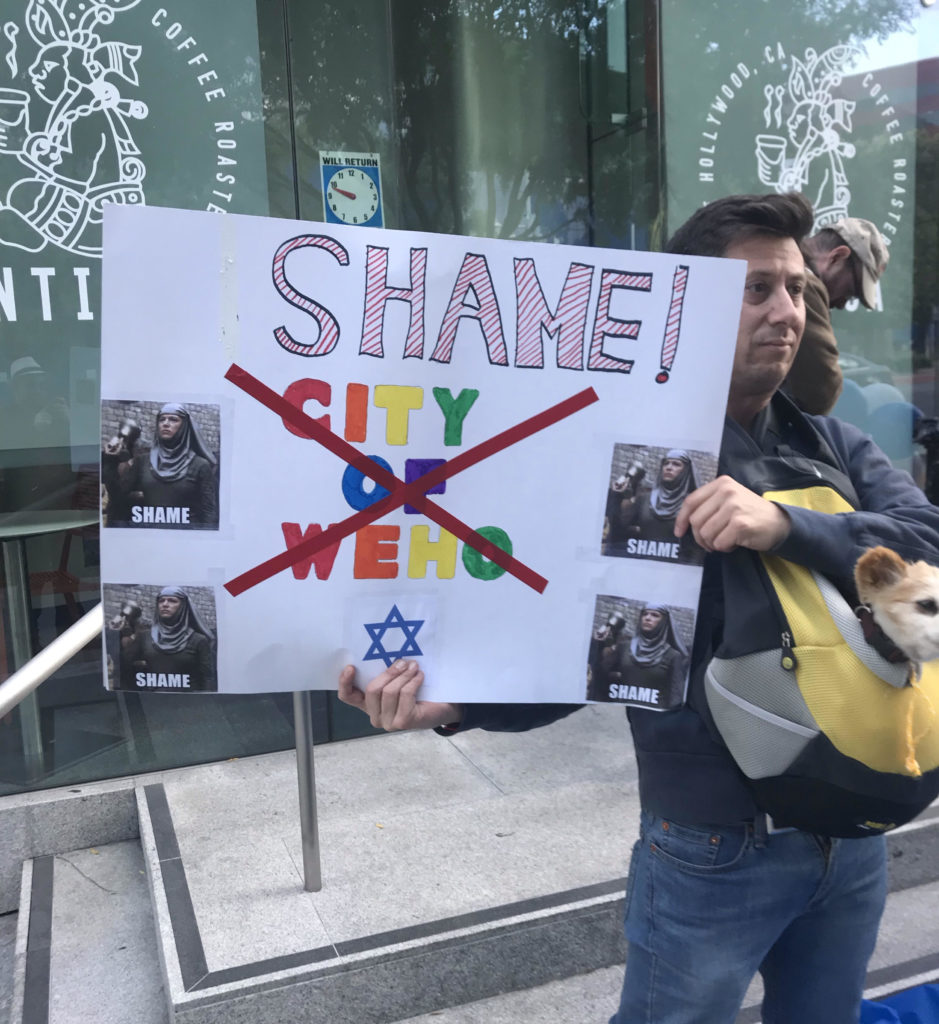
Members of the Jewish community held a protest outside of the West Hollywood City Council chamber on April 16 to protest the screening of the anti-Israel film “1948: Creation and Catastrophe.”
The protests were organized by a West Hollywood Israel coalition, consisting of Congregation Kol Ami, JQ, the Iranian Jewish Federation, Students Supporting Israel (SSI), A Wider Bridge, Israel Civic American Action Network and members of StandWithUs. Around 25 people joined the outside protest, which featured members of the coalition handing out Israeli flags to passersby as well as flyers highlighting the myriad inaccuracies in the film. Additionally, more than 70 members of the coalition attended the film’s screening and panel discussion afterward.
The flyers handed out pointed out that the film claims that Zionists committed “ethnic cleansing” against the Palestinians in 1948:
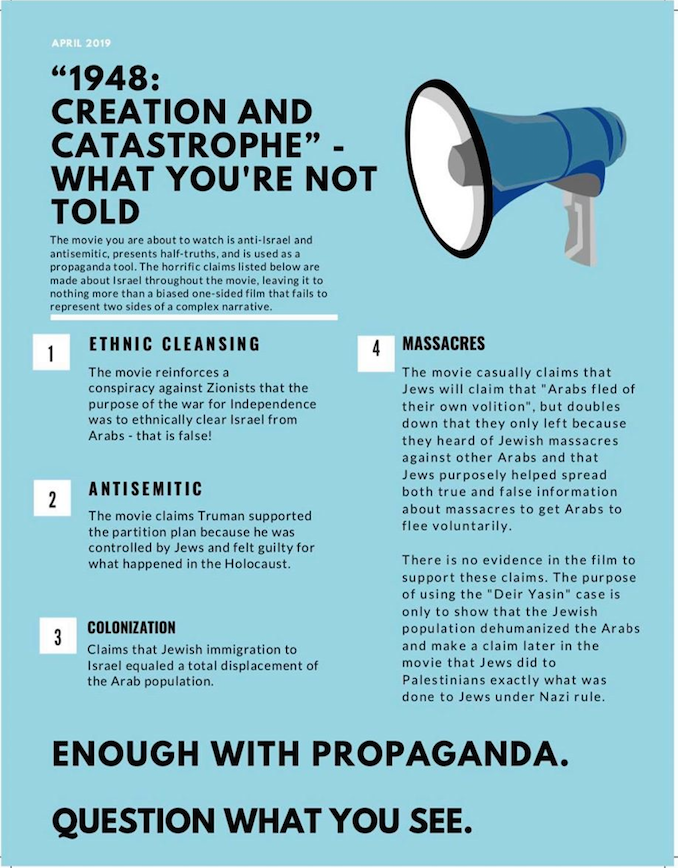
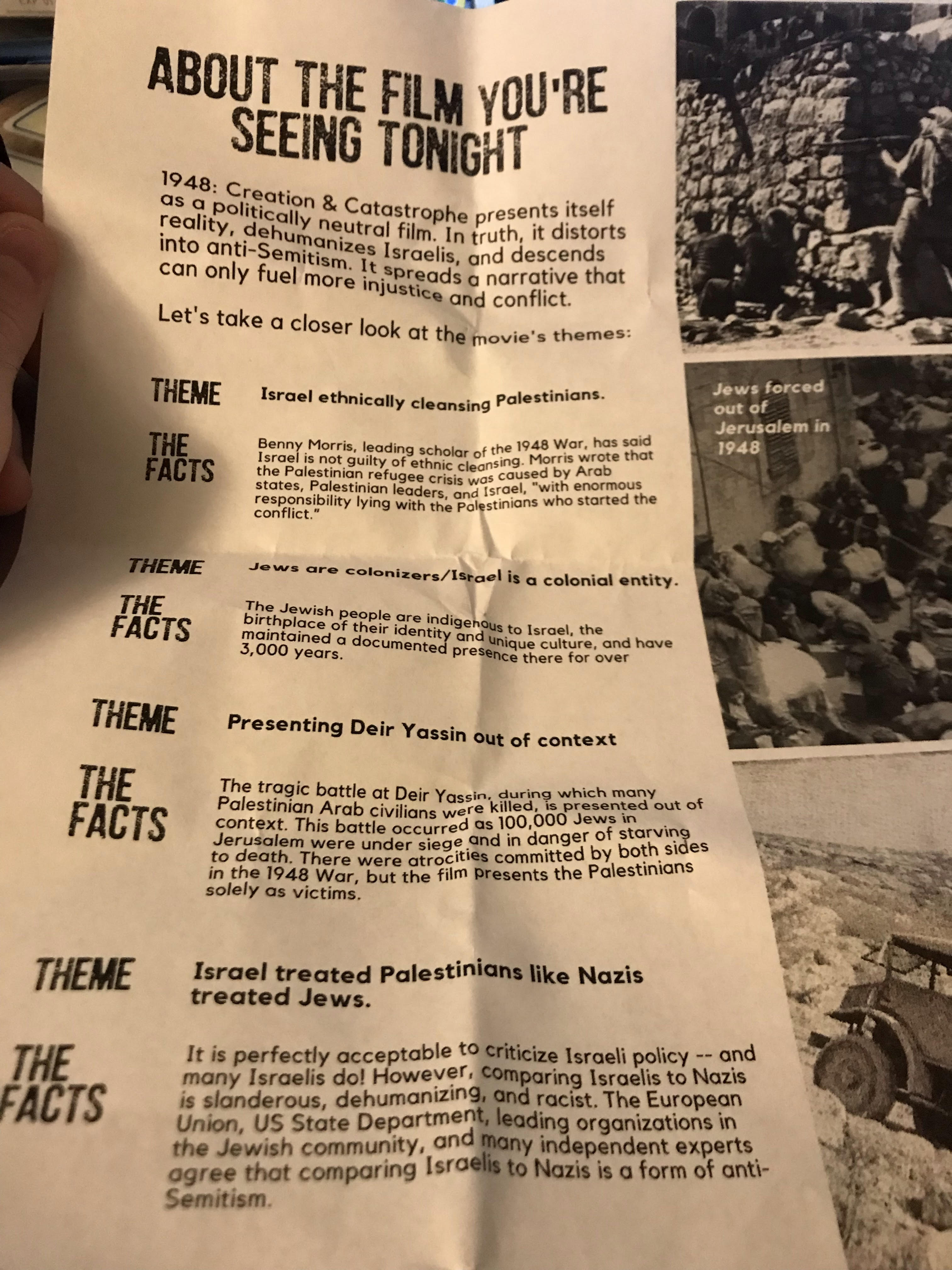
Sean Siegel, an alumnus of SSI and the organizer of the protest, told the Journal, “The protest is to get the city of West Hollywood to open their eyes at what this film truly is and represents, and that’s why we’re here. We want our voices to be heard.”
He added that by showing the film, the city council is not living up to its progressive ideals.
“They’re only showing one side, so the message that they’re sending to people is that we accept some people, not all people,” Siegel said.
Rabbi Denise Eger of Congregation Kol Ami told the Journal that she organized the coalition in December to lobby the city council against showing the film. The city council postponed the film from being shown on its original screening date, December 12, but the city council voted 3-2 on April 1 to show the film this month. City Councilmember Lauren Meister, who voted to postpone the film in December, voted in favor of showing the film in April.
Eger pointed out that the vote to postpone the film occurred before the March elections for the city council and the vote to screen the film occurred after the elections.
“I guess [Meister] was counting her votes and realized she was re-elected didn’t need the Jewish community’s support,” Eger said.
Eger said she hoped that the people passing by the protest “question what they see in the documentary.”
“The film is presented as a historical and authentic documentary with academics, and the truth is it’s filled with lies and exaggerations and distortions about the history of Israel and the plight of the Palestinians,” Eger said, “and I want the people to understand that the city of West Hollywood has really gone and done something that I think is very unsupportive of the Jewish community that has long been part of West Hollywood by sponsoring this film.”
Afterward, Eger told the Journal in an email that protesters talked to a lot of people passing by and that “most were shocked that the City of West Hollywood would sponsor such a film.”
“All were surprised at the one-sided nature of the panel, and for the city residents, that there was no process of community input into how a film gets selected,” Eger wrote.
The Journal attended both the screening of the film and the panel discussion afterward. No one on the panel challenged the film, and all dismissed criticisms that the film was anti-Semitic. In February, Debra Glazer, Orange County representative for StandWithUs, told the Journal that the film depicts Israeli Jews “war criminals and monsters, creating ill will and potentially putting Jews and supporters of Israel in danger.” She had seen the film at UC Irvine on January 31.
Mayor Pro Tempore Lindsey Horvath told the Journal before the screening that while she hadn’t seen the film, she was “disappointed and concerned about the discord that has been created in our community as a result of the choice for this film to be screened on the city’s dime, with city resources, and featuring speakers who support the BDS [Boycott, Divestment and Sanctions] movement, which is in complete contrast to the city’s policy of opposing the BDS movement.”
“I support people’s right to free speech, but I also believe that we deserve to live in safe communities,” Horvath said.
After the screening and panel discussion ended, Horvath told the Journal, “I think there was a clear point that was presented tonight and I look forward to another point of view being offered next month.”
Before the screening started, City Councilmember John Heilman told an audience of nearly 165 people that the city is looking into hosting a pro-Israel panel sometime in May.
Joe Sabag, the head of the Israeli-American Coalition for Action, told the Journal in a statement via email, “The propaganda used in ‘1948: Creation and Catastrophe’ is part of a systematic effort to promote bigoted and hateful perspectives about Jews. As history shows, this kind of propaganda eventually gives way to anti-Semitic discrimination, and ultimately persecution. It is extremely disturbing that the City of West Hollywood – a city otherwise known for standing against hatred and bigotry – went through with screening this film.”
Judea Pearl said in a statement to the Journal via email, “The incomprehensible blunder of the city of North Hollywood made me realize that my generation, the Counter-Holocaust Survivors of 1945-1948, is in danger of becoming extinct, and that the American public, Jews included, knows close to nothing about the intended Arab genocide of 1947-1948. Like European Holocaust survivors, we must bear witness.”
Jewish Community Protests WeHo City Council’s Showing of Anti-Israel Film ‘1948’ Read More »

(JTA) — This time, don’t be fooled by the rocks that she’s got — Jennifer Lopez is set to perform in Israel for the first time.
Concert promoters confirmed the rumor Wednesday. Lopez, 49, will play at Tel Aviv’s Hayarkon Park on Aug. 1.
The pop star and actress had been rumored to play in Israel in 2012 and 2016, The Jerusalem Post reported. It’s her first tour in seven years.
Jennifer Lopez to Perform in Israel for the First Time Read More »

NEW YORK (JTA) — In January, before a measles outbreak spread throughout Orthodox Jewish neighborhoods in New York, Channie Klor booked a Passover stay at a hotel in Pennsylvania for her family of seven.
Four months later, more than 500 cases of the disease have spread throughout the United States in an outbreak linked to Orthodox Jews, especially unvaccinated Hasidim who were infected. And the disease is highly contagious: A single Orthodox traveler from Israel, who went to Michigan via New York City, is alleged to have spread the disease to 39 people after he was misdiagnosed.
That left Klor with a dilemma: Stay home, immunize her 8-month-old baby early in the recommended range for the immunization or stay away from public areas for the length of her hotel stay.
It’s a calculation being made by many of the tens of thousands of religious Jews who will be filling hotels for Passover, dining and mingling in close quarters for eight days.
This year, program organizers in the Greater New York City area are trying to make sure that their clientele isn’t carrying the disease. None who spoke to the Jewish Telegraphic Agency said they were asking for vaccine records. But some said they had asked their guests to be vaccinated before they arrive at the hotel.
“We notified all the people that if they are not taking shots, they cannot come to our hotel,” said Rabbi Motty Katz, manager of the Katz Pesach program at the Long Island Hilton in Huntington, New York. “We’re going to be very strict on that. … If you don’t take a shot, don’t go to a public place.”
Rabbi Yitzchok Neger, one of the managers of the Passover program at the Wyndham Golf Resort in Lancaster, Pennsylvania, said he was “pretty confident we don’t have any virus or contagious situation where we are, with the guests we have.”
Most of his 1,300 guests are not Hasidim.
“Our guests are not coming from any of the Hasidic communities, so the other communities are very much in favor of it,” he said, suggesting immunization is more common in non-hasidic Orthodox communities. “A lot of our people are coming from places where the rabbis sent a letter to everyone that they should be vaccinated. Some of the shuls here had free clinics.”
Every year, kosher caterers and tourism companies rent out entire hotels for the holiday, providing guests with food, religious services, classes and entertainment. More than 100,000 Jews worldwide, mostly Orthodox, will be celebrating the holiday at a Passover hotel, according to Raphi Bloom, founder of TotallyJewishTravel.com, a website that serves as a clearinghouse for Passover vacation bookings.
The measles outbreak has been linked to low vaccination rates. Jane Zucker, assistant commissioner of New York City’s Bureau of Immunization, says largely Hasidic Williamsburg, in Brooklyn, has one of the lowest rates of vaccine coverage among young children.
Agudath Israel of America, which represents haredi Jews, insists that the Orthodox neighborhoods with outbreaks have vaccination rates rivaling those of “many other municipalities,” but that their communities may be more susceptible for other reasons: Its members travel abroad frequently and have tightly related social networks, as well as many children at ages most susceptible to the disease.
Asking guests not to come if they are not immunized is the best approach for hotels to take this close to the holiday, said L’via Weisinger, a member of Emes, Hebrew for “truth,” a new group of Orthodox nurses that encourages vaccination. Had Weisinger theoretically been able to set policy at a hotel, she would have asked every guest to vaccinate and then checked their immunization records at the door.
“You don’t have a right as a citizen to go to a Pesach hotel,” she said. “It’s private, so if they say ‘Unless you’re vaccinated, you’re not welcome,’ there’s nothing wrong with that. Here’s your money back. Whatever.
“With people mingling from all different communities, from all different programs, all different places, it’s like [opening] a feather pillow [and] gathering all those feathers back.”
In the end, Klor decided to give her baby an early MMR shot. In total, about 30 members of her extended family will be spending Passover at the Wyndham Golf Resort. Had she not been able to immunize her kids, she said, Klor would have spent the holiday keeping them out of the hotel’s public spaces.
“For a second, I thought, maybe we should rent a house instead,” said Klor, a nurse practitioner in South Bend, Indiana. “He’s premature, so I’m a little more protective of him. If I wasn’t able to get him that vaccine, I probably would have ended up going, but would be extremely uneasy the entire time.”
Even outside of the Passover hotel industry, the holiday leads to people crowding together on planes, in synagogue and in stores. A pre-Passover clothing drive in Baltimore required those attending to sign a legal waiver that they had been vaccinated. Klor said that in South Bend, people have been rushing to get vaccinated before the holiday.
“I am angered that I need to voluntarily subject him to more pain than should be necessary because I want to protect him from measles,” Klor wrote on Facebook, referring to her baby. “When you choose to vaccinate it’s about more than you, it’s a selfless decision that protects our most vulnerable population.”
How Hotels Hosting Thousands of Passover Travelers Are Dealing with the Measles Outbreak Read More »

The Obligation of Jews
For Jews, the recital of the event that brought the birth of their nation — the Exodus from Egypt — has never been just an exercise in melancholic nostalgia.
The concern of Jewish tradition has been not only that the experience of slavery in Egypt is passed on but that it continues in every generation as a call to action whenever a new king arises to oppress his citizens.
This isn’t too difficult of a task to accomplish.
We live in a time when people are dying so autocratic leaders might retain their power. Like the Pharaoh of old, many heads of countries today are insensitive to the miseries they inflict upon their people in order to satisfy their egomaniacal interests.
Slavery in the biblical tale would be a slightly exaggerated version of the reality endured today by most human beings in countries where those in power bask in splendor while they starve their populations.
The “throwing into the Nile of every boy that is born” is echoed in the modern pharaoh’s denying medical attention — the genocide happening under our watch of which nobody speaks.
If among those lucky ones living in fair and just societies there is the option to remain ignorant of the evil deeds of the “Pharaonic states,” for Jews that option is unthinkable.
By referring no fewer than 120 times to the Exodus from Egypt in the Tanakh, and by commemorating Pesach every year, Jews obligate themselves to become a caring, ethical community for the oppressed and the refugees.
Judaism comes at a price.
Faced with the current despair enveloping large swaths of humanity, where should Israel get the strength — the chutzpah — to go on believing that any group of human beings can be instrumental in bringing some redressing to the world?
Distinct from other ethics, Judaism’s morality is based on the premise that human rights are not entitlements, but the achievement of hard-fought human battles.
The crucial role of commemorating Pesach is for Jews to keep in mind that “Egypt” is not a place in the past but that it symbolizes actual places in many parts of the world.
The Exodus narrative teaches that no matter how terrible the situation may be, there is always a promised land, a place where people can eat, work, build and take care of a family.
Equally important is the understanding that the way to these promised lands requires first to cross a wilderness. And that there is no way to get out from exile to redemption except by joining together and marching.
The once-heard commanding voice of the God of Israel is heard today in the form of conscience. Those who listen to it are the Children of Israel and the multitudes with them.
Rabbi Moshe Pitchon, via email
Sowing Seeds of Jewish Pride
I was very glad to read Karen Lehrman Bloch’s column “The Power of Cool” (April 12). It laid out succinctly the issue of standing up against the anti-Semitic rhetoric that is flooding the United States and the world.
I agree with the writer that the music artist Noah Shufutinsky should be performing at schools, Jewish centers and universities to motivate young Jews to see themselves with pride, freeing them from the poisonous spin about Israel and our history.
My friends have been mulling over this for months and decided action is sorely needed. We are mostly Israeli Americans who love our countries and want to make a difference.
We have formed a team to network across the U.S. to help young Jews to become aware of the truth about our people. We are setting up action teams for communities in every city in the U.S.
Anyone who is interested in participating can contact us at femhil@aol.com.
Hila Abada, via email
Clear Vision of Israel
Gary Wexler’s extraordinary essay (“Can We Separate the Soul of Israel From Its Politics?” April 12) offers the most astute, erudite, brilliant and deeply resonant expression of Israel that I have ever read.
As a Jew, I cannot reduce Israel to a one-dimensional entity or idea whose failings are enough to cause my defection. Just as an American, I cannot reduce the United States to a one-dimensional entity or idea whose failings are enough to cause my defection.
I hope today’s young American Jews will see beyond their narrow and self-righteous angst to study and to learn Israel in all its history and modern expanse and not separate themselves from the community of the Jewish people.
Alice Greenfield, via email
Thank you, Gary Wexler for your beautiful essay on seeing and accepting Israel for more than the current political waves. Perhaps as “Gen Next” rears its children, it will mature enough to know that no person and no thing, including an entire country, is perfect and that you love them anyway. You look for the positive and stay engaged — you don’t walk away (aside from very extreme situations). Relationships are complex and require courage — especially one such as Israel and the Diaspora. A mature perspective understands this truth and rejects myopic and emotive political posturing. Wexler lays out some of the more uplifting aspects of Israeli society — and there are so many more. An entire issue of the Journal could feature essays about what people appreciate about Israel. Perhaps a call for short submissions (100 words max?) could create such a tribute.
Max Morris, Los Angeles
An Alliance That Can’t Be Justified
Rabbi Sarah Bassin seems to believe that Rep. Ilhan Omar (D-Minn.) is guilty of merely “stereotype-ridden language” and the Council on American-Islamic Relations (CAIR) merely “a Muslim-American civil rights organization” (‘Muslims, Jews Need to Support Each Other,’ March 22).
Not so: Omar and CAIR are Muslim supremacists who, like other supremacists, believe that anti-Semitic ideas constitute true insights into the nature of things and thus freely engage in such ideas.
That’s why Omar said in a since-deleted 2012 tweet that, “Israel has hypnotized the world, may Allah awaken the people and help them see the evil doings of Israel.” She viciously asserts that supporters of Israel are seeking to compel American lawmakers to embrace “allegiance to a foreign country” and that AIPAC bribes legislators to support Israel.
It’s no surprise that Omar has keynoted a CAIR fundraiser, given that CAIR is a Saudi-funded, radical Islamic organization whose founder is on record as praising suicide bombers and saying he would like the Quran to be the highest authority in America, and whose personnel have been implicated in crimes consistent with these positions.
CAIR has apologized for Osama bin Laden, employed three people subsequently arrested on terrorism-related charges, and declared its intent to make Islam dominant in America and the Quran the highest authority in the land. The U.S. Department of Justice listed CAIR as an unindicted co-conspirator in funneling millions of dollars to the terrorist organization Hamas.
Those who rightly expose Omar and CAIR’s anti-Semitism deserve our support, not criticism on the grounds of “Islamophobia” –– a nonsense term designed to invalidate any and all criticism of Islam and Muslims as hateful and irrational.
Morton A. Klein, National President
Zionist Organization of America New York
Letters: The Obligation of Jews, Sowing Seeds of Jewish Pride Read More »

Bernard Joseph Barton died March 22 at 78. Survived by son Tom (Dima) Trujillo; sister Carole Cox. Mount Sinai
Marial Beren died March 17 at 88. Survived by husband Daniel; daughter Helene (Bradley) Ross; son Evan (Paula); 4 grandchildren; 2 great-grandchildren; sister Rochelle Cohen. Mount Sinai
Steven Berman died March 19 at 71. Survived by wife Mary; daughter Michelle (Jose); son Joseph; 1 grandchild; brother Richard (Elizabeth). Hillside
Jed Brown died March 9 at 84. Survived by sons Mitch (Carole), Rick (Kristi), Dean (Meryl); sister Sandy Parton. Mount Sinai
Doris L. Carp died March 10 at 93. Survived by daughter Merry (Jay) Mulein; son Jeffrey; 2 grandchildren; sister-in-law Phyllis Levy. Mount Sinai
Fae Dragin died March 22 at 105. Survived by sons William (Judith), Burt; 3 grandchildren; 5 great-grandchildren. Mount Sinai
Melvin Ginsberg died March 15 at 91. Survived by son Michael. Hillside
Norman Goldberg died March 16 at 87. Survived by wife Debbie; stepdaughter Amy (Brian) Goldberg; stepson Daniel (Jenna) Flesch; 4 grandchildren; brothers Irving, Joseph (Lee). Mount Sinai
Russell Grossman died March 10 at 49. Survived by wife Davina; daughters Mikayla, Samara; son Asher; mother Sharon; father Irwin; sister Leigh Rachel (David) Nickoll; mother-in-law, Nira Gross; father-in-law Norman. Mount Sinai
Rose K. Halprin died March 20 at 104. Survived by sons Richard (Paula) Konecky, Douglas (Barbara) Konecky; 4 grandchildren; 2 great-grandchildren. Mount Sinai
Jacqueline Harrell died March 18 at 69. Survived by daughter Erin; stepdaughters Blair, Jaine; daughter-in-law Anika; 3 grandchildren. Hillside
Evelyn E. Joseph died March 9 at 99. Survived by daughter Linda Mathews; son Edward (Sandy); 2 grandchildren. Mount Sinai
Neil Kleeger died March 20 at 78. Survived by wife Amy Labrecque; son Evan Kleeger; sister-in-law Jennifer Smith. Mount Sinai
Deni B. Klunower died March 21 at 90. Survived by husband Henry; daughters Cheryl (Michael) Schulman, Shelby (Ronen) Roth; son Matthew (Callie); 2 grandchildren. Mount Sinai
Ethel Kramer died March 12 at 85. Survived by daughter Michelle; son David (Jeanne); 5 grandchildren; 5 great-grandchildren. Hillside
Pablo Kupersmid died March 20 at 55. Survived by wife Nancy; daughter Solange; son Kelby; mother Golda; brothers Ernesto, Adrian; brother-in-law Adrian Tylim. Mount Sinai
Shirley Law died Nov. 30, 2018, at 93. Survived by daughter Iris (Jakob) Malsman Keijer; son Robert (Marcy) Malsman; 3 grandchildren. Conejo Mountain Memorial Park
Elliot Levin died March 17 at 71. Survived by wife Alice; son Derek (Erika); stepdaughter Wendy; 3 grandchildren; brothers Richard (Olga), Murray. Hillside
Shirley L. Manson died March 14 at 90. Survived by sons Bruce (Susan Stern), Marshall; 1 grandchild. Mount Sinai
Charles Murdock died March 6 at 88. Survived by wife Rosette; son Charles; 2 grandchildren; brother-in-law Albert J. Benamou. Mount Sinai
Jon Nagourney died March 17 at 63. Survived by mother Jean. Hillside
Leroy Pucker died on March 16 at 83. Survived by son Scott; daughter Amy (Brett) Pucker-Barnes; 3 grandchildren; sister Betty Kalikow. Mount Sinai
Anne Robinson died March 21 at 94. Survived by daughter Molly; son Howard (Janis); 1 grandchild. Mount Sinai
Joan Rosen died March 16 at 85. Survived by husband Irving; daughter Jill (Robert); son Michael; 2 grandchildren. Hillside
Julius Rothschild died March 17 at 107. Survived by daughter Muriel (Jeff); 6 grandchildren; 14 great-grandchildren. Hillside
Kitty Saunders died Jan. 7 at 93. Survived by son Ron; 5 grandchildren; 5 great-grandchildren. Mount Sinai
Ludwig Schorr died March 9 at 91. Survived by wife Louise; daughters Helaine, Carolyn Weisz; 2 grandchildren; sister Sonya Krigsman. Mount Sinai
Joseph Irle Seskind died March 16 at 88. Survived by wife Sandra Orlijan Seskind; daughters Lori (Siavash) Gharieb, Wendy (George); son Scott (Juliet); 4 grandchildren; 5 great-grandchildren. Mount Sinai
Sidney “Sid” Sheinberg died March 7 at 84. Survived by wife Lorraine; sons Bill (Shoshana), Jon (Susie); 6 grandchildren; 2 great-grandchildren; sister Alice (John Richards) Schenk. Mount Sinai
Kenneth P. Sobel died March 17 at 74. Survived by wife Gloria; sisters-in-law Brenda Weinstock, Suzanne. Mount Sinai
Marilyn Sonners died March 11 at 88. Survived by daughter Leslie Gray; son Mitchell (Ginger); 2 grandchildren; brothers Fred (Carol) Tanenbaum, Jay (Marsha) Tanenbaum. Mount Sinai
Lorne H. Steiner died March 10 at 70. Survived by daughters Maren, Lindsey (Jonathan) Unger; 2 grandchildren. Mount Sinai
Ilya Tverye died March 5 at 88. Survived by son Gregory (Mila) Tverye; 1 grandchild; 2 great-grandchildren; sister Roza; brother David. Mount Sinai
Selma Venuti died March 12 at 91. Survived by daughters Debra (Larry) Winderman, Robin (Joseph) Rock, Carol Venuti-Morganstern; 5 grandchildren; 3 great-grandchildren. Mount Sinai
Emory Weltsch died March 16 at 104. Survived by wife Lucy; daughter Jo Ann “Jo Jo”; 2 grandchildren. Mount Sinai
Irving Samuel White died March 6 at 93. Survived by wife Joan; daughters
Judith (Barry Michels), Sarah (Chanon) Bloch; son David (Allison); 6 grandchildren. Mount Sinai n
Obituaries: April 19 Read More »

Pico Night of Freedom
Rabbi Yonah Bookstein and Rebbetzin Rachel Bookstein hold an inspiring first-night seder for young professionals and the community. The evening includes a retelling of the Exodus, singing, Torah insights and a reading of the haggadah in English and Hebrew. Organized by the Pico Shul, the seder is held at the nearby Community Shul. 7–11 p.m. $75 for single ticket. Remaining prices include sponsorships at $118, $360 and $1,000. Those unable to afford tickets, email rabbi@picoshul.com. Community Shul, 9100 Pico Blvd., Los Angeles.
Chabad Pesach
Chabad of Westwood’s first- and second-night seders discover historic but perhaps overlooked meanings in the haggadah. Enjoy hand-baked shmura matzo and a dinner spiced with traditional customs. 8 p.m. on April 19; 8:30 p.m. on April 20. $36 per adult, $18 per child. Chabad of Westwood, 741 Gayley Ave., Los Angeles. To order shmura matzo, call (310) 709-1556 or email zeldie@chabadwestwood.com.
Seeking a Seder?
Don’t be a slave to the kitchen. Instead, join Valley Village congregation Adat Ari El at its innovative first-night seder. The Conservative synagogue’s Rabbi Jonathan Jaffe Bernhard and other clergy lead the evening. 6–9:30 p.m. Members: $78 adult, $55 children under 13; General: $99 adult, $70 children under 13. Adat Ari El, 12020 Burbank Blvd., Valley Village. (818) 766-9426. Contact dweinberg@adatariel.org for more information.
Persian Seders
The Chabad Persian Youth Center in Pico-Robertson holds interactive seders rich in the traditions of Judaism. The back-to-back evenings are family-friendly. Handmade shmura matzo is served. 8 p.m. April 19 and 20. $50 adults, $25 children 3 and older. Chabad Persian Youth Center, 9022 Pico Blvd., Los Angeles. (310) 777-0358.
“Passover Seder Quest”
Find redemption in Venice Beach during Open Temple’s “Passover Seder Quest.” The quirky evening includes a “Seder Walk Through Venice,” matzo and puppet theater, goat yoga and more. Vegetarian and vegan food served. 4–8 p.m. Advance tickets are $50 for adults, $18 for children 12 and under; at the door, $55 adults, $18 children. Open Temple, 1422 Electric Ave., Los Angeles. (310) 821-1414.
Second Seder at BCC
Blending modernity and ancient traditions during a musical, second-night seder, Beth Chayim Chadashim offers a catered kosher-style meal that includes vegetarian, vegan and gluten-free options. This is an especially meaningful experience for LGBTQ Jews, families and allies as the haggadah tells a story of redemption and freedom that resounds for many in this LGBTQ congregation. 5:30 p.m. $54 for adult members, $72 for adult non-members, $36 for children ages 13–18, $18 for children 12 and under. For kosher meal options, add $60. Beth Chayim Chadashim, 6090 Pico Blvd. (323) 931-7023.
Seder at VBS
Valley Beth Shalom Senior Rabbi Ed Feinstein and Cantor Phil Baron lead a community seder featuring songs, afikomen for the children, and a kosher, catered meal. 6 p.m. Members: $75 for adults, $40 for children ages 5–12, $20 for children ages 2–4, free for children under 2; non-members: $95 for adults, $55 for children ages 5–12, $30 for children ages 2–4, free for children under 2. Valley Beth Shalom, 15739 Ventura Blvd., Encino. (818) 788-6000.
Family Seder Experience
A second-night family seder at Sinai Temple includes a full seder plate at each table, complete with dinner and dessert. Sinai Rabbis Nicole Guzik and Erez Sherman lead the program. 5–7 p.m. $45 adults, $30 children. Sinai Temple, 10400 Wilshire Blvd., Los Angeles. (310) 474-1518. Contact Rachel Polansky at (310) 481-3228 or rpolansky@sinaitemple.org for more information.
Beth Am Invites Everyone
Temple Beth Am Rabbinic Intern Ariel Root Wolpe leads the second-night musical and interactive seder at Temple Beth Am. Everyone — whether married, single, young or old — is welcome. 7:30 p.m. Adult members $60, adult non-members $65, $30 children ages 5–12, $20 children ages 2–4. Temple Beth Am, 1039 S. La Cienega Blvd., Los Angeles. (310) 652-7353.
Spago Seder
Spago Beverly Hills co-founder and owner Barbara Lazaroff hosts Spago restaurant’s 35th annual seder. The menu includes Spago’s famous oven-baked matzo, as well as Alaskan king salmon, braised beef short ribs, vegetable ratatouille and roasted Moroccan carrots prepared by chef de cuisine Tetsu Yahagi and executive pastry chef Della Gossett. Paired with kosher wines. Rabbi Arnold Rachlis, Cantor Ruti Braier and the West Los Angeles Children’s Choir participate. Proceeds from the evening benefit Mazon: A Jewish Response to Hunger, a national nonprofit working to end hunger among all faiths and backgrounds in the U.S. 5:30 p.m. $195 adults, $80 children under the age of 9. Spago Beverly Hills, 176 N. Canon Drive, Beverly Hills. (310) 385-0880.
Change and Justice Seder
Finding themes of social justice in the Exodus story, the National Council of Jewish Women holds a community seder affirming the group’s commitment to equity and fairness. The event begins with a wine tasting at 5 p.m. The seder follows from 6–9 p.m. $100–$5,000. National Council of Jewish Women, Los Angeles House, 543 N. Fairfax Ave., Los Angeles. (323) 651-2930.
“Global Justice Seder”
West L.A. congregation University Synagogue holds a “Global Justice Seder,” where attendees are asked to relive the Exodus and the Jewish people’s long walk toward freedom. The goal is to connect and compare the Jews’ journey from bondage with the crises of contemporary refugees. 6 p.m. $40 adults, $25 children 12 and under. University Synagogue, Klein Hall, 11960 Sunset Blvd. (310) 451-1980, Los Angeles. Contact Marilyn Weitz at cmweitz@incloud.com for more information.
What’s Happening: Passover Seders Read More »