fbpx

April 17, 2019

This Passover, Teach Your Children About Modern-Day Slavery

While enjoying a seder at a friend’s house, I watched a father tell his 5-year-old daughter the story of Passover. 

“The Jews were slaves in Egypt,” he said. “Do you know what a slave is?” The little girl didn’t. “It’s when someone else owns you and forces you to do stuff you don’t want to,” he explained. “Do you ever feel like a slave, Antonia?” She nodded, still mad that she wasn’t allowed to eat the macaroons before dinner.

Now, telling the story of Exodus isn’t quite like reading “Goodnight Moon” to your toddler. The story of Passover is graphic. It begins with an enslaved woman sending her baby down a river in hopes he will not be fed to crocodiles. But for our people, it’s necessary to put the kids in front of “The Prince of Egypt,” which portrays these horrors in cartoons (and an exceptional soundtrack) so they can understand the slavery we endured. Only that way can they understand the message of Passover: to value freedom and to break chains. 

In 2019, far too many chains remain locked. An estimated 40.3 million people are currently enslaved around the world, according to the International Labour Organization. That’s more than double the global Jewish population. 

The chattel slavery of the Israelites in Egypt is very much alive today. During the Libyan civil war in 2017, a video of men being sold at auction for $400 each went viral. In Mauritania, where slavery is illegal but widely ignored, local human rights organizations believe up to 20% of the population — 800,000 human beings — live in servitude.

Meanwhile, in other countries people are enslaved through debt bondage, in which those who borrow money are forced to work off the debt through forced labor, regardless how inhumane. This practice is primarily inflicted upon migrants, who are seized into servitude in exchange for stay permits. In Salerno, Italy, 35 people are being investigated for enslaving immigrants and earning 6 million euros off their labor. With the rise of anti-immigrant movements in the West, these populations are becoming increasingly vulnerable.

While Western policies place a tremendous burden on refugees to enter democratic nations, totalitarian governments are enslaving their own through conscription. The 2018 Global Slavery Index estimated that North Korea’s regime had shoved about 2.8 million of its citizens into labor camps, with men working in construction and women sewing in sweatshops. The New York Times reported that China is subjecting its Muslim and Jewish citizens to forced labor in internment camps, where they are sent to impose assimilation into secular Chinese life.

Meanwhile, in other countries, slavery has taken the form of child marriage. According to Anti-Slavery International, wedding vows often operate as a shield for those who wish to forcibly wed and exploit children into their adult lives. Regularly, underage girls are taken by warlords as tribute from their families. 

According to UNICEF, 400 million women in the world are married before they are adults, meaning 41% of the global female population is at risk of living in servitude. However, in 93 countries, bondage through marriage remains legal. Why? Authorities contend they are more concerned with heartbreak than human rights. One court in India defended child marriage because if it were outlawed “judges would be left to deal with broken hearts, weeping daughters, devastated parents and petrified young husbands … chased by serious criminal cases, when their sin is that they fell in love.”

But child brides don’t even understand what romantic love is. “I was so young I didn’t even know what marriage meant when I got married,” explained an underage bride from Bangladesh. “Even if I get money, I come home and give it to my husband. If I don’t give him the money, he beats me.”

However, slavery is not a foreign issue. It’s happening right now in the United States. 

Though we may dress it up as “human trafficking,” America is home to 400,000 slaves. 

“In 2019, far too many chains remain locked. An estimated 40.3 million people are currently enslaved around the world, according to the International Labour Organization.”

Rather than being forced to build pyramids, our people are being sold as sex objects. While some Americans engage in the industry of stripping, pornography and prostitution by choice, for many people, sex work is not a choice, it’s rape.

In most conversations about sex trafficking in the U.S., we assume the victims are Vietnamese women being shipped over in barges — refugees and immigrants who were brought into the United States by smugglers who now abuse them. This is a dilemma, but a great deal of sex trafficking survivors are American children. According to ECPAT-USA, a nonprofit working to end commercial sexual exploitation of children, the average age of a child who enters street prostitution is 12 to 14 years old. These children are either enslaved by their own parents or are kidnapped. Not only are sex trafficking victims subjected to regular sexual assault, but their enslavers often beat and starve them.

“In the dictionary, the definition of slavery is the ‘state of one bound in servitude.’ If someone sells you to someone else, is that not slavery?” said Tina Frundt, who was forced into prostitution by her boyfriend when she was 14. “If someone forces you to do things against your will and you are not allowed to leave, is that not slavery? Then I ask you why, when pimps traffic young women and girls on the streets of America, isn’t this a form of modern-day slavery?”

Of course, what people like Frundt go through is against the law. But it is still happening, widely unnoticed. It’s unclear exactly how many Americans are being trafficked for sex in the $150 billion industry. But when authorities bust rings of pimps and prostitutes, they often prosecute and detain trafficking victims for engaging in prostitution, even if they are minors, according to the U.S. State Department’s 2015 trafficking report.

If these modern-day slaves are convicted and imprisoned, the cycle of bondage doesn’t end, it just becomes legal.

Although slavery in the U.S. was outlawed in 1865, not all slavery is a crime. In fact, it’s how we punish crime. Through the mass incarceration of black and Latino Americans, the government has found a way to keep slavery alive.

“Neither slavery nor involuntary servitude, except as a punishment for crime whereof the party shall have been duly convicted, shall exist within the United States, or any place subject to their jurisdiction,” says the 13th Amendment to the Constitution, enabling slavery to remain as the modern prison system. The incarceration of black and Latino citizens is rampant because of a racist culture that depicts them as criminals and superpredators, a justice system that has harsher mandatory minimums for using drugs more popular in communities of color, and calculated crackdowns disguised as part of the war on crime and drugs.

For many, prison is not just a punishment but a means of enslavement. 

In Texas, Georgia, Alabama and Arkansas, incarcerated Americas are forced to perform labor for free. The Texas Department of Criminal Justice, which confines the largest population of convicted criminals in America, has its inmates raise, process and harvest livestock; manufacture soap and clothes; and cultivate 24 kinds of crops. Without making any income, prisoners work 12 hour days as painters, electricians, maintenance workers, cooks, custodians and dog trainers. 

The enslavement of predominantly black and brown Americans through mass incarceration is one of the most insidious forms of racism in this country. While in the past the Jewish, black and brown communities have bonded through our shared history of slavery, the legacy of slavery lives on for people of color.

There’s no doubt modern-day slavery is difficult to talk about, especially during your Passover seder. We all know it’s considered bad decorum to bring up politics during the holidays, especially conversations that involve heated topics like race, sex abuse, tyranny and immigration. 

But Passover, much like being Jewish, is inherently political. It’s not about eating matzo ball soup, it’s about paying homage to the trauma our ancestors survived. It is a ritual stand against slavery, which today, just like in the days of Pharaoh, is a symptom of government policies.

There’s a depraved stereotype that Jews care only about their own oppression. The best resistance to any misconception is to visibly demonstrate its falsehood. Politicizing Passover is our chance to show our empathetic humanitarianism. 

During these eight days, empowered by our history of slavery, we should take tangible steps to fight bondage in this modern world, whether by rallying against mass incarceration and the prison-industrial complex, advocating for survivors of sex trafficking, or simply spreading awareness. This means not just applauding our children for reciting the four questions, but asking ourselves even harder ones. 

How can we inform our little ones about the devastating realities of slavery in this century? How do we teach them to combat not just human trafficking, but also the blaming of its survivors? How can we persuade our lawmakers to institute alternatives to prison as the default penalty for low-level crimes? How can we causally tell the story of painting our doorways with blood and then discuss that blood and flesh is still being sold in Libya? 

Jewish children are outrageously strong. Despite knowing Santa Claus isn’t real, they resist the urge to tell their Christian classmates. They pretend that socks and underwear are substantial gifts. Before hitting puberty, Natalie Portman managed to star in blockbusters. At 11 years old, Naomi Wadler demanded more inclusivity in the national March for Our Lives movement. 

Jewish kids are not afraid of much, likely because once a year we tell them one of the most disturbing stories of all — our history. At each Passover table, as we break matzo and break down our history in Egypt, new children learn what a slave is. Although we might have cute finger puppets for each of the Ten Plagues, we’re still describing turning rivers into blood, boils, beasts and, of course, the murder of firstborn children. 

Judaism has so many practical and symbolic ways to discuss our history of enslavement. Whether munching on bitter herbs to remind us of the acrimonious life of a slave, or visualizing through Charoset the mortar our ancestors used to make bricks into pyramids, we’ve found a way to make bondage polite dinner conversation.

But there’s still more to discuss. 

Let’s start combating modern-day slavery — and start kids on the subject early. Jewish children are strong. We need them to help us free the 10 million other kids still in chains.


Ariel Sobel. is a nationally-recognized writer, filmmaker, and TEDx talker.

This Passover, Teach Your Children About Modern-Day Slavery Read More »

It’s Time to Update ‘Being a Blessing’

As we celebrate Passover and reflect upon our redemption story, we can only imagine what kind of message this story must have had for the ancient world. It challenged the fundamentals of the conventional life order, showing that the paradigm of slavery was no longer in control and, although it took quite a process with the Pharaoh, at some point the world learned that the dominant lifestyle in the Middle East and other parts of the world had come to an end.

The transformative message that emerged from the Passover story had a clear vision about the issues of power, abuse and freedom. Followed by an endless discourse about the meaning of freedom, this message affected humankind beyond the particular Jewish narrative. 

We are a people with a great past. But can we go on with only memories and success stories? Do we Jews have anything to say about contemporary life and, more important, about the future? Can we challenge any of the existing paradigms and contribute anything to humanity today?

Perhaps our greatest message to the contemporary world would be to demonstrate how Judaism and the Jewish lifestyle can embrace core human needs. To deliver this message, we will have to argue about some existing powerful paradigms that dominate the Western world. We will need courage to bless some paradigms and rebuke others. Moreover, we will need to “rebrand” the Torah and Jewish life so that Judaism stops being “a paradigm of survival” and embraces new understanding of meaning, well-being and happiness.

In this article, I will try to challenge some of our conventional views and will address the question that, in my view, should be at the center of Jewish thought and action: “Why do Jews and Judaism matter in the contemporary world?”

Among the foundational Torah stories about the origin of the world, the central one is the story of the Garden of Eden, which speaks in a symbolic language about the fundamentals of human existence. The Tree of Life (Etz Chaim) and the Tree of the Knowledge of Good and Evil (Etz ha-da’at, tov va-ra) are two such symbols. Etz Chaim implies vitality, creativity and love we possess; while Etz ha-da’at stands for duality, free choice and ethics. 

Eve and then Adam ate from Etz ha-da’at, which was prohibited to them, and since then a deep mystery has been imbedded in our reality: Etz Chaim, from which we were supposed to feed, has turned into the prohibited one and remained in the Garden of Eden from where we were expelled; whereas the forbidden tree, Etz ha-da’at, has become the center of our life and feeds us to this day.

The exile of the Jewish people further strengthened the centrality of Etz ha-da’at. For many centuries Judaism has focused on the language of good and evil. We have developed a wonderful set of ethical values to maintain family, community and people. Conserving and preserving our achievements has become the core of Judaism. 

In the 21st century, Jewish existence and vitality need to feed from Etz Chaim. It is this tree that encourages our pursuit of essentiality, well-being and meaning, and that defines how we eat, listen, speak, make love, deal with wealth and cope with sadness, loss and loneliness. It is the foundation for our leaders’ identity as well as for the leader within each of us. The reversal of the Etz Chaim–Etz ha-da’at paradigm will enable addressing the most challenging questions we struggle with today, the first and primary being: “Why be Jewish?” 

A while ago, I met one of the founders of Birthright Israel, who spoke proudly about the program’s extraordinary accomplishments. I was told that in just a few years Birthright will have a positive impact on Jewish demography, and the number of Jews in the world will significantly grow by 2025. I asked a simple question: “So what? Even if the number of Jews were to double, why does this matter?” Many great Jewish leaders aren’t asking this question. 

“The 21st century requires a paradigm shift: We need to strengthen the covenant of destiny and better understand the mission of the Jewish people.”

In Israel and the Diaspora, the Jewish world has an abundant variety of programs whose major aims are to engage Jews in Jewish life and community. With their sophisticated strategies and creative ideas, many great Jewish leaders, thinkers, educators and philanthropists participate in worldwide efforts to ensure Jewish continuity. For many years, I have devoted myself to Jewish education and pluralism in Israel, and I have gained vast experience dealing with Jewish values and their relevance in our era and with the issues of Jewish peoplehood and continuity. 

In 2017, I took a sabbatical to reflect upon my work, as I had begun to feel strongly that I had been part of a paradigm that needed a major review. After long contemplation and numerous discussions, I thought of what has become the crucial question for me and my colleagues regarding the Jewish mission today: Why be Jewish?

Without understanding the added value of Judaism and the Jewish people in the 21st century, we won’t find any meaningful arguments for why a person would choose to belong to the Jewish people and why Jews should remain a people. Our postmodern world has almost broken with the notion of a single, national identity to embrace universal values of humaneness and social justice. Even the concept of tikkun olam is no longer exclusively Jewish, as many wonderful non-Jews have taken upon themselves the common tikkun olam values.

In “Kol Dodi Dofek: Listen, My Beloved Knocks,” the great essay of 1956, Rabbi Joseph Soloveitchik wrote that the Jewish people live under two covenants that are formative for Jewish identity: the covenant of fate (brit goral) and the covenant of destiny (brit ye’ud). The covenant of identity was born from the experience of slavery in Egypt and implies a shared history of persecution and suffering; it was imposed on Jews by the outside world and unites us in the face of hostility. The covenant of destiny started at Mount Sinai, when the Jews chose to become God’s people. Under this covenant the Jewish people have our own voice and will, and we understand our historical mission is to be “God’s witness” on Earth (Isaiah 43:10-12).

The tragedies our people came through in the past centuries deepened and strengthened the covenant of fate. And so today, every act of terrorism committed against Jews — like the recent massacre at the Pittsburgh synagogue, every manifestation of anti-Semitism in Europe, and every terror attack in Israel — makes this covenant ever stronger, as Jews around the world identify with the tragedy and show their solidarity. American Jewish federations raise the most money in years of wars and tragedies. Even such important issues as assimilation and attitude toward Israel ultimately belong to the psychological mode of the covenant of fate and the paradigm of our people’s survival.

The 21st century requires a paradigm shift: We need to strengthen the covenant of destiny and better understand the mission of the Jewish people. Professor Martin Seligman, founder of positive psychology, stated the issue to me with this question: ”Can we be nourished with energy and motivation stemming from the vision of the future and not only from the past?” Indeed, can we imagine an annual campaign that raises money for the vision and future of the Jewish people?

Many thinkers worldwide assert that a fresh mindset is needed to deal with such serious emerging issues of our time — as, for example, the growing gap between the development of technology and the development of human beings. During the last century, technological innovation has created dramatic changes in the daily lives of much of the world’s population. Yet, alongside the phenomenal improvement in our material well-being, many of us suffer from a significant and consistent decrease in our emotional, mental and social well-being. We have lost the art of face-to-face contact and knowing the quality of intimacy. More and more people experience loneliness, anxiety, loss of direction and hope. Apparently, the daily struggle for survival that had been the central issue of human culture has been replaced with higher fundamental needs of belonging, esteem, personal meaning and self-actualization. 

These are the precise issues the “living Torah” should deal with. What does our tradition have to contribute to the existential questions of intimacy, loneliness, pursuit of wealth or dealing with power? Indeed, what is the mission of the Jewish people today? 

The good news is that the answers have always been there — since the very beginning of the Jewish story. The first words God addresses to Abraham — “Vehye bracha” (being a blessing) — imply this mission: “Go forth from your country … And I will bless you … And you shall be a blessing … and in you all the nations of the Earth will be blessed (Genesis 12:1-3).”

What does it mean “to be a blessing”?

Vehye bracha is the “post–Garden of Eden” call for vitality, prosperity and meaning, which asserts that their source is not only from God but also from all human beings created in God’s image. The role of Torah and mitzvot is to define accurate measures for the endless abundance of life forces, so that human beings and the environment will be blessed, not abused. 

Unlike Sabbateanism and the New Age movements that imagined the world without boundaries, vehye bracha realizes that there is no return to the Garden of Eden; rather, we must be rooted in reality, responsibility and ethics. 

Vehye bracha is not a set of values, but rather a 24/7 mindset that places the qualities of Etz Chaim at the center of human existence and impacts all our inner emotions and external behavior. To internalize this mindset requires serious work, but it is rewarded with the wonderful gift of abundance and “oneg” (a unique Hebrew word for high-level joy and happiness), and can add a new dimension to the notions of relationships, responsibility and love. Shabbat is the source of bracha. We must add to Shabbat the elements of Etz Chaim and make it the “Jewish workout day” for exercising bracha and oneg.

The Jewish people were called on to live a life of bracha, and by this they will be a model for all the families on Earth. As it appears in the very first verse of “Lekh-Lekha,” the blessing starts with an individual’s growth and develops onward to the family, the community, the nation and the world. There’s no social growth without personal growth, and personal growth should lead to social growth. 

We must start imagining what a blessed economy, media, leadership and politics can be about. The latest elections in Israel made us clearly understand that we need leadership that can create a vision for the future and not only suggest solutions for current problems. Can we imagine a discussion about a “blessed Jewish State” and a “blessed Jewish community” as a shared agenda for Jews worldwide? This may become the novel concept for the new Jerusalem and Babylonian Talmuds to deal with. Vehye bracha should become the central theme of Israeli-Diaspora dialogue both on individual and communal levels. 

“We must start imagining what a blessed economy, media, leadership and politics can be about. The latest elections in Israel made us clearly understand that we need leadership that can create a vision for the future and not only suggest solutions for current problems.” 

The 21st century is the first time in our history when the particular Jewish story can enter a true and healthy dialogue with the world and address the universal questions of human existence. The way we speak, the way we work, the way we organize our political institutions and our media, the way we perceive the blessing of our body and our sexuality — all can be reviewed today through the bracha lenses to give a new meaning to Isaiah’s words: “Light unto the nations” (Isaiah 41-42; 49; 60). 

We conclude our Passover seder with “Le-shanah ha-ba’ah be-Yerushalayim” (“Next year in Jerusalem”). For thousands of years of exile, this was a prayer for an end of the exile and return to the Land of Israel. Today, when we have the Jewish State with Jerusalem as its capital, “Next year in Jerusalem” stands for our hope and calls for a fresh discussion about the “Why?” question, our future and how we can contribute — in dealing with the questions of meaning, fullness of life and well-being — to the world of bracha.

Le-shanah ha-ba’ah be-Yerushalayim!


Rabbi Mordechai Bar-Or, the founder and past president of Kolot, a study center for social action leadership, has served as a personal rabbi and mentor to many leading Israeli figures including President Shimon Peres. Today Mordechai Bar-Or is a co-founder of a new  Innovative Research Center “V’ehye Bracha” dealing with the themes outlined in the article, from both philosophical and educational perspectives.

It’s Time to Update ‘Being a Blessing’ Read More »

Participating in Our Own Redemption

One day you wake up after years of being painfully trapped in an untenable situation and realize you can’t take it anymore. Your friends have told you to make changes. Secretly, you hoped that someone would swoop in and save you. You’ve gone to bed crying many times, thinking, “Help me, God.” 

Finally, you realize that the pain in staying is worse than whatever unknown is on the other side. So you hurriedly gather your things because you know that if you don’t make the change now, you probably never will. This is your moment and you take it. 

You are saved. In Judaism, we call this redemption (geulah) and this, my friends, is the core spiritual lesson of Passover. After 400 years of slavery, we collectively wake up, take action and are delivered into freedom. 

While growing up, I thought that the Exodus story was “just” one of God’s miracles. Dayenu. But a closer reading reveals a more powerful spiritual teaching that is hidden below the surface. The lesson is that even at our most vulnerable, we must participate in our own redemption.

We begin this story right before the last plague, God’s ultimatum to Pharaoh that if he doesn’t let us go, Egypt’s firstborns will die.

God instructs us to sacrifice a lamb and smear the blood on the doorposts of our homes (the pascal offering). We are not passive observers. No, we must act. And when we do, we need to be ready to leave, with “our loins girded and sandals on our feet.”

“After 400 years of being slaves, we must slay the god of our oppressors.”

And here is where we need to pay close attention. The Torah text says, “… the blood on the houses where you are staying shall be a sign for you: when I [God} see the blood I will pass over you, so that no plague will destroy you when I strike the land of Egypt.” (Exodus 12:13)

Does God really not know where the Jews live? Does that sound like the all-knowing, all-seeing, omnipresent God? And why must we commit such a severe act?

The key word here is “you.” Putting the blood on the doorposts is the action we must take to show ourselves that we were ready to be free. Once we act on our own behalf, then God will pass over our house.

Why a lamb? We learn from Maimonides that “the Egyptians worshipped Aries and therefore abstained from killing sheep …” Aries symbolized the ram, an Egyptian god.

After 400 years of being slaves, we must slay the god of our oppressors. Looked at in this way, the Passover sacrifice is a profound act of civil disobedience from which there in no return. No mystery why they needed to eat hurriedly and be ready to flee.

Our ancestors had to step out of the pain that they knew into a vast uncertainty. As poet Marge Piercy wrote, it takes “… courage to walk out of the pain that is known into the pain that cannot be imagined, mapless, walking into the wilderness, going barefoot with a canteen into the desert …” 

This is how we must read the story of Passover — not as history, but for the deep spiritual truth that we must participate in our own redemption.

The spiritual wisdom of the Exodus is relevant every day of our lives.  Rebbe Nachman of Breslov recognized this when he said: “The Exodus from Egypt occurs in every human being, in every era, in every year and even on every day.”

For all the times that we have been in painful places and deeply wanted someone to save us, the truth is that other people might play a role, but unless we are willing to take the first courageous step, we will never be free. 

It is we who need to make the phone call to get help, say no to toxic relationships or to a job that is destroying the soul. 

No matter the situation, the process is the same.

What is holding you back this Passover? What brave step will you take on your own behalf? Chag sameach.


Rabbi Jill Zimmerman is the rabbi and spiritual leader of Hineni Mindfulness Community and Path With Heart. Sign up for her and Rabbi Cindy Enger’s daily Omer reflections here: eepurl.com/dpZm5r.

Participating in Our Own Redemption Read More »

Passover Is the Beginning of the Journey

Passover begins the evening of Friday, April 19. Thousands of Jews throughout the world will gather around their tables to share a seder, the ceremonial meal characterized by questions, stories, songs and rituals.

It is the first of three important holy days, (including Shavuot and Sukkot), which are called Shalosh Regalim, literally the three walking festivals. Torah instructs the “men” to travel to Jerusalem to bring offerings to the Temple. “Three pilgrimage festivals shall you celebrate for Me … Festival of Matzot … Festival of the Harvest … and the Festival of the Ingathering … the choicest first fruit of your land shall you bring to the House of HaShem.” 

After the Temple was destroyed, the rabbis maintained these three essential holy days and gave them new meaning. Judaism, sans a sacrificial cult, needed to be redefined — the purpose of Jewish life, core principles and new customs and rituals — to ensure its future. With Torah at the center, and prayer, study and new rituals replacing the offerings, we inherited a dynamic and rich tradition that supports and encourages multiple interpretations of how to understand God’s words and our path to expressing tradition.

Passover essentially celebrates our liberation from slavery. And yet it is profoundly connected, seven weeks later, to Shavuot; one leads to the other. The goal of the gift of our freedom is to direct us toward Mount Sinai, where we received Torah and formed a covenant with HaShem. Passover lasts eight days but on the second night, we begin to prepare ourselves to stand “as if” we were at Mount Sinai ready to receive Torah. These seven weeks are called Counting the Omer.

The operative word is pilgrimage. It is no longer to the Holy Temple but a journey of shared memory and reinterpretation and inner exploration. We hear the call and we gather to confront, with family and friends, our past and what it means for our future. What is our responsibility, as receivers of the gift of freedom, to others who are still enslaved? We are reminded by the taste of maror (strong horseradish) of the bitterness once in our lives, but for some, life is bitter today. There may be health issues, grief, ugly divorces, psychological or financial challenges, or political realities. Can we sweeten them, the way we add Charoset (apples, nuts and wine) to the maror?

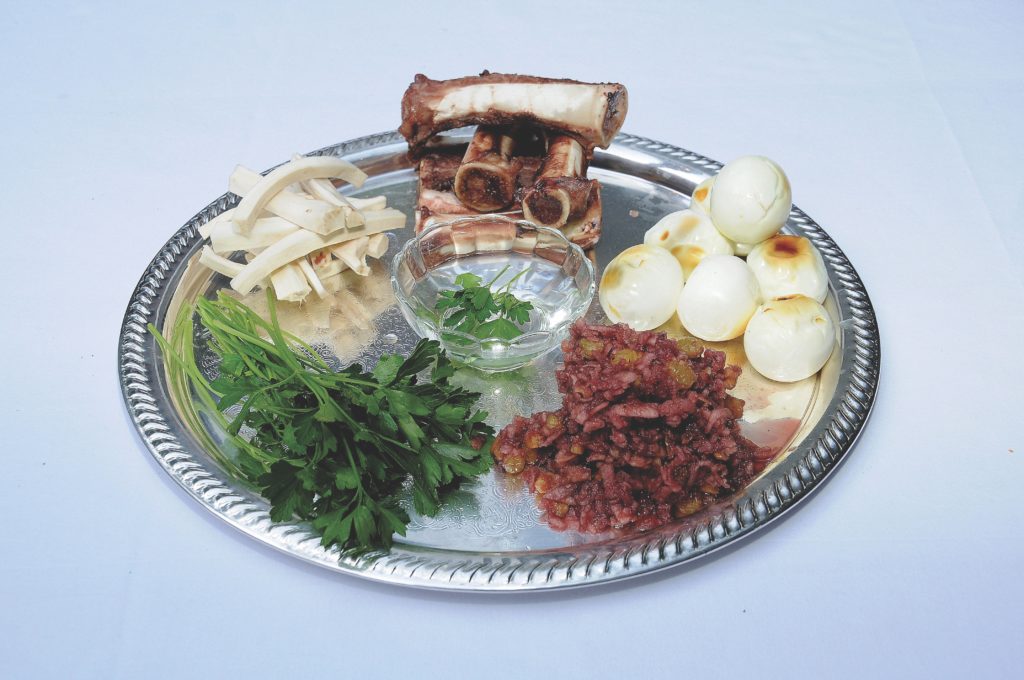
We place a shank bone, symbol of the Temple offering, on the seder plate, yet what are the offerings we are willing to make today, the gifts to express our gratitude to the Holy One for our good fortune? We eat the matzo, the remembrance of both our burdens and our liberation, but do we see it as a metaphor for simpler times and purer spirit when we purge ourselves of unused and unwanted items, or when our egos are in check and better understood?

When we see Elijah’s Cup, do we question what our role is in bringing redemption? For those who haven’t really paid attention, isn’t it time to question where are the women, so essential to the Exodus story that Talmud states, “Israel’s deliverance was in reward for the righteous women”? Or have a cup of water on the table for Miriam, remembering, because of her merit, there was a well of water that followed the people in the desert? 

As we face so many worldwide crises and watch as hate, lies, corruption and power run rampant, perhaps our seders should focus on what freedom really means, the responsibility it brings and how to ensure it continues. With the current onslaught of anti-Semitism, how do we navigate being Jewish in the most secure home in our history when it, too, begins to feel unsafe? Is Egypt truly a thing of the past?

A pilgrimage is a holy journey, a search of moral and spiritual significance. Each holiday is an opportunity to travel deeper into the past, yet elevate the conversation for the present. Passover begins in shared memory and conversation; the second night, we count the Omer, a personal exploration, a way to bring healing and wholeness.

May you have a sweet and uplifting Passover.


Eva Robbins is a rabbi, cantor, artist and author.

Passover Is the Beginning of the Journey Read More »

In Every Generation…

Good stories begin with the words, “Once upon a time.” They take place in a single point in history, a moment that is remembered and retold. Great stories happen in an eternal present, a drama that we enact with our lives. The Exodus is one of the latter, as the haggadah tells us, “In each and every generation a person is obligated to see themselves as a personal participant.”

I learned the difference between these two kinds of stories from professor Michael Walzer, whose book “Exodus and Revolution” (1985) I return to each year before Pesach. In it, Walzer recalls attending a service at an African-American church in Montgomery, Ala., in 1961 while researching the sit-ins and Freedom Rides of that era. The pastor sermonized on the Exodus, and Walzer came to understand that the story isn’t owned by Jews; it belongs to people of many faiths who have used it to describe their own yearnings for liberation.

Walzer explains that all of the cultures and movements that have drawn inspiration from the Exodus have come to understand its three core principles:

First, “wherever you are, it’s probably Egypt.” In every society, there are elements which are oppressive, tyrannical, “Egyptian.” Often they are well hidden behind a false façade of normalcy. 

When I was an undergraduate at UCLA, my younger brother visited me. At that time, he was a teenager obsessed with designer sneakers. When I asked what he wanted do in Los Angeles, he said he wanted to visit Rodeo Drive and check out boutiques featuring shoes that retailed for thousands of dollars. I obliged, and we spent an hour walking the streets of Beverly Hills, peering in windows. When I couldn’t take it any longer, I drove him from 90210 to downtown’s Skid Row. I made him get out of the car and walk around, roaring at him: “You think Rodeo Drive is Los Angeles — this is Los Angeles!” 

While the memory of my college freshman political “wokeness,” now makes me want to cringe, I recognize in it a hint of Walzer’s teaching. Los Angeles has presented itself as Eden — the paradise of palm trees where the sun always shines. Of course, we know that underneath this thin veneer lies incredible brokenness — homelessness, hunger, violence and profound inequality. I suspect ancient Egypt probably wasn’t so dissimilar. The Exodus story teaches us how to look deeper and recognize the oppression that often exists right before our eyes.

“We are one another’s marching partners on the journey from Egypt to Promised Land.”

Walzer’s second principle is “There is a world more attractive, a better place, a Promised Land.” If the only thing that we draw from our narrative is that the whole world is Egypt and always will be, then we have no incentive to try to make it better. Yet, the Exodus story is one of an escape from a brutal reality. The world as it is isn’t the world as it must always be, and so it’s worthwhile to struggle and even suffer to bring about the change we envision. 

How do we do that? Walzer answers with his final rule: “The only way to the Promised Land is through the wilderness, there is no way to get there but by joining together, and marching.”

As director of the Miller Introduction to Judaism Program, each year I meet more than 300 students who are exploring the role that Judaism might play in their lives. I tell them all that, for me, Walzer’s final rule is the job description of every Jew. We are one another’s marching partners on the journey from Egypt to Promised Land. We are all responsible for helping one another to make it across. Months later, when I sit in on their beit dins, I often hear them talk about that moment as one of the decisive ones in their journey to becoming Jewish.

This year, like every year, we’ll gather to tell our sacred story, which didn’t take place “once upon a time,” but rather “in each and every generation.” We are still very far from the Promised Land, but with marching partners like the ones who will fill our seder tables, we have a pretty good chance.


Rabbi Adam Greenwald is the director of the Miller Introduction to Judaism Program at American Jewish University.

In Every Generation… Read More »

Israeli Rabbinical Court Rejects the Jewishness of Orthodox US Convert’s Son

JERUSALEM (JTA) — A rabbinical court in Israel rejected the Jewish status of a man whose mother converted to Judaism in the 1970s and had the conversion reaffirmed last year by the Beth Din of America.

The woman converted in the United States in an Orthodox rabbinical court certified by the Beit Din of America, which is included on the list of international rabbinical courts approved by the Chief Rabbinate of Israel for conversion.

Her son had submitted a request to be registered for marriage through the Tel Aviv rabbinate. Since his mother was a Jew by choice, he was forced to undergo a Jewish status investigation. His request for marriage was denied.

Several years ago, his brother was married through the Chief Rabbinate and his Jewish status was not challenged, The Jerusalem Post reported.

All the rabbis that served on the mother’s conversion court are dead.

Itim, the Jewish Life Advocacy Center, has appealed to Israel’s Ashkenazi chief rabbi, David Lau, to overturn the decision.

In November, the Office of the Chief Rabbi published lists of rabbis and rabbinical courts whose authority it accepts for purposes of conversion and divorce after six years of requests, lawsuits and Knesset hearings led by Itim.

Rabbi Seth Farber, the director of Itim, said the Office of the Chief Rabbi is ignoring its own list of recognized rabbinical courts, “confusing everyone involved.”

“This is an intolerable situation in which the State Rabbinate is discriminating against converts, disregarding its own standards, violating Halacha, and defying normative Orthodoxy,” he said in a statement.

Israeli Rabbinical Court Rejects the Jewishness of Orthodox US Convert’s Son Read More »

Jerusalem Court Orders Deportation of Human Rights Watch Director in Israel

JERUSALEM (JTA) — The director of Human Rights Watch  in Israel must leave the country by May 1 after losing his appeal against deportation.

The Jerusalem District Court ruled Tuesday that Omar Shakir, the agency’s Israel and Palestine director, supported the boycott of Israel and of Israeli settlements in the West Bank. A 2017 law bans from Israel those who publicly call for boycotts of the country.

Shakir’s appeal was the first legal challenge to the law.

Human Rights Watch said that neither it nor Shakir as its representative has promoted boycotts of Israel.

The Interior Ministry had compiled a seven-page dossier to support its deportation order against Shakir. Much of the dossier covers a time period before Shakir assumed his position at Human Rights Watch, including much of his time at Stanford University.

When Shakir, a California native, was appointed to his position in February 2017, he was denied both a work visa and a tourist visa. He was allowed entry to Israel a month later — on the same day the Knesset passed the law banning entry to foreigners who publicly call for boycotting the Jewish state or its settlements. The following month he was granted a work visa.

Last May, the ministry denied Shakir a new work visa and ordered him to leave the country. The Jerusalem District Court issued an interim injunction ordering the Interior Ministry to allow Shakir to remain in the country until the end of legal proceedings.

Jerusalem Court Orders Deportation of Human Rights Watch Director in Israel Read More »

500 Doctors Who Serve US Jewish Communities Sign Letter Urging Vaccinations

(JTA) — Some 500 doctors who serve Jewish communities across North America have signed on to a letter calling on all children and healthy adults to be vaccinated.

“We the undersigned doctors who faithfully serve the Orthodox Jewish communities of North America, strongly urge all members of our community to receive all recommended vaccinations,” the letter begins.

The letter is signed by doctors from states including New York, New Jersey, California, Florida, Texas, Arizona, Ohio, Illinois, Pennsylvania, Michigan, Missouri, Minnesota, Massachusetts and Wisconsin, as well as Toronto and Montreal. It calls on individuals and Jewish communities to work together to “prevent harmful diseases from spreading.” ‎

“We are aware of the dangerous misinformation campaign being spread and reject any unproven unscientific statements that contradict all available current science-based studies on vaccinations,” the letter says.

The letter is being featured in a mass information campaign to the Jewish community about vaccinating, the Yeshiva World News reported.

The majority of Orthodox Jewish children are vaccinated, according to statistics issued by the New York state and New York City health departments. There is no religious reason to not get vaccinated, and prominent rabbis in New York have called on their followers to vaccinate their children.

The United States has confirmed 555 measles cases in 2o19, the Centers for Disease Control and Prevention announced Monday. That’s 50 percent higher than the total number recorded for 2018. The majority of the cases are centered in New York City and its large haredi Orthodox community.

500 Doctors Who Serve US Jewish Communities Sign Letter Urging Vaccinations Read More »

The Beauty of Order

I’ve spent much of my life rebelling against order. My dad wanted me to go into the security of advertising, so I went into the mosh pit of journalism. My mom wanted me to settle down in my 20s, so I ran away from any guy who emitted “marriage material.” Spreadsheets give me a headache.

The older I’ve gotten, the more I’ve realized that order isn’t so bad. In fact, it offers many underappreciated benefits, like creating masterful films and paying your rent on time. Order actually offers more freedom, not less. As French Rabbi Marc-Alain Ouaknin put it in a very special haggadah he created with artist Gerard Garouste: “It is a paradox of liberty that it can only be attained within the framework of order, of rules, of words and symbols of extraordinary precision.”

The word seder, of course, means order. The rules of the seder ceremony — a 14-stage recital — were codified in the Talmud around the second century C.E., at a time when Roman culture was dominant. “This ceremony”, writes Ouaknin, “whose form lies somewhere between theater and liturgy, is an apprenticeship in liberty and creativity through play, questions, mime, song, and an ensemble of symbols.”

Once the seder was codified, it was never changed. “And as astonishing as this may appear,” writes Ouaknin, “Jews today, once a year, behave in a manner connected with second century Roman civilization.”

The use of rituals to celebrate freedom was brilliant, predating the theories of both liberalism and aesthetics. Both reiterate the concept that true liberty springs neither from anarchic chaos or totalitarian rigidity, but from principles that stem from human nature.

Order is often confused with rigidity, and that is precisely why kids rebel against it. Children crave order and boundaries but detest rigidity. In fact, because Pharaoh feared that the Jews in Egypt would one day rebel, he made them slaves — precisely why they then had to rebel. 

The truth is, rigidity — the inability to be flexible, to innovate — is actually a parody of order. Order is about restraint, harmony and unity; it speaks directly to our souls.

The seder shows by example the difference between order and rigidity. Despite all of this emphasis on order, no two seders are exactly alike. At the very least, individual family stories are woven in. My paternal grandfather, who was forced to flee Russia as a child, led our family seders. 

“The seder shows by example the difference between order and rigidity. Despite all of this emphasis on order, no two seders are exactly alike.

As much as he wanted his grandchildren to celebrate our freedom, he always made a point of making sure we understood that we can never take our freedom for granted. Instructed by the Torah to tell the story of Exodus, the story of his own exodus, the story of every Jewish exodus, he would be horrified and heartbroken by what is happening today.

As the youngest, I sang the Four Questions. He made a point of imbuing the prayer, and my job, with sacred significance. To this day, I tear up when singing the Hebrew. Order impels ritual and tradition, which gives each of us our role in building humanity. Or as Rabbi Jonathan Sacks has put it: 

“You are a member of an eternal people, a letter in their scroll. Let their eternity live on in you.”

We grow older, our lives change, our families change. But the order of the seder remains intact.

This year, my son Alexander will no longer be the youngest. We have invited our Muslim Yemenite neighbors to the first seder, and Anaya, 7, will have the honor of singing the Four Questions.

I’m going to teach her the Hebrew words and age-old melody, but I’m also going to encourage her to change the tune if she wants and pair it with some hip-hop moves, her specialty. 

We will tell the story of our slavery in Egypt for 400 years, what it took to finally get out of there, and how all of this led to the birth of the Jewish nation. But we will also talk about how today Egypt is our friend.

Because order inspires freedom. Freedom inspires growth. And growth inspires justice.


Karen Lehrman Bloch is an author and cultural critic living in New York City.

The Beauty of Order Read More »

When Freedom Gets Personal

How can anyone not be madly in love with freedom? Freedom is the very opposite of being imprisoned — and what’s worse than that? Freedom is the bliss of knowing that as long as you don’t break the law, you can do pretty much anything you like anytime and anywhere you choose.

The simple act of criticizing my government without the government coming after me is enough to bring me pleasure. Maybe that’s because I come from a North African country where such freedom is hardly the norm.

When I see hundreds of Jews walking to their individual synagogues in my Pico-Robertson neighborhood, I’m aware that for most of Jewish history, this kind of religious freedom was only a dream.

The Passover holiday is the celebration of that dream. We reflect on the slavery endured by our ancestors, rejoice at their liberation and remind ourselves never to take freedom for granted — for us and for the strangers among us.

And yet, in the midst of celebrating this ultimate human value, this year, I find myself thinking about freedom’s dark side.

After all, freedom includes the freedom to be miserable, to wallow in victimhood, to offend and insult, to disrespect and neglect, to gossip, to be narcissistic and arrogant, to be selfish, to be dull and incurious.

We rarely highlight those darker freedoms at the seder table. We prefer more inspirational ones, such as the freedom to repair the world. This freedom is highly popular partly because it makes us feel good about ourselves. We think big, we fight for justice, we help humanity.

Because slavery and freedom are such epic themes, Passover lends itself well to higher aspirations. We were once slaves in Egypt, so it behooves us to always remember the plight of the oppressed and never stand idly by.

But as much as I value the freedom to make the world a better place, I value equally the freedom to become a better human being. Volunteering at a soup kitchen isn’t worth much if I come home and say something hurtful to my kid.

The freedom to become a better human has two layers. The first is the obvious, positive one — the freedom to be a mensch, to be considerate, compassionate, honest, humble, grateful. We hear those good traits often.

It’s the second, negative layer of freedom, the one we usually ignore, that has more bite. This is the freedom to do bad things, to hurt people, to harbor resentment and bitterness. This kind of darkness is more threatening because it’s so personal and intimate. It’s a lot simpler to tackle the impersonal darkness of societal ills like global warming or social injustice.

But it’s the personal that sticks. When we lose our cool with a friend or family member who voted for the “wrong” party; when we can’t tolerate an aging parent who constantly annoys us; when we berate a child who won’t follow our rules; when we become angry at the world because we can’t catch a break, we are using our freedom to darken our souls.

Just as freedom empowers us to do good in the world, it empowers us to do harm in our lives. We have the freedom to repair the world, yes, but also the freedom to repair ourselves. We can do both.

When I’m stuck in nasty L.A. traffic, I am free to dump my frustration on someone else, just as I am free to call my mother in Montreal and bring a little joy to her day. What is it that compels us to make the right choices? Maybe it’s the stark comparison between the path of darkness and the path of light.

A good metaphor to capture this comparison is to look at freedom as the chisel of a master sculptor. The same instrument can create a magnificent piece of art, or it can puncture a human heart. We hold that instrument of freedom in our hands all day long, with the power both to elevate and to harm those around us. 

My own personal lesson of the Passover holiday is to fall madly in love with the freedom that enhances my humanity, not the one that darkens it.

So, after we ask the Four Questions at our seder gatherings, maybe we can add this one: Which side of freedom will we commit to this year, and how will we use it?

Happy Passover.

When Freedom Gets Personal Read More »