fbpx

April 17, 2019

What’s Happening: Shows and Israel Town Hall

SUN APRIL 21

“Bar Mitzvah Boys”
The humorous and sweet West Coast Jewish Theatre production, “Bar Mitzvah Boy,” follows a non-observant man in his 60s who decides that he must have a bar mitzvah as soon as possible. He winds up in a class with a female rabbi whose eroding faith is driving her in the opposite direction. Through May 12. 8 p.m. Thursdays, Fridays, Saturdays. 2 p.m. Sundays. $25–$35. Miles Memorial Playhouse, 1130
Lincoln Blvd., Santa Monica. (323) 821-2449. .

MON APRIL 22

Israel Town Hall
U.S. Rep. Brad Sherman (D-Sherman Oaks) and Acting Consul General of Israel in Los Angeles Eitan Weiss participate in a Middle East Town Hall. They analyze this month’s re-election of Israeli Prime Minister Benjamin Netanyahu and the general state of politics across the Middle East. They also discuss U.S. military aid to Israel. 7:30–9 p.m. Free. Temple Aliyah, 6025 Valley Circle Blvd., Woodland Hills. (818) 501-9200.

TUE APRIL 23

“We Were The Exodus”
In the spirit of Passover week, the French film, “We Were the Exodus,” recounts the tragic 1947 story of 4,500 Jews from displaced persons camps in Germany who boarded Exodus 1947, a ship bound for British-ruled Palestine and freedom, only to be refused entry. The showdown resulted in the deaths of a Jewish crewmember and two passengers. Ultimately, authorities returned the desperate Jews to the displaced persons camps in Germany. A post-screening Q-and-A features five people with direct links to the Exodus 1947 ship, including Bella Rotenberg and Ariel Flat, who were children on the ship. 6:30 p.m. Free. RSVP required. Los Angeles Museum of the Holocaust, 100 S. The Grove Drive, Los Angeles. (323) 651-3704.

THU APRIL 25

“Old Jews Telling Jokes
Co-created by Peter Gethers and Daniel Okrent, and directed by Jeremy Quinn, the off-Broadway show, “Old Jews Telling Jokes,” is like rye bread and kosher pickles — it’s for everyone (ages 18 and over, that is). The raunchy and suggestive comedic program pays tribute to and reinvents classic jokes of the past and present, and celebrates the rich tradition of Jewish humor — from the fed-up husbands to the complaining wives, the patience-challenged physicians to the gossiping ladies. Through June 16. Thursdays and Saturdays 3 p.m. and 8 p.m., Fridays 8 p.m., Sundays 3 p.m. and 7 p.m. $45–$65. Colony Theatre, 555 N. Third St., Burbank. (855) 448-7469.


Have an event coming up? Send your information two weeks prior to the event to ryant@jewishjournal.com for consideration. For groups staging an event that requires an RSVP, please submit details about the event the week before the RSVP deadline.

What’s Happening: Shows and Israel Town Hall Read More »

A Therapist’s Tell-All Book

Anyone who has spent time in a therapist’s office has wondered: “What is my therapist thinking?” An even more unsettling question is: “What is my therapist saying when she talks to her own therapist? Both of these questions are answered — and much more is put on public display — in Lori Gottlieb’s smart, funny, high-spirited and highly confessional memoir of her life and work, “Maybe You Should Talk to Someone: A Therapist, Her Therapist, and Our Lives Revealed” (Houghton Mifflin Harcourt).

Gottlieb is a practicing therapist in Los Angeles, but that’s not everything you need to know about her. She is also the author of four previous books (starting with the best-seller “Stick Figure”), and she contributes the “Dear Therapist” column to The Atlantic. She is a frequent talking head on the subject of psychotherapy on television. And her newly published book is already a hot item — it appeared on The New York Times best-seller list immediately after publication, and it is in development at ABC as a television series starring Eva Longoria.

The success of Gottlieb’s tell-all is hardly surprising. She takes us to places where many readers have never gone before, both inside on our own heads and inside hers. She tells us secrets that most therapists keep to themselves, including secrets about herself. And she describes her own tumultuous course of therapy after she finds herself in a sudden relationship crisis that begins when she asks her boyfriend, “Hey, is something up?” For a working therapist, it’s a fraught question.

“The answer is obviously yes, because in the history of the world, nothing reassuring has ever following this question,” she writes. “When I see couples in therapy, even if the initial response is no, in time the true answer is revealed to be some variation of I’m cheating, I maxed out the credit cards, my aging mother is coming to live with us, or I’m not in love with you anymore.”

“Lori Gottlieb takes us to places where many readers have never gone before, both inside on our own heads and inside hers.”

The most vulnerable readers may not be thrilled to know how they come across to their therapists: “[I]f I’ve learned anything as a therapist, it’s that most people are what therapists call ‘unreliable narrators,’” Gottlieb writes. She is open about the trade secrets of her profession: “High-functioning is therapist code for ‘a good patient,’ the kind most therapists enjoy working with,” she writes. And she discloses that even therapy can have a placebo effect: “[P]atients often feel hopeful after making that first appointment, before even setting foot in the therapy room.”

Sometimes, Gottlieb describes what goes on in the therapy room with such brutal honesty that we began to feel sorry for the clueless patient. She describes one man named John who “is telling me about all of the people in his life who are ‘idiots’ ” and who wonders out loud if “it has something to do with all the artificial chemicals that are added to the food we eat nowadays.” The patient concludes: “That’s why I try to eat organic. So I don’t become an idiot like everyone else.” Gottlieb stifles a yawn and it comes out as a burp. “Of course,” she writes, “John doesn’t seem to notice.” Her conclusion? “Today he just seems like an asshole.”

But Gottlieb is no less candid when it comes to telling the truth about herself. She is so shattered by her confrontation with her boyfriend that she shows up at her office the next day in a pajama top that says “Namast’ay in Bed.” She carefully considers what she will tell her own therapist, Wendell, at their next session, but when she enters his office, “all that comes out is a torrent of tears.” She points out that insight is overvalued as the goal of therapy: “ ‘Insight is the booby prize of therapy’ is my favorite maxim of the trade,” she quips.

“So while the image of me with mascara running down my tear-streaked face between sessions may be uncomfortable to contemplate,” she confesses, “that’s where this story about a handful of struggling humans you are about to meet begins — with my own humanity. … Of all my credentials as a therapist, my most significant is that I’m a card-carrying member of the human race.”

While she is honest about what therapy can and cannot accomplish, she is also hopeful. “Why would we choose a profession that requires us to meet unhappy, distressed, abrasive or unaware people and sit with them, one after the other, alone in a room?” she muses. “The answer is this: Because therapists know that at first, each patient is simply a snapshot, a person captured in a particular moment. … Therapists have to be interpreters of those blurry snapshots, aware that patients need them to be fuzzy to some extent, because those first snapshots help to gloss over painful feelings that might be invading their peaceful inner territory. In time, they find out that they aren’t at war at all, that the path to peace is to call a truce with themselves.”

So Gottlieb wants her readers to understand the inner workings of therapy itself. For that reason, and entirely aside from its sheer entertainment value, “Maybe You Should Talk to Someone” is the book that you should read if you’re contemplating therapy or if you’re already in it.


Jonathan Kirsch, author and publishing attorney, is the book editor of the Jewish Journal.

A Therapist’s Tell-All Book Read More »

Hen Mazzig: Gay, Progressive, Israeli Activist

Hen Mazzig, a progressive, gay Israeli activist came to California to talk to locals about his family history and his identity. 

About 20 people came to hear Mazzig speak at a private residence in Long Beach earlier this month, at an event hosted by the Jewish National Fund of Orange County.

Mazzig told attendees his father’s family and his mother’s family fled Tunisia and Iraq, respectively, in 1951 to seek refuge in Israel. He said his father’s family was forced to work in Nazi labor camps during Germany’s occupation of Tunisia from 1942-43. “The long arm of the Nazis didn’t just stop in Europe,” he said.

Mazzig said his maternal grandmother told him how, in 1941, the Iraqi government initiated the Farhud, or pogrom against Jews from June 1-2 during Shavuot. On the second day, Mazzig’s grandmother, then a teenager, witnessed her disabled friend Dalia being raped by an Iraqi policeman.

“When she told me this story, she was in tears,” Mazzig said, adding that it was at that point his grandmother knew her family had to leave Iraq. But before they fled, Mazzig’s great grandfather was executed by the Iraqi government in Baghdad for being a Zionist.

“The reason I start with those stories is because it’s so important that we continue speaking about it,” Mazzig said. 

Mazzig, 27, then spoke about his own war experiences as a 12-year-old. In 2002, during the Second Intifada, he was about to enter an ice cream shop in Petach Tikvah when a Palestinian suicide bomber blew himself up. 

As a result of that incident, when Mazzig undertook his compulsory Israel Defense Forces (IDF) training at 18, he chose to join the IDF’s humanitarian Coordination of Government Activities in the Territories unit. Mazzig was stationed in the West Bank Palestinian town
of Ramallah from 2008-13. 

Addressing anti-Zionist slurs of “pink washing” (that Israel offers its LGBTQ community rights to cover up its policies against the Palestinians), Mazzig called the accusations “ridiculous” and “shameful.”

Mazzig recounted how in 2009, his best friend, Ilan, came out to him as gay. Concerned Ilan might just be going through a phase, Mazzig spoke with an officer, Adam, to which Adam replied that he believed Mazzig was also gay and had a crush on Ilan.

“Go back home, confess your love to Ilan, come back and tell me you have a boyfriend,” Adam told him. Mazzig eventually confessed his love for Ilan but Ilan turned down Mazzig, saying Mazzig was too fat.

When Mazzig relayed to Adam what had happened, Mazzig called Ilan the love of his life. Adam responded, “Ilan is not the love of your life because the love of your life wouldn’t treat you this way,” a line that Mazzig said stuck with him. 

Mazzig eventually went on to become an openly gay commander in his unit in 2010. “I knew I had the backing of my commanders,” Mazzig said, citing an instance in 2011, when “one of my commanders imprisoned a soldier for a week for using homophobic words toward me. As a gay person, I feel the most safe in Israel than I do anywhere else,” he said.

Addressing anti-Zionist slurs of “pink washing” (that Israel offers its LGBTQ community rights to cover up its policies against the Palestinians), Mazzig called the accusations “ridiculous” and “shameful,” noting that LGBTQ activists fought for the Israeli government to grant them rights.

Nonetheless, Mazzig acknowledged that Israel still has “a long way to go” when it comes to LGBTQ rights, especially in legalizing same-sex marriage. “It’s a struggle and it’s a process,” he said.

Mazzig went on to state that as a progressive, he has noticed that a lot of progressive circles that claim to support social justice “are the ones that are attacking Israel. Criticism of Israel is OK but there’s a fine line between criticism … and denying the country its right to exist,” he said.

Mazzig concluded his speech by stating he hopes that one day when he has children, he can promise them that they won’t have to serve in the IDF because there will be peace in the region, and that the promise will be fulfilled.

Hen Mazzig: Gay, Progressive, Israeli Activist Read More »

Fusion Labs L.A’s Spring Cohort of Israeli Startups

Founders of seven Israeli startups attended a reception at SPACES in Santa Monica earlier this month, part of Fusion Labs L.A.’s spring session. Some were looking for partners, others for investors.

Los Angeles-based Fusion founders Yair Vardi and Guy Katsovich hosted the fourth annual event and were joined by Simon Legziel, their Israeli-based venture partner. Part of the value of the program is to help Israeli companies understand how United States enterprises and consumers work, CloudBeat CEO Nachum Dimer told the Journal. 

“Fusion LA helps connect us to the right people,” he said. “What’s amazing to see [in the United States] is if you bring value, the customer will pay. The most important part of what we learn [is] to find if the product and market fit and to be able to explain the value of your product to the customers.”

Dimer’s company is a testing and monitoring platform that helps companies release software with better quality and speed.

Alon Ascher, COO of Aduptiv, which uses online tools to help brick-and-mortar stores succeed, told the Journal the showcase event that enables each company to highlight its product is a major draw.

“We worked so hard. You come here, meet great people and tell them what you do. And when you see them excited about it, it’s very satisfying.” — Alon Ascher

“We worked so hard,” he said. “You come here, meet great people and tell them what you do. And when you see them excited about it, it’s very satisfying.”

Attendees included more than 100 Silicon Beach investors, local executives and business leaders. Also in attendance were alums of the program, including founders who have relocated to Los Angeles in the past year: Liron Brish, CEO of Farm Dog; Liat Sade-Sternberg, CEO of Fuse.It; Avi Price, founder of Uniper Care Technologies; and Jonathan Weinberg, CEO of Quarterback.

“This event is special because we have five alumni in the audience that have raised money and relocated to Los Angeles,” Vardi told the Journal. “Over the past 18 months, we’ve invested in 27 companies that have raised more than $40 million in total. We’re fortunate to have a supportive community of local entrepreneurs and investors that mentor our companies and help them succeed in the U.S. market.”

Katsovich added, “The companies arrived in Santa Monica in early February and worked tirelessly on their go-to-market strategy in the U.S. We’re excited to share that a few of the companies received funding offers from American investors during this short period of time.”

The spring cohort, chosen from 300 applicants, includes Adminz.io (a customer support platform) and Legal Automation (artificial intelligence that performs repetitive tasks for insurance and law firms), which along with Aduptiv and CloudBeat, are pre-seed. The other three, ArcusTeam (cyber offensive testing and monitoring), Renovai (automated interior design) and ShapeShift Gaming  (e-sports and gaming database), have all already secured some funding. 

“We are really proud of the progress [our companies] all made during the program, acquiring U.S. clients and engaging with local investors and advisers,” Vardi continued.

Carmit Yadin CEO of ArcusTeam said, “We did the market validation with market leaders, like Motorola, LG and IBM, and they liked our technology. We are here looking to engage with manufacturers of connected devices here in California.”

Alon Chelben, vice president of product for Renovai said, “Everything here is much more stylish. I love beautiful places. I love good food and I love good taste, so this is a city I feel is very connected to me and to the product.”

The next batch of six to eight companies will arrive in Los Angeles in September for the fifth Fusion Labs cohort.

Fusion Labs L.A’s Spring Cohort of Israeli Startups Read More »

Three Rabbis Discuss Politics on the Pulpit

Should rabbis wade into the political fray with their congregants?

That was the burning question at an April 10 forum at the American Jewish University (AJU) titled, “Politics on the Pulpit: Is There A Line and Where Do You Draw It?” 

The event was put on by Community Advocates, Inc.(CAI) and Jews United for Democracy and Justice (JUDJ). This event, co-presented by AJU was the 8th in the Community Conversations Series jointly founded by CAI and JUDJ.

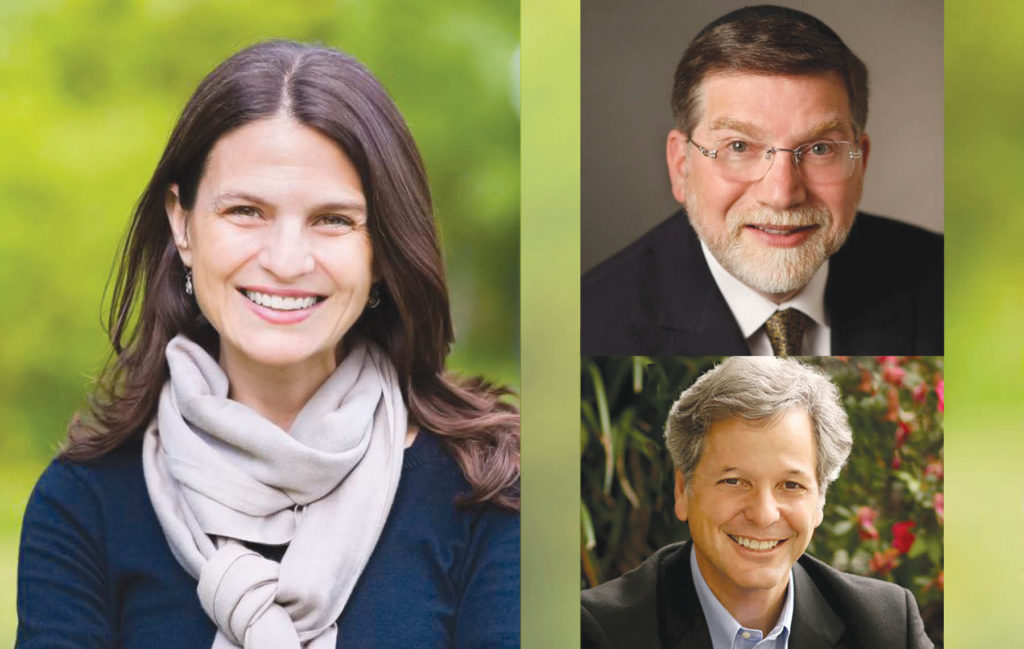
Close to 400 people attended the event to hear IKAR’s Rabbi Sharon Brous, Young Israel of Century City’s Rabbi Elazar Muskin and Temple Israel of Hollywood’s Rabbi John Rosove.

Despite the fact that they spanned the political spectrum, with Muskin and Rosove taking the center-right and -left, respectively, and Brous representing the progressive viewpoint, the conversation — moderated by AJU’s Rabbi Elliot Dorff — remained civil. The rabbis also found much to agree on. They agreed on so much, at one point Muskin joked, “I thought we were going to argue.”

Which is not to say there weren’t points of dissension. Muskin was adamant that politics has no place on the pulpit, insisting that the bimah was “sacrosanct.” If you want to know his political opinion, he said, come to his study. The law, he said, teaches that scholars should “increase the peace, not preach positions that would divide.” 

Brous noted, “progressive rabbis talk a lot to progressive rabbis and Orthodox rabbis talk to Orthodox rabbis and rarely do the two meet.” She said she was glad to have a chance to change that. Her job, she said, is “not to unify [my community] but to teach them to love each other and sometimes, when we love each other, we disagree, fiercely, about important matters.”  

At IKAR, she continued, “We teach Torah. And we talk about core Jewish values of human dignity … particularly when the world’s on fire. We treat each other with love, with patience, with kindness and compassion — even more so than before. As the world gets crueler and uglier, it’s up to us to be even kinder and even more decent and more truthful.” 

Rosove said it is important to make a distinction between politics and partisanship. “[At Temple Israel] we don’t invite candidates to speak on the pulpit unless they’re in debate. The synagogue is not the place for that.” 

Quoting Rabbi Jill Jacobs (executive director of T’ruah, a rabbinical group focused on human rights), Rosove added, “The Torah is political because it lays out a vision for a just, civil society. … It is political because a liberation struggle stands at its core. It is political because it demands that those with more wealth take responsibility for those with less. It is political because it forbids those with more power from taking advantage of those with less.” 

“Immigration is not only an American issue, but a Jewish issue and it belongs everywhere. It belongs on the pulpit; it belongs in the beit midrash. It is a moral issue.” 

— Rabbi John Rosove 

On three issues, the rabbis were all more or less in agreement: education, Israel and immigration. 

They all said they believe that government should stay out of funding private schools. “I want my children to be educated Judaically,” Muskin said, “but that’s my pocketbook.” Brous, whose three children attend day schools, said she and her husband wrestled with the choice, in part because day school gives children a stilted view of the world and also because private religious education proliferated in America in response to Brown v. Board of Education, the 1954 Supreme Court decision that ended racial segregation in schools. 

“Religious Jews have always sought out ways to provide religious, private education for their children,” Brous said, “but most private schools are built on a foundation of white supremacy.  That’s really a part of this conversation we can’t ignore.”

On the issue of Israel, Rosove said, “Israel has to remain democratic, pluralistic and Jewish.” The only way that can happen, he added, is through a two-state solution, but he was worried that the possibility might be slipping away. 

Brous said she is “aching for the State of Israel, which was built on such profound aspirations,” but worried that Israel is “essentially at war with itself.” She said she does not believe that Israel’s safety and security should keep it from “affirming and honoring the dignity of every single person” who lives there and in the Palestinian territories.  

Muskin said he will “never apologize for talking about Israel,” noting that it is the only country in the region with free, democratic elections and “we should all take pride in that.” 

On immigration, Rosove quoted Emma Lazarus’ “The New Colossus” poem mounted on the inside of the pedestal of the Statue of Liberty: “Give me your tired, your poor/Your huddled masses yearning to breathe free.” “This is a value we need to teach our children,” Rosove said. “It’s not only an American issue, but a Jewish issue and it belongs everywhere. It belongs on the pulpit; it belongs in the beit midrash. It is a moral issue.” 

Muskin said he feels sympathy for new immigrants, but the issue is illegality. “You can’t violate the law,” he said.

 Brous responded, saying it’s hard to legally emigrate from Central America and cited the story of Sodom and Gomorrah. “They had a land where the streets were paved with gold and they did not want to share it,” Brous said. “Any visitor that would come into their land would be subjected to incredible acts of cruelty to deter them from crossing the border.” She wondered how anyone could read that story and “not think it applies to what’s happening right now.” 

An audience member yelled out, “Are you running for office? Stick to the subject.” Brous responded, “We can’t shy away from discussing the issues.” The two other rabbis came to her defense, with Muskin saying, “Peace doesn’t mean uniformity. The debate has to be there.”


Three Rabbis Discuss Politics on the Pulpit Read More »

The Chutzpah of Israel’s Attempted Moon Landing

Like any great quest, there are ups and downs, and if the heroes are lucky, they learn something. Such was the case for the Israeli spacecraft Beresheet. 

Beresheet (the Hebrew name for the Book of Genesis, or “in the beginning”) was the privately funded spacecraft constructed by SpaceIL and Israel Aerospace Industries (IAI) that crash-landed on the moon’s surface on April 11. 

Yariv Bash, Kfir Damari and Yonatan Winetraub, the engineering team behind the spacecraft, started the project in 2013. Weighing just over 1,322 pounds (600 kilograms), it was said to be the smallest vessel to ever land on the moon.

In January, the spacecraft finally was ready to travel to Orlando, Fla., to begin the launching process. 

“After eight years of hard work, our dream has come true: We finally have a spacecraft,” SpaceIL CEO Ido Anteby said. On Feb. 21, Beresheet was successfully launched on a SpaceX rocket from Cape Canaveral.

“Beresheet landing on the moon is a giant step for all of Israel. This is a first-rate technological, scientific and an educational project,” Israeli President Reuven Rivlin said in a video after the launch.

The stakes were high for the Beresheet mission. It was the first of its kind built by a private company and if it landed successfully, Israel would make history as the fourth country to land a spacecraft on the moon, after the former Soviet Union, the United States and China.

On Feb. 25, Beresheet failed to execute a scheduled maneuver imperative for a trajectory to the moon. On March 19, however, it successfully conducted its final major maneuver and on April 4 entered the moon’s orbit. 

Netanyahu said, “If at first, you don’t succeed, you try again.”- Prime Minsiter Benjamin Netanyahu

Hundreds of thousands of people watched the livestream broadcast on landing day. Israeli Prime Minister Benjamin Netanyahu, along with philanthropist, millionaire and investor Morris Kahn and IAI Space Division General Manager Opher Doron spoke about the achievement the world would be watching. The spacecraft was then shown approaching the moon’s surface with a yellow metal flag that said, “Small Country, Big Dreams.” 

However, the control room lost communication with the spacecraft at 12:24 p.m. Pacific time.

“We had a failure in the spacecraft,” a SpaceIL engineer said during the livestream. “We were unable to land successfully.”

Nonetheless, Israel became the seventh country to orbit the moon and the fourth to touch its surface.

Netanyahu said, “If at first, you don’t succeed, you try again.” 

Following the launch, Peter Diamandis, the X Prize Foundation’s executive chairman, said he and his partner and CEO Anousheh Ansari would award the SpaceIL team with the $1 million Moonshot Award “for them to continue their work and pursue Beresheet 2.0.”

Israeli-based Journal contributing writer Deborah Danan was at IAI headquarters to watch the moon landing and wrote the following on April 12:

“In our nation’s short history, there have been too many times of war and tragedy that result in bringing us together. Rarely, there are moments of euphoria that also bring us together. Last night was such a moment. 

“Almost nine years ago, I conducted one of my first on-camera interviews with Kfir DamariSpaceIL’s co-founder. His passion was as evident then as it was last night. He was proud of having built the ‘smallest spacecraft in the world’ and that the whole project, almost a decade in the making, had Israeli chutzpah written all over it.

At the event, a TV reporter asked the billionaire nonagenarian Morris Kahn, who funded the $100 million venture, how he felt that Netanyahu et al. was catching a ride on his money and his efforts. Kahn said, ‘They’re not catching a [ride]. I gave it to them, and to all of Israel, with love and a full heart.’ 

His sentiments expressed what everyone felt last night. This moon venture soared far above petty politics. I thought how nice it would be if we could have more of these unicorn moments of positivity to bring us together.

When it became clear that we would not land on the moon, the grown man sitting next to me, an IAI systems engineer, sat very still, his eyes glistening. I cried freely. In that 14-minute-long lunar landing sequence, our nation’s history was summed up. We laugh and we cheer and we cry. We triumph and we crash. But God knows, we’ll never stop trying.”

The Chutzpah of Israel’s Attempted Moon Landing Read More »

From Batman to Moses: Gorfinkel Discusses His Graphic Novel Haggadah

Jordan B. Gorfinkel is a Jewish cartoonist with an impressive resume. He worked as a DC Comics editor for several years, contributing to “Batman” and creating “Birds of Prey,” which will soon be a major motion picture starring Margot Robbie as Harley Quinn. Now, just in time for Passover, Gorfinkel has released the “Passover Haggadah Graphic Novel,” a captivating retelling of the classic Passover story with illustrations by Israeli artist Erez Zadok, and published by Koren Publishers.

Gorfinkel talked with the Journal about his latest project. 

Jewish Journal: Why did you decide to write the haggadah? 

Jordan B. Gorfinkel: Everybody asks for a lightning strike moment. It was not so much prophesy as it was the logical culmination of my career to date — doing mainstream comics, being the editor of “Batman” and doing Jewish cartooning. 

If you’re going to choose a subject for a book, it’s just so logical to do the haggadah. Jews celebrate Passover more than any other holiday. The haggadah is not a chronology. It’s kind of a Wikipedia page or SparkNotes or greatest hits of Jewish history and philosophy. It goes between different time periods constantly. By adapting a brand new translation into the sequential storytelling medium of graphic novels, we are bringing the haggadah to life in a way it’s never been done before. We’re making it exciting. We don’t want the fifth question to be, “When do we eat?” We want it to be, “Can I have more time to enjoy the seder?”

JJ: How long did it take to write the haggadah?

JBG: We have been working on it for three years. It’s a nonprofit project. I alternated between raising funds and writing and producing the book with a wonderful team of people. It takes a shtetl. Koren is the gold standard of Jewish religious books, and they were the icing on the cake … or the frosting on the sponge cake … or the chocolate chip in the macaroon.

JJ: How did you find Erez Zadok?

JBG: I wanted an Israeli illustrator. They have Jewish history in their blood, in their kishkas. They go outside, turn to the left and they can touch the ancient stones of Bnei Brak and the brand new buildings of Bnei Brak. They can bring history and authoritativeness like no other artist. [Zadok] was a top graduate of Bezalel Academy of Arts in Jerusalem. It was clear the second I saw his samples that he was the guy. 

JJ: Is Passover your favorite holiday?

JBG: I have to admit that before I began this I really did not have a true appreciation of the amazing brilliance and depth of the haggadah and the power of the holiday itself. There is this great thing about graphic novels, because they operate on two levels. You can enjoy them for the excitement, action and adventure, and you can revisit them over and over again. You can constantly uncover new Easter eggs, or as I like to call them, roasted eggs.

JJ: Do you still do any work for DC?

JBG: I’m now the owner-operator of Avalanche Comics Entertainment. I do visual storytelling for corporations, nonprofits and entertainment companies. My most recent project was for Paramount on the “Bumblebee” movie. I have a warm association with DC Comics because my work continues to be adapted into TV and movies. You can see my work on “Gotham” on Fox and “Arrow” on CW. The other thing I do in L.A. is music. I direct Kol Zimra, which is the only professional a cappella group with singers local to L.A. We perform at simchas.

JJ: What did you learn from DC about how to tell a story? 

JBG: The haggadah is not a chronological book. People always presume it’s “The Prince of Egypt” or “The Ten Commandments.” It’s the story of our exodus from slavery in Egypt to redemption and nationhood. What I learned from DC Comics and working on over 2,000 stories on “Batman” is how to enforce a three-act structure narrative on an otherwise abbreviated and terse summary of Judaism that has no structure. It shifts time periods and points of view and subjects and themes, from page to page and paragraph to paragraph.

JJ: Is it because different people wrote it? 

JBG: It was written by a consistent group of rabbis but they were rabbis from the oral law tradition. They were the rabbis of the Mishnah. They were writing in the style of the Talmud, which is to have a couple of words or phrases stand in for the presumed scholarship of the Jewish people. We don’t have that kind of scholarship, not at least without doing a Google search anymore. When we try to understand the haggadah we struggle. Now, we’re combining the narrative structure of the modern entertainment world to this ancient, abbreviated oral law book to bring out its inherent excitement and meaning. 

When people learn about this project, what they say is, “Oh, my grandkids are going to love this.” I say, “Yes, they will, but graphic novels are not a childish medium.” It is a sublimely sophisticated medium of communication for storytelling. People ask if it’s appropriate to turn our sacred texts into a comic book, to which I bring up ancient Egypt and hieroglyphics. There is a storytelling tradition we are commanded to pass on. It makes sense [to do a graphic novel]. It comes full circle. The creators of graphic novels were Jewish, so we are bringing it back to where it all began. What’s a more appropriate holiday to do it for than the storytelling holiday of Passover? 

JJ: Do you have any other projects coming up?

JBG: We are looking forward to going onto phase two, which is a line of Jewish graphic novels. We are seeking out likeminded people who see the value in what we are doing. We want to do biblical texts, books of philosophy, Zionism and Jewish humor, like a collection of my Jewish cartoons.

From Batman to Moses: Gorfinkel Discusses His Graphic Novel Haggadah Read More »

Raise a Tambourine for the Song of the Sea at Passover

In last week’s Jewish Journal, I showed how to make placemats for Passover depicting the parting of the Red Sea. The follow-up to that craft activity is inspired by what happened after the waters parted and the Israelites made safe passage out of Egypt — Miriam’s musical celebration, in which she lifted her tambourine and led the people in the Song of the Sea. 

Making your own tambourine for Passover is easy. Since the tambourine is made with paper plates, I decided it would be appropriate to adorn it with the six symbolic foods of the seder plate. This creates a great opportunity to teach kids about the seder plate and what each of the elements mean.

What you’ll need:
Two paper plates
Acrylic paint
Paintbrush
Colored markers
Glue
Graphic icons of seder plate foods (downloadable here)
Hole punch
Jingle bells
String or yarn


1. You’ll need two paper plates per tambourine. I recommend small, 7-inch paper plates as opposed to the larger ones, as they are easier to work with. (And they’re great for little hands.) The back side of a paper plate is usually white, so paint your plates in the color of your choice.


2. Draw designs on the painted side with colored markers. Have fun with the doodles. If you want to add the seder plate icons like I did, download and print them. After cutting them out, glue them to the plates.


3. Line up the two paper plates so that the painted sides are facing out. Punch six holes that are evenly spaced around the rim of the plates, punching through both plates at the same time so the holes will be aligned.


4. Thread string or yarn through the shank of a bell and tie the string around the aligned punched holes. The string not only attaches the bell, it secures the two plates together. If you’re using colored yarn, leave the ends long and loose for an extra decorative accent. Repeat for all the bells.


Jonathan Fong is the author of “Flowers That Wow” and “Parties That Wow,” and host of “Style With a Smile” on YouTube. You can see more of his do-it-yourself projects at jonathanfongstyle.com.

Raise a Tambourine for the Song of the Sea at Passover Read More »

Tosh-Monsey Matzah Bake

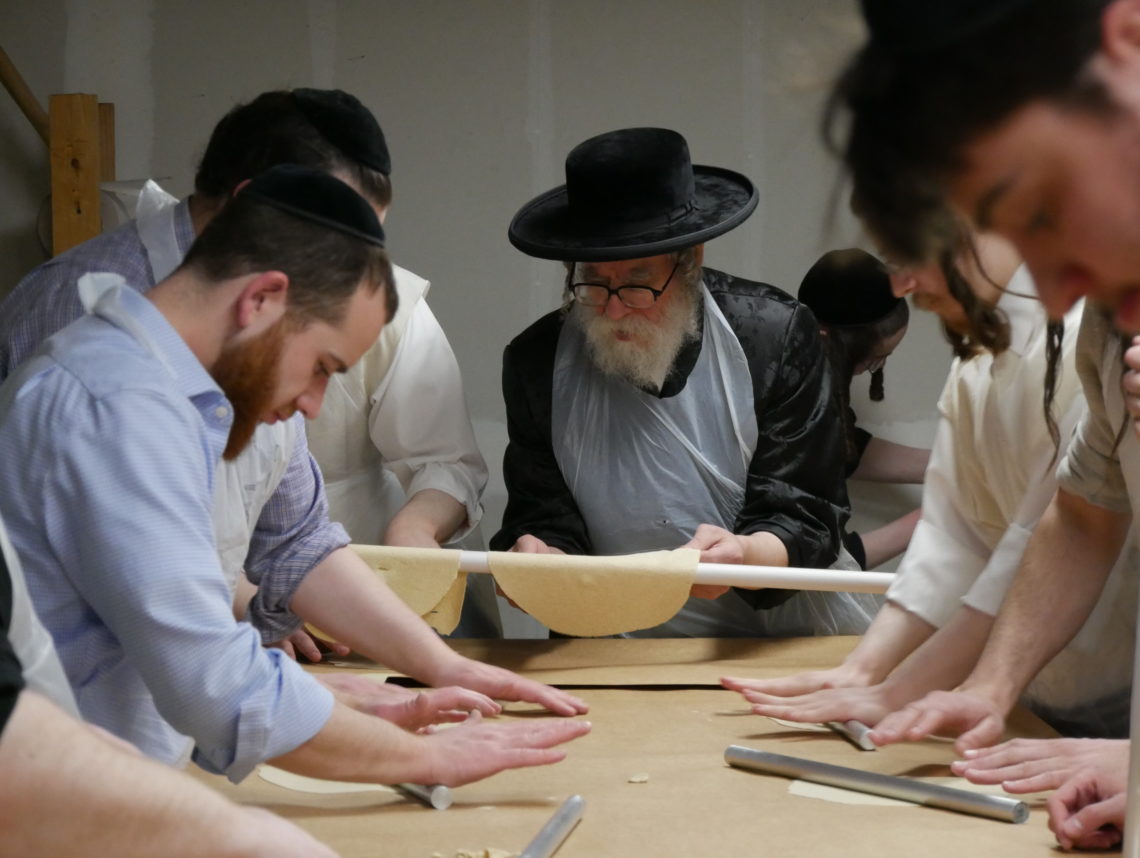
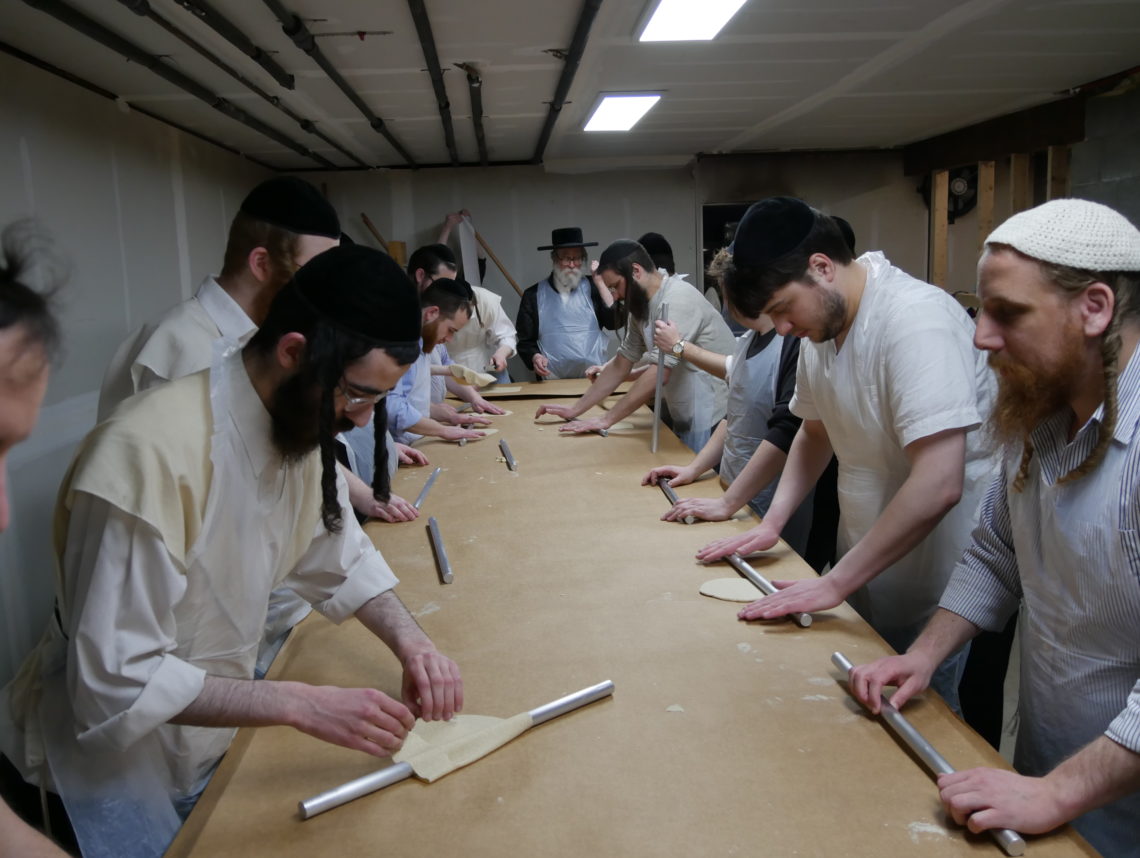
Thousands of matzahs are consumed every Passover. Did you ever wonder what a matzah bake looks like? We got insider access to a matzah bakery while the Tosh-Monsey Rebbe was baking matzahs with some of his followers for their personal use.

Founded in 1999, Tosh-Monsey is leading the way on innovating the Kollel experience. Under the leadership of its dean Harav Hagaon Reb Avrohom Katz and his unique blend of Breslov spirituality with traditional Talmudic rigor inspires Jews from all walks of life. For more information, visit http://toshmonsey.org.

HaRav HaGaon Reb Abraham Katz is the Rebbe of Tosh-Monsey. In 1970, The Grand Rabbi of Tosh hand-picked him as a suitor for his daughter and in 1999 entrusted him to lead the Tosh-Monsey community. Known for his wisdom, insights, encyclopedic Torah knowledge, and mastery of Jewish books of mysticism such as the Zohar, his counsel is sought by many followers and admirers.

The Rebbe founded Mishkanos Lavir Yakov in Monsey, NY, an advanced academy for Torah scholars which has produced many prominent Torah teachers and leaders. As dean of the Talmudical academy, the Rebbe personally instructed and developed many young Torah scholars into teachers and judges. Today, the Rebbe mentors a select group of Kollel fellows to become religious leaders and teachers of Torah.

For many years, the Rebbe was a sitting judge of Talmudic Law in a Beth Din (Jewish civil court) with a particular expertise in the intricate Jewish laws of usury. The Rebbe also contributed to the scholarship on the Jewish laws of religious holidays in his academic treatise called Minchas Avraham. Additionally, the Rebbe is an expert on the teachings of Rabbi Nachman of Breslov and he regularly lectures on Breslov philosophies and wisdom.

Tosh-Monsey Matzah Bake Read More »

Debating Religion’s Role in American Politics

“We are here to learn something about the distinctive insights and perhaps the helpful wisdom that Judaism, Christianity and Islam can bring to this crucial conversation of religion and politics based on the long history of each of these religious traditions.”

With those remarks, Reinhard Krauss, executive director of the Academy for Judaic, Christian and Islamic Studies, introduced a recent panel discussion held at American Jewish University (AJU).

The event was part of the series “Let’s Talk About Religion,” which features interreligious conversations highlighting the similarities and differences between Judaism, Christianity and Islam.

Krauss served as the moderator for this panel discussion, titled “God in the Voting Booth? The Role of Religion in American Politics.”  The panel featured Rabbi Adam Greenwald, director of AJU’s Miller Introduction to Judaism Program; Jonathan Chute, senior pastor at Rolling Hills United Methodist Church; and Aziza Hasan, executive director of NewGround: A Muslim-Jewish Partnership for Change.

Hasan said religion and politics have always intermingled, noting how America’s first president, George Washington, addressed a synagogue about religious freedom and how former Rep. Keith Ellison (D-Minn.) was sworn in to the U.S. House on Thomas Jefferson’s Quran.

Greenwald said the sacred texts of the three monotheistic faiths do not prescribe policy positions. “So I believe one can be motivated by good religion and be a Democrat, and one can be motivated by good religion and be a Republican,” he said. “The question is, are they both responding to the call of religion to be aware of the social ills?”

Although religion has been used as a tool to oppress, Chute said the most sustainable religions are those that ask people to look inward. “I tend to feel that a healthy religious impulse is one that is more critical and actually more specifically self-critical; and one of the differences between what I think of as a healthy religious expression and something that is more reflective of a cult is its capacity for self-criticism,” he said.

Hasan said she was struck by a recent article in USA Today that said an increasing number of people feel like their way of life is being threatened by America becoming more diverse.

“If people are feeling like their values, their way of life is going to be threatened because minorities are taking over, we better start listening really quickly,” she said. She added that after the 2018 shooting at the Tree of Life synagogue in Pittsburgh, she was heartened to see people of diverse political beliefs coming together for a vigil at the Federal Building in Westwood. “We all got to grieve that night,” she said.

Similarly, Greenwald said the same groups that turned out to support one another after the Tree of Life shooting came out to express solidarity following the recent shootings at the mosques in New Zealand.

While the speakers said religion is a force for good in political and civil life, Krauss noted that established religions have not always aligned with good causes such as the civil rights movement and figures like Martin Luther King Jr.

During the event’s Q&A session, an audience member asked for the panelists’ opinions of Rep. Ilhan Omar (D-Minn.), who has made anti-Israel statements on Twitter. Hasan, who was raised in Jordan by a Christian-American mother and a Muslim-Palestinian father, denounced the rise of “anti-Jewish sentiment.” She said the controversy surrounding Omar’s anti-Israel statements has furthered her education about the many forms of anti-Semitism.

“I can see tropes I was blind to before, and it’s been a journey,” Hasan said.

When an audience member said that clergy who use their pulpits to express political positions bothered him, Chute agreed. “I try to preach in a way that invites people to ask their own questions and to wrestle with things that I think are substantive and important,” he said, “but I really seek to avoid proscription and partisan pronouncement.”

Debating Religion’s Role in American Politics Read More »