“We are here to learn something about the distinctive insights and perhaps the helpful wisdom that Judaism, Christianity and Islam can bring to this crucial conversation of religion and politics based on the long history of each of these religious traditions.”
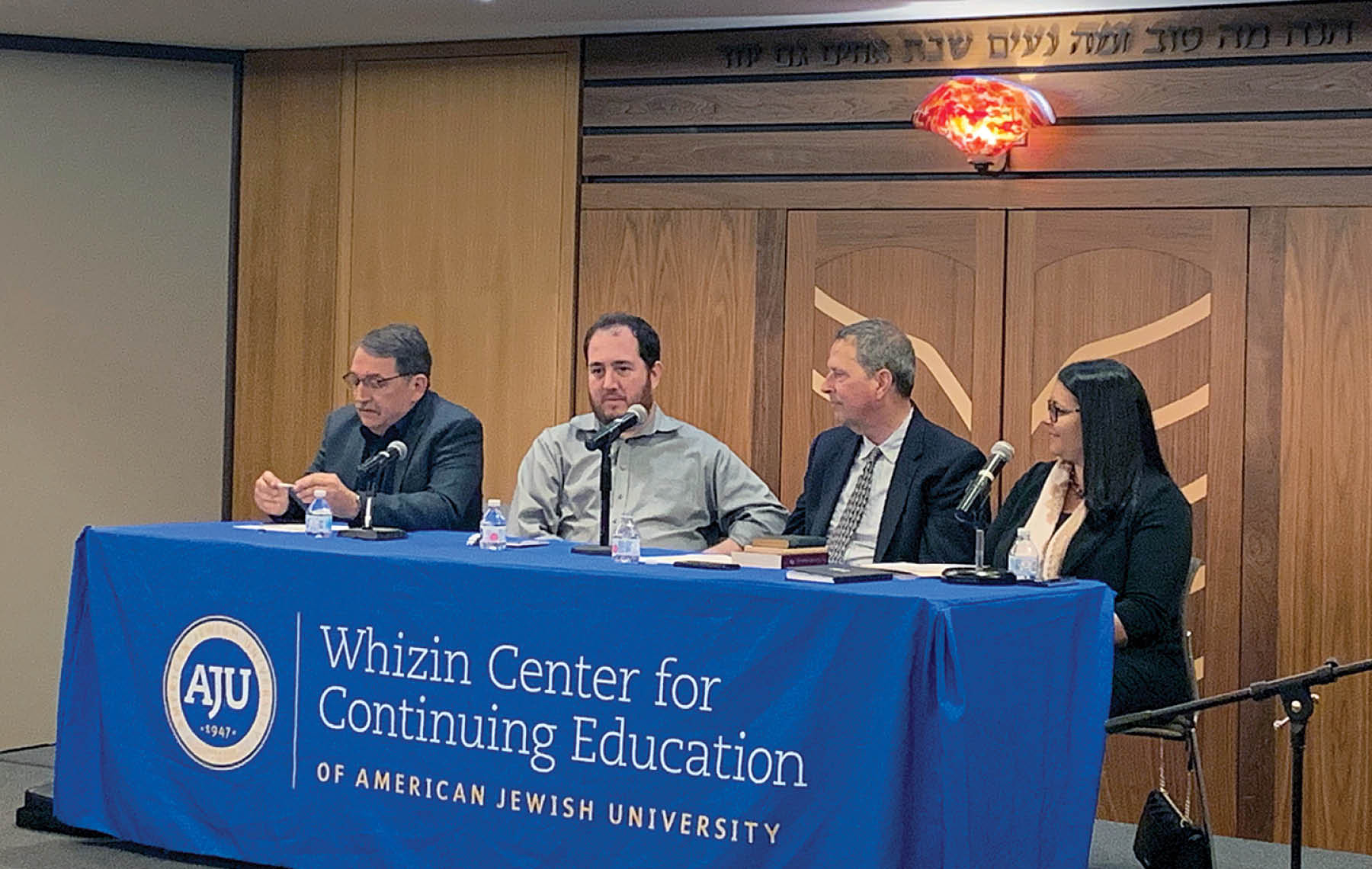
With those remarks, Reinhard Krauss, executive director of the Academy for Judaic, Christian and Islamic Studies, introduced a recent panel discussion held at American Jewish University (AJU).
The event was part of the series “Let’s Talk About Religion,” which features interreligious conversations highlighting the similarities and differences between Judaism, Christianity and Islam.
Krauss served as the moderator for this panel discussion, titled “God in the Voting Booth? The Role of Religion in American Politics.” The panel featured Rabbi Adam Greenwald, director of AJU’s Miller Introduction to Judaism Program; Jonathan Chute, senior pastor at Rolling Hills United Methodist Church; and Aziza Hasan, executive director of NewGround: A Muslim-Jewish Partnership for Change.
Hasan said religion and politics have always intermingled, noting how America’s first president, George Washington, addressed a synagogue about religious freedom and how former Rep. Keith Ellison (D-Minn.) was sworn in to the U.S. House on Thomas Jefferson’s Quran.
Greenwald said the sacred texts of the three monotheistic faiths do not prescribe policy positions. “So I believe one can be motivated by good religion and be a Democrat, and one can be motivated by good religion and be a Republican,” he said. “The question is, are they both responding to the call of religion to be aware of the social ills?”
Although religion has been used as a tool to oppress, Chute said the most sustainable religions are those that ask people to look inward. “I tend to feel that a healthy religious impulse is one that is more critical and actually more specifically self-critical; and one of the differences between what I think of as a healthy religious expression and something that is more reflective of a cult is its capacity for self-criticism,” he said.
Hasan said she was struck by a recent article in USA Today that said an increasing number of people feel like their way of life is being threatened by America becoming more diverse.
“If people are feeling like their values, their way of life is going to be threatened because minorities are taking over, we better start listening really quickly,” she said. She added that after the 2018 shooting at the Tree of Life synagogue in Pittsburgh, she was heartened to see people of diverse political beliefs coming together for a vigil at the Federal Building in Westwood. “We all got to grieve that night,” she said.
Similarly, Greenwald said the same groups that turned out to support one another after the Tree of Life shooting came out to express solidarity following the recent shootings at the mosques in New Zealand.
While the speakers said religion is a force for good in political and civil life, Krauss noted that established religions have not always aligned with good causes such as the civil rights movement and figures like Martin Luther King Jr.
During the event’s Q&A session, an audience member asked for the panelists’ opinions of Rep. Ilhan Omar (D-Minn.), who has made anti-Israel statements on Twitter. Hasan, who was raised in Jordan by a Christian-American mother and a Muslim-Palestinian father, denounced the rise of “anti-Jewish sentiment.” She said the controversy surrounding Omar’s anti-Israel statements has furthered her education about the many forms of anti-Semitism.
“I can see tropes I was blind to before, and it’s been a journey,” Hasan said.
When an audience member said that clergy who use their pulpits to express political positions bothered him, Chute agreed. “I try to preach in a way that invites people to ask their own questions and to wrestle with things that I think are substantive and important,” he said, “but I really seek to avoid proscription and partisan pronouncement.”