

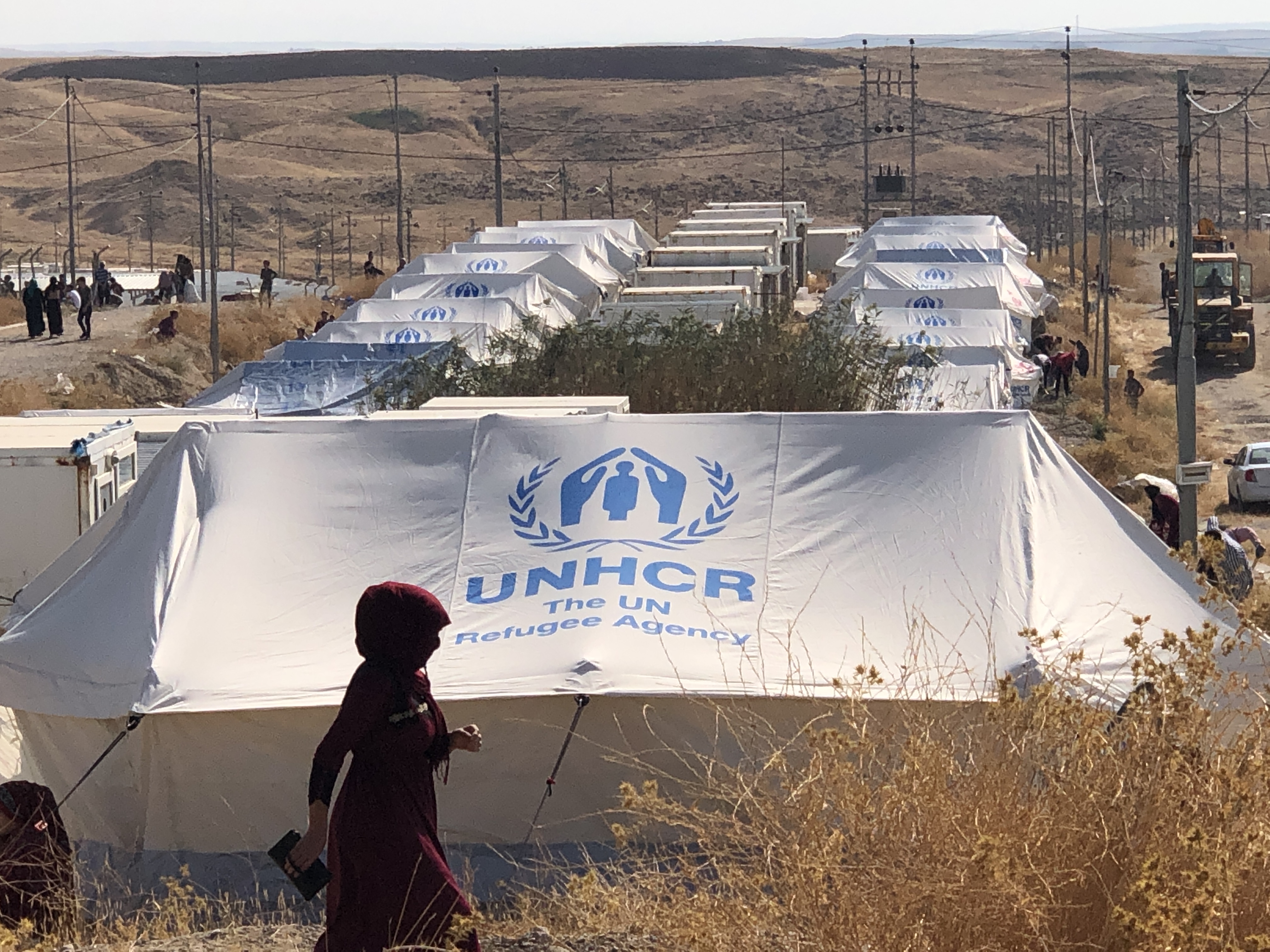
Kurds have more in common with Jews than I had ever imagined before I arrived in northern Iraq last week to interview refugees fleeing Turkish aggression.
Kurds are an ethnic group that alleges to have existed since biblical times. They have a clear sense of their homeland, and their loyalty to their people extends well beyond transitory changes to borders, language and religion. Kurds have lived in a warped form of diaspora since external powers superimposed countries where they existed for centuries. They are a people struggling to survive in the very place they have lived for centuries. Sound familiar?
There are 30 million Kurds in the world today, approximately twice as many as there are Jews. In 1916, a secret plan to carve up the Middle East, known as the Sykes-Picot Agreement between France and Britain, was put into effect, for which we are all still paying the high cost. The Kurds, who at the time did not have a nation, found the territory in which they had lived for centuries had been assigned to Turkey, Syria, Iraq and Iran.
Kurds are without a state although they occupy a mountainous borderlands region that includes parts of Iran, Iraq, Syria and Turkey that often is referred to as Kurdistan.
Since their alienation by the imposition of the new countries, Kurds have had to navigate the rivalries and wars of the countries in which they live while maintaining their identities. Kurds who live in the northern part of Syria face a new peril as Turkey consolidates its position there through its agreement with Russia.
We know from the study of not only the Holocaust but also the 20th-century genocides that targeted Armenians, Tutsi Rwandans, Bosnian Muslims and indigenous Guatemalans that the cover of military objectives is used by powers to execute more sinister goals.
The term “ethnic cleansing” has been used to describe Turkey’s goals but this is a euphemism that makes the removal of civilians seem more palatable. The Nazis used their own ethnic cleansing euphemism “Judenrein” — cleaned of Jews — to hide their genocidal killing from plain sight. “Ethnic cleansing” is not an end in itself, it is a means to bring the life of a community in a particular place to an end. Deadly, violent or nonviolent, ethnic cleansing is motivated by ethnic hatred and violates many international conventions and laws.
“Like Jews who fled Germany in 1933, before it was too late, the families I have been speaking to decided not to wait to find out how lethal Turkey, Russia and Syria will be.”
In situations like the one unfolding in northern Syria, as the crisis ramps up, the voices of the victims become increasingly silenced. News agencies are interested in the politics, the casualties, the body count. But victims who know more about what is happening than anyone tend to get silenced.
During World War II, the media gave astonishingly short shrift to the Holocaust. When the atrocities were covered, the news was often downplayed. Consider this headline — discovered in a recent project by the U.S. Holocaust Memorial Museum — in the Nov. 25, 1942, edition of the Los Angeles Times: “Half of Jews in Europe Dead.” Front-page news? Guess again. It ran on page two.
Or this piece in the New York Daily News the same month: “Jews Declare 5,000,000 Face a Nazi Death.” Page 45.
The Jews facing persecution were acutely aware of the neglect. This is why Jews in the Warsaw Ghetto were feverishly documenting their story, as depicted in Roberta Grossman’s most recent docudrama, “Who Will Write Our History?” They knew if they did not tell their story, who would?
I am currently in northern Iraq to research why refugees who are crossing the border into southern Kurdistan decided to leave their homes. It may seem obvious because they have been living under a hail of Turkish shells. However, it is clear that the only reason that Turkey is in Syria at all is to displace the Kurds. Like all other dangerous regimes, they blame the victims, labeling Kurdish separatist militias as terrorists, which is no reason to terrorize the entire population in return.
The refugees I have met to date confirm my suspicion that there are two distinct reasons for their hurried departure from northern Syria. The first is the immediate threat of death from the military operation. The second is a longer-term visceral understanding that they cannot survive in a region occupied by powers that do not want them there. If they sense their community is in danger, then it probably is because they understand the threat more than any of us. Like Jews who fled Germany in 1933, before it was too late, the families I have been speaking to decided not to wait to find out how lethal Turkey, Russia and Syria will be. They know it is far from over.
Kurds in southern Kurdistan have a regional government in northern Iraq where, unlike many countries across the Middle East, they believe in a multicultural society. They recently renamed their Ministry of Muslim Affairs to the Department of Religious Affairs to ensure all religious traditions are represented. There are Christian Kurds, Zoroastrian Kurds, even a handful of Jewish Kurds (living in Israel now).
Like Jews in the past who needed non-Jews to speak out for justice, Kurds need vocal advocates who understand the threat they are facing to speak up now.
Stephen Smith is the Finci-Viterbi executive director of USC Shoah Foundation and UNESCO Chair on Genocide Education.
































