There are two common responses when a group is hit with fierce external criticism. The first is defensiveness — what Americans call, drawing on the frontier days, “circling the wagons.” The second is reflection — pausing to look inward and examine whether the criticism has any merit.
Defensiveness is immediate and sharp. They say “starvation” — we deny. They say “genocide” — we shout “antisemitism.” They are the critics, many of whom clearly have no interest in our well-being. We are the criticized, rallying together. This is not the time for nuance or soul-searching, we tell ourselves. This is the time for volleys of rebuttal, for counterattack.
Reflection is a more measured response. But it’s necessary. It leads to questions like: Could there really be starvation? If friendly countries — Britain, Australia, Germany — are all saying we’ve gone too far, is it possible we’ve indeed gone too far?
This week I’ve been listening to a long series of interviews conducted by physicist Lawrence Krauss with scholars who contributed to his new book “The War Against Science.” Some are household names—Richard Dawkins, Steven Pinker, Niall Ferguson, Nicholas Christakis. All of them, in one way or another, argue for reflection in an era that rewards defensiveness.
Ask most university administrators who’s waging the most dangerous war on science and they’ll point to Donald Trump and his circle: the vaccine deniers, the budget slashers, the alternative-fact crowd. Their instinctive response to this assault is to circle the wagons.
But Krauss and his contributors demand something more: they want the scientific community to look inward. Yes, Trump’s war on universities is aggressive and perhaps dangerous. But no, it cannot be fully understood without acknowledging one of its causes: a scientific community that, in some respects, has lost its mind.
UC Davis Mathematician Abigail Thompson spoke with Krauss. Like many of his interviewees, she pointed to the way American campuses erupted after Oct. 7 as an example — if not proof — of intellectual unraveling. “If people want to demonstrate in the quad with swastikas saying, Heil Hitler, from noon to one… I will defend their right to do that,” she said, “but that’s not what was happening… It’s not a question of free speech when you allow them to camp out for six weeks in the middle of the quad, and you allow them to march through classrooms.”
For those who support Israel, it’s easy to sympathize with Thompson. Easy to argue that Western universities must stop circling the wagons and begin a process of real introspection. It’s easy to call for reflection when you’re the one doing the criticizing. It’s much harder when you’re the one being criticized. When your country is accused of committing crimes — that’s when defensiveness takes hold.
Because you know your country. You know its army isn’t carrying out ethnic cleansing. You know its commanders strive to minimize harm to civilians. And you also see the hypocrisy of Israel’s critics. David French, writing this week in The New York Times, put it plainly: “I can see the extraordinary antisemitism and bias in the larger international community. When a United Nations that includes North Korea, Syria, Russia and China condemns Israel more than any other nation in the world (by far), you know that the Jewish state is being singled out.”
But French didn’t stop there. And maybe neither should we. The fact that Trump cut important research budgets doesn’t absolve the universities from self-examination. The fact that the world unfairly targets Israel doesn’t absolve Israel from self-examination. One of the foundations of Zionism is the decision by Jews to take responsibility for their own fate. Responsibility cannot be fulfilled by blaming others for your complex, difficult situation. Responsibility cannot be discharged by pointing to factors outside your control.
The fact that the world unfairly targets Israel doesn’t absolve Israel from self-examination. One of the foundations of Zionism is the decision by Jews to take responsibility for their own fate.
Responsibility means defending yourself — while also asking, with honesty, what you may have done to give those enemies an opening. And to be clear: an honest examination of Israel’s conduct will not necessarily lead to the conclusions its critics want. The argument here is not “the critics are right, Israel is doing terrible things.” The argument is “the critics are attacking—let’s examine why now, and whether anything we’ve done has enabled this.”
Have government ministers made reckless statements that invited global backlash? Has ill-considered policy given Hamas an opportunity to strike us where it hurts? Has foot-dragging and indecision allowed our enemies to gain an edge? And we might ask: has a posture of reflexive defensiveness in the face of all criticism contributed to our current strategic bind?
This must be said plainly: Israel is struggling to extricate itself from the war with the upper hand. After astonishing operational successes in Lebanon, in Iran and in Gaza, Israel now finds itself stuck in a dead-end alley.
If it escalates the war, it risks internal unrest, endangers the hostages, increases economic strain and worsens its international isolation. If it pulls back, Hamas will exact a steep price in concessions and could reestablish its rule over Gaza.
We can blame the government and its leader for the current situation. Most Israelis do. We can blame the IDF, as some ministers and their right-wing supporters now do. Just as with Israel’s growing isolation, questions of blame are important. But finding someone to blame will not get us out of the alley. Reflection just might.
Something I wrote in Hebrew
Explaining new data of Americans’ view of Israel I highlighted something that certain observers tend to ignore:
Polarization in American society is not something Israel can control. In some cases, a drop in support for Israel from one political camp may stem not from anything Israel did or didn’t do — but simply as a reflexive reaction to rising support for Israel in the opposing camp. In our case: if Donald Trump supports an Israeli action, Trump’s opponents will oppose it. And they will not necessarily oppose it because they’ve studied the facts, carefully weighed the circumstances and concluded that what was justified a year ago is no longer justified today. They will oppose it because Trump supports it … In other words, the shift we’re now witnessing compared to last year may not be a result of what happened this past year in Gaza, but of what happened this past year in Washington. A year ago, Trump wasn’t president. This year — Trump is president.
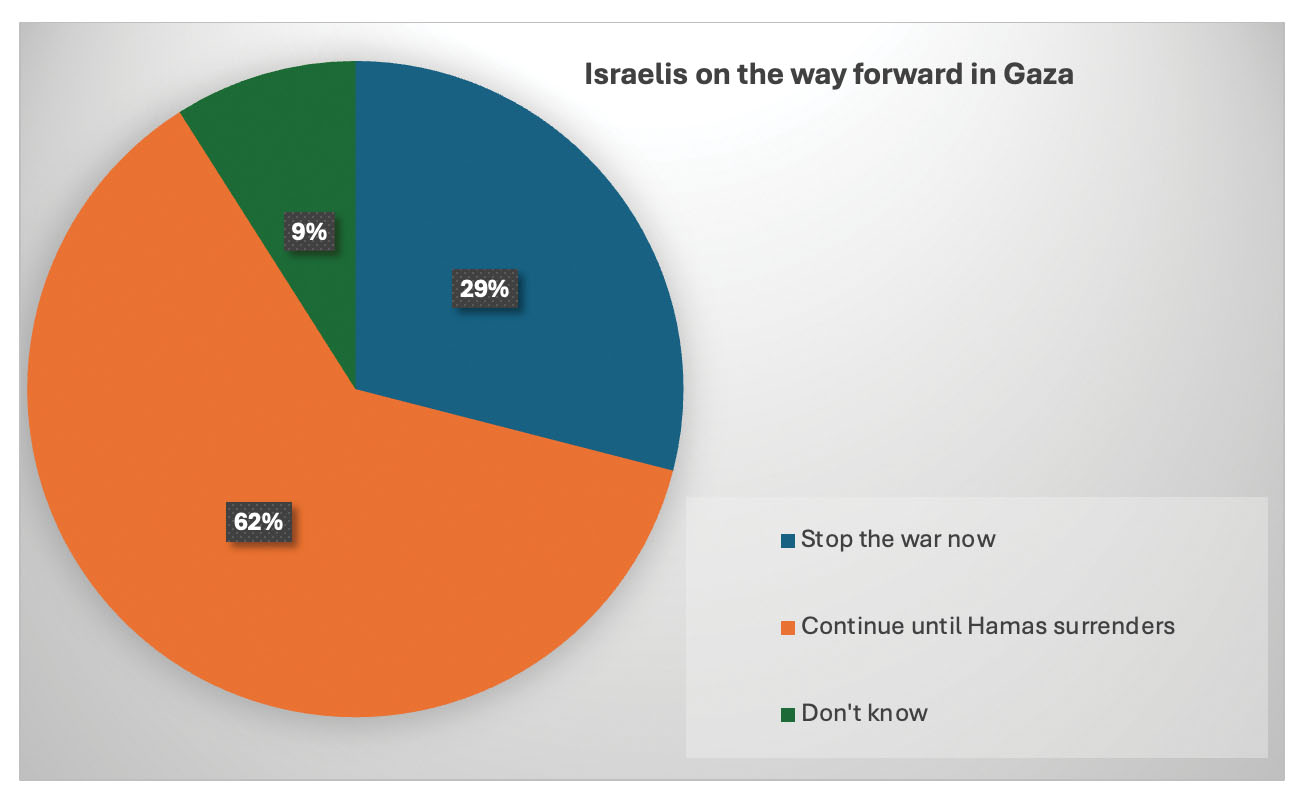
A week’s numbers
Ch13 poll from last Sunday. This could easily change because of changing circumstances.
A reader’s response
Adam Katz writes: “Israelis should know that many Jews in New York support Mamdani.” My response: They do, but to be honest, have much bigger problems.
Shmuel Rosner is senior political editor. For more analysis of Israeli and international politics, visit Rosner’s Domain at jewishjournal.com/rosnersdomain.