A full moon ambushed me the other morning.
It was pasted on the sky like a crafts project, too flat and too burnt orange, and too close to Beverly and La Brea, to be real.
I wasn’t, How beautiful! I was, How strange.
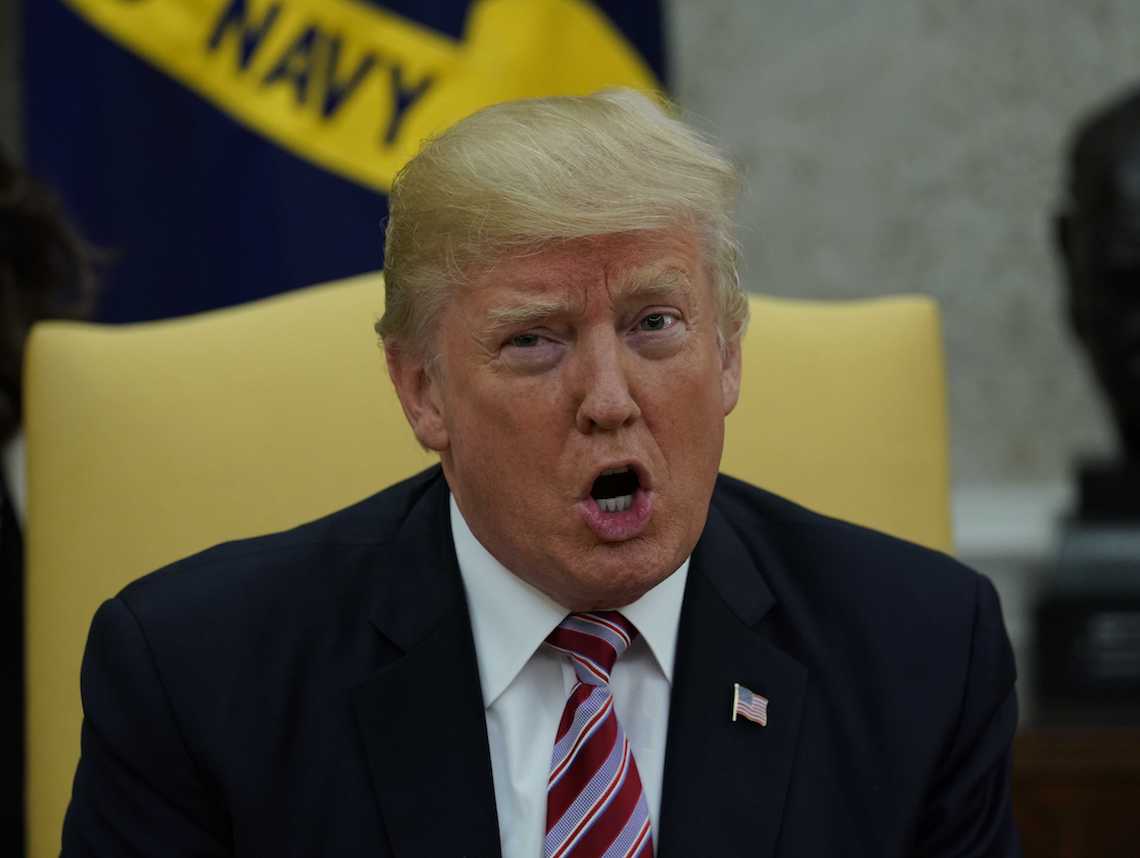
How strange there’s a four-and-a-half billion-year-old rock rotating around me; how strange that this disc rising from Blick Art’s roof gets its crayoned glow from nuclear fusion 93 million miles away; how strange that its whole Juney moony existence is indifferent to, and makes irrelevant, the satellite radio voices in my car channeling my anxieties about Donald Trump firing special counsel Robert Mueller, Trump goading himself into nuking North Korea, Trump giving Vladimir Putin a pass on gaming the election Trump won.
I don’t usually live on cable news time and in geologic time at the same time. When I drive to Trader Joe’s, the Big Bang typically gets no attention from me. But the other morning I was blown away by the strangeness of being simultaneously in Newton’s solar system, where space is space and time is time; in Einstein’s universe, where everything is spacetime, and it’s warped; and in the TJ parking lot, where a ridiculously narrow space takes forever to find.
“Your happiness,” behavioral scientist Paul Dolan writes in “Happiness by Design,” “is determined by how you allocate your attention…. If you are not as happy as you could be, then you must be misallocating your attention.”
If I allocated more attention to the sound of rain than to the sound of Sarah Huckabee Sanders, I’m sure I’d be happier. But I don’t allocate my attention to her. She steals it. Like her boss, she’s contemptuous of a free press, and she gets away with it. I have to watch – it’s disaster porn, and its victim is American democracy.
I’m not the only boss of my attention. I run the conscious, intentional executive function of my brain, but attention is involuntary, too, vulnerable to hijacking and noticing whatever it wants, whether our judgment intends it or not.
“We’re hooked on the dopamine squirts we get from likes, shares and comments.”
Daniel Kahneman, the behavioral psychologist who won the 2002 Nobel Prize in economics, describes two kinds of thinking, fast and slow. System 1 is fast, automatic, emotional, subconscious. System 2 is slow, effortful, logical, conscious.
System 2 behaves as though our free will allocates our attention, but actually it’s System 1, bombarded by inputs, that impulsively calls the shots and gets System 2 to reverse-engineer reasons for what we notice.
What pitches does System 1 fall for? Danger, sex, play, novelty and stories are especially good at grabbing attention. They’re what entertainment uses, and news, politics, commerce and culture, too. Social media platforms are all that in one, and we gladly carry them around on our phones. They captivate us; we’re their attention slaves. It’s not our fault if we Instagram a total eclipse or live-tweet a string quartet: We’re hooked on the dopamine squirts we get from likes, shares and comments. #MozartIsDaBomb
Industries are built on this. When we practice meditation and mindfulness, the distractedness of our monkey minds isn’t attributable to human nature alone; it’s also a casualty of the battle to sell our eyeballs and data to advertisers. We may want to infuse our days with reverence and gratitude, but some random commercial sighting – a picture of a beautiful body, beach or burger – can kidnap our attention and brainwash us with a yearning we can slake solely by spending money.
Paying attention to Trump is inevitable. Well before he became a candidate, he was an accomplished tale-teller, which is catnip for System 1. His tallest tale is the story of himself. He has one subject, Trump, and one object, our attention. Now that our Little Caesar bestrides the world like a colossus, we may persuade ourselves that being rapt by his awfulness is civic vigilance, not rubbernecking at the apocalypse. But that’s just System 2 rationalizing the prurience of System 1.
I love a good media detox, and there are times I’ve been able to unplug for a week. But day-to-day, Trump’s mastery of the horror genre makes getting my attention a cheap date.
I can’t stop Trump from stealing my attention, but I can try to switch where it takes me. Not, How scary. No — I want that burnt orange face to make me mindful of my Crayola moon. How strange.
Marty Kaplan is the Norman Lear professor at the USC Annenberg School for
Communication and Journalism. Reach him at martyk@jewishjournal.com