fbpx

November 6, 2017

Saudi Arabia: Iran and Lebanon Committed ‘Act of War’ Against Us

Saudi Arabia has accused Iran and Lebanon of committing an “act of war” against the Gulf Kingdom after a missile heading toward Riyadh was intercepted on Saturday.

The missile was aimed at Saudi Arabia’s Riyadh Airport, but ended up being harmless after the Gulf Kingdom shot it down. The Houthi rebels in Yemen, a faction supported by Iran in Yemen’s civil war, claimed responsibility for the missile.

“Iran cannot lob missiles at Saudi cities and towns and expect us not to take steps,” Saudi Foreign Minister Abdel Jubair told CNN.

Thamer al-Sabhan, the Gulf Kingdom’s Persian Gulf Affairs Minister, told a state news outlet that they’re considering the failed missile strike as Lebanon declaring war on the Gulf Kingdom.

“Lebanon is kidnapped by the militias of Hezbollah and behind it is Iran,” said al-Sabhan.

He did not elaborate on any action that Saudi Arabia plans to take against Lebanon, but he warned Lebanon that they “must all know these risks and work to fix matters before they reach the point of no return.”

Iran is denying the accusations, claiming that the Houthis acted on their own. Iranian Foreign Minister Mohammad Javad Zarif blamed Saudi Arabia for the death and destruction occurring in Yemen.

Lebanese Prime Minister Saad al-Hariri announced on Saturday that he was stepping down, a move that shocked even his aides. Hariri claimed his resignation was due to Hezbollah plans to assassinate him; Hezbollah is accusing Saudi Arabia of strong-arming Hariri into his resignation.

Saudi Arabia: Iran and Lebanon Committed ‘Act of War’ Against Us Read More »

Are Jews the Only Ones Who Need a Thick Skin?

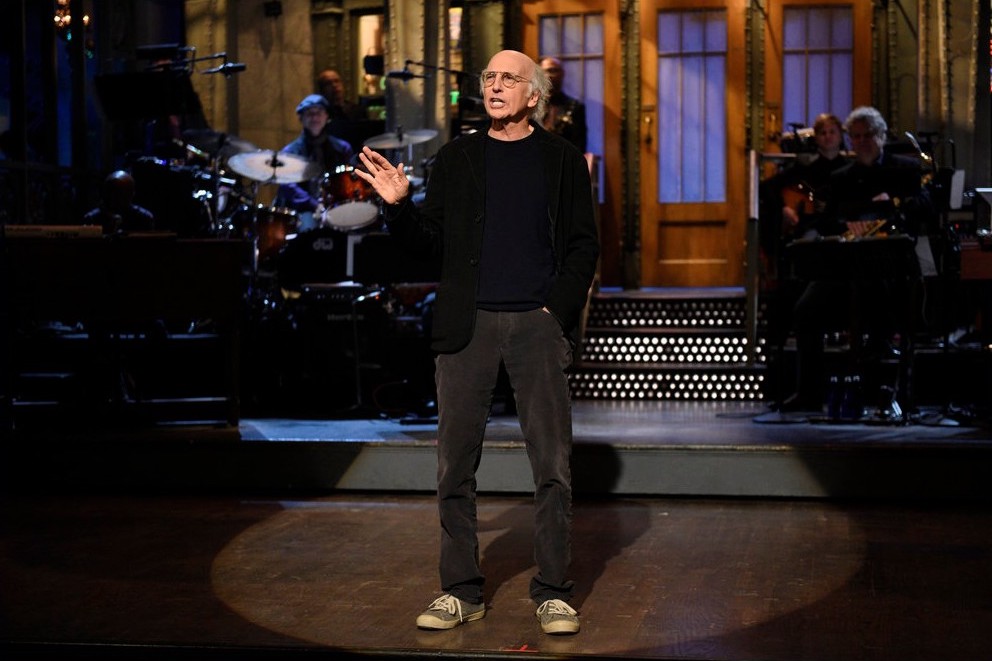
Why would Larry David stride up so confidently on the “Saturday Night Live” stage and joke about picking up women in a Nazi concentration camp? And why would he wallow in the fact that many of the recently accused sexual aggressors have Jewish names? Hasn’t he heard about anti-Semitism?

Here’s my theory: He assumes Jews can take it. At a time when everyone is allowed to get offended by the smallest slight, Jews are supposed to be, well, different.

College students can get offended by an email about Halloween costumes, but Jews should handle gross jokes about the Holocaust. Any student can yell about a micro-aggression, but Jews are expected to handle macro-aggressions.

Maybe David figured Jews are on another level. We’re the chosen ones, right? We’re the sophisticated Americans obsessed with education and with being loved by gentiles. Who has endeared the Jews to America? It’s not the lawyers, believe me. It’s the comedians.

For more than a century, from Burns to Benny to Allen to Crystal to Seinfeld, we’ve made America laugh by poking fun at ourselves. And why not? When you’ve been persecuted for 2,000 years and you finally find a place that accepts you, what better way to show your gratitude than by being entertaining?

And Larry David surely is an entertainer. “Curb Your Enthusiasm” is my all-time favorite comedy. I love, among other things, that there’s no laugh track. No one cares whether I laugh or not. I get to eavesdrop on a wacko who obsesses over stuff that makes me squirm.

That’s the key word — eavesdrop.

Last Saturday night, as David was using the Holocaust to try to make me laugh, I wasn’t eavesdropping at all. I was looking straight into the eyes of a stand-up comic. This was not the David of “Curb” who was oblivious to my presence and just going about his crazy business. This was a guy who was pushing my buttons, who wanted something from me.

One of the extraordinary things about “Curb” is David’s ability to break virtually all taboos. I’ve often watched an episode and thought, “I can’t believe he’s pulling this off.” He’s poked fun at African-Americans, people with disabilities, Palestinian Muslims, and, yes, even Holocaust survivors, and, somehow, he pulls it off.

For one night at least, I wanted to yell to my fellow Jew to curb his enthusiasm.

His mistake last Saturday night was a professional one — he overlooked the context. What works in his “Curb” bubble doesn’t necessarily work under the bright lights of a live stage. The sacred cows he could slay on “Curb” ambushed him on stage.

The funny thing is, until he brought up the Holocaust, he seemed to understand those limitations. His act was quite funny. It’s only when he veered into the excruciatingly sensitive subject of a Nazi concentration camp that he blew it.

As Rabbi David Wolpe tweeted, David was “joking about how a starved, shaved and beaten woman might still reject him. I’m helpless with laughter.” Without the protective cover of his show, David just stood there, naked. On “Curb,” he’s an oblivious fanatic who can get away with almost anything. On “SNL,” he’s a self-aware comic with no margin of error. That’s not the best moment for a Holocaust joke.

After watching his act, part of me wanted to say, “Hey, we’re Jews. We can take it. We have a sense of humor!” But the other part wanted to say, “You know what? I’m tired of trying to be better. I want to be offended, just like other Americans.”

That side won out. For one night at least, I wanted to be like those college students and tap into my sensitive gene. I wanted to be an activist with Jewish Lives Matter and yell to my fellow Jew to curb his enthusiasm.

Are Jews the Only Ones Who Need a Thick Skin? Read More »

Here’s What You Need to Know About the Texas Shooter

At least 26 people were killed and 20 others were injured at Sunday’s shooting at a church in Sutherland Springs, TX. The shooter has been identified as Devin Kelley, 26, who is now dead. Who is Kelley, and what was his motive?

Kelley, a former unarmed security guard at a waterpark, has a rap sheet of alleged violence. He plead guilty in 2012 to assaulting his then-wife and stepson; the latter suffered a fractured skull as a result of Kelley’s violence. Kelley was serving in the Air Force at the time and was dishonorably discharged as a result of his actions.

Additionally, Kelley was accused of punching a dog in 2014, an allegation he denied and the charges against him were dropped. Some women have accused Kelley of stalking them, including one who claimed he stalked her when she was 13 years old.

Those who knew in high school described him as being socially awkward and creepy. One former classmate of his told the Daily Mail that Kelley “always creeped me out.” Another wrote on Facebook that Kelley “got in an argument with me in school and tried to punch me several times.”

Other former classmates noted that Kelley frequently berated people online who didn’t subscribe to his atheist worldview.

“He was always talking about how people who believe in God we’re stupid and trying to preach his atheism,” Nina Rose Nava, a former classmate of Kelley’s, wrote on Facebook.

Kelley also recently posted a photo of a firearm resembling an AR-15 to his now deleted Facebook profile, writing “She’s a bad b*tch.” Kelley had an AR-15 and a handgun on him during the shooting.

Under federal law, it is illegal for those who have assaulted or attempted to assault a family member to own a firearm. But Kelley was able to obtain his firearms because the Air Force didn’t provide the FBI with Kelley’s violent history, thus resulting in his background checks to come back clean.

However, Texas Gov. Greg Abbott (R) told CNN that Texas denied Kelley from obtaining a right-to-carry permit.

Prior to the shooting, Kelley had reportedly been texting threats to his mother-in-law, Michelle Shields, who is a member of the First Baptist Church in which the shooting took place. Shields was not present at the church at the day of the shooting, but Kelley’s grandmother-in-law, Lula Woicinski White, was at the church and killed by Kelley.

Kelley and his current wife Danielle are reportedly separated.

Kelley fled the scene of his crime after Stephen Willeford, a former National Rifle Association (NRA) instructor, heard the gunshots from across the street and fired his gun at Kelley.

“I know I hit him,” Willeford told a local news station. “He got into his vehicle, and he fired another couple rounds through his side window. When the window dropped, I fired another round at him again.”

Willeford hopped into another man’s truck and they chased down Kelley. Kelley’s car crashed, and it is believed that he shot himself before law enforcement arrived.

Here’s What You Need to Know About the Texas Shooter Read More »

Rand Paul Could Be Out Awhile After Being Assaulted

Sen. Rand Paul (R-KY) could be absent from the Senate for a prolonged period of time after being assaulted at his home in Bowling Green, KY on Friday afternoon.

The senator suffered five fractured ribs, three displaced fractures and lung contusions from the assault, according to Paul’s senior adviser Doug Stafford.

“It is not clear exactly how soon he will return to work, as the pain is considerable as is the difficulty in getting around, including flying,” Stafford said in a statement.

Stafford added that such “fractures can lead to life-threatening injuries” and features “severe pain that can last weeks to months.”

Paul’s neighbor, 59-year-old Rene Albert Boucher, confessed to “going onto Paul’s property and tackling him.” Paul had alleged that his neighbor “tackled him from behind.” Boucher was released from jail after posting a $7,500 bond.

Paul and Boucher have reportedly been feuding for a while over reasons unknown. The FBI reportedly believes that Boucher’s assault on Paul was “politically motivated.” Boucher is registered as a Democrat.

However, Boucher’s attorney issued a statement saying that the assault had nothing to do with politics:

The Kentucky senator tweeted out his gratitude for the support he’s received:

Senate Majority Leader Mitch McConnell (R-KY) noted that Paul’s absence could complicate Senate proceedings.

“I’ve got a 52 to 48 majority, and as you saw on several occasions, we’re not always totally in lockstep,” said McConnell. “Anytime we have a senator on our side who’s not there, it’s potentially a challenge.”

Paul was one of the Republican congressional members present at the July shooting at a baseball field in Alexandria, VA, where House Majority Whip Steve Scalise (R-LA) was shot by James Hodgkinson.

Rand Paul Could Be Out Awhile After Being Assaulted Read More »

The President of Stranger Things

A full moon ambushed me the other morning.

It was pasted on the sky like a crafts project, too flat and too burnt orange, and too close to Beverly and La Brea, to be real.

I wasn’t, How beautiful! I was, How strange.

How strange there’s a four-and-a-half billion-year-old rock rotating around me; how strange that this disc rising from Blick Art’s roof gets its crayoned glow from nuclear fusion 93 million miles away; how strange that its whole Juney moony existence is indifferent to, and makes irrelevant, the satellite radio voices in my car channeling my anxieties about Donald Trump firing special counsel Robert Mueller, Trump goading himself into nuking North Korea, Trump giving Vladimir Putin a pass on gaming the election Trump won.

I don’t usually live on cable news time and in geologic time at the same time.  When I drive to Trader Joe’s, the Big Bang typically gets no attention from me. But the other morning I was blown away by the strangeness of being simultaneously in Newton’s solar system, where space is space and time is time; in Einstein’s universe, where everything is spacetime, and it’s warped; and in the TJ parking lot, where a ridiculously narrow space takes forever to find.

“Your happiness,” behavioral scientist Paul Dolan writes in “Happiness by Design,” “is determined by how you allocate your attention…. If you are not as happy as you could be, then you must be misallocating your attention.”

If I allocated more attention to the sound of rain than to the sound of Sarah Huckabee Sanders, I’m sure I’d be happier. But I don’t allocate my attention to her. She steals it. Like her boss, she’s contemptuous of a free press, and she gets away with it. I have to watch – it’s disaster porn, and its victim is American democracy.

I’m not the only boss of my attention. I run the conscious, intentional executive function of my brain, but attention is involuntary, too, vulnerable to hijacking and noticing whatever it wants, whether our judgment intends it or not.

“We’re hooked on the dopamine squirts we get from likes, shares and comments.”

Daniel Kahneman, the behavioral psychologist who won the 2002 Nobel Prize in economics, describes two kinds of thinking, fast and slow. System 1 is fast, automatic, emotional, subconscious. System 2 is slow, effortful, logical, conscious.

System 2 behaves as though our free will allocates our attention, but actually it’s System 1, bombarded by inputs, that impulsively calls the shots and gets System 2 to reverse-engineer reasons for what we notice.

What pitches does System 1 fall for? Danger, sex, play, novelty and stories are especially good at grabbing attention. They’re what entertainment uses, and news, politics, commerce and culture, too. Social media platforms are all that in one, and we gladly carry them around on our phones. They captivate us; we’re their attention slaves. It’s not our fault if we Instagram a total eclipse or live-tweet a string quartet: We’re hooked on the dopamine squirts we get from likes, shares and comments. #MozartIsDaBomb

Industries are built on this. When we practice meditation and mindfulness, the distractedness of our monkey minds isn’t attributable to human nature alone; it’s also a casualty of the battle to sell our eyeballs and data to advertisers.  We may want to infuse our days with reverence and gratitude, but some random commercial sighting – a picture of a beautiful body, beach or burger – can kidnap our attention and brainwash us with a yearning we can slake solely by spending money.

Paying attention to Trump is inevitable. Well before he became a candidate, he was an accomplished tale-teller, which is catnip for System 1. His tallest tale is the story of himself. He has one subject, Trump, and one object, our attention. Now that our Little Caesar bestrides the world like a colossus, we may persuade ourselves that being rapt by his awfulness is civic vigilance, not rubbernecking at the apocalypse. But that’s just System 2 rationalizing the prurience of System 1.

I love a good media detox, and there are times I’ve been able to unplug for a week. But day-to-day, Trump’s mastery of the horror genre makes getting my attention a cheap date.

I can’t stop Trump from stealing my attention, but I can try to switch where it takes me. Not, How scary. No — I want that burnt orange face to make me mindful of my Crayola moon. How strange.


Marty Kaplan is the Norman Lear professor at the USC Annenberg School for
Communication and Journalism. Reach him at martyk@jewishjournal.com

The President of Stranger Things Read More »

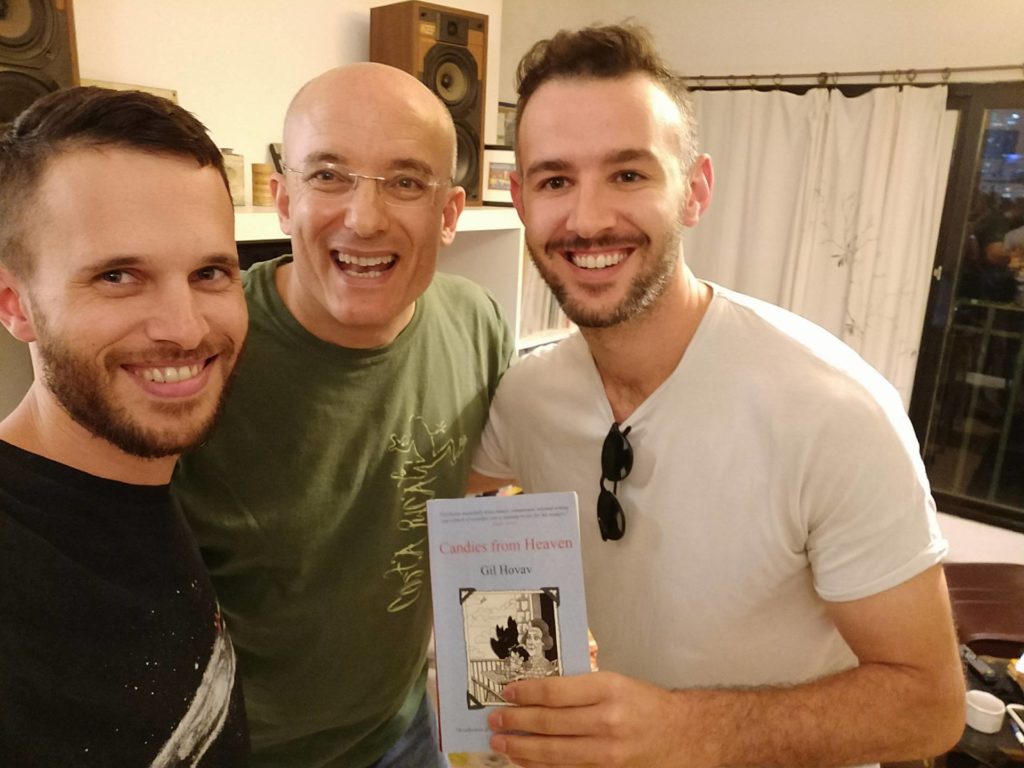
Episode 63 – Candies from Heaven: Tales of a Jerusalem Boy

Jews have been longing for Jerusalem for two thousand years. But in the 19th century only a few were courageous enough, some might say crazy enough, to take everything and leave their homes to the Holy Land.

And that’s exactly what several poor Yemenite families did. They walked by foot from Sanaa to Jerusalem, only to find out that the Holy city is actually a dump.

Gil Hovav’s ancestors were one of these families, and when a few generations later, Yemenite Jew Moshe Hovav Married the granddaughter of Eliezer Ben Yehuda, reviver of the Hebrew language – Gil Hovav was the result.

Gil grew up amidst a clash of cultures, which took place in a city torn apart by wars and religion. His fascinating childhood is the subject of his autobiographical book, Candies From Heaven, which was just now released in English.

Gil is one of Israel’s greatest experts in food and food culture. Gil has been a regular guest in every Israeli household for over 20 years. He’s a pioneer of the televised cooking shows here in Israel. He’s a food journalist and author of many cooking books and some novels as well.

Gil joins us for the second time to talk about his amazing childhood in Jerusalem.

Gil’s book Candies From Heaven on Amazon

Gil’s Facebook page

RSS Subscribe

Direct Download

Episode 63 – Candies from Heaven: Tales of a Jerusalem Boy Read More »

THREE BILLBOARDS OUTSIDE EBBING MISSOURI *Movie Review*

“Three Billboards Outside Ebbing Missouri” is officially billed as a darkly comedic drama, but it’s far more drama than comedy.  Mildred (Frances McDormand) pays for three billboards questioning the local police chief’s investigation into her daughter’s murder when the case stalls after seven months.  The murder mystery, though, is more a device than actual plot point as the case takes backseat to Mildred’s grief, actions and evolution.

The local police chief (Woody Harrelson) and detective (Sam Rockwell) are as multi-dimensional as Mildred.  However, particularly with Mildred and Detective Dixon, it’s up to viewers to decide if they are truly better versions of themselves by the end.

The movie also stars Woody Harrelson, Sam Rockwell and Caleb Landry Jones.

For more about the evolution of the characters in “Three Billboards Outside Ebbing Missouri“, take a look below:


–>Keep in touch with the author on Twitter and Instagram @realZoeHewitt.  Looking for the direct link to the video?  Click here.

All film photos are courtesy of Fox Searchlight.

THREE BILLBOARDS OUTSIDE EBBING MISSOURI *Movie Review* Read More »

Does world Jewry have the right to say that Jerusalem has a Haredi problem?

The study is not yet fully available (it will be posted on the JPPI website in the next 2-3 days), but it is already making headlines: The Jewish People Policy Institute’s structured dialogue on the Jewish people and Jerusalem found that the demographic growth of ultra-Orthodox Jews in Jerusalem is more of a concern to world Jewry than the demographic growth of Arab residents in the city.

I have the full report — because I was a co-head of the project (with Senior JPPI fellow John Ruskay) — so I would like to explain why this study should be of great concern to all those who care about the Jewish people: It backs with quotes and data the sense of a growing trend of alienation between Orthodox (mainly Haredi) Jews and non-Orthodox Jews.

This trend is troubling for many reasons, but, as JPPI states in its recommendations, it is especially troubling “since in both Israel and the Diaspora the relative numbers of ultra-Orthodox Jews are on the rise, and hence the presence and influence of such Jews within the community are expected to grow.” In other words, a growing, vibrant, and at times assertive minority is seen by most other Jews as a problem. That was the reason for JPPI to make the following (probably controversial) recommendation in its report:

“Jewish leadership around the world ought to be more aware and more considerate of Haredi sensitivities. This important segment of the community cannot be expected to accommodate itself to the rest of the community and tailor its agenda accordingly, without a parallel effort by the community to accommodate the needs of the Haredi group.”

It is easy to play a blame game as we consider this Haredi-non-Haredi divide. On both sides there is a tendency to see the behavior of the other group as the main source of trouble. In the report, we wrote the following paragraph:

“In almost all communities, participants refer to Haredi communities in negative terms, describing them in ways that would be unacceptable in many other venues, and expressing both apprehension and frustration with their actions. ‘I have a problem with control and domination by the Haredim, who I see as intolerant,’ a participant in St. Louis said. We, the Jews, ‘need to maintain a Jewish majority [in Jerusalem], but have more diversity in the Jewish population to balance the Haredi influence,’ said a participant in Sydney.”

But here is an interesting question: What if the easiest way of preserving a Jewish majority in Jerusalem is having Haredis make more children in Jerusalem?

At dialogue discussions — more than 40 such sessions were held around the world as we gathered information for the report — we did not specifically present this possible dilemma. But looking at the questions we did present to the participants, we might be able to take a guess.

For example, participants in the dialogue were asked if they thought the growth of the non-Jewish population in Jerusalem (that is, Arab) was a “positive development as it gives Jews and Arabs the opportunity to live together.” They were also asked if they thought the growth of the ultra-Orthodox population in Jerusalem was a “positive development as it gives Jews of various types the opportunity to live together.” The result is telling. There are far more Jews who see the growth of the Arab population as a positive development than Jews who see the growth of the Haredi population as a positive development.

This outcome, understandably, makes many people angry. One of them wrote to me this morning: “Jerusalem was a city which was entirely Haredi before the “Zionists” (The real Zionist were the Baal Shem Tov and HaGra who sent their students to a barren land) came and secularized the city. Beezrat Hashem, in a few years we will be the majority and Moshiach will drive out all secular people.” Some of them attached their angry comments to the Jerusalem Post article on this study, comments such as “So-called Diaspora leaders are the captains of sinking ships,” “What foreigners, with a marginal stake in the city, have to say is of marginal interest,” “World Jewry has its collective head in the sand,” and so on and so forth.

Anger can be found on both sides: Non-Haredi Jews are mad because of Haredi behavior and aggressiveness. Haredis are mad because it is their city more than it is the city of people who live in other countries. But in both cases anger clouds the vision of Jews: rather than asking who’s to blame, rather than getting mad, rather than debating whether this or that Jew has or doesn’t have the right to have an opinion, we should all try to figure out (that is, if we are interested in helping the Jewish people thrive) how to defuse an unhealthy situation of anger and alienation between Jews, in Jerusalem and elsewhere.


Does world Jewry have the right to say that Jerusalem has a Haredi problem? Read More »