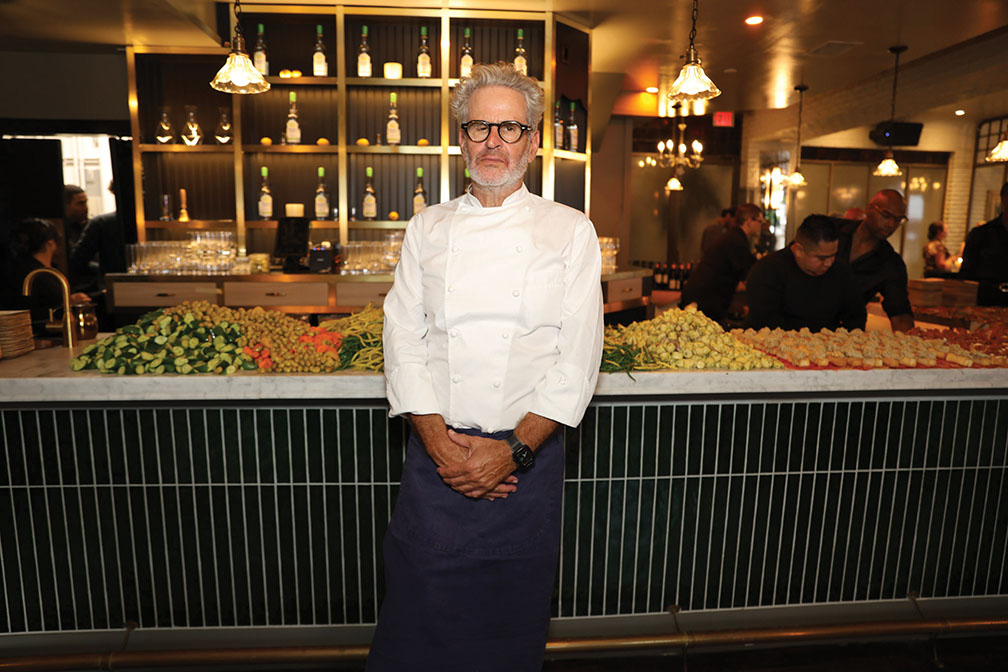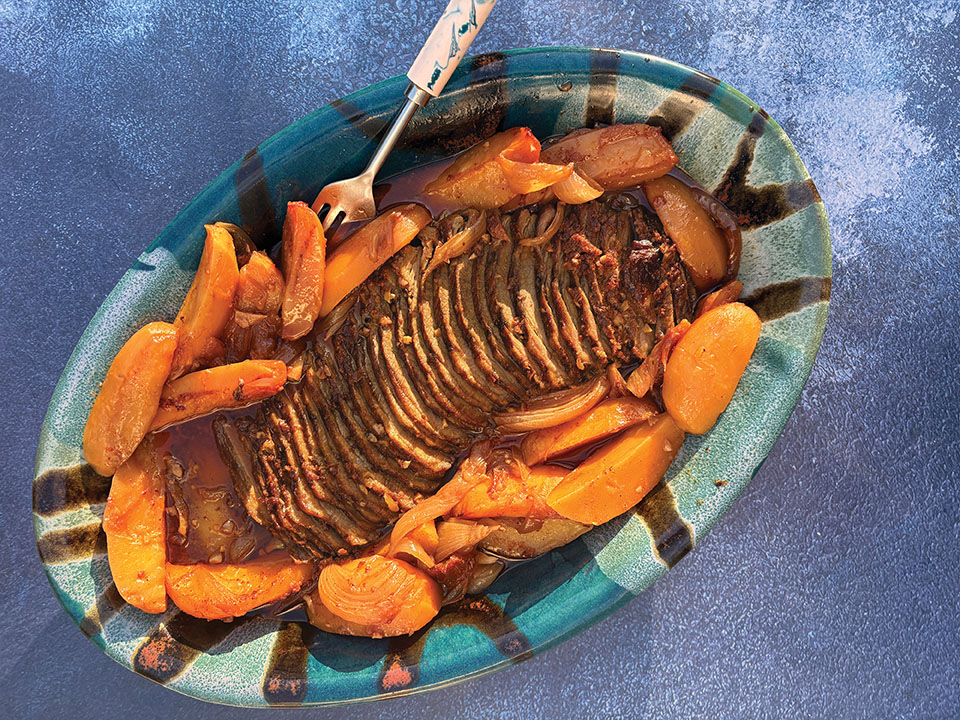

“We have mole, Baruch HaShem,” chef Todd Aarons said after dashing into his restaurant’s kashrut kitchen to check on the status of the complex sauce that originates from Oaxaca, Mexico.
Leave it to a Californian to do things differently in Jerusalem.
Aarons, who years ago created Tierra Sur at Herzog Wine Cellars in Oxnard, opened Crave Gourmet Street Food last October in a particularly buzzy pocket of Jerusalem’s Mahane Yehuda Market district. Locating it steps from the vendors inside the legendary shuk, he joined forces with three partners to bring a culinary edge to Israel, thanks to the chef’s SoCal-influenced palate and an unorthodox approach to the restaurant business.
Crave eschews Israel’s typically low wages and awkward tipping system in favor of menus with prices slightly higher than those of hyper-casual restaurants and a stronger commitment to staff training.
Its eclectic menu makes perfect sense to diners who are familiar with California’s food truck culture and the state’s culinary cross-pollination of Asian and Latin American influences. But even among people who find these concepts novel, Crave has been doing a brisk business since opening. After all, diasporic mashups are an inherent part of Israeli cuisine and culture. And Aarons’ kosher cheeseburgers don’t hurt the appeal.
Married to an Israeli, Nava, and the father of four daughters between the ages of 10 and 16, Aarons made aliyah two years ago. But he and his partners, in particular James Oppenheim, whose expertise is marketing in the tech industry, “wanted to come here and put an imprint on what it is that we do,” Aarons said.
Crave’s team recognized an opportunity to introduce progressive American innovations. “We’re big fans of Danny Meyer, and we dissected what he was doing,” Aarons, 48, said of the Union Square Hospitality Group and Shake Shack founder, who is committed to higher wages and benefits for his employees. “If I were to open up something in the Pico-Robertson area, I would’ve done the same thing,” Aarons said.
To Aarons, making aliyah also meant finding ways to make a positive impact on Israeli society and culture. As he often asks his colleagues, “What kind of conversation can I add to what’s going on here?”
The Crave menu gives prospective diners plenty to consider and discuss when they enter to see street art murals that decorate the interior and outside walls. Other visual and design elements make Crave much less formal than Aarons’ previous restaurants.
Before he made lamb bacon served with Israeli craft beer, Aarons attended culinary school in San Francisco, where he worked at chef Judy Rodgers’ iconic Zuni Cafe on Market Street. Peter Hoffman’s erstwhile Savoy restaurant in New York City was a logical next step, given its role as an early adopter of market-driven, seasonal cuisine in which everything was made from scratch. Aarons also spent time cooking in Europe and Mexico as he was growing more serious about his Judaism.
During the mid-2000s, when Aarons was running Mosaica, his kosher bistro in New Jersey, winemaker Peter Stern and the Herzog wine family lured him back out West. Aarons then created Tierra Sur at the Oxnard winery, arguably the state’s best kosher fine-dining establishment.
“We happened to open up a place in an area with lots of farms,” Aarons said of his time at Herzog Wine Cellars. “The farmers really dictated our menu there,” which was an extension of his training at Zuni and Savoy.
Aarons spent nine years commuting from North Hollywood to Oxnard, and after leaving Tierra Sur and a short-lived project in the Pico-Robertson area, he moved to Israel.
One of his partners, Tzvi Maller, who hails from Northridge, operated restaurants in the United States, such as Nobo Wine & Grill and Sushi Metsuyan in Teaneck, N.J., even after Maller made aliyah. He was looking for a new project in Jerusalem, and he found the timing right to join forces with Aarons.
But after years in white tablecloth-clad rooms, Aarons’ Jerusalem goals were different.
“I wanted to do street food, something that wasn’t as high-end, and [have it be] accessible,” he said. Incorporating the global cuisines he cherished back in Los Angeles also was key.
The four partners spent about 18 months polishing the concept, which remains a work in progress.
“Coming from Los Angeles, I miss Californian cuisine and Mexican cuisine. So for us, our comfort food is Mexican,” Aarons said. “When I grew up in L.A., I wasn’t kosher. I did plenty of Korean barbecue and Mexican food.” He pointed to his admiration of chef Roy Choi and his fusion Kogi truck empire.
Aarons uses techniques he honed over the years, such as slow cooking food in vacuum-sealed plastic bags in low-temperature water, a method known as sous vide.
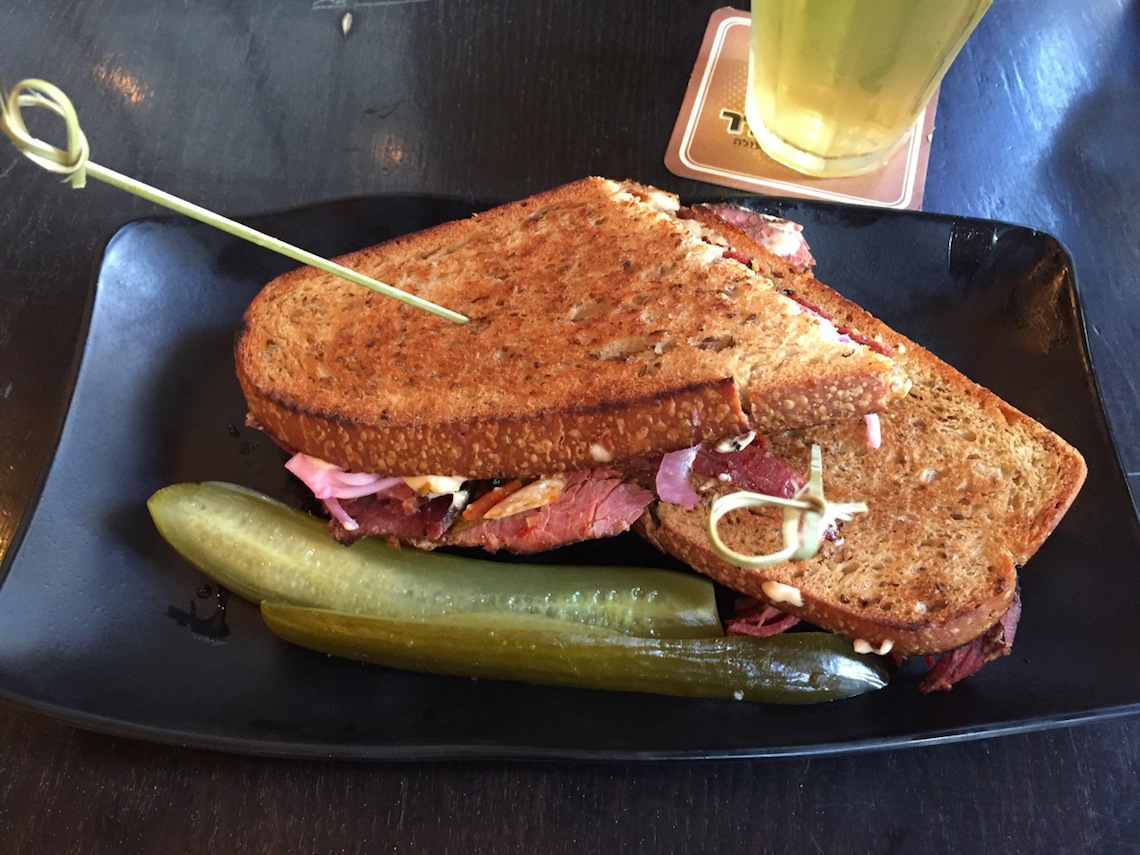
Younger Israelis, he said, “travel and they’re looking for authenticity and something new and exciting.” So, his twist on a pastrami Reuben sandwich with house-made kimchee, truffle sriracha mayo and pickled onions slathered on the rye bread finds a warm welcome.
Questions of cultural appropriation that might arise in the United States when a Jewish chef serves Filipino-inspired adobo brisket or Baja-style fish tacos don’t seem to be an issue in Israel thus far.
“There are very few ingredients we have to bring in,” he said. “Chili flakes we don’t find. But sriracha is here. It’s a small country but everything is here.”