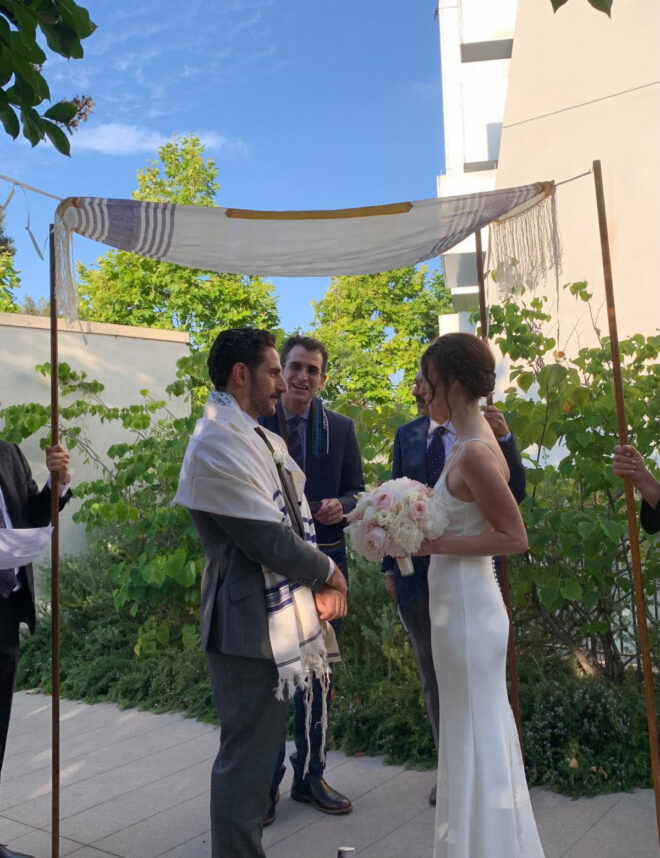
When Richard Weiner and Judith Forman geared up for their November nuptials last year, they didn’t register at Crate & Barrel, Macy’s or Bed, Bath & Beyond.
“We’re 65 years old,” chuckled Weiner, a Philadelphia lawyer who has become bicoastal since marrying his Manhattan Beach bride. “We’re at an age when you start getting rid of stuff, not getting new stuff.”
Both already had wine goblets, linens and fine china from previous marriages — so the couple decided to do something to reflect their commitment to tikkun olam (repairing the world). They asked their guests to donate to the Judith Forman and Richard Weiner Family Fund for the Advancement of Interreligious Dialogue, which supports lectures and scholars-in-residence on interreligious issues sponsored by their respective local Philadelphia and Los Angeles American Jewish Committee (AJCommittee) chapters.
Weiner and Forman are particularly passionate about intergroup relations, and the two met on the AJCommittee’s Adenauer Exchange Program, an annual event organized by the AJCommittee and the Konrad Adenauer Foundation of Germany. The two organizations exchange lay leaders for the purpose of building bridges of understanding between the Jewish community in the United States and Germany.
The couple’s wedding plans were not as unique as one might think. The notion of repairing the world and helping others in conjunction with weddings is something that many Jewish couples are opting to include in their big day.
Sarah Dakar, owner of Under the Chuppah, a wedding and event production company in the Pico-Robertson area, often fields clients’ requests to include philanthropy in their simchas.
“By attaching some kind of charity to their wedding, I have seen it only enhance the couple’s joy by helping others,” Dakar said.
There are countless ways that couples can incorporate philanthropy into their weddings. Some sponsor a meal at a soup kitchen on their wedding date, donate leftover food to a charitable organization, donate a percentage of their cash gifts to charity, donate their floral centerpieces to a local hospital or donate money or even a wedding dress to local organizations that help brides who can’t afford their own.
For her February simcha, Jennifer Bilovsky, 30, plans to donate leftover food from the event to Global Kindness, a small family-run organization in the Pico-Robertson area that helps feed a base of 75 needy Jewish families in Los Angeles. In addition, she and her fiancÃ(c) will donate money to a local hachnosas kallah (bridal assistance), which helps less fortunate couples pay for their weddings.
“Traditionally, Jewish weddings were a way to give back to the community and to open doors to the needy,” said Bilovsky, a writer who lives in Encino. “[Making these donations] is a way that we could continue that mitzvah within the context of the modern wedding.”
Historically, there has also been a long-standing tradition of Jews helping poor Jewish couples pay for their weddings.
“It is a mitzvah to help out a needy bride and enable the wedding to occur and be a joyous affair,” said Rabbi Jonathan Jaffe Bernhard of Adat Ari El in Valley Village.
But while the act of charity is selfless, isn’t a wedding supposed to be about the bride and groom?
“Even though the focus is naturally on the couple, no wedding takes place in a vacuum but always within the context of a larger community,” Bernhard said. “Being philanthropic reminds us of that and instills within us a sense of gratitude for what we have been blessed with and our obligation to help others in need.”
Coming from two very philanthropic families, Sasha Strauss and Leerone Milstein grew up believing in the importance of helping those less fortunate. When planning their December 2006 wedding, the Los Feliz couple immediately knew they wanted to include a charitable aspect to their big day. But rather than simply asking guests to donate to a worthy cause, the couple wanted something more.
“We wanted a program where [our guests] could participate hands-on in a philanthropic cause to feel like they have already affected someone when they left,” said Strauss, the chair of Jewish Family Service of Los Angeles’ marketing and communications committee and the owner of a brand consulting firm.
A few days before their wedding, the couple and about 40 of their guests spent several hours assembling food baskets at the SOVA Food Pantry in Los Angeles. Strauss, his wife and their guests were deeply affected by the experience.
“That type of direct exposure changes people,” Strauss said. “It makes you look at writing that check [for charity] in a whole new way because you envision the person whose life is changing from you writing that check.”
Preparing for one of his frequent trips back to Philly, Weiner, too, reaffirms his dedication to making a difference. He and Forman will continue to make donations to the AJC fund they created.
“We wanted to do something that was meaningful to us and reflects our commitment to the principles that AJC advocates,” said Weiner. “I feel really good about the choice we made.”
For more information, visit
Hachnosas Kallah
(310) 552-2446
Global Kindness
(310) 286-0800
Under the Chuppah
(310) 728-6020
http://www.underthechuppah.com/
Jewish Family Service of Los Angeles
(323) 761-8800
American Jewish Committee
(310) 282-8080