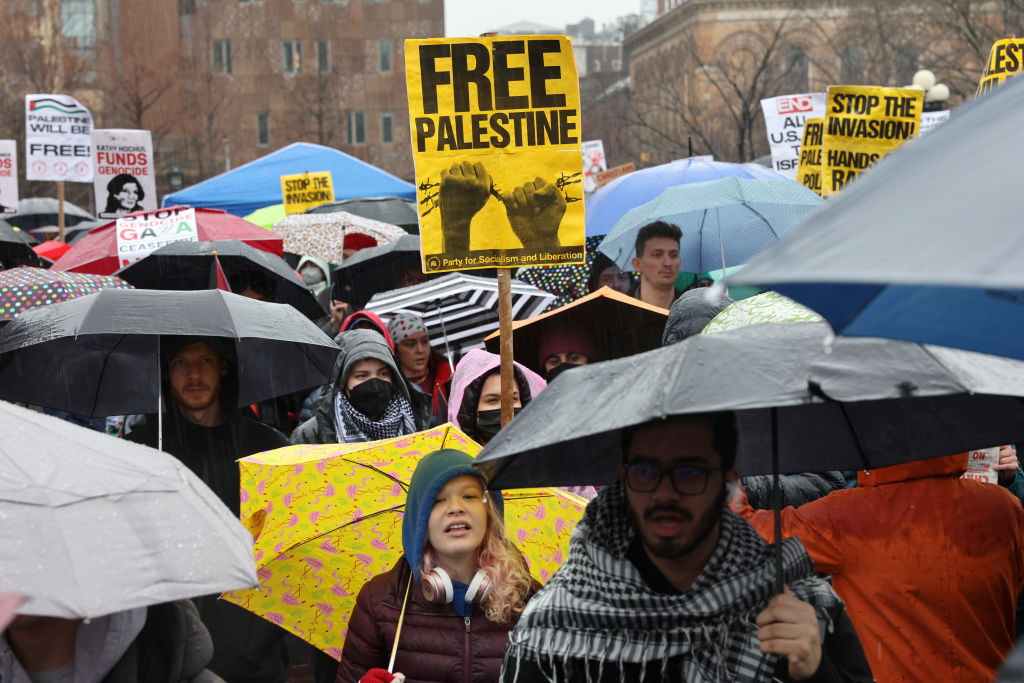
It’s clear that Christine O’Donnell, the Tea Party Republican nominee for Delaware’s U.S. Senate seat, is a Christian. She used to be an activist for conservative Christian organizations. But what about the rest of the loosely defined Tea Party?
The Forward ponders just how Christian the Tea Party is. An excerpt:
A New York Times/CBS poll conducted in April found Tea Partiers to be more Republican, more likely to own a gun and older than average voters. It also found them to be more likely to attend religious services: Fifty percent of Tea Party supporters attend services once a week or almost once a week, compared with 35% of those in the general public (and 15% among Jews, the least frequent worship attendees of all American religious groups). Among Tea Partiers, there is a higher proportion of Protestants and of those who define themselves as evangelicals or born-again Christians. Jews, according to the poll, make up only 1% of the movement’s backers, compared with their 2% share in the American public.
Researchers caution that the higher share of churchgoers among Tea Party supporters could simply be a product of their older-age profile, because religious services attendance increases with age.
Nevertheless, the fact that Tea Party supporters live a more active religious life — which is a Christian life — could explain the comfort that candidates associated with the movement feel when discussing religion, faith and God on the campaign trail.
The article goes on to discuss statements made by Tea Party candidates that are of particular concern to Jews. But the statements aren’t Christian; they are political. And in that sense I think this story does what far too many do: It conflates Christian references and images used by Tea Party candidates with the actual beliefs of Christians.
To be sure, I’m bothered too by politicians who casually refer to other politicians as the “Antichrist” or “Hitler” and I believe separation of church and state is crucial my being able to freely practice my religion, which, if you need to be reminded, is Christianity. But nothing in this article really answered the question posed in its headline: “How Christian Are the Tea Party’s Political Candidates?”