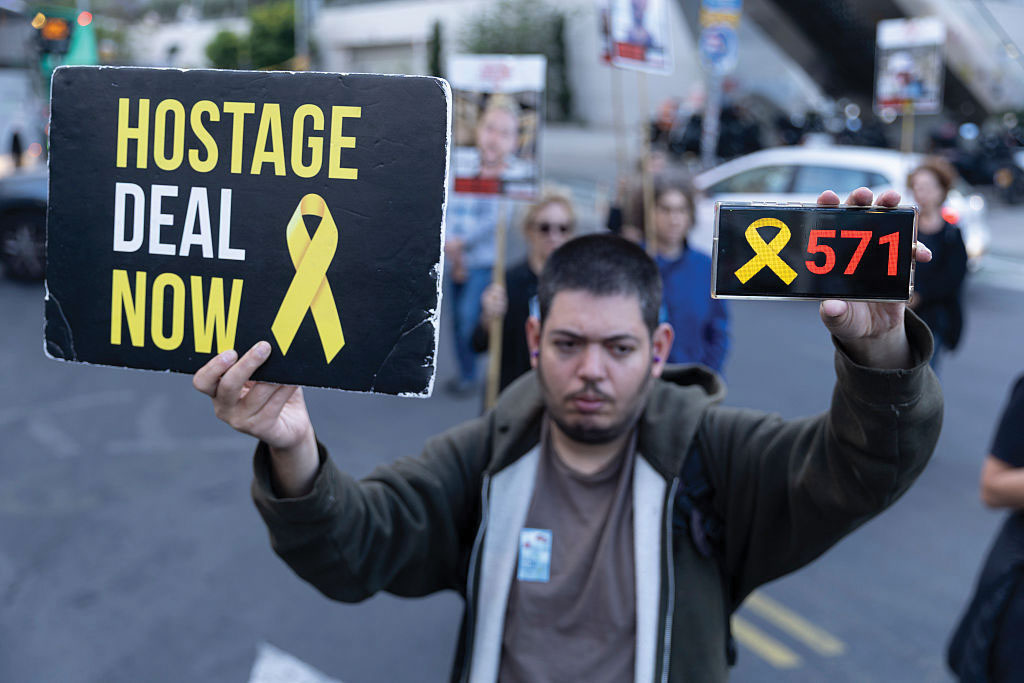
The headlines were unambiguous:
• “An Overwhelming Majority of Israelis Support a One-Phase Hostage Deal.”
• “Seventy Percent of the Israeli Public Back a Deal to Free All Hostages in Gaza in Exchange for Ending the War.”
Sounds decisive. The Israeli public wants a deal. A majority of Israelis prefer that it be executed in one phase. The numbers seem to indicate an overwhelming consensus. And yet, as is often the case in Israeli politics—and in war—it pays to scratch beneath the surface. Because when you do, the picture becomes less clear. More complicated. More human. And of course, frustrating for those of us who need or want to clearly understand Israeli reality.
One poll reported that 74% of Israelis support “the release of hostages in one phase and an end to the war.” But that phrasing carries a built-in ambiguity. It includes two components: one, the hostages are all released at once (a proposition not currently under discussion). Two, the war ends. You could say that in this case we get a two-for-one ticket. Two things that we all want: a release of all hostages, and the end to a long war.
Not all Israelis though believe now is the time to end the war. What is a survey respondent to do if they support the first part—freeing all hostages at once – but oppose the second – ending the war prematurely? They face a dilemma. Forced into a “package deal,” some may say ‘yes’ because the hostage issue is paramount. Others might say ‘no’ because the believe the war must continue. Some may opt for ‘I don’t know’. Those weren’t the exact options offered in that poll, but you get the point. It’s a recurring theme in public surveys: the structure of the question heavily influences the answer.
But we wish to know how Israelis feel about a hostage deal. We want to know what deal would be acceptable to them. So we looked at four recent polls that asked a question about the deal. In two of them, support for a deal that ends the war and brings home all the hostages is overwhelming—north of 70%. In the other two, support is still a majority, but a slimmer one—under 60%. Why the discrepancy?
Here’s a hypothesis: In the first two polls (Channel 12 and aChord), the question was about return of the hostages and an end to the war. Get the hostages, end the war. No other details – no word about what comes next, about who rules Gaza. In the second pair of polls, the wording made the outcome more explicit: there will be a hostage deal that ends the war and leaves Hamas in power.
An abstract “end to the war” is easier to support than a concrete “Hamas stays in charge.”. This could explain the drop in support in the two latter polls. Saying yes to freeing hostages and stopping the war – two things almost everyone wants – is easier than saying yes to a trade-off: you get the hostages back, but you let Hamas survive. That’s a more bitter pill. Yes, it may be implied in any current end to the war that Hamas remains in power. But when it’s spelled out, people flinch.
The question of Hamas’ continued rule in Gaza is a sensitive one. A large majority of Israelis would much prefer that Hamas fall. But a majority also believes – at least at this moment – that toppling Hamas is not an achievable goal. In a June survey by JPPI, only 30% of Israelis said they believed that at the end of Israel’s ground operation in Gaza, “Hamas will cease to exist” in Gaza. That leaves a wide gap between what Israelis want, and what they believe can actually happen.
And we must add something that is usually only whispered: there is a huge gap between Jewish and Arab Israelis in how they respond to these questions. About nine in ten Arab Israelis support a deal that means Hamas remains in power. That doesn’t mean they support Hamas – many Arab Israelis detest Hamas – but it does reflect a clear prioritization: end the war, even if Hamas survives. Among Jewish Israelis, the trade-off is more divisive. When the question is specific, the Jewish public is split nearly evenly. Support for a deal barely edges out the opposition.
So where does this leave the government? PM Netanyahu claimed on Sunday that the polls are “engineered” by the opposition, or the media, to create the impression of support for any deal. The accusation is false, but he does have a point. By insisting on certain terms that currently (Tuesday) seem to make the deal less likely, does the government act against the will of the majority? Would a clear majority of Israelis support ending the war if it meant a significant IDF withdrawal from Gaza and Hamas remaining in power? Perhaps. But that majority would likely be narrower than what some polls seem to suggest. And among voters for the current governing coalition it might not be a majority at all.
The Israeli public may be ready for a deal. But like most things in Israel, support comes with conditions and caveats. The hostages are precious. A deal is complicated.
Something I wrote in Hebrew
Israelis seem less sensitive to cases of the IDF unintentionally harming uninvolved Palestinians in Gaza. Here’s what I wrote:
One can only hope that the shift in the Israeli sensitivity is a temporary one. There’s no fundamental reason to reject the idea that “Israel should aim to win, and strive to do so without harming innocent people.” That a significant portion of Israelis do not choose this option when asked about it – can be explained by their anxiety. Some of them fear that when they’re asked to “win without harming innocents,” what is actually meant is: “compromise on victory.” And that’s something they’re unwilling to do. This sentiment is understandable in light of the situation Israel is facing. And yet, it’s important to remember: societies enter dangerous territory when they choose to eliminate a value entirely, rather than manage the tension between competing values. Victory is important – fighting morally is important. That’s a tension we must live with.
A week’s numbers
Here’s one way to appreciate the impact of the Iran operation on Netanyahu’s standings. Surveys by aChord.

A reader’s response
Dave Argos writes: “I was shocked to read the NYT report on how Netanyahu deliberatly prolonged the war in Gaza.” My response: “You’d be somewhat less shocked if you treat the facts as facts (and the report contains many valuable facts) while remembering that speculation and assumption are speculation and assumption (the report contains many of these too).
Shmuel Rosner is senior political editor. For more analysis of Israeli and international politics, visit Rosner’s Domain at jewishjournal.com/rosnersdomain.