
The new Israeli government is spiraling down, and the country follows. A radical legal reform is moving forward with no sign of readiness to meaningfully compromise; signs of economic repercussions are visible: From the weakening NIS, to the credible threat of entrepreneurs that they might move their business elsewhere; a budget is passed with little vision and a lot of allocations to the less productive sectors (namely, the ultra-Orthodox); terrorism raises its ugly head, unimpressed by the supposed right-wing toughness of the coalition; a Jewish mob attacks a Palestinian village, pogrom style; reservist officers declare their intention to refuse a call of duty.
Is it fair to call a government a failure when it barely started what’s supposed to be a four-year term? Is there any other name this government deserves other than failure?
Is it fair to call a government a failure when it barely started what’s supposed to be a four-year term? Is there any other name this government deserves other than failure?
These are hard times in Israel, in which frustration, anger and despair are common, and calm, pragmatic policies are rare. Ask: Where is Benjamin Netanyahu when all these things happen? That’s a good question. Netanyahu is an experienced, able, wise leader. He used to be a cautious leader. One could have disagreed with many of his actions and still acknowledge a simple truth about him: he doesn’t just roll the dice when things are of real essence. He doesn’t bet on Israel’s security, nor its economy, nor its justice system.
Now things have changed. The justice system persecuted Netanyahu, and he seems to have lost his motivation to defend it from populism. Israel’s economy is shaky because the government’s actions, and the PM blames the leaders of the opposition rather than do something. Then, there’s security: it’s not Netanyahu’s direct fault that terrorism is on the rise, but he hardly seems as someone rushing to extinguish the fire. His minister of Homeland Security is a juvenile Rambo wannabe, his Minister of Defense must fight back the ambitions of the Minister of Finance, the coalition is full of people who could win a smash-mouth competition against “Dilbert” creator Scott Adams hands down.
Where is Netanyahu? There are three main theories, all of which are hard to confirm.
The first theory is that Netanyahu has a big plan. He is in control, and at the right moment (maybe it already happened, between the time of wring and time of publication?) he will reemerge, setting the tone, putting things back in order, achieving his exact goals. Proponents of this theory assume, with reason, that Netanyahu doesn’t want to fail, and would not let things deteriorate unless he had a plan.
The second theory is that Netanyahu wants it – that he wants things to be where they are. Why would he want such thing? Because only with his coalition in full control of the legal system can his trial be canceled. And what about the economy, Israel’s security? That’s collateral damage, so the theory goes. Netanyahu, at this stage, is ready to make the country suffer to set himself free (without losing his power).
The third theory is that Netanyahu is weak. He is weak as a politician, and cannot control the Huns who joined his coalition – neither the right-wing radicals who do not have a real problem with Jewish pogromists, nor the sectorial hacks who only care about allocations to their community’s institutions. He is also weak as a human being, and would not make the obvious choice and leave, clearing the way for a new, more moderate, Israeli coalition.
There are problems with each of these theories, and there are unanswered questions that they do not fully address. One thing seems clear though: A few weeks under this government feel like years. So much so, that several political analysts had begun speculation about – guess what? – another election.
If Netanyahu did not lose his grasp of reality, if he still wants this country to thrive, if he doesn’t want to leave a legacy of ruin behind, then he must understand that this isn’t working. It’s true that Netanyahu was always cautious with the dice on security and economic matters, but he wasn’t always as cautious with it when political gambles were involved.
How could such gamble work? Go to a new election, expect no side to win a clear majority, make the opposition an offer it cannot resist – by reminding the voters and their leaders what happens when Netanyahu is forced into a coalition that includes only right-wing and religious members.
The goal is simple: turning the “never Bibi” camp into a “better Bibi” camp. It’s not an easy goal to achieve, but look at the alternative.
Something I wrote in Hebrew
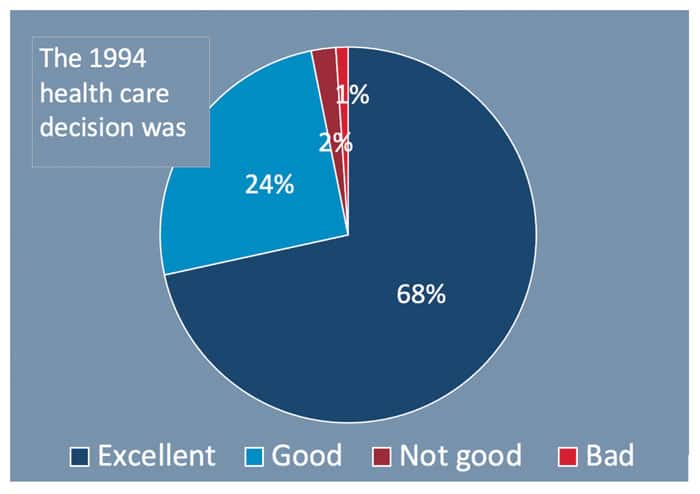
I was reminded of a dramatic “reform” that worked better than the current reform, Haim Ramon’s 1994 Health Care reform. Here’s what I wrote:
The American debate about health care is not evident in the Israeli arena. No party proposed to repeal the state health care law. The religious Zionist party, some of whose leaders entertain radical economic ideas, wrote in its platform about “the essential need for a strong and functioning national health system.” Netanyahu did not even hint at wanting to turn the wheel back. Those who want Israel without Ramon’s law will have to vote for fringe parties. Not only did Ramon’s reform pass without opposition, it was also without opponents. Not in the Knesset — not in the public. That’s how one passes a controversial reform.
A week’s numbers
See previous item to understand why this matters.
A reader’s response:
Alan Goller asks: “Is it time for the American Jewish community to say enough is enough about Israel”.
My response: Only if you think this will change anything (which I don’t).
Shmuel Rosner is senior political editor. For more analysis of Israeli and international politics, visit Rosner’s Domain at jewishjournal.com/rosnersdomain.