Last week, some tried to make Shabbat (Feb. 25) a “Day of Hate,” sending ripples of fear throughout Jewish communities. The previous week in LA, two Jews were shot as they walked near their shuls. When we hear about such abhorrent events, we may be tempted to lose ourselves in despair and terror. How is this possible in 2023? As we say on Tisha B’Av: “Oy, what has happened to us…”
But during this month of Adar, we read the parshiyot about building the Mishkan, and we are challenged to reflect on what it means to make space for the Divine in this broken world.
Purim occurred when the Temple was in ruins, when we were in exile and our lives were threatened, when God’s presence was hidden.
Purim occurred when the Temple was in ruins, when we were in exile and our lives were threatened, when God’s presence was hidden. It’s a time of joy, but that joy is tempered. We see this in the rabbinic decision to not say Hallel (Psalms of praise) on Purim because we were still living under Achashverosh, not free to serve God and only God.
Reading the parshiyot about the Mishkan, we may wonder how we can reconcile God’s desire to live with us with the hiddenness and exile in Adar and the Purim story.
Meor Einayim (a Chasidic commentary) reveals a teaching in the name of Adar itself, and suggests that we read “Adar” as “Alef”-“dar.” The alef stands for “alufo shel olam,” “Master of the world” and “dar,” “to dwell.” This makes A-dar the time “when God lives with us.” Meor Einayim says this is why even though Adar and Purim point to exile in our history, we still increase our joy (“mishenichnas Alufo shel olam dar marbim b’simcha”). It’s certainly a time when God lives with us, just not in the obvious ways we may expect.
Today, we long for wholeness and God’s Temple to be rebuilt but are faced with the reality that it isn’t. This makes understanding Adar as the time “when God lives with us” even more necessary.
Today, we long for wholeness and God’s Temple to be rebuilt but are faced with the reality that it isn’t. This makes understanding Adar as the time “when God lives with us” even more necessary. We acknowledge that it’s hard to see God in our lives and to connect to a parsha about building the Temple. It’s difficult to have faith when the world is in conflict. In the calendar, we are almost as far as we can be from Elul and Tishrei, when God is most obvious. Nevertheless, what Adar and Purim reveal is that God is committed to living with us between Temples, even when we feel disconnected or lost. And it’s not a coincidence that the Second Temple was built right after Purim, giving us Divine affirmation.
By showing up for each other in our shuls, we create space for God and joy even as we face fear and hiddenness. We fuse the love of building a home for God with the message of Adar.
We have agency in this. By showing up for each other in our shuls, we create space for God and joy even as we face fear and hiddenness. We fuse the love of building a home for God with the message of Adar. In this way, we make every Shabbat a “Day of Love”: love of people and love of God, answering brokenness and hatred with goodness.
I am reminded of a prayer written by Rav Avi Weiss: “Ahavnu” or “We have loved” (complementary to the High Holy Day confessional “Ashamnu,” “we have sinned”). Rav Avi’s intention was to give us a text to reflect not only on what we did wrong but also on what we did right. During Adar “when God lives with us” (and with yom hakiPURIM in mind), I suggest that we read this text as both a descriptive and prescriptive prayer to ground us in how we can respond to hatred. In doing so, may we call our world to foster greater love and joy, and in moments of hiddenness, truly build a home for God.
“Ahavnu” by Rav Avi Weiss
We have loved, we have blessed, we have grown, we have spoken positively.
We have raised up, we have shown compassion, we have acted enthusiastically,
We have been empathetic, we have cultivated truth,
We have given good advice, we have respected, we have learned, we have forgiven,
We have comforted, we have been creative, we have stirred,
We have been spiritual activists, we have been just, we have longed for Israel,
We have been merciful, we have given full effort,
We have supported, we have contributed, we have repaired.
Rabbanit Alissa Thomas-Newborn is a board certified staff chaplain at New York-Presbyterian Columbia University Irving Medical Center where she specializes in end of life, palliative, ICU and psychiatric care. A graduate of Yeshivat Maharat, she is also the Devorah Scholar at Congregation Netivot Shalom in Teaneck, NJ and the president-elect of Neshama: Association of Jewish Chaplains.
Torah teaches that “you shall rejoice in your festivals,” bringing opportunities to bless, to sing, to share in convivial celebration, but none so outrageously as the holiday of Purim. It is between Hanukkah and Pesach and all three share historical reminders of predominant cultures attempting to control, persecute, and annihilate Judaism. These holidays share a common goal, to defeat the autocrat and establish freedom to express our religious values and customs.
Purim, however, is lifted by the rabbis to an exalted place, “Purim will never be abolished.” It is the one holiday that will exist for all time. In fact, the Book of Esther, which we are commanded to read, states “Days of Purim will not pass … their memory will not cease for generations to come.” What makes this text, of all the writings in the Bible, so important and so timeless, that it is as relevant in the present and the future as it was in the past. In fact, it is a story where G-d is, at least on the surface, not present. G-d’s name never appears. It is a tale of hidden identities, courtly flaunting, political intrigue, exaggeration and bawdy excesses, drinking and sexual orgies — basically a carnivalesque happening with dark overtones of manipulations and evil aspirations.
As a whole, it is itself a mask covering deeper social inequities and a world that is upside down. Both an anti-Semite and a misogynist, the King in the end is brought to their knees by two Jewish protagonists, Mordechai, leader of the Jews and his adopted cousin, Es-teir, who becomes the Queen. In a time when men ruled the earth, it is a woman who transforms history and foreshadows the Passover story, where it is the women, as well, who save the Jews.
Based on a statement in Torah, “G-d will surely hide His/Her face…” “Hasteir panim,” the rabbis believe this book is written as a creative endeavor to comfort those in Exile in Persia. The tradition teaches that the exiles are punished for abandoning G-d and choosing idols and material objects and endowing them with power and influence over their lives. This book comes to assure the people redemption is possible, even when G-d appears concealed. Es-teir represents this ‘hiddenness’ of the Divine. The spelling of the word Hasteir is closely aligned with the spelling of our heroine’s name, Es-teir. Even as she hides her Jewish identity, wearing the mask of royal clothing, the Kabbalist teach she is truly the indwelling of the Divine. The book states “Es-teir was clothed in royalty,” It doesn’t say dressed in royal clothing, just “Tilbash Malchut,” which means “donned in royalty,” but mystically represents the female indwelling of G-d, Shechinah. Beneath the veil of simple understanding lies deeper meanings.
In another chapter the word appears again, as “Keter Malchut,” “Crown of Royalty,” which mystically represents the Tree of Life, from the most heavenly, all- encompassing Divine presence to the most physical/earthly and all that exists in between. The continually veiled references to G-d is what lies beneath the mask, the covering that often hides who we truly are and the Divine spark within. The holiday encourages the outrageous expression of frivolity and drunkenness at a moment when we are reminded the enemy lurks ready to destroy us.
Then Mordechai says to Es-teir, “Who knows, maybe you have attained this royal position for a purpose?” The Hebrew says, “HaGittah l’Malchut” which literally means ‘to be touched or to arrive at’ her royal station, but it veils the deeper meaning that she has ‘reached’ her purpose, to be Shechinah, the One Who accompanies, holds and protects the people when they are in exile. If you change one letter in “HaGittah,” from Ayin to Hay, the mask is lifted higher to reveal an even deeper meaning, “to shine and give light.”
This is the more powerful lesson that the ‘light’ must shine forth, as the book states, “Lay’hudim Hay’tah Orah,” “Light is with the Jews,” a phrase we repeat every Shabbat at its end in Havdalah. It is not only Es-teir who reveals the Holy Spirit. It is upon us as well when we remove the mask of fear and inauthenticity and reveal our strength and holy intentions.
Eva Robbins is a rabbi, cantor, artist and the author of “Spiritual Surgery: A Journey of Healing Mind, Body and Spirit.”
Hazzan Mike Stein of Temple Aliyah has a personal connection to “Mordechai Superstar,” the Purim shpiel he is writing and directing this year. Stein was in the original Broadway cast of “Jesus Christ Superstar” in 1971 – he played the role of Peter.
“Mordechai Superstar” will be Stein’s Purim shpiel swan song, because after 23 years, he will retire as cantor of Temple Aliyah at the end of June.
“I have so much fun writing the shpiel every year, and this year is especially meaningful,” Stein said. “I thought, ‘Why not go out with a bang?’”
He even asked some of his friends in the original cast of “Jesus Christ Superstar” to join the show.
During the pandemic, a group from the 1971 Broadway production started meeting on Zoom every week. Stein joined the group about a year ago, after he learned about it from fellow cast member Charlotte Crossley.
“All of our reminiscing about the show and how we were all so fortunate to have been on Broadway at the time as very young people created a bond,” he said. “So, ‘Superstar’ was on my mind.”
When Stein writes the shpiel, he cuts and pastes the original words from the play he is parodying, and then manipulates the text to make it fit with the story.
He explained, “What’s the buzz? Tell me what’s happening” became, “What’s the shpiel? Tell me what’s happening. Hey, shlemiel, tell me what’s happening?”
“I don’t know how to love him” becomes “I don’t know how to tell him,” sung by Queen Esther as she reveals that she is Jewish.
“Writing this play brings back so many memories,” Stein said. “I can hear the original singers as I write the words to the songs; [I remember] what I was doing on stage while they were singing. We were a close-knit group, many ex-pats from ‘Hair,’ and most of us were hippies more than actors.”
Doing a Purim shpiel is what Stein loves most about the holiday.
“The shpiel helps us laugh at ourselves. We take a conflict that has the potential to destroy our people, and we make light of it.“
– Mike Stein
“The shpiel helps us laugh at ourselves,” he said. “We take a conflict that has the potential to destroy our people, and we make light of it. Unfortunately, that is how we have faced so many similar situations and what gives the Jewish people her sense of humor and irony.”
Stein’s favorite part of the story is the idea of Jewish identity: Trying to assimilate and then, when it matters the most, unmasking and showing who you really are.
“There is a sense of triumph, that good can overcome evil,” he said. “And throughout the story, God’s name is not mentioned, but we know that God is there in the mix.”
Purim shpiels also create community.
“There is a core of actors and singers doing our Purim plays for over 20 years,” he said. “It keeps expanding as people come and go, and there is anticipation all year long about the play’s name, casting, etc. This is what synagogue life is about.”
When asked what people can expect from this performance, Stein said, “To laugh and laugh and laugh again.”
“Superstar” was not a comedy, so some of the seriousness rubbed off, and some moments have a taste of introspection for Mordechai and Ester.
”[It’s] a little bit irreverent, but that is to be expected from a shpiel. I hope people walk away with a bit of a taste of what I experienced on Broadway.
After “Jesus Christ Superstar,” Stein was in the original road show of “The Who’s Tommy.” He settled down, had a family and joined the United States Navy Band White House Unit in Washington DC; he played fiddle for four presidents at the White House and around the world. After retiring from the Navy, Stein became a full-time cantor in Washington, D.C., before moving to LA and joining Temple Aliyah.
“I have come full circle,” Stein said. “I have been so fulfilled as cantor of Temple Aliyah for 23 years, but writing and directing this shpiel allows me to draw on experiences that mean so much to me from my past. It feels really good.”
Temple Aliyah and Shomrei Temple are teaming up for Purim events this year. “Mordechai Superstar” will be performed at Shomrei Torah in West Hills at 7p.m. on March 6. For more information, go to TempleAliyah.org/purim.
A few years ago, my husband Daniel and I felt like we were floundering and lost in our Jewish community in Los Angeles. We were shul hopping and didn’t have one synagogue we called home. We didn’t have many friends and found it hard to make them. Coming from the east coast, we didn’t have family out here, either. We were on our own.
But we were excited, because Purim was coming up. Daniel, a comedian, always had gigs on the holiday, and we’d get to go to other communities and celebrate the holiday with them. We always loved meeting new faces and making friends with people from all different backgrounds.
I also enjoyed Purim because we’d receive mishloach manot, the goody bags filled with homemade hamantaschen, candies, fruits and snacks that our friends would leave on our doorstep. We’d make our own and give them out to our friends, too.
If we were home on Purim day, we’d get to say hi to our friends as they dropped them off. Our dogs would bark to alert us that someone was there to greet us. It was fun catching up with people I hadn’t seen in a while.
This particular year, after dropping off our mishloach manot, we had some time before Daniel’s gig. We hung out at home, and I waited for our friends to start arriving.
It was 1 p.m., and nobody had come yet, which was odd. Then, it was 2 p.m. Then 3 p.m. Every time my dogs barked, I got up excitedly and looked out my window to see if anyone was there. But no one came. Around 4, we had to go to the gig. We hopped in the car and I turned to Daniel.
“It’s so strange that nobody has given us mishloach manot yet,” I said.
“Don’t worry,” he said. “I’m sure we’ll have some when we get home.”
We headed off to the gig and had a good time there. And when we got home that night, I ran up to our porch. I looked at our table, where people usually left the bags. There was nothing there.
I checked the gate to see if anyone had hung them there. There was nothing.
And then, on the step by our front door, I saw one bag. I opened it up. There were candies and pretzels and shimmering paper inside, and a note that said, “Happy Purim! I love you so much. Love, Bubbe.”
Daniel came up to the front door.
“We got one,” I said, feeling the tears welling up in my eyes. “It’s from Bubbe.”
Bubbe was my friend Miriam’s mother. Even after Miriam and her family moved from L.A. to the east coast, we stayed friends with Bubbe, who had driven all the way from Agoura Hills, an hour away, to deliver mishloach manot to us and her other friends.
It was late, so I texted Bubbe with a picture of the mishloach manot: “You have no idea how much this means to us. Thank you. We love you too.”
“Of course!” she texted back the next day. “How could I forget the Lobells? Hugs and kisses.”
If Bubbe hadn’t dropped off that bag, Purim would have been so much sadder that year. At the same time, it meant so much more to me to receive the one from her. Looking back, there was a lesson God was trying to teach me: Don’t forget your fellow Jews on Purim.
It’s important to give mishloach manot to friends – but it’s also critical to give to those who might not receive as many as other people.
It’s important to give mishloach manot to friends – but it’s also critical to give to those who might not receive as many as other people. This could include Jews who aren’t so observant and have never gotten one, or single people who may not be as connected as families, for instance. Since that Purim, Daniel and I drop off mishloach manot to people outside of our immediate friends circle so that nobody feels the way we did. We want everyone we know to receive at least one bag.
Purim is all about joy; you are not supposed to be sad on the holiday. This Purim, find one or a few new people you can give mishloach manot to. A small deed, just one little gesture of kindness, can make all the difference in the world.
Have something joyful to email me? Kylieol@JewishJournal.com.
Kylie Ora Lobell is the Community Editor of the Jewish Journal
Everyone loves a nice, sweet hamantaschen for Purim. However, there are other festive foods to enjoy.
“We always had fun baking hamantaschen on Purim, but everyone seemed to get more excited about eating the poppy seed cookies,” Norma Zager told the Journal.
A baker and comedian, Zager is one of the judge grannies on Peacock’s “Baking It!”
“When my children were growing up, my brother-in-law’s mother, Grandma Bell, used to make poppy seed cookies on holidays,” she said. “We all looked forward to her cookies. She would bring them in a decorative tin and, when we pried open the top, we knew we were in for a treat.”
Zager’s recipe is as close to what her family remembers.
Bubbe Bell’s Lemon Poppy Seed Cookies
1 ¾ cup all-purpose flour (spooned & leveled)
½ teaspoon baking soda
¼ teaspoon salt
½ cup unsalted butter, softened
¾ cup granulated sugar
1 large egg, room temperature preferred
zest of one lemon (about 1 tablespoon)
1 tablespoon fresh lemon juice
1 teaspoon lemon extract
2 tablespoons of poppy seeds
In a large mixing bowl, mix together the flour, baking soda and salt. Set aside.
In the bowl of a stand mixer fitted with the paddle attachment, or a large mixing bowl using a hand-held mixer, beat the butter and granulated sugar until light and fluffy.
Add in the egg and mix until well combined. Add in the lemon zest, lemon juice and lemon extract, and mix well, scraping down the sides of the bowl as needed.
Slowly add in the dry ingredients and mix until just combined.
Cover tightly and transfer to the refrigerator for at least 30 minutes to chill the cookie dough.
Preheat the oven to 350°F. Line two large baking sheets with parchment paper or silicone baking mats.
Remove the cookie dough from the refrigerator and scoop out two tablespoon sized pieces of cookie dough onto the prepared baking sheets. I prefer to roll the dough into balls and then gently press them down a little.
Bake in batches at 350°F for 10-12 minutes. The cookies should look done on the outside, but still a little soft on the inside. Remove from the oven and cool on the baking sheet for 5 minutes, then transfer to a wire rack to finish cooling.
“The famed hamantaschen is usually a sweet cookie with yummy filling, but, times they are a changin,’ Danny Corsun, founder of Culinary Judaics Academy (CJA), told the Journal.
CJA decided to go savory and create a whole hamantaschen meal.
“CJA has tweaked this classic spinach/pastry dough recipe to feature some seriously comforting, cheesy goodness,” he said. “Enjoy!”
CJA Cheesy Spinach Leek and Artichoke Puff Pastry Hamantaschen
20 puff pastry squares (4 × 4 inches each)
½ tbsp olive oil – for sauteing
2 medium leeks thinly sliced
1 (14 oz) jar artichoke hearts, drained
and chopped
1 (10 oz) bag baby spinach leaves
1 (8 oz) package cream cheese
1½ cups shredded mozzarella cheese
3 green onions, sliced
1 tsp garlic herb powder
Salt and pepper, to taste
1 clove garlic, minced
2 tbsp olive oil – for garlic oil
1 clove garlic, minced – for garlic oil
Sesame Seeds – for topping
Preheat the oven at 400° F.
Heat oil in a large pot over medium-high heat. Add the thinly sliced leeks and cook until soft. Add artichoke pieces and cook for one minute.
Reduce heat to medium, add the spinach and cook until wilted. Mix in cream cheese and mozzarella, and allow them to melt entirely. Fold in the green onions and season with salt and pepper to taste. Remove from heat.
In a small dish, stir together 2 tablespoons olive oil and 1 minced garlic clove. Set aside garlic oil topping.
Cut pastry squares into triangles. Position half of the triangles onto a baking sheet lined with parchment paper.
With the other half of the triangles, cut out a triangular hole in the center, forming a window.
To assemble:
Place a couple of tablespoons of the filling on the base triangle and cover with the “window” triangle.
Use a fork to press down the edges, making sure they are sealed well.
Brush over the top of the puff pastry with the garlic oil and sprinkle with sesame seeds.
Bake for 25 to 30 minutes. Serve warm.
Yields 10 hamantaschen.
Corsun said the story of Purim “gives us an opportunity to take responsibility for each other and the world around us.”
Corsun said the story of Purim “gives us an opportunity to take responsibility for each other and the world around us.”
Queen Esther is a great example.
“My daughter loved to dress as Queen Esther,” Zager said. “I was really always proud to share with my daughter that Queen Esther was a hero and had saved our people. It was truly a pre-feminist holiday.”
Added Corsun, “Esther stepped forward and risked everything.”
While she could have prayed to G-d for a miracle to thwart the evil Haman, instead, she helped make the miracle. If she didn’t, we would likely be telling a different story.
“This Purim, tap into your inner Queen Esther,” Corsun said. “In addition to getting dressed up and eating some Hamantaschen, volunteer your time, donate to a worthy cause or just be there for a friend who needs some support. Get out there and help make the miracle!”
Purim is one big party. Whether you are attending a Purim carnival or Megillah reading at your synagogue, or celebrating at home, it’s the perfect opportunity to have some fun with spirits.
When creating “Esther’s Revenge” Rabbi Avi Finegold tried to imagine what Esther would serve to Achashverosh and Haman at their feasts.
“The Megillah refers to them as feasts of wine, but she must have started them off with something a little more potent,” Finegold, the creator of the Jewish Cocktail Lab, told the Journal. When he isn’t giving cocktail workshops, Feingold hosts Canada’s leading Jewish podcast Bonjour Chai, among other podcasts.
“I thought of her remembering her days preparing to meet the king, [spending] six months at a spa with various oils and treatments and another six months in an aromatherapy spa,” Feingold said.
Esther starts with her local spirit and adds to it spices from the breadth of the kingdom.
“With a lemon plucked from the palace orchard, she crafts something sweet, tart and guaranteed to get Haman and his ten sons hanged,” he said.
Esther’s Revenge
2 oz. Arak
3/4 oz Lemon Juice
1 oz. Six Month Syrup (recipe below)
Shake with ice and strain into a cocktail coupe. Garnish with 11 raisins on a 50-cubit cocktail pick.
Cook gently until sugar is dissolved and flavors are infused. Strain syrup and store in the refrigerator for up to 3 months.
Kosher food blogger Gayle Levine Schindler, creator of FoodyFunKosher.com, said her shul always has a bottle of Sabra on the schnapps table for Purim. Schindler is author of “Stocked: Flavor Bombs & Staples For Your Kitchen.”
“I used it to create a cocktail that is easy and looks festive,” Schindler told the Journal. “Coconut milk keeps it parve for a meat meal.”
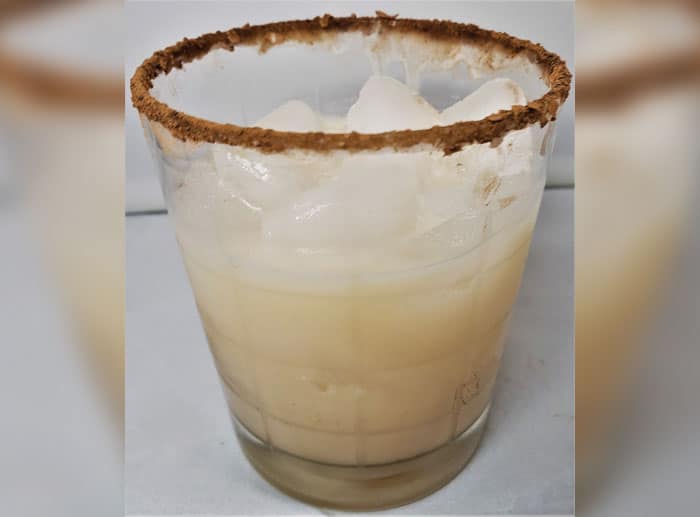
Coconut Sabra
1 ounce rum or vodka
1½ ounce Sabra liqueur
2 ounces coconut milk
1 tbsp unsweetened cocoa + 1 tbsp sugar OR 1 tbsp hot chocolate mix to rim glass
On 2 small plates: pour a little bit of coconut milk onto 1 plate and cocoa or hot chocolate mix on the other.
Turn the glass upside down; dip the rim first in milk, then in chocolate to coat the glass rim.
Fill the glass with ice.
In a separate glass, combine liquids and stir.
Pour into prepared glass over ice.
Note: Canned coconut milk does not have a strong coconut flavor; it does have a delicious creamy mouth feel. You can use lite coconut milk, regular or coconut cream, but I used the canned version. All three will separate into a thicker layer of cream over a more liquid base in the can. Use a whisk to reincorporate the layers before using.
“I’ve always had an eye for detail, flavor and presentation in crafting drinks,” Psyk told the Journal.
Psyk put his mixology skills to work to create a unique Purim cocktail for his Jewish friends.
“It was a way for me to show them my care and appreciation for their traditions,” he said. “My friends cleverly named it, ‘The Red Sea Cocktail.’”
The Red Sea Cocktail
2 ounces vodka
1 ounce strawberry liqueur
4 ounces cranberry juice
4 ounces of pineapple juice
Fresh strawberries, sliced, for garnish
Fresh pineapple, diced, for garnish
Ice
In a cocktail shaker filled with ice, combine vodka, strawberry liqueur, cranberry juice and pineapple juice.
Shake vigorously for 10-15 seconds until well combined.
Strain the mixture into a tall glass filled with fresh ice.
Garnish with a slice of fresh strawberry and diced pineapple.
Chef Rossi’s favorite drink works for Purim, Passover or really any celebration: her world-famous Manischewitz Spritzers!
Rossi is the owner and chef of The Raging Skillet, a cutting-edge catering company and author of the memoir, “The Raging Skillet: The True Life Story of Chef Rossi.”
Manischewitz Spritzers
2 shots Manischewitz Concord grape wine
1 shot apple juice
Pour over ice. Top with club soda and orange wedge
Readers had love on their minds with the most recent inquiries submitted to “Dear Tabby.” If you have a question you’d like answered in this mostly useful advice column, please email deartabby@jewishjournal.com.
Dear Tabby,
I have a friend who’s newly married in the last couple of years. She always asks me how dating is going and says things like, “imYH (Im Yiratz Hashem/G-d willing), soon by you” whenever we talk. How do I tell her it’s annoying and not so sensitive?
Thank you,
Soon By Me
Dear Soon, I happen to know a thing or two about inserting such words almost obsessively and, at this point, robotically, into nearly every other utterance. I’ve been told that I sometimes utter “Bezrat H-shem” (“with G-d’s help”) in my sleep. Ironically, your friend may fear that she would be insensitive by not using these words. She probably wants you to experience the same happiness she may feel. It’s also probably a part of her vernacular. Although there is the possibility that she may also be using this language to neutralize and somehow diffuse any envy that she may fear on your part, whether it exists or not. I know that’s hard to hear. Either way, it’s not your problem. Your role is to simply make your friend’s habit smaller for yourself. Add the letters “imYH” to her name as a contact on your phone and the next time she calls, enjoy a little chuckle. Try to count how many times she says “imYH” in a conversation (and maybe take a shot of tequila each time). Have compassion for her in a way that frees you from the burden of her habit. I know others would tell you to stand up for yourself. But let’s face it: There’s simply no nice way to tell someone to stop giving you a blessing of “G-d-willing, soon for you”; you can try, but I anticipate it’ll be awkward. Worse, she may really believe you’re envious of her. Find something trivial in your life that your friend doesn’t have (the more trivial, the more you’ll laugh). The next time you speak with your friend, enthusiastically mention your joy over your new immersion blender and add, “imYH, next by you!” Maybe she’ll get the hint.
Dear Tabby,
I can never think of creative questions on a date. Do you have any creative question ideas to ask on a date? I feel like this is a good way to get a sense of the other person’s personality.
Thanks,
Just Asking
Dear “Asking,”
I’m so glad you asked. Conversations on dates have come a long way since the evening began with, “Are you on MySpace?” These days, given the rampant crime in many cities, dates often start with, “Did you see [on Citizen] that there was a robbery three blocks away?” I recommend starting a date by asking if the person prefers to carry pepper spray, a taser or a good, old-fashioned club with a heavy, metal ball and spikes at the end of it — the kind they used on dates in the medieval days.
When I was single, I liked to ask my victims … er … dates, about the day-to-day responsibilities of their jobs, what brought them joy, and their favorite movies and television shows. Feel free to ask your date about their favorite streaming series (and inquire if you can borrow their password from time to time). If they offer you their password, quickly grab your phone to jot it down (and check your Citizen app for more crime alerts). In general, stick to three topics that always prove successful on dates: politics, your mother and the shelf life of that diuretic your doctor prescribed last fall.
Tabby Refael is an award-winning, LA-based writer, speaker and weekly editorial columnist for the Jewish Journal of Greater Los Angeles.
Bay Area High School Teacher Placed on Leave for Assigning Antisemitic Material
A high school English teacher in Hayward was placed on leave on February 23 for assigning antisemitic material to his class.
The Jewish News of Northern California (The J) reported that the Mt. Eden teacher, Henry Bens, had assigned a 42-page pamphlet called “The Hidden Tyranny,” which spreads conspiracy theories of Jews controlling American politicians as part of an overarching plan for “world domination.” Bens had reportedly told students “to annotate the text and highlight important sections about how Jews control and manipulate power structures” and made “Heil Hitler” salutes on multiple occasions, per The J. The Hayward Unified School District has placed Bens on leave while they investigate the matter.
The J also found sermons that Bens, who is also a pastor, gave at the Alameda church Congregation Rehoboth; Bens endorsed Khazar Theory, the conspiracy theory that Ashkenazi Jews are descended from the Turkish people known as Khazars, and has defended rapper Kanye West as well as the antisemitic movie that NBA star Kyrie Irving shared a link to on social media.
More Than 120 Scholars Call for U of Chicago to Denounce Protests of Israeli Class
A letter signed by more than 120 scholars called for the University of Chicago to condemn ongoing protests of an Israeli course and “do everything possible to prevent physical disruption of these classes.”
The letter, which was sent by the Academic Engagement Network, stated that the protests are being held outside the classroom where the class, “Security, Counter-Terrorism, and Resilience: The Israeli Case,” is being held. “When protests disrupt teaching and learning they should be treated as violations of campus policy and antithetical to the core academic principle of open intellectual exchange,” the letter stated. “Students have a right to study in a safe learning environment.”
NY to Investigate CUNY Law Over Faculty Support for BDS
The New York State Division of Human Rights announced in a letter that they will be investigating the City University of New York (CUNY) School of Law for alleged antisemitism after the faculty passed a resolution endorsing the Boycott, Divestment and Sanctions (BDS) movement in May.
The Times of Israel (TOI) reported that CUNY Professor Jeffrey Lax filed the complaint in July; the resolution had called for CUNY to sever all relationships with Israel and to abolish Hillel from campus, accusing the organization of harassing and initimidating Palestinian students.
“We feel that having BDS policy adopted by a law school discriminates against the Jewish students, faculty and staff of that law school,” Lax told TOI. “We have demanded that the chancellor put a stop to CUNY Law School implementing discriminatory, bigoted BDS policy and he’s done nothing about it, he’s only defended it. I think the message is, ‘We don’t want Jews at CUNY.”
Palestinian Peace Activist Event Disrupted at Tufts
An event at Tufts University featuring a Palestinian peace activist was disrupted by various protesters on February 21.
The Algemeiner reported that the event featured the activist, Khalil Sayegh, and an Israeli citizen named Sarah Mandel; they are speaking as part of a country-wide tour to build bridges between Israelis and Palestinians through an organization called Roots. According to The Tufts Daily, the protesters, who were donning masks, interrupted the event 15 minutes after it started with chants of “Roots, Roots, you can’t hide, you’re protecting genocide” and one protester calling Sayegh a “slut” in Arabic and other vulgarities. Eventually the protesters were removed, and the event resumed.
“The disruption of the event and the offensive language directed toward the Jewish and Palestinian guest speakers are absolutely unacceptable and a violation of our community standards,” Tufts University President Anthony Monaco said in a statement to The Algemeiner and the Daily. “Tufts University police and other relevant offices at the university are investigating and we will hold accountable any members of our community who are found to be responsible.”
Antisemitic Flyers at University of Vermont
Two antisemitic flyers were found in the University of Vermont in the past week.
Stop Antisemitism posted a photo of the flyer found on the third floor of the Dudley H. Davis Center on Twitter. The flyer stated “Every aspect of the slave trade is Jewish.” The group claimed “This is the third time in the past month the white [supremacist] group has targeted @uvmvermont with their atrocious anti-Jewish leaflets!”
Previously, an antisemitic flyer was found on February 20 in a campus bathroom, NBC5 News reported. According to Stop Antisemitism, that flyer accused Israel of being behind the 9/11 terror attacks. “Jewish students tell us they’re concerned the University is unable to stop those responsible for spreading the antisemitic hatred,” Stop Antisemitism tweeted.
You’d never guess from speaking with Rabbi Aryeh and Sharona Kaplan that they’ve been working deep in the trenches of college campus life since 2004. High school sweethearts from Teaneck, New Jersey who met through NCSY, the young couple went to work for the Orthodox Union’s Jewish Learning Initiative (OU-JLIC) at UCLA Hillel when they were barely older than the students themselves. Nearly 20 years later, their enthusiasm and energy for their work remains palpable.
The Kaplans provide Jewish learning and social opportunities on campus: lunch-and-learns, weekly Shabbat experiences and holiday programs, and advice on personal or halachic questions. They also serve as mentors and role models. Their success on campus led to their becoming Directors of OU-JLIC’s West Coast operations in 2016, training other rabbinic couples and offering tactical and visionary support for programming.
The OU-JLIC model is novel because both partners are individually hired and compensated. “The wife isn’t simply a ‘plus one’ to the rabbi,” Sharona observed. “Young adults are looking for models of marriage, and the structure of the OU-JLIC network is sensitive to that.” About twenty couples who met through the Kaplans’ programs have married, four of whom went on to work on campus for OU-JLIC.
With six children having been born during the Kaplans’ tenure, students have had plenty of opportunities to see a large, vibrant Jewish family thrive, particularly at their Shabbat tables, though Kaplan kids are also seen in the Hillel lounge, playing ping-pong and talking with students. Rabbi Aryeh noted that their kids “have learned to appreciate the plurality in Judaism, engaging all Jews and not labeling any as ‘other.’”
Despite consistent antisemitism on campuses nationwide, the Kaplans happily report that most Jewish students they see are proudly Jewish, wearing stars of David and enthusiastic about participating in activities. Rabbi Aryeh said, “Many have transferred from a junior college and their happiness in being part of a vibrant Jewish community is not diminished by concerns of antisemitism. Many also missed out on a gap year or had truncated high school experiences due to COVID. They have a can-do attitude and want to fully participate in Jewish life on campus.” Quarterly Shabbatons that had drawn only 50 to 60 students in years past now draw upwards of 150, with some students bunking on their friends’ dorm room floors to participate.
Many students choose UCLA specifically for its strong Jewish life. With a daily minyan, kosher food on campus, and a vibrant Hillel, “they come and feel, ‘I’ve arrived,’” Sharona noted.“Fortunately, campus politics are a non-issue for most students who are not chasing it.”
Despite talk about the entitlement mindset of Gen Z, the Kaplans see high levels of gratitude among students.
Another bright spot: despite talk about the entitlement mindset of Gen Z, the Kaplans see high levels of gratitude among students. “Unsolicited, many tell us how lucky they are to have this programming. They are blown away by what is available, both qualitatively and quantitatively. We regularly get calls asking for programming on other campuses as well,” Sharonasaid.
The couple also received a grant from the OU in partnership with JNF USA to launch a West Coast branch of OU-JLIC’s Yavneh Fellowships, which trains students on campus for leadership positions within their campus community. One of their student leaders who took exceptional efforts to keep the OU-JLIC programming running during COVID was hired upon graduation to oversee and nurture the next generation of student leaders. Currently, there are 97 students in the Yavneh program at California universities, primarily in Southern California.
If UCLA is any example, Jewish students view their Judaism positively. “We’re seeing exceptional things,” Rabbi Aryeh said. “At Southwestern Law School, between 60 and 70 students are attending a weekly Torah lunch and learn.” On a recent Thursday night, more than 100 attended a challah bake. “Food is always a draw, it creates an easy opportunity to mingle, and provides an accessible touch point to Judaism,” Sharona explained. Next up: a hamantaschen bake to keep the momentum going.
Many of the student-led programs, such as the holiday events and learning opportunities, are so popular because students “have their finger on the pulse of things. They know the optimal time and location for their peers, and the programming they run can be hotter than top-down professional programming,” she added.
The Kaplans avoid burnout by getting out of town for occasional professional conferences with colleagues, or visits to family. And because their demographic is dynamic, turning over every few years, staleness is less of a problem. “We have room to pivot and reevaluate what works. We’ve also learned to work with more synchronicity and intention, and manage our efforts so we don’t drain ourselves,” Rabbi Aryeh said. “Sometimes less is more.”
The Kaplans are thankful for the sponsors who make their work possible: The Orthodox Union, the Jewish Federation of Greater Los Angeles, Hillel at UCLA, and hundreds of individual donors, including many of their own alumni.
Fast Takes with Rabbi Aryeh and Sharona Kaplan
Jewish Journal: What is your favorite Jewish food?
Rabbi Aryeh: Orange beef from Shanghai Kosher Garden.
Sharona: Frozen yogurt, all day, every day.
JJ: Where do you go to relax?
Sharona: I love relaxing with our family at the beach.
Rabbi Aryeh: I love watching the UCLA Bruins play at Pauley Pavilion.
JJ: Favorite Word?
Both: Optimal.It’s become our brand, describing the students we work with and our life in LA.
For Rachel and I, the annual Kahal Joseph Purim Community Bake is one of our favorite events! I mean, what could be better than the enticing aromas of freshly baked Purim treats.
For us, Kahal will always feel like home. In our early twenties, we spent many, many Monday nights at the Sephardic Educational Center’s Classes for the Masses and many Shabbats and holidays praying there. Our boys grew up spending Shabbats playing there and celebrated their bar mitzvahs there. We have had many amazing cooking classes there and now we have a wonderful monthly yoga and meditation class with artist Leat Silvera (follow @leatsilveraart). But the Bake is unique and special.
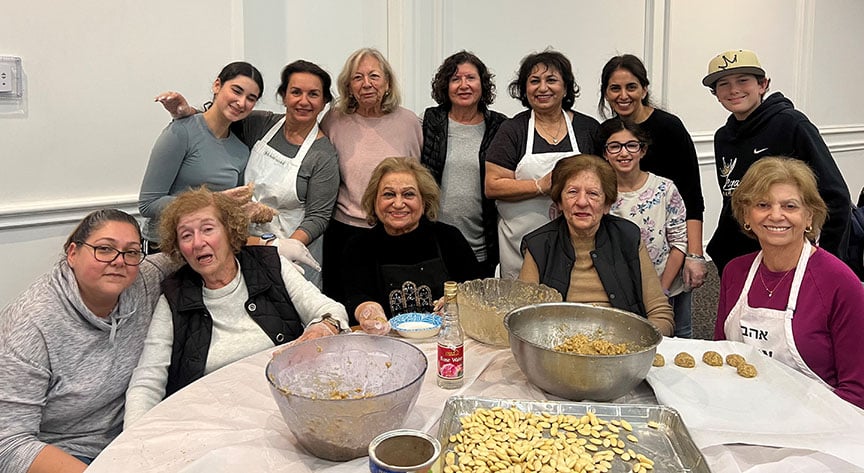
We love seeing the grandmothers, mothers, daughters, granddaughters and great-granddaughters (and even a grandson or two) working together to bake. It’s incredible to watch the recipes and techniques passing down from generation to generation.
(For me, it is especially touching to hear the ladies speaking Iraqit, the unique Judeo-Arabic spoken during the 2,600 year Babylonian exile, because it brings back beautiful memories of both my grandmothers.)
It is also a wonderful opportunity to hear the stories of the lovely women who bake there. While the majority of the Jews left Iraq for Israel in the early 1950’s in Operation Ezra and Nehemiah, there were a brave minority who stayed. Rosy Atraghji, who has generously helped Rachel and I with our baking demos, is one of those. In Baghdad, Rosy was good friends with Albert Nissan. She was earning her degree from the College of Architecture and he worked for an auto parts company. But the idyll was disrupted in 1970, when he and his younger brother and sister were arrested and imprisoned by the Iraqi authorities. They alleged that their father (who had passed away many years before) was not an Iraqi citizen and that his children were not citizens and must be deported. In desperation, their mother spent many days going from consulate to consulate trying to find a country that would give them asylum. Luckily, she walked into the Dutch consulate and her children were issued visas to the Netherlands.
Soon after, Rosy escaped Iraq to Iran. In Teheran, she was stateless, but again the Dutch embassy issued her a visa. She was able to join Albert in Amsterdam, where they were soon married. Albert studied aeronautical engineering at the University of Delft and after he graduated, he worked in The Hague.
In 1988, they came to Los Angeles with their children, Marc and Jaimie, where they were reunited with Rosy’s mother and sisters Rachel and Yvette.
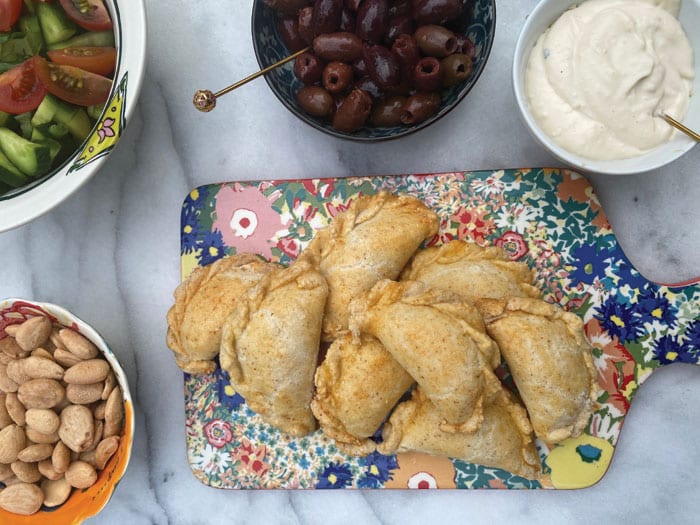
Rosy and her sister Yvette Dabby tell us that in Iraq, especially before Purim, whole days were dedicated to baking huge batches of baked delicacies. As a little girl, Yvette remembers being fascinated by the lady her family hired to make the three feet wide, ultrathin layers of phyllo pastry. The pastry would then be transformed into syrupy baklava and crispy malfouf (crushed walnuts, cinnamon and cardamom filled cigars). They would make pillowy cheese sambusak and crispy nut-filled sambusak and baba tamar, crispy date-filled cookies.
All the pastries would be placed on large trays and sent to be baked in huge commercial ovens. On Purim, an assortment would be placed on beautiful platters and given as Mishloach Manot to friends and family.
This week, the women also baked huge quantities of baba tamar and cheese sambusak. (I got to sample straight out of the oven because I was in the dairy kitchen with my bestest friends David and Louise Elias.)
It was beautiful to watch four generations of Tikva Iny’s family making her famous cinnamon spiced, rose water infused almond macaroons. (Tikva’s father Naim Naba and my grandfather Aba Naji were school friends in Baghdad. They both attended university and became teachers and they corresponded and visited each other in Israel and Los Angeles.)
I’m sure the recipients of these Mishloach Manot will be thrilled.
Purim Sameach!
—Sharon
When Neil and I got married in 1991, our first apartment was across the street from Kahal Joseph and soon after we bought our house close by. We stayed because we loved the traditional, warm and welcoming community. Purim was all about the kids and always excitng. There would be the most fun, craziest carnival out on the wide sidewalk on Santa Monica Boulevard. Jonathan and Sigal Kelly would donate hundreds of stuffed animals. The kids would collect their tickets and go home with armfuls of Pokémon, Spiderman and Care Bear stuffed toys. For the evening Megillah reading, the Sisterhood would fill cellophane bags with nuts, dried fruits, candies and ra’ashanim (noisemakers). Though my children thought this Iraqi tradition was “weird”, they always ate it all up.
I love that this sisterhood has been able to keep its traditions alive. I love talking to all the ladies (many of whom have become dear friends). I love to find out what they like to cook and bake and I love their advice. This year I was scolded by one of the older ladies because the date paste was visible under the dough of the baba tamar I was forming. We had a good laugh and Sue, Sharon’s mother, was kind enough to show me the correct way to roll it out.
My Moroccan family tradition is to make a Purim bread called Ojos de Haman (Haman’s eyes). It is an individual roll or a round loaf, sprinkled with fennel or sesame seeds with one or two hard boiled eggs in the shell baked on top, which symbolize Haman’s eyes. Each egg has an X made of dough on top and when torn off to eat, it’s as though we are ripping Haman’s eyes out. Another Moroccan tradition is to eat Letrea, before the Fast of Esther. Letrea is a thin egg noodle cooked in a saffron broth and the noodles are meant to represent Haman’s hair. Silly but delicious.
In Morocco, the women prepared lots of sweets for Purim.
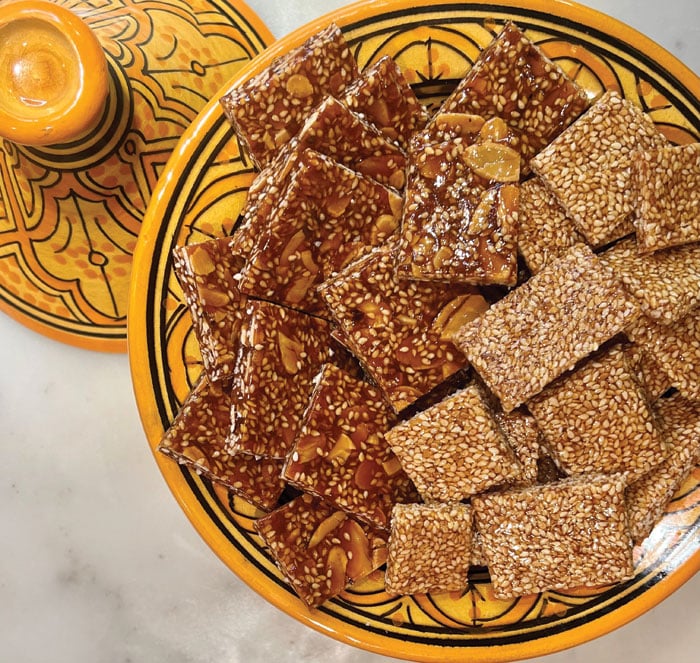
This delicacy, made from sesame seeds and sugar, is popular throughout the world. (It’s said that the sesame seeds represent the fleas on Haman … I’ve heard the same about poppy seeds.)
They made stuffed marzipan cookies and dates and Fijuelas, a fried dough soaked in honey. They also made the ultimate Moroccan candy, sesame brittle. This dulce dates back to Spain and is perhaps the first candy confection. This delicacy, made from sesame seeds and sugar, is popular throughout the world. (It’s said that the sesame seeds represent the fleas on Haman and I’ve heard the same about poppy seeds.) In Europe, this is still a very popular dessert. It is very chic and pieces of sesame brittle are used to decorate wedding cakes or cream puff towers. It is very nostalgic because nowadays it’s only made by pastry chefs.
I recall my mother making it for holidays when I was younger and you might still find this delicate little candy at hennas, weddings, bar mitzvahs and brit milahs. It’s truly a joyous treat. I don’t make it often but when I do my husband and my cousins are very excited. When I mentioned the sesame brittle to my cousin Alia, she jumped and said she remembered it being called Haloua de Jijlan in Arabic, Aljalwas de Ajonjoli in Spanish and Croquent de Sesames in French.
When making sesame brittle be sure to lay out all the utensils and have the ingredients pre-measured. Working with hot sugar means having to work quickly before it hardens. The only tricky part is rolling it out thinly. I recommend using a stone or marble countertop or use a Silpat nonstick mat on the bottom and another on top of the syrup and use a rolling pin on top of the mat, ensuring that it won’t stick.
Purim Alegre! Joyeux Purim!
—Rachel
Cheese Sambusak
Dough:
4 cups self raising flour, sifted
1/2 cup butter
2 tbsp avocado or olive oil
1 tsp salt
1 cup warm water
Filling:
2 cups shredded mozzarella or Muenster
cheese
2 cups crumbled feta cheese
1 tsp baking powder
Pinch of white or freshly ground black
pepper
Pinch of salt
Five eggs, beaten
Place flour and salt into a bowl. Add softened butter and mix together until the mixture resembles breadcrumbs.
Add the oil and mix well. Add the water and knead the dough until it comes together and is soft and smooth.
Form a ball, cover and let rest for two hours.
While the dough rests, combine the shredded cheese, feta, baking powder and seasonings in a bowl and mix together.
Gradually add eggs, one at a time and combine until the mixture comes together, then refrigerate for 15 minutes.
Flour the counter and using the dough, form balls the size of a walnut. Place on a baking sheet.
Roll out each ball to create a thin circle.
Place a teaspoon of the cheese mixture on one half of the circle and fold over. Press the edges firmly together.
Use a fork to press down on the edges to secure the dough or make a beautiful pattern by pinching the dough.
Place each sambusak on a parchment lined baking sheet and bake at 350°F for 25 minutes or until golden.
Sesame Brittle Photo by Alexandra Gomperts
Sesame Brittle
1 cup raw sesame seeds
1 cup white granulated sugar
2 tbsp hot water
Vegetable oil spray
Or
Sesame and almond nougatine-
2 cups white granulated sugar
1 cup raw sesame seeds
1 cup raw slivered almonds
3 tbsp hot water
Wooden spoon
Rolling pin
Spray the work counter with plenty of vegetable spray. Spray the rolling pin and have it ready to use.
In a pan over medium heat, toast the sesame seeds and almonds until golden, then remove from heat.
In a deep heavy pot, add the sugar and warm over a low flame. As the sugar slowly melts into a caramel, begin to stir with a wooden spoon.
Keep stirring until the caramel is dark and golden and all the sugar has dissolved.
If sugar lumps appear, keep stirring until they dissolve
Add the sesame seeds and almonds all at once and stir vigorously. Quickly pour onto the work counter.
Using a well-oiled rolling pin, start to roll the caramel out as thinly and quickly as possible.
Using a very sharp knife, cut brittle into squares
Let cool completely for 15 minutes and separate the squares.
Store in a tin or glass container with a tight lid.
This week we share our column with our good friend and excellent baker Sivan Kobi of @sivanskitchen. We hope you try her yummy hamantaschen recipe and have a freiliche Purim!
Sivan’s Hamantaschen recipe
blueenayim/Getty Images
When I was a little girl, my father would bring home hamantaschen dough from his bakery (Sherman’s Bakery), so we could make hamantaschen together. He also opened up his bakery to local Jewish day schools to come for field trips and bake hamantaschen for Purim. I especially loved that, since I went to Valley Beth Shalom day school and the bakery was only a couple blocks away. These memories bring me such joy. When I became a mother, my mom would prepare the dough at home and all the grandkids would come and bake Purim cookies, with all delicious fillings, like assorted jams, chocolate filling, chocolate chips, nuts, whatever it was that we liked. Recently I made these favorite Purim cookies with my grandson Nathaniel. This is a family tradition and the recipe is so easy, anyone can make it. You can use a mixer to make it or just mix it using your hands. The hamantaschen stay fresh for two weeks covered on your kitchen counter. This recipe can be dairy free too, just substitute the butter for a non dairy butter.
2 sticks of softened not melted butter
(226 grams)
3/4 cup powdered sugar
one whole large egg
2 cups of all purpose flour (about 325
grams)
1 tbsp of baking powder
1 tsp vanilla extract
1/4 tsp salt
Fillings:
Any preserves of your choice. Apricot, raspberry, poppy seed filling, chocolate fillings such as Nutella or non dairy chocolate. Chocolate chips, or lotus cookie butter.
Cream your butter and powdered sugar together till creamy. Add your egg and vanilla extract and mix. Add your dry ingredients continuing to mix and incorporate all the ingredients together. Knead the dough together into a nice ball. Cover with plastic wrap and refrigerate about 30 minutes. Lightly flour your surface and roll out your dough to about 1/8 thickness using a round cup or 3 inch cookie cutter, cut circles in to your dough. Fill in each circle with your favorite fillings and close them up. You can pinch the sides of your circle baking a triangle or fold in the dough baking a triangle shape. Place on a baking sheet lined with parchment paper and bake in a preheated oven at 350° for about 20-24 minutes. Once cooled you can dust powdered sugar on top, this makes them very beautiful.
Enjoy !!
Tip:
Don’t be tempted to fill them in heavily. They tend to open up while baking if they’re over filled.
Rachel Sheff and Sharon Gomperts have been friends since high school. They love cooking and sharing recipes. They have collaborated on Sephardic Educational Center projects and community cooking classes. Follow them on Instagram @sephardicspicegirls and on Facebook at Sephardic Spice SEC Food.




 During the pandemic, a group from the 1971 Broadway production started meeting on Zoom every week. Stein joined the group about a year ago, after he learned about it from fellow cast member Charlotte Crossley.