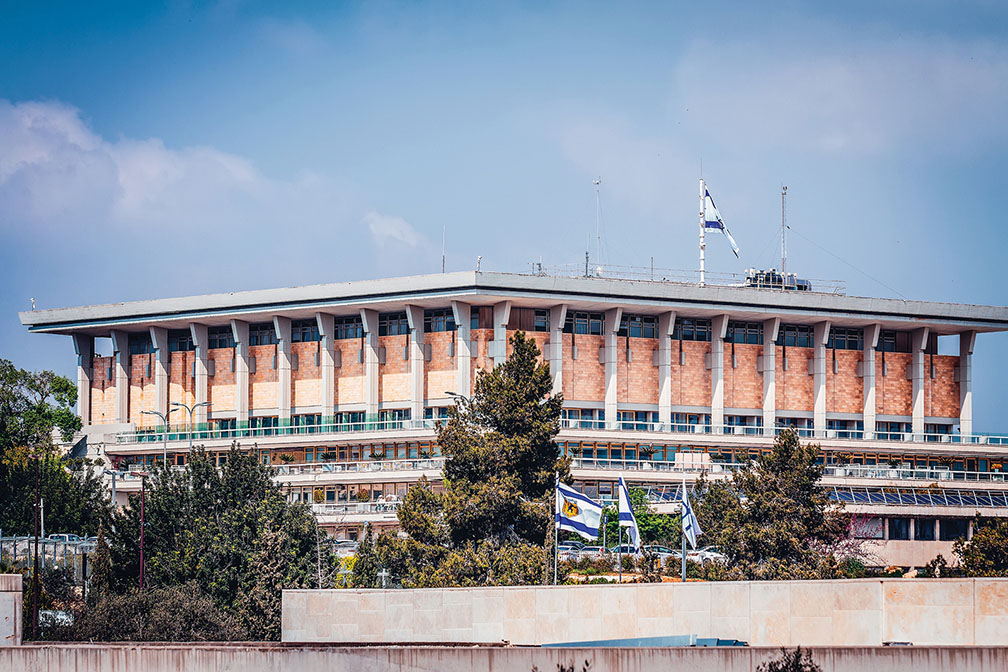
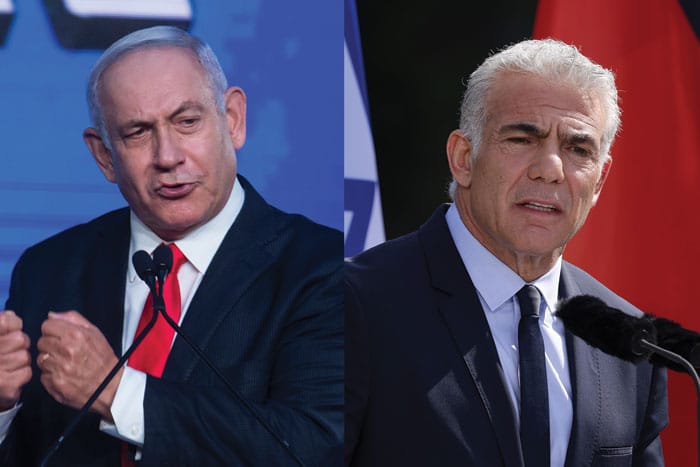
It’s an hour or so after the first day of Sukkot, and opposition leader Benjamin Netanyahu goes back on Twitter to send the following message: “Behind the backs of the citizens of Israel and the Knesset, Lapid and Gantz surrendered to Hezbollah’s blackmail”.
Maybe half-an-hour earlier, Prime Minister Lapid took to Twitter to send a different message: “I strongly condemn the Russian attack on the civilian population in Kyiv and other cities in Ukraine”.
There is a connection that merits exploration, as the world grapples, yet again, with a daunting question: what is a cause worthy of devastation and war?
Two leaders, two topics, same say – three weeks to Election Day. There is a connection between these messages, political and substantial. There is a connection that merits exploration, as the world grapples, yet again, with a daunting question: what is a cause worthy of devastation and war?
Let’s begin by getting rid of the political optics. Netanyahu responded in his tweet to reports that, after a short hiatus and a few hurdles, Israel and Lebanon are scheduled to sign a maritime border deal. I wrote about this deal last week. The deal is supposed to end a dispute over some 860 square kilometers of the Mediterranean Sea, including areas where gas fields of both countries are planned or located. Netanyahu’s political goal is to paint the deal as weak on security, and hence its signatories as unworthy of Israel’s votes. Lapid’s political aim is to seem strong on defense. Sending a strong message in support of Ukraine, and defying Russia is one way to do it.
The events in Ukraine, where Russian forces bombed civilian infrastructure in what was clearly a vindictive response to a bold Crimea bridge attack, are a stark reminder that war can be devastating. They are also a stark reminder that strongmen are not easily deterred by a weak response to aggression. And here is the similarity between Israel’s dilemma and the many dilemmas with which the Ukraine war is burdened. Vladimir Putin threatened to devastate Ukraine unless it responds to his outrageous demands. The Ukrainians decided to fight back, to pay a heavy price. Putin calculated that the rest of the world will not respond with boldness to his aggression – but some countries surprised him by showing more backbone than he expected.
Did he quit? Not really. He is now upping the ante, behind a threat to use nuclear weapons. “Mr. Putin hopes the political shock waves set off by nuclear explosions in Europe would shatter the West’s resolve to support Ukraine,” writes Walter Russell Mead. Like many aggressors before him, Putin’s bet is on the lack of resolution of the other side. Like many before him, his bet could lead to triumph – or disaster. It is not always easy to predict how a rival might respond to a dramatic threat. Would Ukraine cave and surrender? Would the West put pressure on Kiev to settle, less the crisis becomes a World War?
The inconvenient truth is that threats do work against societies and governments, especially against societies of free countries. Putin might have erred by not thinking through complications he could encounter with his own public if the war goes south, but for democratic governments such process of considerations are built in. Hence, when Lapid and Netanyahu debate the risks and the merits of the deal with Lebanon, what underlies their debate is a contrasting assessment of Israel’s willingness to take a risk for achieving a certain goal.
In fact, there are two main goals: One: To have natural gas extracted. Two: To enhance Israel’s defense against Hezbollah. Lapid would argue (with the support of the military) that Israel gains by getting both. Israel could drill, and Lebanon would also drill and hence have something to lose, and thus less prone to provoke Israel (this would be a mutual deterrence as both countries will have gas fields that can be attacked and destroyed). Netanyahu is making a more challenging argument. Yes, Israel could drill, but it was willing to compromise only because of the Lebanese threat of war. Long-term – that’s Netanyahu’s argument – compromising with an aggressor is a bad strategy, as his appetite only grows. You want proof of that? Read Lapid’s tweet about Ukraine.
Something I wrote in Hebrew
As far as I could find out, there has never been such a static election campaign. Not in the history of Israel. This is not necessarily surprising, given the circumstances. After four consecutive elections, everyone already knows who their party is. No significant changes in the camps or parties occurred (except for the Arabs), so there was nowhere to move either … Deviations of a mandate of two up or down in the polls mean little. These are random deviations. In the average polls, the Netanyahu bloc stands at about 60 seats. And saying “60” is not only a prediction – it is also a state of mind. A tie. A coin-tossing state of mind.
A week’s numbers
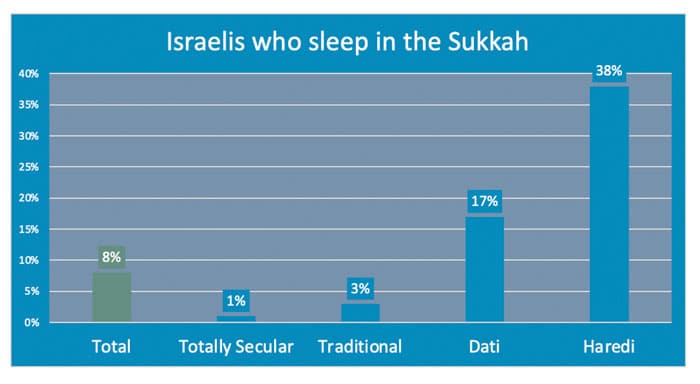
Less we forget, because of all the other news, that this is the holiday season. A number from our study on #IsraeliJudaism (Google it, if you want to know more):
A reader’s response:
Hans Dollinger asks: “Will Israelis travel to Qatar to watch the World Cup?” Answer: In droves. They love soccer and love the opportunity to travel to a country that doesn’t usually accept them with open arms.
Shmuel Rosner is senior political editor. For more analysis of Israeli and international politics, visit Rosner’s Domain at jewishjournal.com/rosnersdomain.