
The Israel-Russian tension is a serious matter. It is serious, and somewhat mysterious. The Russians, as is their habit, aren’t always forthcoming in making their intentions clear. Everyone remembers Winston Churchill describing Russia as “a riddle, wrapped in a mystery, inside an enigma.” Fewer remember that the quip also had a second part: “But perhaps there is a key. That key is Russian national interest.”
Russia is moving forward with a plan to close Jewish Agency offices in the country. The pretext is legal, something about the Agency collecting data about Russian citizens. But when a delegation was ready to go to Russia and attempt to sort things out, the Russians would not give its members a visa. Clearly, Moscow did not particularly want a settlement. It wanted to make a stand. Why? The riddle, the mystery — and the national interest. It is probably, though no official says it publicly, retribution for Israel’s updated Russian policy. The way the Russians see it, their move is not action; it is reaction.
What changed in Israel’s policy? That’s also hard to define. It is a change in tone more than a change in action. As Prime Minister, Naftali Bennett was careful to keep Israel as far away as possible from confrontation with Russia over the war in Ukraine. Israel did express solidarity with the Ukrainians but was careful not to point a finger at the Russians. The reason was not lack of moral clarity, but an abundance of pragmatic realism: Russia is strong, and has a presence in the Middle East, including military forces in Syria. Israel frequently operates in Syria to prevent Iranian forces from getting a stronghold in the country, and the need to keep the Russian forces uninvolved in this fight was considered crucial to Israel’s security.
Closing Jewish Agency offices is considered by many observers of the relations a payback for Lapid’s decision to occupy the high moral ground.
When Yair Lapid was still Foreign Minister it was already clear that his own attitude is somewhat different. His tendency is to get closer to the more critical American-Western approach to the war, even at the risk of Russian ire. When Lapid became the PM, his attitude became Israel’s attitude. The Russians grumbled, and then acted: Closing Jewish Agency offices is considered by many observers of the relationship a payback for Lapid’s decision to occupy the high moral ground. And if anyone was hoping that some resolution could be found through negotiation, Lapid himself sealed the fate of these offices by essentially warning Russia of “severe consequences” if the Jewish Agency is kicked out. That is an implied threat that almost forces Russia to up the ante and move forward with its plan.
What’s coming next? That’s a test for Israel more than the Russians. If the Jewish Agency cannot operate in Russia, it will operate from afar, somewhat limiting its ability to encourage aliyah from the country. On the other hand, it would be reasonable to assume that the Russians who did not yet decide to move to Israel aren’t great enthusiasts for aliyah, so maybe the attempt to convince them to move is overly excessive. Maybe by forcing a close of the offices the Russians are forcing us to break a redundant habit and are actually doing us a favor.
So Israel could have said, “You want the offices closed? No problem, good luck, and goodbye.” But Israel didn’t say that. Israel warned of consequences, and it now must respond to the Russian move. It can close a Russian cultural center. It can make its support of Ukraine even more pronounced. The risk is obvious: What if the Russians decide to complicate Israel’s military presence over Syria’s skies? On the one hand, Israel cannot be seen as weak by Russia because the Russians have little mercy or sympathy for the weak. On the other hand, confrontation with Russia isn’t small change, and Israel must attempt to avoid it.
There is another troubling aspect in this situation. The Jewish Agency is a force for good in the Jewish world, but in this instance, it became a stick over Israel’s head. A country, Russia, attempts to pressure Israel by putting pressure on the Jewish Agency. This is also something that Israel cannot afford: It must clarify that the operation of the Jewish Agency isn’t a bargaining chip with which to extract concession from Israel. A Russia with no Jewish Agency? If that’s what the Russians want, so be it.
Something I wrote in Hebrew
Apparently, Israelis have a position on Kamala Harris. They have a certain confidence that she will “do the right thing regarding world affairs.” Not all Israelis think that. But about half of them do, 48%. How do they know? How can they have such opinion? It’s a mystery and yet they do. Forty-eight percent trust her, 39% do not trust her, and only 14% say they don’t know. Of course, there are gaps between the right and the left on the Harris question. As in most other countries surveyed by PEW, trust in Harris is higher in Israel among center and left voters. In fact, the gap in Israel between voter positions is the largest of all countries except Hungary. Forty percent trust her on the right, 64% on the left. In Australia the gap is also large (20%), and in Greece it is large, but opposite to the trend. Strangely, the right trusts her, but not the left.
A week’s numbers
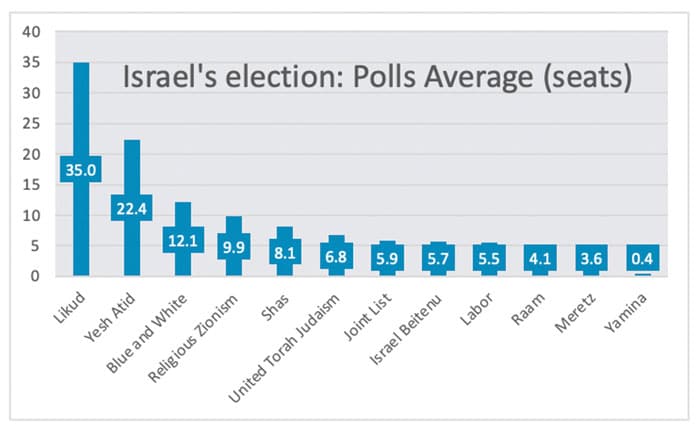
A little less than 100 days until Election Day, and Israel is still at a tie. Yamina is in big trouble, Likud will lead the pack, all other things are yet to be determined.
A reader’s response:
Avi Klein asks: “How can you be optimistic about Israel when you say that Haredi power is back?” My response: what choice do I have?
Shmuel Rosner is senior political editor. For more analysis of Israeli and international politics, visit Rosner’s Domain at jewishjournal.com/rosnersdomain.