fbpx

July 28, 2022

COVID Ground Hog Day

COVID update? The eyelids grow heavy. Those that aren’t sick from it are certainly sick of it. Still, there’s enough new to justify a review. Like the proverbial bitter pill COVID currency is good for us.

In researching this column, I read that COVID-19 mortality is 3000-fold greater among 90-year-olds than among teenagers. Five minutes later the phone rang, and a nurse informed me that Marilyn, my 96-year-old mother, just tested positive at her assisted living facility.

The call underlined the perversity of this virus and its ability to surprise and alarm us, both individually and collectively. Still, glimmers of hope penetrate the general rottenness. Although our collective fate placed us among history’s pandemic generations, we’ve fared better than most. Historically we’re doing “pandemic light.” Despite its dogged persistence, relative mortality from COVID remains less than half that of the 1918 flu pandemic. Bubonic plague? The scourge that killed about half of 14th-century Europeans defies comparison with our travails.

In an earlier column I suggested that in the epic contest between a virus and humankind, one should bet on the virus early and on us in the longer run. Two and a half years on, the bet remains a good one. In viewing that bet and the status of the pandemic we need to consider vaccinations, treatments and social measures to reduce transmission and the evolution of the virus.

Vaccinations, developed with record speed, made the largest difference, saving an estimated 14 million lives. Although months of mutations reduced their ability to prevent disease, they remain remarkably effective at reducing death and hospitalization.

Current treatment is primarily oral Paxlovid. Approved only for high-risk populations, it has been shown to reduce both death and hospitalizations. Fortunately, most healthy individuals don’t require it. For those at highest risk, preventive treatment with Evusheld, a combination of two monoclonal antibodies, reduces risk for six months after a single treatment.

Variants produced by mutations continue to “win out,” producing progressively more infectious strains.  The current circulating variants, notably the predominant BA.5, all descend from the highly infectious Omicron strain that created havoc in December and January. BA.5 became so prevalent in mid-July that each morning I’d awaken to messages from another crop of newly infected patients. Because viruses that kill their hosts or leave them bedridden impair their own ability to spread, it makes sense that newer and more contagious strains become milder. Consequently, despite extremely high viral prevalence, our local hospital’s COVID census stabilized recently at only a quarter of January’s peak. Another sign of BA.5 mildness are the reports that up to 90% of COVID hospital admissions represent incidentally positive tests in patients admitted for non-COVID issues.

Because viruses that kill their hosts or leave them bedridden impair their own ability to spread, it makes sense that newer and more contagious strains become milder.

So, where is the pandemic heading? Despite COVID capriciousness we can extrapolate cautiously based on recent experience. The virus will likely continue to produce more contagious variants. We can be hopeful that they will also continue to be less lethal. More concerning, the virus is also being selected for the ability to evade immunity and re-infect those with recent infection. This emerging trait will likely increase the population of susceptibles and may allow the virus to continually re-circulate. This trait could produce endemic illness with ongoing risk of cold or flu syndromes requiring periodic vaccinations to prevent more serious illness. In time, it may settle into a milder seasonal pattern, like flu and cold viruses.

Though adherence is tiresome, the ways to stay well remain simple and unchanged.  We should keep current with vaccinations and continue to mask in crowded areas, preferably with highly effective masks, such as a K95 or N95. The penalty for a slip-up has become less serious for most: a cold or flu syndrome and some time off. Some, particularly the elderly, immune-impaired and unvaccinated will continue to face mortality risk. Around November an updated vaccine with specific coverage of variants may help us finally move on.

And Marilyn? She started Paxlovid the day after being diagnosed. She had a cough but never had a fever or difficulty with intake of fluids or food. After ten days she came out of isolation. I teased her about being “nonagenarian tough.” Perhaps she was just lucky. Hopefully, luck will soon start circulating as well.


Daniel Stone is Regional Medical Director of Cedars-Sinai Valley Network and a practicing internist and geriatrician with Cedars Sinai Medical Group. The views expressed in this column do not necessarily reflect those of Cedars-Sinai.

COVID Ground Hog Day Read More »

Deborah Lipstadt Discusses Role As Special Envoy to Combat Antisemitism in ADL Webinar

Special Envoy to Monitor and Combat Antisemitism Deborah Lipstadt discussed her first couple of months on the job during a July 27 webinar hosted by the Anti-Defamation League (ADL).

Lipstadt told ADL CEO Jonathan Greenblatt that she came into the job during a “unique moment” in world history and that her job is to “put out fires” and then “make sure those embers don’t explode” when the fire is put out. Her first week on the job coincided with the German airline Lufthansa preventing more than 100 Jewish passengers from boarding their connecting flight to Budapest after one of the passengers didn’t comply with the airline’s mask mandate. Lipstadt said her office was “very disturbed” by the incident and pointed to the “terrible irony” of Lufthansa being a German airline. She did acknowledge that the airline is “taking it very seriously” and has adopted the International Holocaust Remembrance Alliance (IHRA) definition of antisemitism as an educational tool.

But it was in her meeting with the head of the airline that Lipstadt realized that she was “speaking on behalf of the United States government,” which she said added a “different gravitas” to it.

Lipstadt also discussed her recent travels to the Middle East, specifically her meetings with government officials in Saudi Arabia. The ministers she met in Riyadh and Jedda showed a “willingness to separate antisemitism” from the Israeli-Palestinian conflict; Lipstadt said she also heard similar sentiments from editors at major newspapers, publishers and NGOs in the country. “No one is saying everything is terrific in the kingdom of Saudi Arabia … but is there a change? Yes there’s a change.” She also lauded the Abraham Accords––which she said the Biden administration has fully embraced––and that the administration has a chance “to do something positive.”

When Greenblatt asked Lipstadt about the Iran nuclear deal and the Iranian government’s promulgation of antisemitism, the special envoy demurred on commenting about the deal itself, as she said it wasn’t in her purview. But Lipstadt did say that the Iranian government’s dissemination of antisemitism is something that the administration has “taken very seriously.”

On the issue of white nationalism, Lipstadt said that the focus of her office, by law, is on combating antisemitism abroad, but argued that it’s becoming tougher to distinguish between domestic and foreign issues. She pointed to the terrorist behind the hostage crisis in Colleyville, TX as an example, as he was a British national but once he entered the United States, his actions became “domestic terrorism.” Lipstadt said she is pushing for greater “interagency coordination” to handle such matters.

Regarding anti-Zionism, Lipstadt acknowledged that “criticism of Israeli policy is not antisemitism”; however, the issue is when people “question the legitimacy of the state of Israel,” especially since “Israel is home to the greatest number of Jews in the world.” “When someone has a singular focus only on Israel or only on the wrongs done by Israel … then you have to ask, what is this about and why?” Lipstadt said.

Lipstadt and Greenblatt also discussed the movements in Europe to ban kosher slaughter and circumcision. Lipstadt pointed out that those calling for the ban of kosher slaughter aren’t also calling to ban hunting and cooking lobster, which she said involves putting a live lobster into a pot. Regardless of the motivation to ban kosher slaughter and circumcision, Lipstadt said that doing so would make “it impossible for Jews to live as Jews.”

The webinar concluded with Lipstadt calling for instances of antisemitism to be condemned solely as antisemitism rather than as antisemitism and “all other forms of hatred,” arguing that doing so was tantamount to saying “All Lives Matter” in response to the Black Lives Matter movement. Lipstadt also called it a “privilege” to visit Yad Vashem with President Joe Biden and that it was “touching” to see the president get down one knee to speak with Holocaust survivors so they wouldn’t have to get up from their seats.

Deborah Lipstadt Discusses Role As Special Envoy to Combat Antisemitism in ADL Webinar Read More »

Footfalls of Memory – A poem for Matot-Masei

And they were called with names of the names of the cities they built.
– Numbers 32:38

I am lucky enough to have just returned from vacation
in egregiously beautiful cities so rich with history
I’m almost embarrassed to live in California where
we’re barely a week old, and drying up so fast
no one can guarantee the roots you put down will thrive.

Let me show off a bit with names like Savannah,
named for a tribe of people whose land we built on top of.
Whose streets are called after people such as Oglethorpe,
who sketched out grids and squares for people to
lay a town around. All sitting in Georgia, named

for a king who never crossed the ocean to see
what had his namesake. Or, even older, Charleston,
named after yet another King who also never
came to dinner. Or Asheville (and full disclosure,
I had to look this up) named after, yet another

eighteenth century figure … Samuel Ashe, who
had the decency to set foot on the property.
The ancient Israelites did it backwards (or perhaps
we’ve been doing it wrong this whole time) and
took the names of the cities they occupied.

I realize occupied is a touchy word, but it’s the
first one that came to mind and, honestly,
I’m not sure I mean much by it. I can only hope
someday they rename my neighborhood Lupertville.
Or at least put up a plaque to indicate what was done here.

Which leads me to the point – What are we doing here?
Do our names on places erase the history of who came before?
What is the statute of limitations on memory?
May my actions forever be worthy of the ground I walk on.
May I never forget the names of those who came before.


God Wrestler: a poem for every Torah Portion by Rick LupertLos Angeles poet Rick Lupert created the Poetry Super Highway (an online publication and resource for poets), and hosted the Cobalt Cafe weekly poetry reading for almost 21 years. He’s authored 25 collections of poetry, including “God Wrestler: A Poem for Every Torah Portion“, “I’m a Jew, Are You” (Jewish themed poems) and “Feeding Holy Cats” (Poetry written while a staff member on the first Birthright Israel trip), and most recently “The Tokyo-Van Nuys Express” (Poems written in Japan – Ain’t Got No Press, August 2020) and edited the anthologies “Ekphrastia Gone Wild”, “A Poet’s Haggadah”, and “The Night Goes on All Night.” He writes the daily web comic “Cat and Banana” with fellow Los Angeles poet Brendan Constantine. He’s widely published and reads his poetry wherever they let him.

Footfalls of Memory – A poem for Matot-Masei Read More »

Kishinev and History’s Non-Non Sequiturs

While Putin wages war against
Ukraine, Moldova’s now afraid,
since, having of its Jews dispensed

in pogroms. Kishinev, which made,

in nineteen-three and nineteen-five,
two I regret may be repeated
by Putin, willing to connive

what once was by the gentiles meted

on Jews by gentiles, a pogrom
like Kishinev’s two savage ones,
in sequiturs which are not non,

with rockets, not with knives or guns.

These methods, treated once perhaps
as history, may be de trop,
Putin’s maga-manic maps

like Lenin’s traded twisted rope,

and Kafka’s tightrope, that’s designed
to trip up all the acrobats
who’ll be crestfallen, undermined

by fallacies of bureaucrats.

The fate of Jews in nineteen-three
and five may well befall the goyim.
Tell Putin my sad prophecy,

although I doubt it will annoy him,

because reality is not
a state that he’s prepared to choose,
preferring a sad end to plot

for foes who will cause him to lose.

On 7/24/22, Fareed Zakaria on CNN interviewed Natalia Gavrilița, the Prime Minister of Moldova. In describing the present population of Moldova the existence of what may be as few as 4,000 Jews or as many as 20,000 she was totally oblivious.

Regarding the Kishinev pogroms, Wikipedia writes:

The Kishinev pogrom was an anti-Jewish riot that took place in Kishinev (modern Chișinău, Moldova), then the capital of the Bessarabia Governorate in the Russian Empire, on 19–21 April [O.S. 6–8 April] 1903. A second pogrom erupted in the city in October 1905. In the pogrom of 1903, which began on Easter Day, 49 Jews were killed, 92 were gravely injured, a number of Jewish women were raped, over 500 were lightly injured and 1,500 homes were damaged. American Jews began large-scale organized financial help, and assisted in emigration


Gershon Hepner is a poet who has written over 25,000 poems on subjects ranging from music to literature, politics to Torah. He grew up in England and moved to Los Angeles in 1976. Using his varied interests and experiences, he has authored dozens of papers in medical and academic journals, and authored “Legal Friction: Law, Narrative, and Identity Politics in Biblical Israel.” He can be reached at gershonhepner@gmail.com.

Kishinev and History’s Non-Non Sequiturs Read More »

“Girl No. 60427”: A Survivor Story From a Grand- daughter’s Perspective

If you’re a descendant of Holocaust victims, do you remember the first time you learned about your relative’s experience?

“Girl No. 60427” is a new short film that presents the moment that a 10-year-old girl discovers her grandmother’s diary, which contains stories about her time at Auschwitz. 

The 20-minute film is based on the real childhood story of director Shulamit Lifshitz discovering her grandmother Shifra’s diary about being sent to Auschwitz and witnessing the brutal murder of her sister Tzipora. 

Lifshitz created the film as part of her studies at The Ma’aleh Film School in Jerusalem. She graduated this year. 

In the film, Shifra is presented as distant and stern with her grandchildren. Throughout the film, granddaughter Reut, based on Lifshitz, secretly reads horrifying excerpts of the diary and imagines what her grandmother went through. In real life, Shifra was just as distant as her portrayal in the film. But unfortunately, Shifra’s diary was not discovered in an attic until her descendants were sitting shiva for her in 1998. She wrote it in 1946 while in Italy, so for 52 years, the diary was hidden.

Lifshitz was only in fifth grade when her grandmother died and the diary was discovered. Until then, she never understood why her grandmother wouldn’t hug anyone. After reading the diary, it made her see her grandmother in a totally different light. 

“The reason I did this film is because I wanted the chance to talk to my grandmother about her diary,” Lifshitz said. “I wanted to hug her after I learned what happened but I never got that chance because she died before we found the diary. I wish it was like in the movie and [I] had this chance.”

Lifshitz creates a reality with the character Reut that she was not able to have in her own lifetime. In her childhood, there was no understanding or conversation with Shifra, and there was no hug she could offer after learning what her grandmother had experienced at the hands of the Nazis. 

Shifra did not speak of her survival story, not even to her daughter (Lifshitz’s mother). Lifshitz said that the family would hear a word about the Holocaust in “general here and there,” but they knew nothing of the details. Family members saw the number 60427 tattooed on her arm, but it was always hidden under long sleeves in public.

“This guilt and this heaviness really affected her relationships with others.” – Shulamit Lifshitz

“This guilt and this heaviness really affected her relationships with others,” Lifshitz said.  

In the diary, there are poems that her grandmother had written. One of things her grandmother wrote is that after liberation, everybody was dancing and singing and happy to be out of the camp. Her grandmother wrote that she could not be happy because she felt guilty and upset about her sister’s death.

“She was ashamed of being a Holocaust survivor,” Lifshitz said. 

Neta Ariel, the director of the Ma’Aleh Film School, spoke to the historical context of the closed off nature of some Holocaust survivors in the years after World War II.  

“It’s important to remember the atmosphere in Israel at that time — it was really during the Eichmann trial [in 1961] that broke the stigma after hearing the witnesses testify,” Ariel said. 

The actress playing Reut is Lifshitz’s niece, Tehilla — her brother’s daughter, and fourth generation from her great grandmother Shifra. After conducting auditions for the lead, she realized that nobody played the role as well as Tehilla. 

“Her eyes tell us a big story. We couldn’t understand how she did it, so we went back and begged her to do it,” Lifshitz said. Her parents agreed.” 

In one unsettling scene, Reut locks herself in the bathroom and writes “60427” on her own arm with a pen before hastily washing it off. 

Originally, “Girl No. 60427” was supposed to be a documentary about discovering Shifra’s diary. 

Lifshitz realized quickly that the most effective way to present the story was in a live-action narrative. But there is one thing in particular that sets this short film apart from other films surrounding the Holocaust: its use of mixing of live-action with animation.

As Reut secretly reads her grandmother’s diary and imagines the horrors, animated figures of her young grandmother and great aunt Tzipora appear before her eyes. These short but powerful animations are an incredibly creative and effective means of portraying the traumatic diary entries. 

Lifshitz’s brother-in-law Oriel Berkovits is the animator and credited as co-creator of the film. Together, they worked out the script and decided quickly that Reut’s emotional process would be live-action, but the stories from the diary would be animated. These two time periods are presented simultaneously, and the animation complements the life-action seamlessly. 

“Girl No. 60427” is an incredible short film, and not just for a first-time student director. It’s loaded with subtle symbolism in every scene about the Nazis’ dehumanization of Jewish people and innocence lost among their descendants. Lifshitz is clearly a talented filmmaker and effective storyteller. Expect to see not just more acclaim for the film, but more beautiful films from the director. 

The film is the first Israeli film to win the prestigious British Academy of Film and Television Arts (BAFTA) student competition — only three live-action films were selected out of 715 submissions from 134 schools in 36 countries. Regardless of the awards, “Girl No. 60427” is the film Lifshitz needed to make for herself. 

“It feels like a continuation and memorialization of my grandparents,” Lifshitz said. “It’s a fitting testament to their lives and what they went through.”

You can watch the trailer on YouTube.

“Girl No. 60427”: A Survivor Story From a Grand- daughter’s Perspective Read More »

Delicious Recipes to Try During the Nine Days

The nine days of Av commemorate the period of mourning the loss of our Temples and the subsequent diaspora that followed.

“As a Chasid, I like to focus on the positive,” Chef Lenny Nourafchan of Lenny’s Casita told the Journal. “In my view, the fact that we are still here thousands of years following the Jewish exile from our homeland, as Jewish as ever, just shows how incredibly strong we are as a people.”

This year, the nine days take place from the evening of July 28 through August 6. During this time, no meat (including poultry) is eaten. 

Some restaurants in Los Angeles, like Lenny’s Casita and LA Burger Bar, are closed, while others have created a special menu in addition to their regular offerings. 

Jeff’s Gourmet Sausage Factory in Pico-Robertson will be running their famous blackened salmon specials along with their Impossible veggie burger and “jungle fries,” which are loaded with pickled red onion, roasted jalapeno, “cheesy” sauce, ranch, an Impossible patty and a fried egg.

The Kosher Burger Joint, also in Pico-Robertson, has Impossible Smash Patties (single, double and triple options) with cheese, lettuce, tomato, grilled onions and pink sauce and a variety of salads and sides.

PSY Street Kitchen in Sherman Oaks, has a Crunchy Shroom (deep fried portobello topped with tahini and homemade barbecue sauce), roasted cauliflower and eggplant.

Before heading out to your favorite kosher restaurant, give them a call or check online to see their nine days menus.

For those opting to cook during the nine days, here are some delicious recipes from some of your favorite kosher kitchens.

“We are reminded that even though we have endured tremendous tragedies over the years, we have come out of them stronger and will merit to see Moshiach coming, may it be soon,” Nourafchan said. “While we wait for Moshiach’s imminent arrival, it will be my job to make sure we are well fed. Let’s begin with Lenny’s Casita’s famous corn ribs.”

Lenny’s Casita’s Famous Corn Ribs

4 ears sweet corn
1 stick unsalted butter or margarine
3 cloves garlic
1 bunch chopped parsley
Salt and pepper
Vegetable oil for frying

  • Peel back the husks of the corn and slice the corn lengthwise into four “ribs.”
  • Heat up a generous amount of vegetable oil and fry the corn ribs until golden brown.
  • Combine the butter with crushed garlic and parsley in a bowl.
  • Toss the crispy corn ribs in the herb butter and top with a generous amount of salt as well as black pepper to taste. It takes on a flavor like salted buttered popcorn and it plates beautifully.

“The nine days are a very important time for us and the restaurant because we are really challenged to think deeply about why we do what we do,” Elan Adivi, general manager of Jeff’s Gourmet Sausage Factory, told the Journal. “It is a time for the Jewish community to reflect on difficulties of our past (and present) where celebrations and physical joy are minimized.”

Since Jeff’s is a meat-centric eatery, business is slower than usual. However, they will still have their full menu (they have many non-Jewish and non-observant customers), and all fish and vegetarian items will be cooked on non-meat surfaces. 

“Yes, we could just close our doors for the week and send our staff home,” Adivi said. “But we believe with a little creativity and willingness to push through, we are able to bring something fun and different, like our blackened salmon tacos, to the community, which is permitted to enjoy by all.” 

Jeff’s Blackened Salmon Tacos
(Photo courtesy of Jeff’s Gourmet Sausage Factory)

Jeff’s Blackened Salmon Tacos

1.5 lb fresh salmon fillet, cut into
pinky-sized slices
4 cups cabbage mix
8 oz Jeff’s pickled red onion
8 oz Jeff’s creamy herb sauce
1 cup Jeff’s blackened seasoning
(or recipe of your choice)
2 tbsp vegetable oil
24 corn tortillas (or 12 flour)
2 limes

  • Heat oil in a large nonstick skillet on medium-high heat
  • Coat the salmon with the blackened seasoning
  • Sauté salmon for approximately 5 – 6 minutes to desired doneness
  • Heat another large skillet (no oil) and add the tortillas, heat for 2 – 3 minutes on each side
  • Build your tacos using 2 corn or 1 flour each (3 tacos per serving), a handful of cabbage mix divided for each serving, blackened salmon, Jeff’s sauce and pickled red onion.
  • Garnish with lime wedges, fresh cilantro and enjoy!

“The nine days for me is time to reflect on myself and understand how to be a better person to myself and to others, to love and not to hate,” Chef Uzi Wizman, owner of PSY Street Kitchen, The Kosher Burger Joint and Sheba Catering & Events, told the Journal. Here is his sea bass sashimi recipe.

Chef Uzi Wizman’s Sea Bass Sashimi
(Photo courtesy of Uzi Wizman)

Chef Uzi Wizman’s Sea Bass Sashimi

1 Sea Bass Filet
1/2 Cup Olive Oil
1/4 Cup Freshly Squeezed Lemon Juice
1/4 Cup Citrus Ponzu
1 Tbsp Manuka Honey
1 Finely Chopped Persian Cucumber
1 Tbsp Finely Chopped Parsley
1 Tbsp Finely Chopped Cilantro
1 Tsp Finely Chopped Tarragon
2 Tbsp Finely Chopped Arugula
1 Tbsp Chopped Black oil-cured Olives
1 Tbsp Chopped Pine Nuts
1/2 Tsp Red Chili Flakes
1 Tsp Chopped Toasted Coriander Seeds
Black Pepper
Coarse Sea Salt
Dill Leaves for garnish

  • Make sure you are working with a fresh piece of fish (and a sharp knife). Most types of fish will work for this recipe.
  • Prepare the sea bass filet by removing the skin and any tiny bones that might still be there.
  • Thinly slice the fish in any shape or size that you like.
  • Place all of your Sea Bass slices on a plate, spread out.
  • Mix all of the rest of the ingredients together in a bowl, except for the salt, black pepper and dill.
  • Sprinkle salt and pepper on the sea bass slices.
  • With a spoon, pour the mixture on all of the sea bass slices.
  • Garnish with fresh dill leaves.

Delicious Recipes to Try During the Nine Days Read More »

Tisha B’Av: Our Sufferings and Our Hope

If I forget you, O Jerusalem, let my right hand lose its cunning; let my tongue stick to my palette if cease to think of you, if I do not keep Jerusalem in memory even at my happiest hour.—Psalm 137

Whoever mourns for Zion will be privileged to behold her joy.—Talmud, Sotah

To believe is to remember. The substance of our very being is memory, our way of living is retaining the reminders, articulating memory. After the destruction of Jerusalem, the city did not simply become a vague memory of the distant past; it continued to live as an inspiration in the hearts and minds. of the people. Jerusalem became a central hope, symbol of our hopes.—Abraham Joshua Heschel


I remember a family trip several years ago to Jerusalem for my brother-in-law’s wedding. Late in the summer, Israel’s heat extends into its nights, thick and heavy. The week prior to Danny’s wedding, my wife and I were in Jerusalem, walking the city’s streets — now alive again with activity, development and people, savoring our chance to absorb its smells, sounds and character. With the coincidence of Tisha B’Av (the ninth of Av) and Danny’s wedding at the same time, Elana and I had a chance to mark the fast in one of Jerusalem’s many synagogues.

We chose Congregation Emet Ve-Emunah (Truth and Faith), where my father-in-law had become a bar mitzvah many decades prior. The congregation still met in the same basement, at the bottom of an old apartment building on one of the city’s winding side streets.

As my eyes adjusted to the dim light of the synagogue, which was itself little more than a basement with benches, a podium and a ponderous wooden closet containing a few Torah scrolls, the attendants passed out candles to everyone present. To my surprise, they then turned out all the lights, punctuating the dark with a scattering of candles, one per worshiper. At the front of the sanctuary, his back facing us so he would pour out his song toward the Ark, to God, the Hazzan chanted the mournful words of Eikhah, the Book of Lamentations, describing the Babylonian assault on Jerusalem in 586 B.C.E. and the suffering of its inhabitants.

The present dissolved. Huddled on low benches while mourning the Hurban (the destruction) of Solomon’s Temple, and of the Second Temple some two thousand years ago, I felt that Tisha B’Av seemed more compelling, a more potent symbol of the human predicament than anything in contemporary life. In the basement of a rebuilt apartment complex in Jerusalem, we fasted and cried over the ruins of ancient Jerusalem and the disappointments of the human condition.

Each year at the same time, the residents of Jerusalem enact a poignant paradox. Despite the fact that the city has been reunited, that Israel’s capital is now the home of a great university, impressive museums and concert centers, bustling commerce, vibrant new and old neighborhoods, once a year the people of Jerusalem, as do Jews everywhere, pause to mourn the destruction of their ancient city — our city — thousands of years ago.

To observe Tisha B’Av in Jerusalem is to allow the past to engulf the present, to induce a willful amnesia in the conviction that the resultant memory will be more true, more incisive and more real. To mourn the destruction of ancient Jerusalem is to deny the present its despotic hold on our attention, to affirm that there is much to learn from the past—about human living, about coping with despair and suffering, about redeeming the human heart.

Tisha B’Av is a day of mourning that originated in the year 586 B.C.E., when the First Temple—the one built by King Solomon some 400 years earlier—was destroyed by the Babylonians, and the Jews of Israel were forcibly deported east. At the same season, in the year 70 C.E., the Roman troops under their general Titus destroyed the Second Temple, ending an era in Jewish worship. Throughout the years, this day has remained a magnet attracting Jewish suffering: The Edict of the Expulsion of the Jews from England in 1290 and the expulsion from Spain in 1492 were both signed at the time of Tisha B’Av. The tragedy of World War I was initiated on Tisha B’Av, in many ways setting the stage for World War II and the murder of six million Jews in the Shoah.

For the past two thousand years, Jews have used this day as a sponge, absorbing millennia of suffering and abuse at the hands of pagan, Christian and Moslem persecutors, and more recently, Nazi, Communist, terrorist and White Supremacist assaults. Years of forced conversions, rape, degradation, pogroms, lynchings and murders contribute to a renewed memory and determination on Tisha B’Av.

Suffering alone cannot provide purpose to Jewish identity, but one cannot come to terms with what that identity has meant without grappling with the ancient and resurgent presence of antisemitism. 

Suffering alone cannot provide purpose to Jewish identity, but one cannot come to terms with what that identity has meant without grappling with the ancient and resurgent presence of antisemitism. On Tisha B’Av, we mourn that so many people have hated so much. We cry over the consequent suffering of innocents beyond counting.

But this fast is not simply to record the endlessness of Jew hatred and Jew beatings. This day also marks the end of Jewish sovereignty, of the kind of security and self-confidence that can only emerge when a people controls its own destiny, lives on its own land, determines its future for itself.

Some two thousand years ago, on Tisha B’Av, Jews lost the power to cultivate our own character according to our own standards. Stripped of control, of the authority of our own leaders and laws, Jews became the subject of other peoples’ legal systems, other peoples’ cultural priorities and prejudices, other peoples’ armies and police. For two thousand years, we have developed a variety of Jewish identities and cultures, always judged by external standards, living as a persecuted minority, in countries we were told were not ours, we learned to keep a wary eye on how others would perceive our values, our symbols and our achievements.

On Tisha B’Av, then, we mourn our lost independence and our weakened self-confidence. We mourn our dependence on the whims and kindnesses of strangers.

Finally, on Tisha B’Av, we attend not only to history — the loss of a building and of national standing — we mourn a psychological and spiritual reality as well.

For our ancestors the Temple was not merely a place of worship and pomp; it was a symbol of wholeness. There it was possible to fulfill the desire of our Creator completely, to become one with God. Religion — tangible in form and simple in concept — provided a concrete way to expiate guilt, express gratitude, and share in success. By its very structure the Temple stood beyond time, offering the iron-clad assurances that God dwelt there, that all was well.

The Hurban destroyed that sense of well-being. Instead of providing a place where Jews knew exactly how to make good with God, the ruins now became a potent symbol that we all live in a world of inevitable pain and ultimate abandonment. Love affairs, so full of promise at the start, often slide into mediocrity or erupt into hostility. Careers fail to provide a sense of excitement or purpose — jobs are frequently lost or denied. Children and parents rarely fulfill each other’s dreams and expectations. Those we love move to distant places. Illness erupts into the best of lives; people die. Each of us, no matter how content we may be, live under the shadow of aging and our own mortality.

The Hurban symbolizes all that. There is no perfect place. The Temple, a projection of the harmony and unity that we perceived as children, has fallen before the onslaught of maturity, sexuality and death. On Tisha B’Av, we mourn the loss of that innocence. And of wholeness.

At the very beginning of the evening service for Tisha B’Av, the Hazzan rises to announce that “This year is the __th year since the destruction of the Holy Temple. Each generation in which the Temple is not rebuilt should regard itself as responsible for its destruction.”

There is no Temple. The world is still saturated with disappointment, disease and despair. Our task, simple to articulate and impossible to complete, is to begin the work of rebuilding the Temple — by restoring a wholeness to our shattered planet, renewing a bond of trust between humanity and its members, repeating the commitment made by our ancestors to nurture our covenant with God, to be a holy people.

Tisha B’Av, by forcing us to recognize a trail of tragedy and a psychology of division, is the crucial first step toward transformation and transcendence. In the words of the Talmud, “You are not required to complete the task, yet neither are you free to desist from it.”

Tisha B’Av signifies a willingness to begin the task, even though its conclusion eludes our view.

It is up to us to begin.


Bradley Shavit Artson, a contributing writer to the Jewish Journal, is Abner and Roslyn Goldstine Dean’s Chair of the Ziegler School of Rabbinic Studies, American Jewish University.

Tisha B’Av: Our Sufferings and Our Hope Read More »

Writer Jerry Stahl Takes a Bus Trip of Holocaust Sites

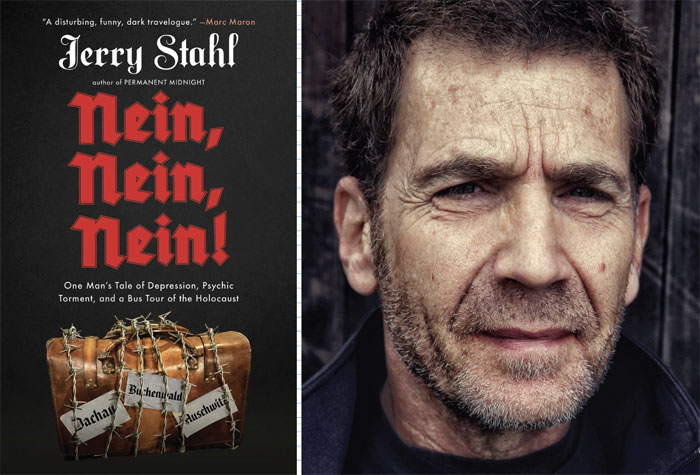
Novelist and screenwriter Jerry Stahl was in the throes of a major depression in 2016. Instead of going the conventional route, he decided to address his pain by taking a bus tour of the sites of the Holocaust in Germany and Poland. He chronicled his journey in his new book, “Nein, Nein, Nein!: One Man’s Tale of Depression, Psychic Torment, and a Bus Tour of the Holocaust.” 

“I needed something more than my own shame spiral — and its showbiz spinoff — to fortify the sadness and rage gnawing my guts,” Stahl writes. “I needed to walk where Himmler walked. I needed to go to Naziland.” 

There’s a laugh on almost every page of ‘Nein, Nein, Nein,” but for all his wit and somewhat skewed perspective, Stahl never loses sight of the gravity of the places he visits. 

“I was reacting to other people’s reactions on some level, and you don’t expect to go to the site of the greatest crime of the 20th century and have people taking selfies or dressed like they’re going to Orlando,” Stahl told the Journal. “I don’t know why I didn’t expect that. I don’t know why that surprised me, but it did.” 

Stahl, 68, grew up in Pittsburgh. His father David Henry Stahl was a federal judge who left Lithuania at age 10, eight years after his own father was killed in a pogrom. Judge Stahl died of accidental carbon monoxide poisoning when Stahl was only 16 years old. 

Depression would remain a constant torment throughout his life. Still, Stahl carved out a successful career in writing for both television and film for over 30 years, including episodes of “CSI: Crime Scene Investigation,” “Maron” and “Bad Boys II.” His 1995 memoir “Permanent Midnight” was adapted into an independent film starring Ben Stiller as Stahl. 

In “Nein, Nein, Nein!”, having been plunged into a bus full of strangers, Stahl grows to love the cast of characters he shares the experience with: Tad and Madge, who are the embodiment of a “Don’t Mess With Texas” t-shirt, an ex-rugby player from Australia and Dozer Bob, “whose reason for the Eastern Europe tour is straightforward: ‘Just wanted to travel, didn’t I?’” And then there’s their tour guide Suzannah from the United Kingdom whose accent, Stahl writes, “makes you question your own intelligence.” 

Stahl’s book shows the thought processes of a man feeling at his lowest soothing his “shpilkes” by experiencing one of the most sobering, draining tours one can possibly imagine. For him, it’s cathartic, and readers might find it to be the same for them.

“The flip side of that is you’re dealing with humanity, and humanity has their own weird reaction. And it isn’t always appropriate.”

“There’s nothing but respect and reverence and sorrow, to the extent you can even comprehend what happened,” Stahl said. “But the flip side of that is you’re dealing with humanity, and humanity has their own weird reaction. And it isn’t always appropriate. So when a bunch of teens from God-knows-where mistake me for Michael Richards and start yelling ‘Kramer’ and want a selfie with me after I staggered out of the crematoriums at Auschwitz, what is the etiquette in that situation?” 

The book is also loaded with historical facts. Before the trip, as he fell deeper into his depression, Stahl spent those months reading books and testimonials by Holocaust survivors, “only to arrive and bear witness, not to the vast travesty represented by the camps, but to my own troubling incapacity to comprehend it,” he wrote.

He didn’t expect a cafeteria, snack bars, calzones and pizza at the somehow painfully normal accommodations and concessions at Auschwitz. 

He didn’t expect a cafeteria, snack bars, calzones and pizza at the somehow painfully normal accommodations and concessions at Auschwitz. 

“These [tourists] want a nosh after, but I wouldn’t say I was judging,” Stahl said. “But I certainly was struck — not what I expected. So that to me is where the humor comes in. Certainly there is no humor regarding the main event.”  

Stahl illustrates in “Nein, Nein, Nein!” that you can’t always expect everyone to react the same way as you to even the most universally-accepted truths — in this case, that the Holocaust was horrific. When you see someone laughing at a funeral, more often than not, it’s not disrespect but what psychologists call a “manic defense,” defined as a coping strategy that subconsciously aims to “prevent feelings of helplessness and despair from entering the conscious mind by occupying it with opposite feelings of euphoria, purposeful activity and omnipotent control.” 

“I made the decision rightly or wrongly to out myself as a guy in the midst of this horror — and the burden of the soul crushing evidence of history — to out myself as a guy who gets stuck in my own rat on a wheel obsessing about my own bull***t as I’m going through it,” Stahl said. “I think as the great Jewish writer, Bruce J. Friedman once said…‘If you write a sentence that makes you squirm, keep going.’ So I kind of squirmed my way through [writing] this book because I wasn’t trying to look good and obviously I didn’t, you know?”

Stahl will discuss and autograph the book at Book Soup in West Hollywood on Thursday, July 28th at 7:00 pm. More details can be found on the Book Soup website: https://www.booksoup.com/event/jerry-stahl

Writer Jerry Stahl Takes a Bus Trip of Holocaust Sites Read More »

A Time of Grieving

During the summer heat, as we anticipate a time of slowing down and perhaps even finding moments of pleasure, we Jews tap into a sadness leading to grief. Tradition encourages our memories to be jogged as we enter into the new month of Av, laden with historic calamities, particularly the ones most pivotal and strikingly cataclysmic: The destruction of the holy temples, the first in 586 BCE and the second in 70 CE. Both were a devastation of our then central physical home as well as the Holy Land on which it stood, Jerusalem, in blazing fire and blood-filled streets. Tisha B’Av, the Ninth of Av, is calendared so as not to forget. And the destruction included the annihilation of thousands of Jews, as well as the dismantling of our community, with many fleeing for their lives, inaugurating an ongoing exilic journey for generations to come.

The rabbis, with their astounding and innovative coping mechanisms, reshaped Judaism, shifting from the sacrificial as the center of ritual life to a religion focused on words based on Torah (both written and oral) and prayer. The words of Torah are the first words and teachings from above, from HaShem to us, and prayer is comprised of heart-felt words of devotion, pain and gratitude from us to HaShem. Yet our beloved sages made sure we continued to honor our history, the customs of our past, and vast breadth of emotions including the pain and sadness interwoven with these events. Grief, which reflects the depth of pain and loss in our souls, is among the most necessary of emotions to be expressed. The deep wisdom of our sages instilled, as part of our tradition and rituals, an ongoing connection to empathizing with our ancestors and their pain, reliving it as if it is a reality in the moment. When we sit low to the ground, chant the text of Lamentations, surrounded by the dim light of burning candles, we relive in a visceral way the degradation, the despoliation, and horrors that besieged our people 2,000 years ago. In fact, this same date also marks the devastating events of 1492 when Spain expelled all Jews, as well as events connected to WWI, WWII and the Holocaust.

Opening our hearts to pain creates a soul more tender and open to the coming messages of the High Holy Days and T’shuvah, change and return.

It is not only a powerful moment to be honored in the present, but also the beginning and preparation for Rosh Hashanah and Yom Kippur. Opening our hearts to pain creates a soul more tender and open to the coming messages of the High Holy Days and T’shuvah, change and return. It is a brilliant, well-connected continuing circle that we dance year after year.

But for Jews, women and Americans where do these vital and painful emotions reside? How do we have an opportunity to connect with them and find release and transformation in the process? Grief has been an integral feature of these past years. We’ve watched millions throughout the world die of COVID, seen cities burn as a result of climate change, been witness to the dismantling of democratic beliefs and actions, witnessed devastating carnage from rifles that belong on fields of war, experienced the removal of freedoms and choice for women left only with fear, and observed the outrageous lack of consequence for those who participated in a political coup, while also managing our own losses in many facets of our lives — familial, professional and personal. For some it is as if the world we once knew is slipping through our finger tips.

We must embrace and honor grief, even as it has a way of draining energy, causing foggy minds and even moments of sadness and depression, which have risen over the past three years.

So many mourn and don’t even realize it. Life is a constant confrontation with change and many of us manage to acclimate to and even accept these moments in our lives, but the life-altering and cultural shifts brought on by such devastations as war, climate change, outrageous political controls, deaths of innocent young children, and a global pandemic impact each of us at our very core. The result is grief. We must embrace and honor grief, even as it has a way of draining energy, causing foggy minds and even moments of sadness and depression, which have risen over the past three years. Close to 300,000 million people have incidents of depression and my hunch is this does not include the many who have not shared what they are experiencing, particularly those alone and still in lockdown. Living with unknown has a way of bearing down on one’s spirit, particularly when it is laden with potential terrifying, negative outcomes.

As we come to honor our Jewish past, we must also give homage to the human dilemma in which we reside, find connections to others who feel the same and explore and share ways of expression and new modes of healing that can transform suffering and brokenness into new levels of inner calm and wholeness.


Eva Robbins is a rabbi, cantor, artist and the author of “Spiritual Surgery: A Journey of Healing Mind, Body and Spirit.”

A Time of Grieving Read More »

The Los Angeles Jewish Home Is Now Los Angeles Jewish Health

On July 5, the Los Angeles Jewish Home unveiled its new name: Los Angeles Jewish Health. This update aligns with the broad spectrum of care the organization offers to seniors of all backgrounds, whether they are in-residence or part of the community.

“The Los Angeles Jewish Home name served us well for more than 100 years, but it doesn’t describe what we do now as an organization,” Andrew Berman, chair of the group’s board of directors, told the Journal. “We are a healthcare organization for seniors, and although people do reside with us, we offer so many other services beyond what you would expect from just a ‘home.’” 

Founded in 1912, the organization is the largest single-source provider of comprehensive senior healthcare services in the L.A. area. Supporting thousands of seniors each year, its offerings include independent housing, adult day care, skilled nursing facilities, short-term rehabilitation, hospice services and more.

President & CEO Dale Surowitz Photo by Steve Cohn

“The new name is representative of our mission and Jewish values, and is more consistent with the fact that we offer a diverse array of services and that we support people in the community as well as in-residence,” Dale Surowitz, CEO-president, told the Journal. 

Then there’s another factor.

“While many of the people we serve are Jewish, we’re also helping people from other ethnicities, nationalities and walks of life,” Surowitz said. “We want to make sure everyone feels welcome, no matter what their religion.” 

Los Angeles Jewish Health’s goal is to serve seniors across the board, especially since no other facilities are doing it to the same extent.

“I’ve been a CEO for 30 years, running acute care hospitals, and I have seen how seniors get lost,” Surowitz said. “Hospitals do a wonderful job generally of treating people in an acute event setting.”

When seniors are discharged, sometimes they fall through the cracks. They then end up back in the hospital. Los Angeles Jewish Health strives to keep seniors healthy and out of the hospital.

When seniors are discharged, sometimes they fall through the cracks. They then end up back in the hospital. Los Angeles Jewish Health strives to keep seniors healthy and out of the hospital.

“I think [Los Angeles Jewish Health] is in a wonderful position to break that cycle of recidivism and improve the health of people in our community,” Surowitz said.

The place was established in East Los Angeles in 1912 to assist Jewish men seeking shelter. It has evolved and grown into a leading senior health system, supporting a rapidly growing elder population. There are four campuses (Eisenberg Village, Grancell Village, Fountainview at Eisenberg Village and Fountainview at Gonda Westside). Their programs include PACE (A Program of All-inclusive Care for the Elderly), hospice, palliative medicine, community clinics, short-term rehabilitation and acute psychiatric care.

“We have another PACE program opening in November on Roxbury and Pico, so that will serve about 400 to 500 seniors in those communities,” Surowitz said. “We’re going to be adding a couple more PACE programs, probably one in the South Bay and another one in the Valley.” 

New resources, such as pet therapy, music therapy and more intergenerational programming, are also being developed.

“Our goal is to continue to expand those services to meet the needs of the older seniors,” Surowitz said. “The average age of the person we care for in skilled nursing, as an example, is 91.”

According to the Population Reference Bureau in Washington, D.C., by 2030, one in five Americans are projected to be older individuals. Furthermore, seniors 85 and older are the fastest growing segment of this population and are expected to increase fivefold over the next 30 years, from 4 million in 2000 to 21 million in 2050. 

“The people we care for tend to be older, and they deserve to have the quality of their life enhanced in their twilight years,” Surowitz said. “And I think we have an opportunity to do that.”

The Los Angeles Jewish Home Is Now Los Angeles Jewish Health Read More »