
Naomi Shemer, one of Israel’s most famous songwriters, once wrote a tune that no preschooler can graduate without singing. “In our yard / in the shade of olive trees / lots of guests come for the summer / each one of them has his own language / each has his own way of saying hello.” Then come the details: the hello of the Japanese guest, the Kenyan guest, the Brazilian guest, the British guest, etc. Just this week I noticed there is no American guest. Well, there is a Hawaiian guest. But his hello is Aloha. So clearly, Shemer was not aiming to make the Hawaiian guest the typical continental American. He isn’t a Joe Biden.
As you read this column, it’s been a week since U.S. President Joe Biden said goodbye and ended his three-day Israel visit. As I write, it’s been three days since he left, and the trip is already almost forgotten. A summer escapade, a fleeting sensation, a passing fling. Scratch your head to look for concrete achievement and you might end up with a rush and an itch. The achievement was a mutual sense of good feelings and no setbacks. Did Biden solve any problems, did he advance Israel or the US in any specific way? The answer is probably not. He also didn’t cause any harm, and for a political leader in today’s environment, this is no small achievement.
President Biden’s Israel visit was mostly a reason to wonder about the future.
Biden’s Israel visit was mostly a reason to wonder about the future. His long-established commitment to the US-Israel alliance, his acquaintance with all Israeli leaders since the early seventies (mercifully, I will not repeat the story of his meeting with Golda Meir before the Yom Kippur war), his instinctive inclination to see Israel as a positive force – all these make him a relic of a lovely past. His unapologetic use of the word Zionism is refreshing and even bold. I interviewed many Israelis during his visit. Many of them were skeptical about his chances of moving a needle in a positive direction, but few of them were skeptical of his good intentions. Many of them consider his policies wrong, but few of them are suspicious of his motivations.
Still, they must wonder: Does he speak for the future — of his party, of America, of the alliance? Biden has its way of saying hello Israel, but future American leaders might have a different way of saying hello Israel. Following his visit was like watching a soccer game with Leo Messi, or a basketball game with LeBron James. They can still play the game, but the observer cannot escape the melancholic awareness that sooner or later, they will become relics of another era.
The observer must also wonder about the unresolved challenges that remain: After Biden’s departure, an Iranian official announced that the country has the “technical capability” to produce a nuclear bomb. Clearly, the sanctions aren’t working, and Biden’s tendency to argue that President Trump made a mistake by ditching the JCPOA nuclear agreement might be a good excuse for why things are going in the wrong direction, but it doesn’t solve any problem. Fifteen months of talks aimed at reviving the deal have deadlocked. Iran doesn’t seem to be deterred. No wonder Biden was pressed on whether he was ready to use military force against Iran. His reply: “Yes, as a last resort”.
But how does one know the time has come for a “last resort”? And what exactly justifies a last resort? Biden did not answer such questions, neither in public nor in his meetings with Israelis. The Americans were not even ready to commit to a date in which they’ll announce that the talks with Iran had failed and a time for other means of persuasion had arrived. The administration’s initial hope to cut a “longer and stronger” deal with Iran is already looking like a bad joke, and yet, Biden is wavering on doing something else. It is using the language of “last resort” as if the situation hasn’t changed. It is using the language of “last resort” as if this is 2012, not 2022. Israelis (and Saudis) understand what this means. All Biden was doing is saying a friendly hello – how to deal with the menace of Iran is up to them.
Something I wrote in Hebrew
Remember last week’s column? It argued that Haredi power is back. Here’s some more proof:
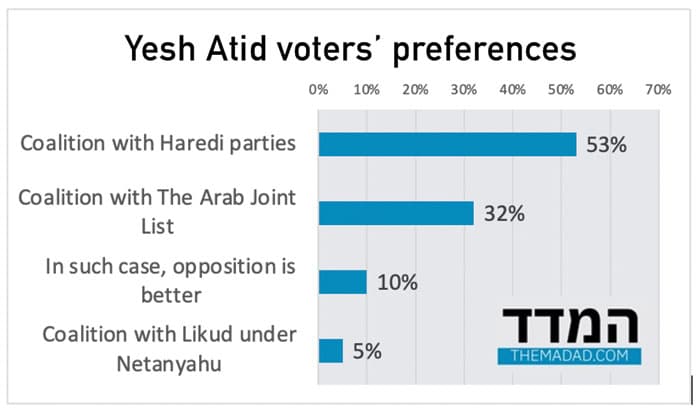
Yesh Atid Voters are mentally prepared to form a coalition with the ultra-Orthodox parties. They probably understand the compromises involved in such a coalition. They probably know that dealing with the ultra-Orthodox challenge isn’t going to happen in a coalition with United Torah Judaism and with Shas. If they have some understanding of the human psyche, they also know that the ultra-Orthodox parties (if they ever join a coalition with Yesh Atid, and that’s a big if), will want to make sure their political victory over Yair Lapid is clear. They will want achievements, both substantive and symbolic. So, swallowing it will not be easy. Still, Yesh Atid voters are ready and willing.

A week’s numbers
Continuing with the same topic: why secular, urban Yesh Atid voters accept a partnership with Haredi parties? Because they consider the other options we offered them in a poll even less appealing.
A reader’s response:
Roi Rosen writes, in response to last week’s column: “it’s time for Israel to wake up, the Haredim are more dangerous to the country than all the Arabs combined”. Well – I disagree, but can see where this is coming from.
Shmuel Rosner is senior political editor. For more analysis of Israeli and international politics, visit Rosner’s Domain at jewishjournal.com/rosnersdomain.