fbpx

July 21, 2022

Just Women, Map Pins. and Replaceable Men – A poem for Parsha Pinchas

I
Zelophehad’s daughters speak justly.
-Numbers 27:7

When modern courts made up of men
decide the fate of women – their dictums
based on ancient beliefs

let us refer back to the oldest text
where there is precedent for the wisdom of women
validated by the Arbiter of all Arbiters.

Case closed.

II
Go up to this mount Abarim and look at the land
that I have given to the children of Israel.
-Numbers 27:12

I’d like to visit Budapest, Hungary and Vienna
before I send my child onto this holy land without me.
Maybe even the Highlands of Scotland.
I’m putting pins on a map and, though I feel
accomplished so far, I know there is far more
space for pins, than pins available for me.
There are so many cities in Italy I probably
will never get to eat pasta in. It hardly seems fair.
I’m going to treat every set of forty years
as if they were my last. Enjoy every breath
I’m lucky enough to take.

III
Take for yourself Joshua the son of Nun, a man of spirit,
and you shall lay your hand upon him
-Numbers 27:18

The stakeholders always appreciate
a solid plan of succession. Think of all the
irreplaceables who left us and needed to
be replaced:

Jobs, Washington, Lincoln, Tubman, King.

We regard ourselves as invincible
until doctor appointments become
more frequent than bowel movements.

What you do now may make an impact
but you are not forever, so make a document
with all your passwords, and teach a younger person
everything you know. For when your dust
becomes part of the spinning globe.


God Wrestler: a poem for every Torah Portion by Rick LupertLos Angeles poet Rick Lupert created the Poetry Super Highway (an online publication and resource for poets), and hosted the Cobalt Cafe weekly poetry reading for almost 21 years. He’s authored 25 collections of poetry, including “God Wrestler: A Poem for Every Torah Portion“, “I’m a Jew, Are You” (Jewish themed poems) and “Feeding Holy Cats” (Poetry written while a staff member on the first Birthright Israel trip), and most recently “The Tokyo-Van Nuys Express” (Poems written in Japan – Ain’t Got No Press, August 2020) and edited the anthologies “Ekphrastia Gone Wild”, “A Poet’s Haggadah”, and “The Night Goes on All Night.” He writes the daily web comic “Cat and Banana” with fellow Los Angeles poet Brendan Constantine. He’s widely published and reads his poetry wherever they let him.

Just Women, Map Pins. and Replaceable Men – A poem for Parsha Pinchas Read More »

Disembodied, God Invented Zoom

It’s so much easier being in each other’s presence than
it was before God, whom I now presumptuously, perhaps unpardonably, presume
was the unpatenting Inventor of what I’m a major fan,
presented by Him to us, helping us be present when He’s absent, using Zoom.

By means of Zoom all human beings are by God enabled
to play on one another the same trick that He on us has played for ages,
pretending to be present while He truly isn’t, His undisabled,
disembodied presence echoed by all humans in their zeitgeist Zoomed menages.

Divine, this rationale I postulate for Zoom, is like the cause
that Weiss-Halivni postulated for the Shoah, claiming that it was the op-
posite of revelation, a disaster in which God withdraws
Himself, revealing absence from this most malicious monstrous malaprop.

David Berger concludes his obituary of Rabbi David Weiss-Halivni in the New York Times, July 7, 2022:
Professor Halvini’s 2007 book argued that the Holocaust revealed that God had decided to let mankind make its own choices without his interference.
Professor Halivni was considered something of a theologian, and in 2007 he published “Breaking the Tablets: Jewish Theology After the Shoah.” In that book, he added a second revelation to the traditional one at Mount Sinai: the revelation at Auschwitz.

While the revelation at Sinai crowned God’s singular attachment to the Jews, he posited, Auschwitz marked God’s withdrawal from intervening in human affairs. He rejected those who tried to rationalize the Holocaust as punishment for Jews’ sins. God, he said, had already decided to let mankind make its own choices without his interference.

“This is a revelation of the absence of the divine,” he said, “a revelation of the possibility of God’s absence from the world.”


Gershon Hepner is a poet who has written over 25,000 poems on subjects ranging from music to literature, politics to Torah. He grew up in England and moved to Los Angeles in 1976. Using his varied interests and experiences, he has authored dozens of papers in medical and academic journals, and authored “Legal Friction: Law, Narrative, and Identity Politics in Biblical Israel.” He can be reached at gershonhepner@gmail.com.

Disembodied, God Invented Zoom Read More »

Table for Five: Pinchas

One verse, five voices. Edited by Salvador Litvak, the Accidental Talmudist

The Lord said to Moses, “Take for yourself Joshua the son of Nun, a man of spirit, and you shall lay your hand upon him. And you shall present him before Eleazar the kohen and before the entire congregation, and you shall command him in their presence.”

– Num. 27:18-19


Nili Isenberg
Judaics Faculty, Pressman Academy

The issue of leadership is explored in the entertaining Ukrainian comedy “Servant of the People.” The hero, portrayed by Jewish actor Volodymyr Zelenskyy, suddenly becomes president and struggles to combat corruption in his country. In a stunning example of life imitating art, Zelenskyy was actually elected President of Ukraine, and we are all now familiar with his story from the headlines. 

Political corruption has always been a concern, as indicated by our own texts. Moses may have been suspected of wanting his own son to succeed him, but the midrash (Sifrei Bamidbar, compiled around the third century) points out that Moses appointed Joshua “with joy, undiluted with regret for his son.” Furthermore, Nachmanides (1194–1270) observes that the appointment was made in public “so that it could not be viewed as a high-handed act by Moses.” 

Samson Raphael Hirsch (1808–1888) adds that the ceremony in front of the people “means to place him in their service.” The Talmud (Horayot 10a) recalls a related story about Rabban Gamliel’s humble disciples hesitating to accept the position as heads of the academy. Gamliel chastises them, saying “You imagine it is an honor that I offer you; but it is rather servitude.” 

The Biblical text connects Joshua with the concept of servitude in his role as “Mesharet Moshe,” the servant of Moses. Today, I recommend to you Zalenskyy’s show, which in Hebrew is called “Mesharet HaAm.” Let us hope that our leaders today, like Joshua, come to their positions with an attitude of service.


Rabbi Benjamin Blech
Professor of Talmud, Yeshiva University

Even Moses realized there comes a time to appoint a replacement for the day he is gone. So how does a congregation choose the ideal candidate to lead them — the question facing every synagogue board when an aged, beloved Rabbi recognizes the need to make way for his successor? 

Moses was chosen by God. That was easy. And his selection was accompanied by a miracle. God revealed Himself by way of a bush that was burning, yet miraculously was not consumed. 

On a simplistic level it was a show of divine power, an act defying the physical laws of nature meant to prove to Moses that it was indeed the Almighty who commanded him to assume the difficult task of leadership. Yet if it was no more than that, surely God could have come up with a more amazing miracle. Why simply a bush impervious to fire? 

To my mind, more than demonstrating a miracle, God was sending Moses a message: If you accept the task of leadership of my people, no matter how difficult your mission may be you will never ever, just like the bush, suffer the breakdown of burnout! 

And so the Torah, as its first requirement for the appointment of a new leader, tells Moses to take Joshua because he is “a man of spirit.” Spirit is everlasting; spirit is optimistic; spirit is the divine quality that defines a quality of leadership immune to burnout. 


Nicholas Losorelli
3rd Year Rabbinical Student, Ziegler School of Rabbinic Studies

Sometimes the solution to lots of change is actually more change. As difficult as it can be, often it’s that final push that shifts our course. For example, the people have been through previously unimaginable change, and in this week’s parsha they face something even more daunting: Moses stepping down, and Joshua taking his place. 

With the discord between the people and Moses, something has to give. Rashi would call the people “troublesome”, but I find it hard to blame them. Maybe they are more troubled than anything. Troubled by what they’ve been through, troubled that this operation could go wrong in a million ways, and troubled after seeing Moses and Aaron seeming to claim that it was their power that drew the water from the rock and sounding an awful lot like aspiring Pharaohs. To resolve this trouble, leadership needed change, inaugurated not in divine private like Moses, but in holy public for the people to see, so they could trust that this new reality they were building wasn’t just going to be more of the same, and is in fact bigger than any one person. 

So, when we find ourselves troubled and stuck, even after so much change, we often need to find one more thing to change and make that change visible, even if only to ourselves. And it’s that shift that has the power to set us off on the new and promising course that is waiting for us, just at the edge of our imagination.


Rabbi Natan Halevy
kahaljoseph.org

Moshe asked Hashem who his successor would be. Hashem chose Joshua. 

Hashem instructed Moshe to impress upon Joshua the awesome responsibility he was accepting and how he must become very sensitive to the needs of the people. At the same time, he must know that the final responsibility rested on him when major decisions had to be made and he must be firm and fearless. When the people would hear Moses publicly impress upon Joshua the qualities that a leader must display at all times, they in turn would feel confident that a man so instructed by Moses would indeed do everything to live up to the task entrusted to him. 

They would accept his authority willingly and follow his directives. 

What is unique about the ‘spirit’ of Joshua? His holy strength. His ability to lead the different ‘spirits’ within the nation according to their needs. 

Moshe’s conferring of leadership and his blessing were impactful. He literally made a spiritual transfer of power. His blessing added to Joshua’s wisdom and conveyed an aura of regal authority. Though Hashem told Moshe to place one hand upon him, Moshe placed both his hands to increase the blessing as much as possible. 

Eleazar was Aaron’s extension, and this solidified the event even more in the eyes of Israel. Eleazar’s merit would support Joshua as Aaron supported Moshe. 

By learning of these matters, we become blessed with the spiritual energy contained in them in our lives. May our leaders always be blessed with such wisdom and compassion.


 Rabbi Mari Chernow
Temple Israel of Hollywood

You don’t need to look very far in today’s headlines to know that the peaceful transition of leadership is critical for a healthy society. Which does not mean it is easy. 

What more gentle and loving gesture could there be than the outgoing leader laying a hand on the head of the incoming? What greater statement of blessing, confidence, and trust? 

I wonder what is going through Moses’ mind as God issues this order? Immediately before doing so, God reminds Moses of his striking the rock and the consequence that he will not enter the promised land, as if he needs reminding. Then God adds, “And give some of your splendor to him [Joshua].” It is not only the labor of his lifetime that he is about to hand over; it is his standing and respect in the very society he has worked so hard to create. 

Moses is facing the excruciating truth that his leadership will come to an end. His life will come to an end. He will leave business unfinished, conversations incomplete and goals unmet. As we all will. A colleague of mine, an avid reader, marvels that when her time comes to die, she will be partway through a book. It is just a question of which book. 

Moses handles this moment with generosity and grace. As the commentators note, he places both hands on Joshua’s head, doubling the blessing for his successor and granting the gift of peace to his community.


Table for Five: Pinchas Read More »

A Moment in Time: Blending In or Sticking Out?

Dear all,

I was riding my bike this week when I came upon a small pond. At the exact moment in time that I looked into the water, a large turtle popped its head up, and we locked eyes.

At first I did a double take. I mean, the turtle blended in perfectly with the water. It was nearly camouflaged.

And, of course, it made me think….

There are times we need to try to blend in. And there are times we have a responsibility to stick out.

Figuring out the right timing is, perhaps, the key to wisdom.

Now, I could swear the turtle winked its eyes at me. While that could have been my imagination, it certainly imbedded a memory I won’t soon forget!

With love and Shalom,

Rabbi Zach Shapiro

A Moment in Time: Blending In or Sticking Out? Read More »

A Bisl Torah – Locked In

This week I finally have three kids under one roof. It feels as if summer can officially begin. As the three reunited, they ran outside to color the sidewalk with an array of chalk.

My middle guy closed the front door and nervously yelled, “Mommy, I think we’re locked in!” He mixed up the phrase. He meant, he thought we were locked outside the house. We weren’t. But what great imagery. It was the exact moment in which I wanted to be locked in.

Locked into the magic of a late California afternoon, cool enough to be comfortable, warm enough to ignore the impending bedtime hour. Locked into three children miraculously not arguing, playing hopscotch, and illustrating the front walk with innocence and fun. Locked into a memory that I pray will typify 2022: appreciating each other, our blessings, and the world around us.

Often, when we take a great picture, someone might suggest: frame that one. But the suggestion comes after the experience. Locked in is being present in the moment and locked into the diary of time. Capturing a sliver of pure bliss.

A preview of months to come: I can’t help but think about the final service during the High Holy Days, Neilah. The service in which we imagine the gates of repentance closing, asking God to seal us in the Book of Life. But during these long summer days and nights, we conjure up different gates, asking God to lock in contentment, to lock in joy, to lock in love.

May these be the memories sealed for eternity. Amen.

Shabbat Shalom


Rabbi Nicole Guzik is a rabbi at Sinai Temple. She can be reached at her Facebook page at Rabbi Nicole Guzik or on Instagram @rabbiguzik. For more writings, visit Rabbi Guzik’s blog section from Sinai Temple’s website.

A Bisl Torah – Locked In Read More »

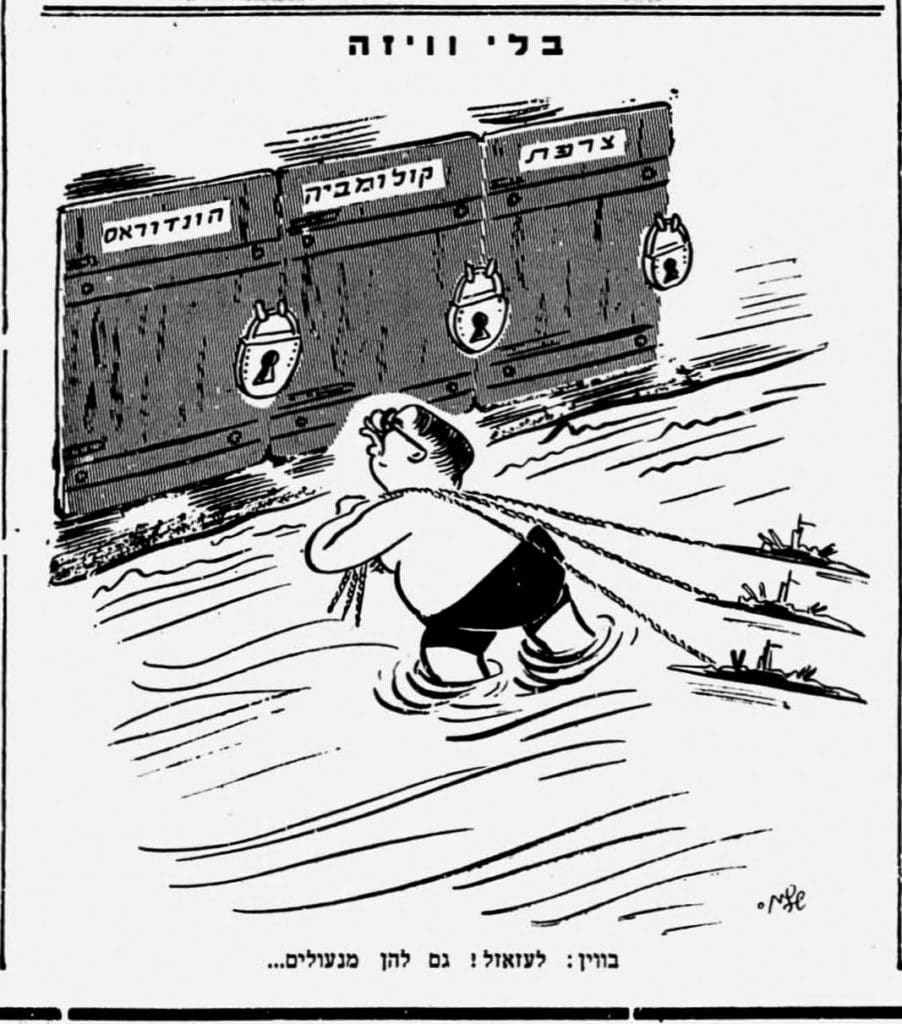
The Voyage of the Exodus Through Cartoonists’ Eyes

Seventy-five years ago this week, the incredible voyage of the refugee ship Exodus captured the hearts and minds of the international community.

The lively and provocative political cartoonists for the Hebrew-language press in Palestine chronicled the journey with the unique mix of humor, sarcasm and poignancy that is the hallmark of their profession.

Originally used to carry American troops in the Normandy Beach landings in World War II, the ship was purchased by agents of the Haganah, the Jewish underground in Palestine, and repaired in the Baltimore harbor after the war.

In July 1947, the Exodus, manned by a crew that included numerous Ameri­can volunteers, took aboard more than 4,500 Holocaust survivors at a rendezvous point on the coast of France.

The British navy, implementing its government’s strict policy of preventing most Jewish immigration to Palestine, trailed the ship as it crossed the Mediter­ranean.

When the Exodus approached the coast of Palestine on July 18, a British destroyer rammed the ship and truncheon-wielding Brit­ish soldiers charged aboard. They brutally beat many of the passengers and crew, including American crewmate Bill Bernstein, who died of his injuries. More than 20,000 New Yorkers filled Madison Square Garden several weeks later for a memorial ceremony in Bernstein’s honor.

International controversy over the Exodus intensified when the Brit­ish shipped them back to France in three ships that were outfitted as floating prisons. But when the ships reached Port de Bouc, all but a handful of the passengers refused to disembark, and the French authorities de­clined to force them to do so. The refugees remained there for more than three weeks, focusing embarrassing attention on Great Britain’s harsh policy toward Jewish immigrants.

On August 22, the British ordered the refugees sent to the British Zone of occupied Germany. Upon arrival at Hamburg, many of the Exodus passengers staged a sit-down strike and had to be dragged ashore by British troops. Others physically resisted disembarking and fought a two-hour pitched battle with the British sol­diers. Media coverage of the struggle further galvanized international criticism of Great Britain’s policies.

The passengers of the Exodus finally reached Eretz Yisrael in late 1948, following the establishment of the State of Israel.


Arie Navon
Davar
August 1, 1947
“Mother, why is it taking so long to reach Eretz Yisrael?”
Under ordinary circumstances, it takes 8 to 10 days to sail from France to Israel. From July 11, 1947, when the Exodus first set sail, until August 22, when its passengers were forcibly taken ashore in Germany, the refugees spent a total of 43 straight days on board.
Adam Schleyen
HaBoker
August 15, 1947
“Sha, sha —don’t wake up our Britons!”
The caption at the top, summarizing a recent news report, says: “Five children have already been born on the expulsion ships sailing from French waters, and according to the law, they are British subjects.”
Yosef Bass
Ha’aretz
August 29, 1947
“These Days: On land /On sea / And soon—in the air!”
Until the voyage of the Exodus, Jewish refugees who were apprehended by the British would be incarcerated in detention camps in Palestine or Cyprus. The creation of “prison ships” was an innovation. What tactic would they come up with next?
Arie Navon
Davar
September 12, 1947
“Victory Wreaths”
Foreign Minster Bevin’s head is crowned with a laurel wreath, the symbol of a Roman emperor; the bloody bandage on the head of the Jewish refugee is labeled “Runnymede Park,” the name of one of the three British ships that were used to deport the Exodus passengers.

Dr. Medoff is founding director of The David S. Wyman Institute for Holocaust Studies and author of more than 20 books about Jewish history and the Holocaust. His latest is America and the Holocaust: A Documentary History, published by the Jewish Publication Society & University of Nebraska Press.

The Voyage of the Exodus Through Cartoonists’ Eyes Read More »

Print Issue: Digital Detox | Jul 22, 2022

CLICK HERE FOR FULLSCREEN VERSION

Print Issue: Digital Detox | Jul 22, 2022 Read More »

Are You Staring at Your Phone?

I read an alarming report in The Guardian last week on how the geniuses who helped make technology so addictive are now disconnecting from that very technology. It’s as if the chef at a great Italian restaurant was afraid to eat his own food. 

In the piece, Paul Lewis profiles tech designers like Justin Rosenstein, who “banned himself from Snapchat, which he compares to heroin,” and imposed limits on his use of Facebook. Rosenstein, it turns out, is the Facebook engineer who created the “like” button, which he described as “bright dings of pseudo-pleasure.”

Lewis calls these rebels “Silicon Valley refuseniks alarmed by a race for human attention.” They are designers, engineers and product managers who, like Rosenstein, several years ago “put in place the building blocks of a digital world from which they are now trying to disentangle themselves.”

These refuseniks, Lewis writes, are most concerned about the psychological effects on people who, research shows, touch, swipe or tap their phone 2,617 times a day.

On average, humans touch, swipe or tap their phones 2,617 times a day … The addiction to technology has been with us for so long it’s become old news. We’re so addicted that we’re numb to the fact that we’re addicted.

Let’s repeat that: On average, humans touch, swipe or tap their phones 2,617 times a day.

As well as addicting users, Lewis cites the concern that technology is contributing toward “continuous partial attention,” severely limiting people’s ability to focus, and possibly lowering IQ. One recent study showed that the mere presence of smartphones damages cognitive capacity – even when the device is turned off. “Everyone is distracted,” Rosenstein says. “All of the time.”

I found the piece truly alarming, until I noticed something even more alarming: It was five years old. The story was dated October 2017. The addiction to technology has been with us for so long it’s become old news. We’re so addicted that we’re numb to the fact that we’re addicted.

Of course, it helps that technology has an extraordinary side. When we have most of humanity’s knowledge at our fingertips, and can keep in touch with anyone at any time, and can be entertained at will, what’s a little addiction?

But that’s precisely the point. We get addicted to stuff that gives us easy pleasure, and the more pleasure we get, the more pleasure we want. How do we set limits to limitless pleasure?

In her cover story this week, Journal columnist Judy Gruen weighs in on this modern dilemma. Among other things, she delves into the personal story of Molly DeFrank, whose efforts to deal with her own kids’ digital addiction led to her book, “Digital Detox: The Two-Week Tech Reset for Kids.”

In her cover story this week, Journal columnist Judy Gruen weighs in on this modern dilemma. Among other things, she delves into the personal story of Molly DeFrank, whose efforts to deal with her own kids’ digital addiction led to her book, “Digital Detox: The Two-Week Tech Reset for Kids.” Gruen writes:

“When a kid starts melting down when their device is taken away, it’s not even their fault, DeFrank says. ‘You are watching a dopamine crash in real time. The games and apps are designed to release so much dopamine receptors that the kids are numbing out. That’s why they think real life is boring and why just tweaking the number of minutes you allow a child to be online each day doesn’t always help.”

The line “that’s why they think real life is boring” especially got to me. When the rich complexity of life can’t compete with continuous dopamine hits from ever-available gadgets, where’s the future?

Gruen writes that “Curbing a teenager’s use of devices is far trickier, but DeFrank believes that ‘smart kids already understand at a certain level that their brains are being hijacked’ by their tech habits and that ‘many intuitively feel that they need parental help.’ As an example, one of DeFrank’s teenaged foster daughters had been given a smartphone by a well-meaning friend. One morning the teen was angry and upset, but despite DeFrank’s efforts, the girl refused to talk. Instead, she hunkered down on her smartphone, ‘numbing out’ by scrolling on social media, headphones on.”

The good news is that humans are resilient. When certain red lines are crossed, we adjust. We correct. Just like the Silicon Valley refuseniks who are fighting back, authors like DeFrank are digging deep to help wean us and our children from the digital drug grafted to our hands.

There is a whole movement, in fact, dedicated to “digital detox,” complete with nature retreats, meditation techniques, seminars, replacement therapies and other ideas designed to moderate our use of technology and bring more balance to our lives. 

You have to hand it to that ancient tribe 3,300 years ago at Sinai who could sense even back then that a weekly detox on Shabbat would become such an eternally good idea. Those were the original rebels.

Are You Staring at Your Phone? Read More »

Ellie Zeiler: The 18-Year-Old Fashion Influencer Dominating Social Media

When the COVID quarantine went into effect in March of 2020, Ellie Zeiler, then a high school student, suddenly had more free time. She started actively posting on TikTok and quickly grew a following. Today, she has 10.6 million followers on TikTok and 1.7 million on Instagram. 

“I realized there was an opportunity to turn creating content into a potential career path,” said Zeiler, who grew up in San Diego and now lives in Los Angeles. “I have many goals and feel lucky to have a jump start on a career at such a young age.” 

On social media, Zeiler shows off outfits she’s purchased, skin care products she loves and travel accessories she’s using on her pages, often pairing her videos with music and taking pictures in places like Paris, Beverly Hills and local beaches. Her TikTok videos have gained the most traction, garnering her over 370 million likes. Since she has such a huge following, she’s been able to promote products from brands like Lancôme, Levi’s and Amazon. 

“As a partner to these types of brands, my role is to create photos and video content that promotes their products and communicates their brand messaging,” she said. “I learn so much about business every single day.”

While in San Diego, Zeiler became deeply involved in her Jewish community. She attended Chabad Hebrew Academy, went to Camp Gan Israel and was an ambassador for her Jewish youth group in high school. 

When Zeiler started high school, she was “shocked” by the antisemitism she encountered. “On any given day while sitting in class, you might hear a cultural or religious slur made by a student as if it’s nothing.” When her friends confided to her they were experiencing the same thing in their schools as well, they decided to start Together As One, an organization that aims to combat antisemitism and encourage others to learn about cultural diversity and acceptance. When the Poway synagogue shooting happened in April of 2019, Zeiler led Together As One in raising funds to support those injured and affected by the shooting.

Zeiler has proudly shared her Jewish practices online, posting videos about Rosh Hashanah and showing her support for Israel – even though she’s gotten backlash for it.

“I am incredibly proud to be Jewish and feel lucky to live in a city where there is such a strong community. Feeling connected to Judaism has given me a sense of belonging and security as I’ve grown up.” – Ellie Zeiler

 “I am incredibly proud to be Jewish and feel lucky to live in a city where there is such a strong community,” she said. “Feeling connected to Judaism has given me a sense of belonging and security as I’ve grown up. Knowing that I am part of such a remarkable community of thought and business leaders, spiritual mentors and true survivors gives me a sense of comfort and courage wherever I am.”

Looking to the future, Zeiler is going to be pursuing acting while continuing to post on social media. This year, she had a debut starring role as Ari in season three of “Crown Lake” on Brat TV, a digital media company focused on Generation Z. She’s also going to college next year and wants to transition into a career in real estate. 

It has taken years for the teen influencer to build momentum online, but right now, she feels blessed she has the opportunity to do what she loves.  

“Growing a following on social media is honestly a mix of luck plus consistency met with hard work,” Zeiler said. “Developing a personal brand and creating high quality content that communicates who you are requires a lot of time, vulnerability and effort. I absolutely love what I do and wake up excited to create new content every day.”

Ellie Zeiler: The 18-Year-Old Fashion Influencer Dominating Social Media Read More »

When Mick Said ‘Wow’ to Me

I have been asked this question more than a few times … If I could meet anybody in the world, who would that be?  That answer has changed over the years but when I was 10 years old, New York Yankee Mickey Mantle was that guy. To me and my friends, Mickey Mantle was a kind of god. When I went to Yankee Stadium and Mickey was playing, I said the same thing that the Jews probably said when they saw the Red Sea split: Wow.  At 10 years old, if you asked me if I would rather witness the Red Sea split or Mickey hit a grand slam, it would have been The Mick. 

Some 30 years later, my friend Steve Mittleman and I got to meet The Mick. We were working in Las Vegas and read Mickey was signing autographs at the MGM Grand. At that time, I was enjoying the benefits of being nine years sober. When my turn came to get an autograph, I decided to tell Mickey I was sober since I had read he was trying to get sober. I wanted to let him know, just in case I could be helpful. You never know unless you try. Sobriety is like a high fly ball on a sunny day to deep center. It’s easy to lose sight of it if you are not extra careful. And from what I read in the press, Mickey did not have an easy time staying sober. The allure of the drink is blinding. 

Mickey was seated alone at a long table. I stepped up to say hello and asked if I could take a photo with him. He said, “Sure.”  To him, I was just another full-grown little kid who loved him. Even in his early sixties, he still had much of his farm boy baby face. We shook hands and I got the picture. Touching the hand that, with 35 inches of wood could slam a ball more than 500 feet, seemed surreal.  

After a deep breath, I leaned in and swung for the lights. “Hey Mick, I’m sober for 9 years. I know you’ve been trying. Good luck.”

With more of a grimace than a smile, he said, “Wow” — the same thing I said when I saw him shag a fly or hit one out of the park. Then he said, “I don’t know if I can last nine more minutes.” I wanted to say, “Sure you can. You’re the Mick. You can do anything.” But I froze. His honesty shook me. Wow. His son, who was also his handler, politely asked me to move on so the next person could say hello to their hero.

After decades of alcoholism, Mickey told his fans, “If I knew I was going to live this long, I’d have taken better care of myself.” 

After decades of alcoholism, Mickey told his fans, “If I knew I was going to live this long, I’d have taken better care of myself.” Mickey was told by a doctor that his liver was so badly damaged that it “looked like a doorstop.” After burning through his liver and spending a very short time on the transplant list, Mickey received a hotly contested new liver. He checked into the Betty Ford Center on January 7, 1994. On August 13, 1995, at 63 he died of liver and lung cancer.  

Mickey was not a bad person. Mickey had a disease. A deadly disease. Even heroes get diseases. There is more to quitting drinking than just quitting drinking. If someone doesn’t want help, it’s almost impossible to help them.  Even being told you have a “doorstop for a liver” may not be enough. Alcoholism cares zero about your home run stats. Its goal is to bench you and eventually kill you. 

When Mickey played ball, he was backed up by his team, the Yankees. Sober people also need a team backing them up. It helps to have a good infield to help you cut off the first drink. But what’s also needed to stop and stay stopped is the gift of desperation. When Mickey joined the Yankees, he was desperate to do well and he became the best. I don’t know if he was as desperate to stay sober. 

Getting sober and staying sober is minute-to-minute hard work for anyone, even for a hero like the Mick. 

So, if you’re reading this, and you’re newly sober – even for just one day, or even just five minutes — pat yourself on the back and say WOW.


Mark Schiff is a comedian, actor and writer, and host of the ‘You Don’t Know Schiff’ podcast.

When Mick Said ‘Wow’ to Me Read More »