fbpx

It’s Like … ‘No One You Know’

House pets eloquently dissecting their own primal instincts. Children verbalizing disillusionment in adultspeak. Patients and therapists locked in passive-aggressive combat. Welcome to the deadpan world of cartoonist Bruce Eric Kaplan.
[additional-authors]
July 8, 1999

House pets eloquently dissecting their own primal instincts. Children verbalizing disillusionment in adultspeak. Patients and therapists locked in passive-aggressive combat.

Welcome to the deadpan world of cartoonist Bruce Eric Kaplan.

With scalpel-sharp precision, Kaplan cuts through the genteel falseness in our cluttered, overly analyzed urban lives.

Kaplan himself insists that his inspiration comes from a much simpler source: “It’s completely personal. I’m just a victim like everybody else.”

Raised in Maplewood, N.J., Kaplan grew up with a minimal interest in comics. After college, he worked a thousand jobs before cracking the Hollywood nut with a television writing assignment. In his spare time, Kaplan sent reams of single-panel cartoon ideas to the offices of The New Yorker, only to receive its equal in rejection slips.

Then, in 1991, while authoring banter for the 43rd Annual Emmy telecast, the aspiring cartoonist received another correspondence from the Manhattan-based magazine, this time announcing their purchase of three panels. It was a euphoric event for Kaplan. After all, within the world of gag cartoonists, The New Yorker is the equivalent of playing Carnegie Hall. Kaplan has been cartooning for the periodical ever since.

Currently supporting “No One You Know,” the just-released collection of his cartoons, Kaplan has spent the better part of his life satirizing our lives in the big city — and not just with his comics. Kaplan also wrote scripts for sitcoms “Cybill” and “The Naked Truth” before achieving another career high by joining the staff of “Seinfeld.” Hired to write for the acclaimed NBC comedy’s last season, Kaplan was responsible for some of the late sitcom’s most memorable half hours, including (not so coincidentally) the one in which Elaine sets out to prove that New Yorker cartoons are not funny.

“If I hadn’t written it,” says Kaplan, “I would’ve hated it!”

For information on purchasing original cartoon art by Bruce Eric Kaplan contact Storyopolis (310) 358-2500.


Did you enjoy this article?
You'll love our roundtable.

Editor's Picks

Latest Articles

‘NAZA’ Proves Nada

“Naza” is not successful on any level as a documentary, but if judged on awards, and getting people who were already angry angrier, it very well may be.

The Virtues of Fresh Salads

After weeks of holiday feasting and heavy meals, the new Jewish year is a perfect time to reset, to nourish our bodies with food that is wholesome and still tastes delicious.

On Oct. 7, Reflections on Remembrance

Even as we mourn everything we’ve lost, let us also remember the moments of hope and healing — moments that restore our faith in humanity’s promise.

The Other Shoe

I stood there in awe, my eyes blurring with tears, listening to the hush and experiencing the unnamed. I couldn’t tell which was stranger: feeling the rainforest in me, or me in the rainforest. And then my phone rang.

A New Graphic Novel Re-Presents the Bible

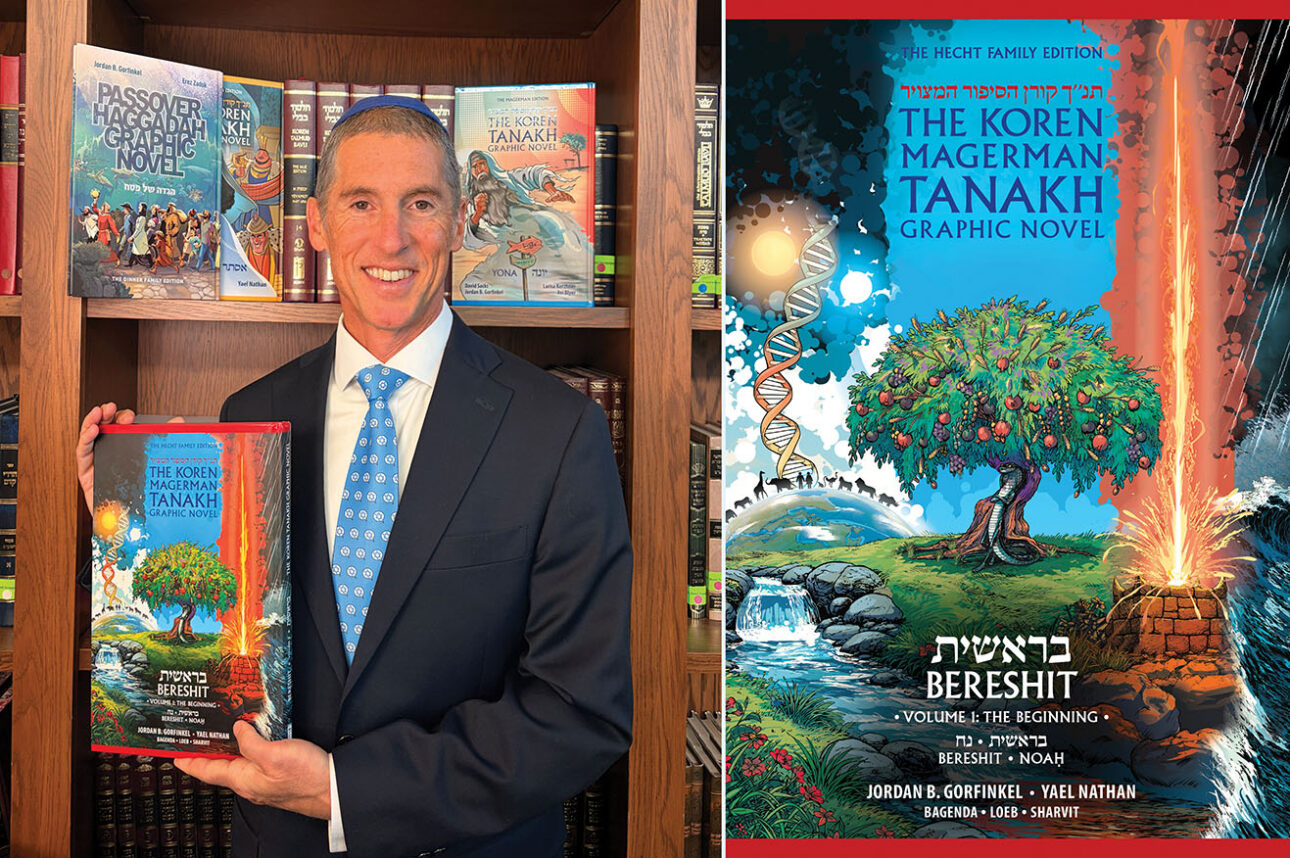
Following on the heels of his earlier presentations of the Passover Haggadah and the books of Esther and Jonah, Gorfinkel, known to his friends as “Gorf,” along with Israeli illustrator Yael Nathan and a team of specialized artists, have produced “The Koren Magerman Tanakh Graphic Novel: Bereshit Vol. 1,” which renders the first two Torah portions in Genesis, Bereshit and Noah, in dynamically engaging visual narrative form.

Flydubai Flight FZ1073 and the Indomitability of the Jews

FZ1073 has a message for the world. For the terrorists striving to take innumerable Israeli lives and make the survivors’ lives unbearable, the message is that your love of death will never diminish our love of life nor make us any less determined to defend it.

Achievement, Relationship, Purpose

A career becomes more rewarding when it supports rather than consumes the rest of life. Wealth becomes more meaningful when it creates security and enables generosity.

More news and opinions than at a Shabbat dinner, right in your inbox.