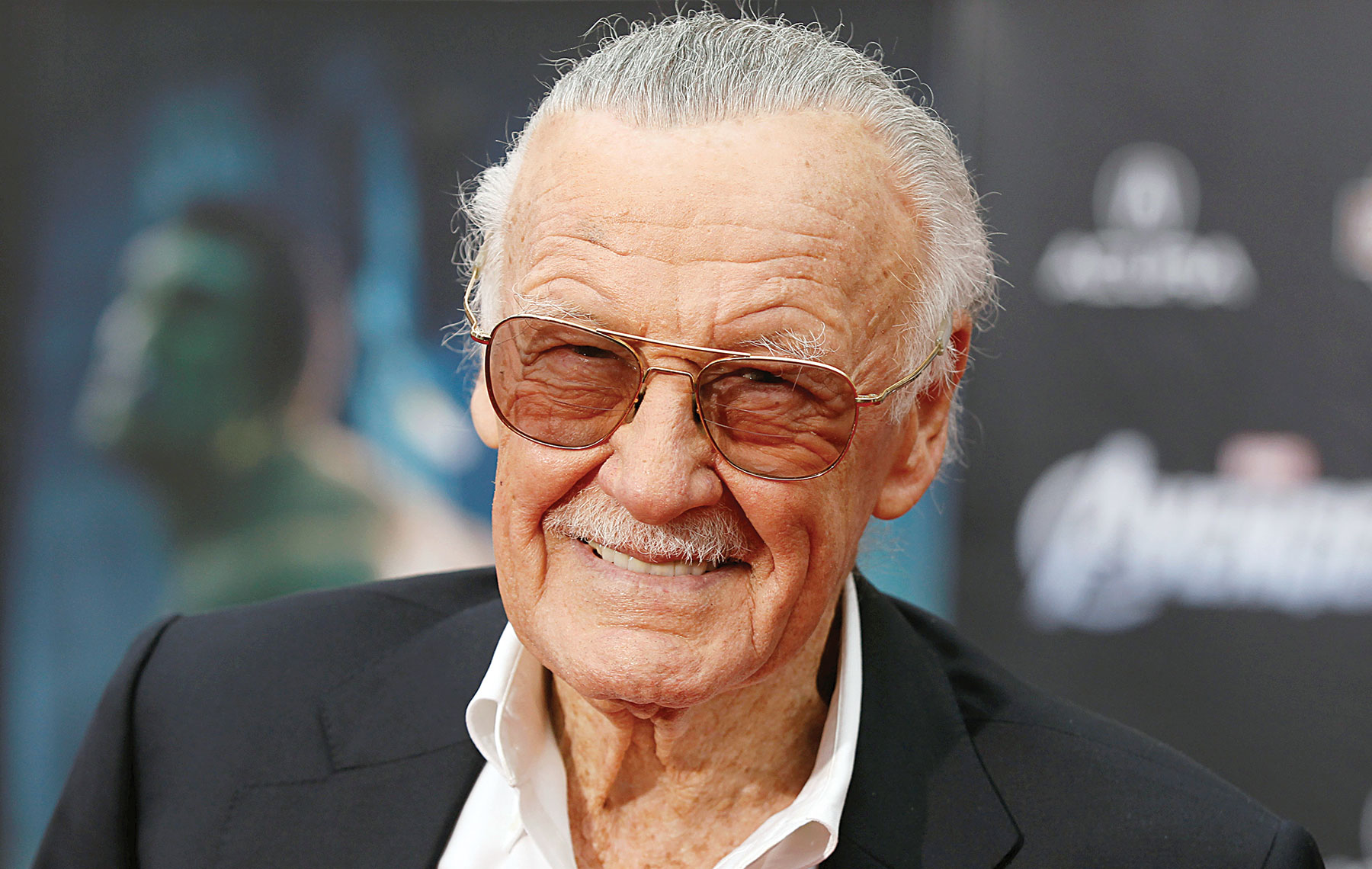
Stan Lee, whose work as a writer, editor and publisher at Marvel Comics in the 1960s changed the superhero landscape with creations like Spider-Man, the Fantastic Four, the Incredible Hulk, Thor, the X-Men, Avengers and Black Panther, died Monday at Cedars-Sinai Medical Center in Los Angeles. He was 95 years old.
Lee’s characters, for all their superpowers, suffered from the same doubts and worries of their readers and ushered in what became known as the “Silver Age” of comics, eventually becoming the stars of a billion-dollar series of films.
Stanley Martin Lieber was born on Dec. 28, 1922, in New York City, the eldest son of Jewish immigrants from Romania, Jack and Celia (Solomon) Lieber. His father worked in the garment trade. Lee graduated from DeWitt Clinton High School with ambitions to be a “serious” writer, but ended up getting a job at Timely Publications, the company that eventually became Marvel Comics. He started as a “gofer” but soon moved up to write and edit various comics. When the artist and writer team of Jack Kirby and Joe Simon, the creators of Captain America, left the company, Lee became the chief editor. He wrote under various pseudonyms, to both save his real name for his more literary efforts and to give the impression that the company employed a large stable of writers. He eventually settled on Stan Lee.
“Lee’s characters, for all their superpowers, suffered from the same doubts and worries of their readers and ushered in what became known as the “Silver Age” of comics, eventually becoming the stars of a billion-dollar series of films.”
After World War II, in which he served with the Army Signal Corps, he returned to New York. He married Joan Boocock, a British model, in 1947. She died in 2017. They had two daughters, Joan Celia, who survives him; and Jan, who died three days after her birth in 1953. After the war, Lee went back to Timely, but the business was changing. In the 1950s, government hearings derided comics as a bad influence, and the Comics Code Authority was established to self-police the books, turning them into tame stories with square-jawed, one-dimensional heroes.
In 1961, Lee and Jack Kirby created the Fantastic Four, a quartet of heroes to compete with DC Comics’ Justice League of America. Among the innovations introduced in the series was the fact that the team did not attempt to hide their real identities (including Benjamin Grimm, a Jewish pilot who became “The Thing”), had doubts and often argued among themselves, which sometimes hindered their ability to fight crime. In 2005, Lee described them to Wired as “heroes with hang-ups.”
The Fantastic Four was a surprise hit. Lee and Kirby created new characters, each with their own “hang-ups.” The Incredible Hulk was a Jekyll-and-Hyde monster who appeared only when Bruce Banner was angered. The Mighty Thor, the Norse god of thunder, was exiled by his father, Odin, to Earth, where he was forced to deal with his troublemaking brother, Loki.
With Steve Ditko, Lee created Dr. Strange, a surgeon injured in a car accident who becomes a sorcerer’s apprentice; the X-Men, a group of superheroes whose powers are the result of a genetic mutation, and not only have to fight crime but prejudice; and the company’s biggest success, Spider-Man, aka Peter Parker, a nerdy high-schooler who gains superpowers after being bitten by a radioactive spider, but still has problems talking to girls and doing his homework.
Marvel’s superheroes not only had real problems readers could identify with, they lived in the real world of New York and frequently interacted. Asked to explain the appeal of the characters in “The Origins of Marvel Comics,” Lee said “the characters would be the kind of characters I could personally relate to; they’d be flesh and blood, they’d have their faults and foibles, they’d be fallible and feisty and — most important of all — inside their colorful, costumed booties they’d still have feet of clay.”
At Marvel, Lee also instituted what became known as “the Marvel Method”: Instead of writing a full story and having it illustrated, he went to his artists with just a synopsis, later adding dialogue and sound effects to the drawings. This later led to contentious arguments over credits, with both Kirby and Ditko eventually leaving Marvel (they are now credited as co-creators in the movies based on their characters).
Lee became not only the editor of Marvel Comics, but its public face. He wrote a monthly column, Stan’s Soapbox, filled with snappy patter, inside jokes and hints of upcoming developments, each ending with the exclamation “excelsior!” When Marvel characters — starting with 2002’s “Spider-Man”— began appearing in a phenomenally successful series of movies, Lee would make a cameo appearance in each film. He also appeared as himself in “The Big Bang Theory,” “The Simpsons” and “Mallrats.”
Lee continued working well into the 21st century, starting POW! (Purveyors of Wonder) to create and license new characters. He was awarded the National Medal of Arts in 2008. But following the death of his wife, there were reports of problems among his caretakers, including lawsuits and the Hollywood Reporter claiming he was a victim of “elder abuse.” But in April of this year, he told The New York Times he was “the luckiest guy in the world.”