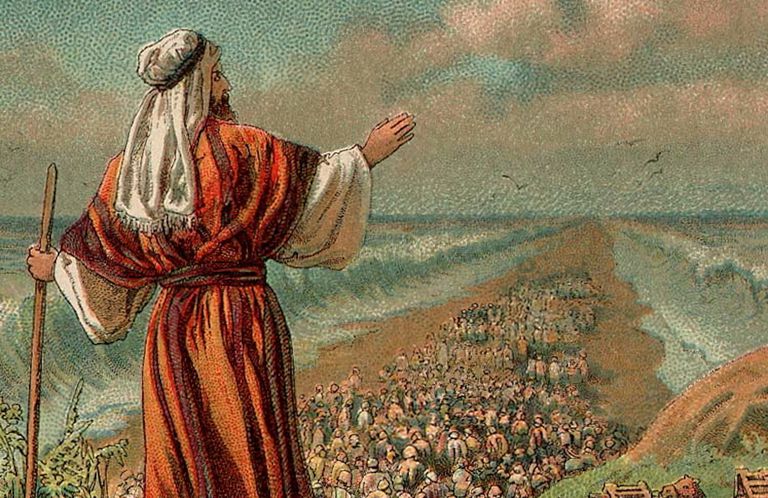
“This is how you shall eat it: your loins girded, your sandals on your feet, and your staff in your hand; and you shall eat it hurriedly: it is a passover offering to the Lord.” (Exodus 12:11)
These words are but one example of the many, many rules about observing Pesach and specifically, the seder. But what are they really telling us today?
Sure, it’s easy to find modern analogues for almost everything in the verse. We Southern Californians are no strangers to sandals, a staff was just 1750 B.C.E.’s answer to a smartphone, and of course, everyone wants to get to the matzo ball soup as quickly as possible!
But what about the loin-girding?
Perhaps this highly concrete language is not just a reflection of pre-Israelite fashion, but a message that we should try to feel the urgency of the Exodus in our guts. (I would have said “kishkes,” but they’re chametz.)
So again, what does that mean to we moderns?
This existential feeling of being constantly “on the move” is not only good for remembering our past, it’s critical to our present and future.
The feeling of “always being on the move” is hardly a novelty in Jewish tradition. Most of the books of the prophets that we read as the haftarah are about our people losing the land and being exiled because of our sins (spoiler alert: God brings us back later). It’s no accident that Chaim Potok chose to name his masterful history of the Jews “Wanderings.”
And even as a Jew, living in the most welcoming Diaspora in Jewish history (sorry, Babylonia), I have to say, the feeling of “not quite fitting in” never completely leaves me. When I read about my immigrant ancestors who left everything behind in Eastern Europe and started at America’s ground floor, I can’t help wonder “What if that were me?”
But as with most things in Judaism, this goes deeper.
I think the feelings of transience that the seder is meant to evoke make it something like Sukkot on the other side of the year. On that holiday, we dwell in mandated temporary shelters to remind ourselves of the fragility of creation, and our ultimate dependence on God.
So why do we need this reminder when we already got it back in the fall, and at least then we could eat kishkes? I would turn the question around and say, “Why don’t we have more of these reminders?”
For every day, we wake up and construct a world: of priorities, obligations, opinions, grievances and desires. The trick is to remember that is not the entirety of the world.
Which is where Pesach comes in, rouses us from our cocoons like an army bugler, and says, “Wake up! Time to move! And for heavens’ sake, put on some pants!”
Which brings us back to loins. Without jeopardizing the PG rating of this column — there is, of course, a second association with loins. They are the source of our children. And the children are the overwhelmingly driving purpose of the seder. The word haggadah comes from the biblical command to “tell the story to your children.” Read in this light, “gird your loins” becomes a way of saying “safeguard what you pass along to the next generation.”
So what exactly are we passing along? The fact that this existential feeling of being constantly “on the move” is not only good for remembering our past, it’s critical to our present and future.
In the policy sphere, we as a nation are grappling with the thorny question of immigrants, literally the “strangers” that we were in Egypt. This is a topic we need to engage our kids in, whatever side of it we come down on.
And in a broader sense, child development experts and educators talk about something called the “growth mindset.” This is the idea that no matter our age, we are never “fixed” into our current traits, strengths and weaknesses. Rather, we can always learn something new, try something new and be someone new.
In other words, we human beings are always on the move. And that’s a good thing.
Chag sameach. And may your girdings not be too tight.
Rob Kutner is a writer for “Conan” and the author of the comic book “Shrinkage.”