The term “Nimrod” has changed its meaning over the years. Initially, a “Nimrod” was a powerful figure, not to be trifled with. Medieval writers used it as a metaphor for tyrants. By the 1600s, it became a term of praise, indicating that the person is an exceptional hunter.
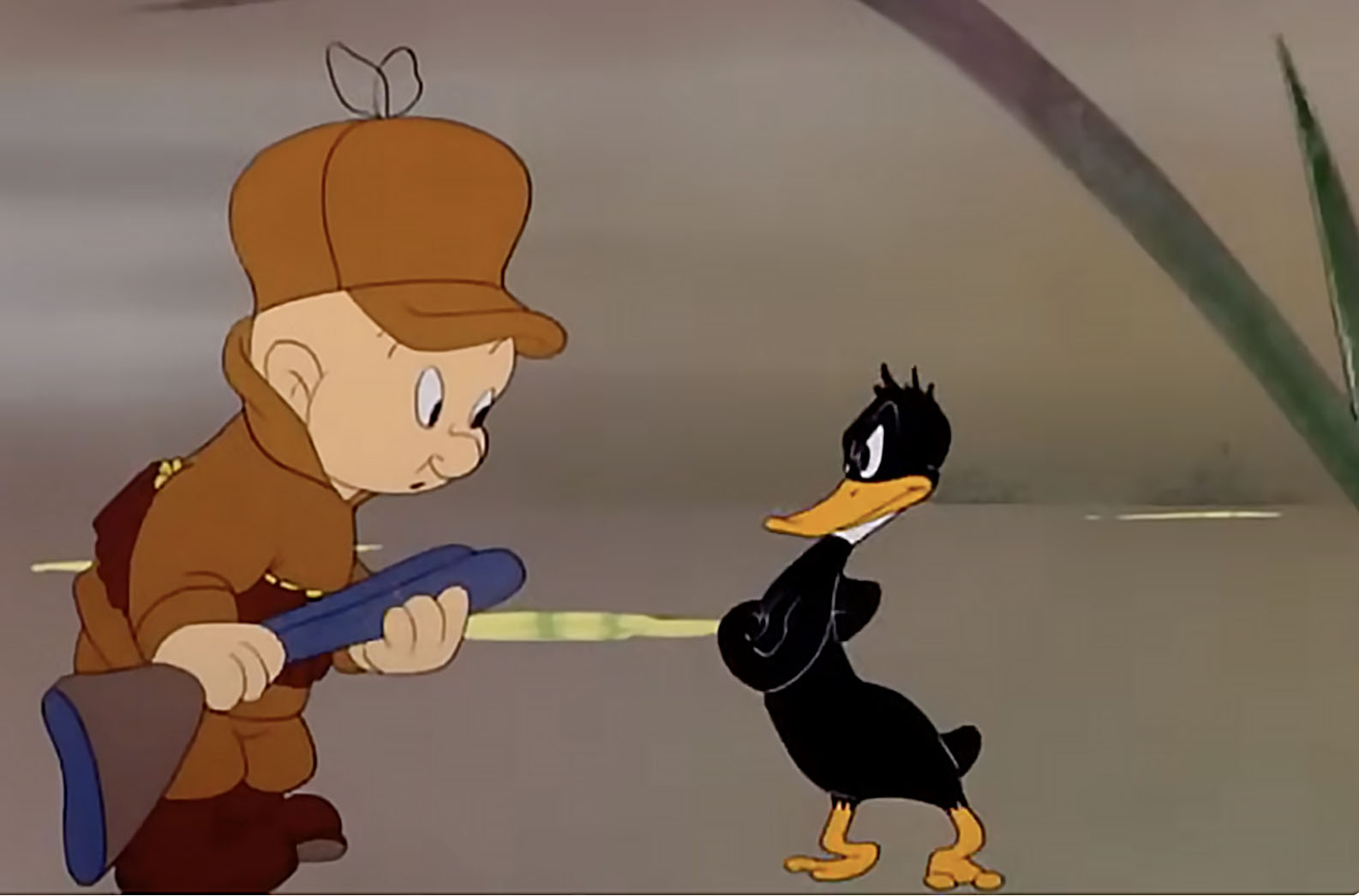
However, in the mid-1940s, Nimrod became synonymous with nitwit. And it all has to do with a cartoon.
In the Looney Tunes cartoons, Elmer Fudd goes hunting for Daffy Duck, and he misses every time. Daffy Duck mocks him for being an incompetent “Nimrod.” And from there, the new definition stuck for several decades.
These linguistic twists and turns are poetically fitting; the original Nimrod in the Tanakh is difficult to define as well. Only a few ambiguous verses tell us of his life; because Nimrod’s career focuses on hunting and political power, generations of commentaries focus on his biography.
In Genesis 10, the Torah says the following about Nimrod:
Cush begot Nimrod; he began to be a mighty one on the earth. He was a mighty hunter before the Lord; therefore it is said, “Like Nimrod the mighty hunter before the Lord.” And the beginning of his kingdom was Babel, Erech, Accad, and Calneh, in the land of Shinar. From that land he went to Assyria and built Nineveh, Rehoboth Ir, Calah, and Resen between Nineveh and Calah (that is the principal city).
From these few words, a mountain of interpretation emerges.
Commentaries debate the meaning of the unusual phrase “before the Lord.”
Some medieval commentaries say these words imply Nimrod was a religious hero. Rabbi Yoseph Kra writes, “that from heaven it was decreed that Nimrod would be filled with the spirit of might, and be victorious wherever he goes.” Ibn Ezra takes this a step further and says that Nimrod “would trap animals… and build altars to bring those animals as burnt sacrifices to God.”
These interpretations run counter to a tradition that casts Nimrod as a villain. Philo, in the first century, associates Nimrod’s name with the Hebrew word mered, which means rebellion. Josephus explains that this rebellion has to do with the Tower of Babel:
He threatened to have his revenge on God if He wished to inundate the earth again; for he would build a tower higher than the water could reach and avenge the destruction of their forefathers
Over 1,000 years later, Rashi will offer a similar account of the Tower of Babel; it was built to protect against future floods, and as the launching pad for a battle against God.
Rabbinic literature frequently mentions this portrait of Nimrod; it understands the words “before the Lord” as meaning “against the Lord.” Nimrod is a powerful king who rebels against God and builds the Tower of Babel. The Talmud and Midrash add another layer to the legend of Nimrod: that Nimrod is the adversary of young Abraham.
These Midrashim explain that after Abraham had broken his father’s idols, Abraham was brought for judgment before the emperor Nimrod, who decrees that Abraham should be thrown into a fiery furnace for this crime. Miraculously, God saves Abraham.
By this point in the interpretive history, Nimrod has become a full-fledged villain. He is the builder of the Tower of Babel, the launching pad for a battle against God; and as the tormentor of Abraham, the father of the Jewish people.
This negative interpretation becomes so well accepted that the Christian and Islamic traditions adopt it as well; and it eventually finds its way into literature, including Chaucer and Dante.
At first glance, this depiction of Nimrod seems extreme; the Torah only says that he was an expert hunter and king! For this reason, some commentaries underline the nuances of the text that imply Nimrod was a tyrant. Naphtali Hertz Wessely, offers an interpretation (based on one by Abravanel,) that depicts Nimrod as a religious hypocrite:
The verse explains how Nimrod maintained his kingdom through cunning. It says that he was a mighty man who fought the beasts of the land with bow and arrows, and he cleared the lands that were overrun by wild animals, making them fit for human habitation. He justified his actions before people by claiming that he did this out of fear of God, to benefit humankind. In this way, people were deceived by him and followed him, until he saw himself as strong and powerful. Then he began to be a “mighty man on earth,” rising up against the righteous and ruling over them with arrogance.
Wesley sees the words “mighty man on earth” as implying violence and arrogance.
Abravanel adds that Nimrod offered sacrifices, just as Ibn Ezra suggests. But Nimrod’s religiosity was fake, mere virtue signaling. His piety was meant to fool the masses and facilitate his rise to power. Nimrod the hunter traps animals with his snares, and entraps people with his deviousness.
Samson Raphael Hirsch adds another point that explains the rabbinic portrait. Nimrod is an empire builder. Hirsch explains:
Babel, Erech, Accad, and Calneh — these were originally distinct localities, each with its own character and population. The fact that all four became part of one ‘kingdom’ indicates the first joining of separate states into a single empire. From this time forward, human political history unfolds: the struggle between power and right, between the rule of might and the rule of moral law.
Nimrod is the first totalitarian.
Perhaps the most fascinating reading of Nimrod’s personality is found not in Biblical commentary, but in a legal responsa.
In the late 1600s, newly affluent Jews posed questions about the permissibility of hunting for sport. Rabbis Saul Levi Morteira and Samson Morpurgo, in Amsterdam and Italy, both condemn the practice. They explained that the Talmud forbids visiting Roman colosseums to observe contests of killing wild beasts; certainly the hunt itself is forbidden. Half a century later, Rabbi Ezekiel Landau, the Chief Rabbi of Prague, provided a thorough response to the question of sports hunting. After exploring multiple halakhic issues associated with hunting for sport, he writes:
However, I am surprised by the matter itself. We find no hunters other than Nimrod and Esau, and this is not the way of the children of Abraham, Isaac, and Jacob…. For how can a man of Israel actively kill beasts needlessly, simply to pass his leisure time by engaging in hunting?
According to Landau, people like Nimrod hunt, not Jews. And Nimrod’s flaw is that he is a hunter. Landau assumes Nimrod hunts for sport; and that speaks volumes about Nimrod’s character. Hunting for sport worships power at the cost of compassion. And Nimrod lacks compassion.
This interpretation is not just an 18th-century retelling; it corresponds to the reality in the ancient Near East. Kings hunted for sport. Initially, hunting wild animals was a necessity, to make new cities habitable; but after a while it became a way for leaders to prove their might. In ancient Assyria, kings embarked on ritual lion hunts to demonstrate their power to the masses. Killing lions proved the king’s worthiness.
And this is the moral problem. As Rabbi David Zvi Hoffmann says, the Tanakh allows humans to kill animals for their own needs. But to hunt for sport is just heartless. And that is what Nimrod did.
One must never let go of compassion, even when taking on wild animals.
The negative assessment of Nimrod in the Rabbinic tradition begins with his profession. The rabbis had an innate dislike for hunting.
The rabbis were not naive. They recognized that hunting was initially a matter of safety, and paved the way for civilization to develop. Even so, they challenged us to recognize moral nuance. This lesson is not theoretical; it is important for anyone who must exercise power.
Power is an absolute necessity for every country. Wild animals can threaten cities; wild enemies can threaten nations. Humanity must exercise power, but not worship it. And we must never lose our souls and our sense of compassion.
We must not become Nimrods.
Rabbi Chaim Steinmetz is the Senior Rabbi of Congregation Kehilath Jeshurun in New York.