fbpx

October 23, 2025

Parents: For the Love of G-d, Make a Jewish Choice in 5786

The Jewish new year is the ideal time for reflection and making changes in our lives that can positively impact not only ourselves and our families, but also our Jewish community, and beyond.  Today, lots of people are asking today, “What will Jewish America look like in the coming decades?” Although we cannot say for sure, we have a good hunch and the answer isn’t pretty.

One of us is the CEO of the largest JCC in North America and the other is a law professor and author/educator in the Jewish space. We both live and work in Chicagoland, the third largest Jewish population in the United States, numbering almost 320,000. Jewish Chicago is rich with Jewish programming and other opportunities for families like ours to make Jewish choices. In fact, we have both chosen Jewish preschools and Jewish summer camps for our children and made numerous other Jewish choices for our respective families.  But statistics show that we are a dying breed.

According to the 2020 Chicago Jewish population study, only 20% of Jewish children from birth to age five attend a Jewish early childhood program, which is a decrease from 40% in 2010. Among K-12 Jewish students, only 24% attended a Jewish summer program or camp. We suspect that in other locations, the percentages would be even lower. The Foundation for Jewish Camp reports that only 15% of Jewish children attend a Jewish overnight camp.  Although the majority of religiously liberal Jewish programs and institutions now define “Jewish” in a broad, inclusive sense, making these types of Jewish choices simply is not the norm for most Jewish parents.

We believe it is imperative that individual Jews with young children start thinking much more seriously about how to incorporate Jewish choice into their lived experience. If you plan to send your child to a preschool, why not choose a Jewish preschool? If you plan to send your child to a summer camp, why not choose a Jewish camp?  Preschool children bring home challah covers and Haggadahs in their backpacks along with love of Jewish ritual, tradition, language, and food in their hearts. These experiences infuse their homes and help the entire family grow Jewishly.

As for Jewish summer camp, as children grow from day to overnight camping, they gain not only independence but also a pathway for their personal Jewish journeys. While decisions for young children sit mostly with parents, older kids choose to return to their Jewish camp.  We are not surprised that the FJC reports that 94% of families find that overnight camp fosters connection to Jewish people and the broader Jewish community. Even more report that overnight camp creates an atmosphere where their children are proud to be Jewish. These choices are then followed by “the next Jewish thing,” be it Jewish youth groups, Hillel or Chabad on campus, a young adult trip to Israel.

Jewish is fun, Jewish feels good. Jewish choices breed more Jewish choices. Imagine a world in which significantly more young people choose to travel to Israel, seek Jewish young adult engagement programs, and raise their hands for leadership roles in their Jewish communities. Not only would American Jewry thrive in ways too many to count, but our Jewish agencies—the infrastructure designed to engage, connect and support the Diaspora—will similarly flourish. Just imagine.

Organizations need to do a better job of convincing more young Jewish parents to make those first Jewish choices. JCCs, Jewish preschools, camps, and agencies designed to invite Jewish engagement can do better at making the case. Our community funders can do more to support Jewish choices, which are sometimes more expensive than secular choices. Financial incentives developed decades ago have not kept up with either inflation or increased program costs, and the scholarship application process can be confusing, uncomfortable, or both.  There is definitely room for improvement on the communal side when it comes to facilitating more Jewish choices.

But make no mistake–the ripple effect in the opposite direction is where the crisis lies. Not choosing Jewish will likely lead to both a worsening of statistics and a decline in the availability of those Jewish choices. If less people show up, for how long will the doors be open? Now imagine your community with no Jewish preschools, no Jewish camps, and no JCCs. Sound dire? It is.

We cannot allow a future in which Jews opt out of themselves.

Parents: for the love of G-d, make a Jewish choice in 5786!


Addie Goodman is the President & CEO of JCC Chicago and serves on the Board of Directors of JCC Association of North America and as a Trustee for the Harold Grinspoon Foundation. Roberta Rosenthal Kwall teaches at DePaul Law and is the author of “Remix Judaism” and “Polarized: Why American Jews are Divided and What to Do About It” (Bloomsbury Press, 2026).

Parents: For the Love of G-d, Make a Jewish Choice in 5786 Read More »
Rabbis of LA | Rabbi Daniel Levine Wants to Have a ‘Civil Dialogue‘

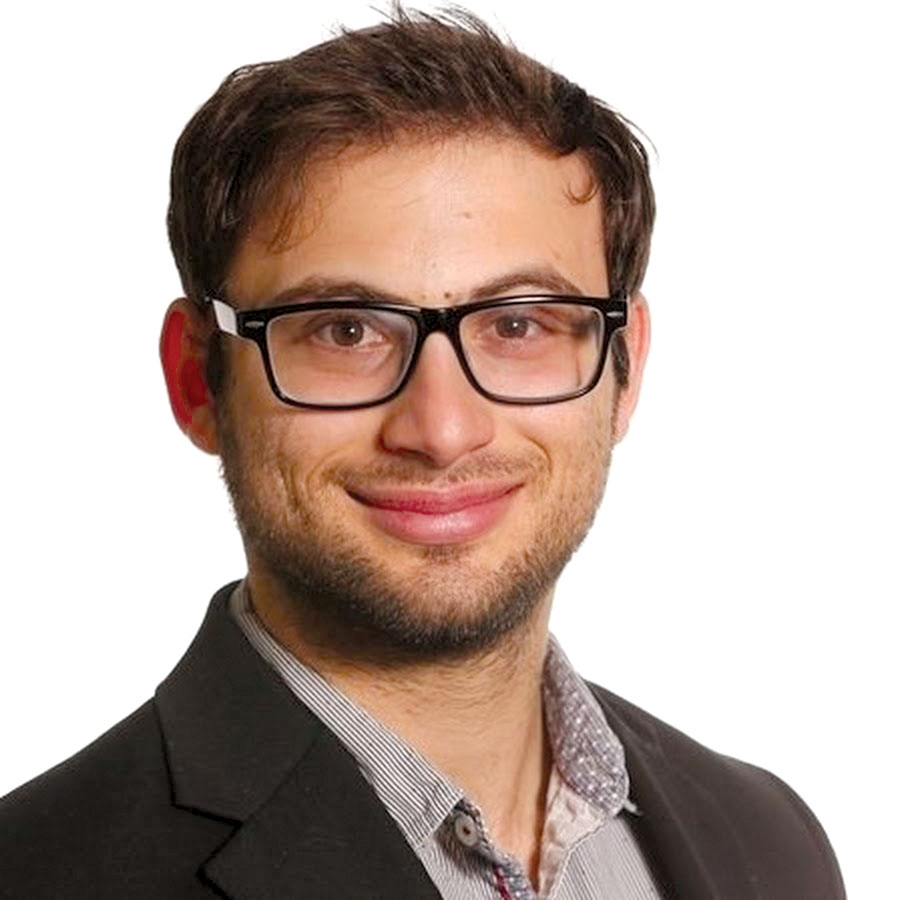
“I am very much a fan of free speech,” Rabbi Daniel Levine said. And on his YouTube show, the 32-year-old San Diego native and professor at UC Irvine practices what he preaches. He interviews people from both the right and left; .his goal each time is to spread light on their views, whether you agree or disagree with the guest’s opinions.

His interviews are about happenings in the Jewish world, he said, but they are more.  He almost dares the viewer to guess what his views are. The show, which has been running for about a year, is called “The Fifth Question,” a reference to the Four Questions asked at the Passover seder. “There aren’t a lot of people having nuanced conversations,” he told The Journal. “I try to talk to people I disagree with. I did an episode with someone critical of Israel, another episode with a rabbi who officiates interfaith marriages – and we had a debate about that. I had a friendly debate with a friend about whether Jews should vote Republican or Democrat in the upcoming election.” He tries to model what it means to have civil dialogue and debate, which he believes society lacks. He teaches classes on four campuses, and has seen “many students hungry for conversation, hungry to see ideas clash in a way where everyone is being respected – where there is no violence and everyone is trying to be civil for the community.”

One of the rabbi’s central themes is that more dialogue is good. When it’s mentioned that was something the late Charlie Kirk believed, he called Kirk’s murder “disgusting; one of the more horrific things to happen in my lifetime in public in America. I didn’t agree with all of his views, but I think we need more such people. The divide is between people who believe in freedom of speech, freedom of expression, and people who don’t.” 

Levine believes there are extremists on both sides, and neither side agrees with the tenets of basic liberalism. “When you go far enough right he said, “there are people who don’t agree that everybody should have free speech, freedom of religion and all things fundamental to what it means to be in a liberal democracy in America.”

In the past year, Levine has encountered people from both the left and right who understand they can disagree on taxes, tariffs and foreign policy but as long as we are doing it within civil dialogue and respecting each other, that is fine. However, as soon as we start calling each other names and start threatening each other, our society is going to collapse.”

He calls himself a “principled centrist,” and explained that some think centrists are people who don’t have any views. They’re wrong, Levine insisted. As a genuine centrist, he thinks that “people both on the right and the left have good points some of the time. I don’t think either side makes good points all the time. All human institutions have flaws. Humans can never reach perfection. Only God is perfect. Anything humans create is going to be imperfect. When we try to make political parties into idols – in Judaism we know what happens to idols.”

People should look for nuance, to have their ideas challenged and invite those they disagree with for a civil dialogue. But at times, he finds himself playing devil’s advocate. “In the last couple months I have done two episodes, one where I was talking with someone much more to the left than I am while defending a right-wing viewpoint. When I was talking with someone to the right of me, I was defending a left-wing view.” Both cases, he said, proved no one side has a monopoly on truth. “Our society will be better off when we start to realize that many different groups and many different people can hold a little bit of truth.”

This, the rabbi explained, is why Judaism values dialogue so much –  because it takes a lot of hubris to say any one idea holds all the truth. And to come to a wider understanding of what truth is, you have to talk to people who disagree with you.

In every interview, he wants people to “understand the art of civil debate is not over. It’s very much alive. And it is a deeply Jewish idea. Our entire Talmud is full of people disagreeing with each other in a principled way, and still remaining part of a community. That trend has continued the last 2,000 years of Jewish history. It’s fundamental to being Jewish – being able to have difficult conversations while remaining in the same community.”

Who does Rabbi Levine look for to join him on “The Fifth Question”? “People with interesting ideas,” he said, “who are willing to have an open conversation. It’s not really about what views they have.  One question is, are they willing to have a civil conversation? And, do I think there is a value here?”

Rabbi Levine, teaches Jewish Studies at two schools and runs Hillel events at another one. He spends 80 percent of his time at UC Irvine, and divides the rest among between Chapman University, Cal State Fullerton and Cal State Long Beach.  

To view episodes of “The Fifth Question,” go to https://www.youtube.com/@rabbidaniellevine

Fast Takes with Rabbi Levine

Jewish Journal: What is your favorite vacation spot?

Rabbi Levine: Any place where there was an historic Jewish community. 

JJ: What is the best book you ever have read?

RL: “As a Driven Leaf” by Milton Steinberg

JJ: What is your favorite family activity?

RL: We have an eight-month-old baby (our first), and we have just begun to take her hiking.

JJ: What is your next goal?

RL:  I might write a book. I really love fiction.

Rabbis of LA | Rabbi Daniel Levine Wants to Have a ‘Civil Dialogue‘ Read More »

The Hunter

The term “Nimrod” has changed its meaning over the years. Initially, a “Nimrod” was a powerful figure, not to be trifled with. Medieval writers used it as a metaphor for tyrants. By the 1600s, it became a term of praise, indicating that the person is an exceptional hunter.

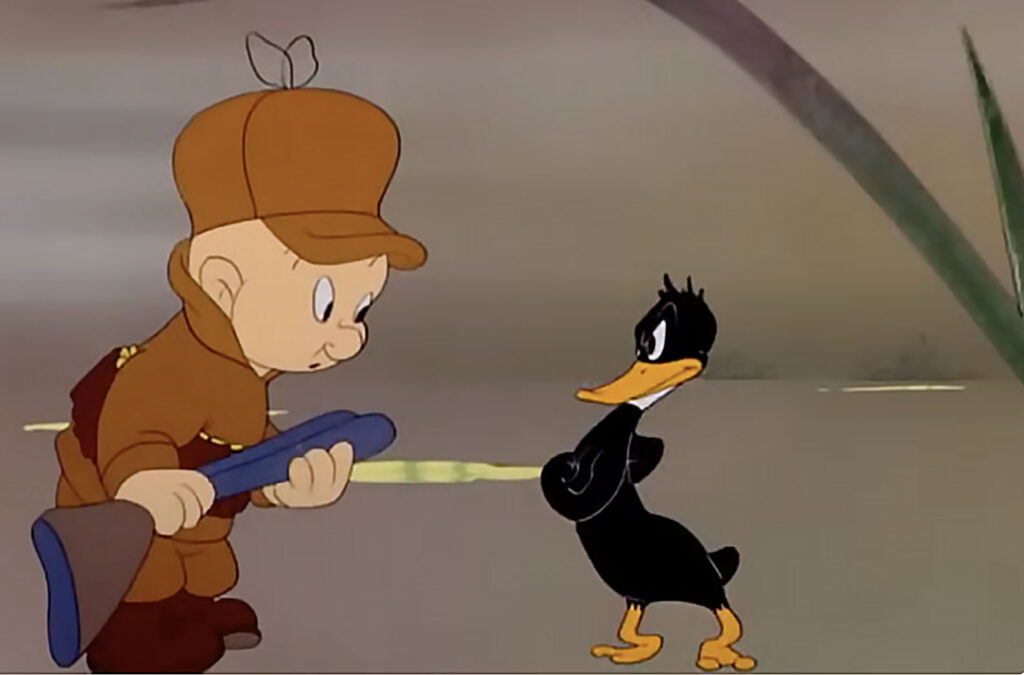
However, in the mid-1940s, Nimrod became synonymous with nitwit. And it all has to do with a cartoon.

In the Looney Tunes cartoons, Elmer Fudd goes hunting for Daffy Duck, and he misses every time. Daffy Duck mocks him for being an incompetent “Nimrod.” And from there, the new definition stuck for several decades.

These linguistic twists and turns are poetically fitting; the original Nimrod in the Tanakh is difficult to define as well. Only a few ambiguous verses tell us of his life; because Nimrod’s career focuses on hunting and political power, generations of commentaries focus on his biography.

In Genesis 10, the Torah says the following about Nimrod:

Cush begot Nimrod; he began to be a mighty one on the earth. He was a mighty hunter before the Lord; therefore it is said, “Like Nimrod the mighty hunter before the Lord.”  And the beginning of his kingdom was Babel, Erech, Accad, and Calneh, in the land of Shinar. From that land he went to Assyria and built Nineveh, Rehoboth Ir, Calah, and Resen between Nineveh and Calah (that is the principal city).

From these few words, a mountain of interpretation emerges.

Commentaries debate the meaning of the unusual phrase “before the Lord.”

Some medieval commentaries say these words imply Nimrod was a religious hero. Rabbi Yoseph Kra writes, “that from heaven it was decreed that Nimrod would be filled with the spirit of might, and be victorious wherever he goes.” Ibn Ezra takes this a step further and says that Nimrod “would trap animals… and build altars to bring those animals as burnt sacrifices to God.”

These interpretations run counter to a tradition that casts Nimrod as a villain. Philo, in the first century, associates Nimrod’s name with the Hebrew word mered, which means rebellion. Josephus explains that this rebellion has to do with the Tower of Babel:

He threatened to have his revenge on God if He wished to inundate the earth again; for he would build a tower higher than the water could reach and avenge the destruction of their forefathers

Over 1,000 years later, Rashi will offer a similar account of the Tower of Babel; it was built to protect against future floods, and as the launching pad for a battle against God.

Rabbinic literature frequently mentions this portrait of Nimrod; it understands the words “before the Lord” as meaning “against the Lord.” Nimrod is a powerful king who rebels against God and builds the Tower of Babel. The Talmud and Midrash add another layer to the legend of Nimrod: that Nimrod is the adversary of young Abraham.

These Midrashim explain that after Abraham had broken his father’s idols, Abraham was brought for judgment before the emperor Nimrod, who decrees that Abraham should be thrown into a fiery furnace for this crime. Miraculously, God saves Abraham.

By this point in the interpretive history, Nimrod has become a full-fledged villain. He is the builder of the Tower of Babel, the launching pad for a battle against God; and as the tormentor of Abraham, the father of the Jewish people.

This negative interpretation becomes so well accepted that the Christian and Islamic traditions adopt it as well; and it eventually finds its way into literature, including Chaucer and Dante.

At first glance, this depiction of Nimrod seems extreme; the Torah only says that he was an expert hunter and king! For this reason, some commentaries underline the nuances of the text that imply Nimrod was a tyrant. Naphtali Hertz Wessely, offers an interpretation (based on one by Abravanel,) that depicts Nimrod as a religious hypocrite:

The verse explains how Nimrod maintained his kingdom through cunning. It says that he was a mighty man who fought the beasts of the land with bow and arrows, and he cleared the lands that were overrun by wild animals, making them fit for human habitation. He justified his actions before people by claiming that he did this out of fear of God, to benefit humankind. In this way, people were deceived by him and followed him, until he saw himself as strong and powerful. Then he began to be a “mighty man on earth,” rising up against the righteous and ruling over them with arrogance.

Wesley sees the words “mighty man on earth” as implying violence and arrogance.

Abravanel adds that Nimrod offered sacrifices, just as Ibn Ezra suggests. But Nimrod’s religiosity was fake, mere virtue signaling. His piety was meant to fool the masses and facilitate his rise to power. Nimrod the hunter traps animals with his snares, and entraps people with his deviousness.

Samson Raphael Hirsch adds another point that explains the rabbinic portrait. Nimrod is an empire builder. Hirsch explains:

Babel, Erech, Accad, and Calneh — these were originally distinct localities, each with its own character and population. The fact that all four became part of one ‘kingdom’ indicates the first joining of separate states into a single empire. From this time forward, human political history unfolds: the struggle between power and right, between the rule of might and the rule of moral law.

Nimrod is the first totalitarian.

Perhaps the most fascinating reading of Nimrod’s personality is found not in Biblical commentary, but in a legal responsa.

In the late 1600s, newly affluent Jews posed questions about the permissibility of hunting for sport. Rabbis Saul Levi Morteira and Samson Morpurgo, in Amsterdam and Italy, both condemn the practice. They explained that the Talmud forbids visiting Roman colosseums to observe contests of killing wild beasts; certainly the hunt itself is forbidden. Half a century later, Rabbi Ezekiel Landau, the Chief Rabbi of Prague, provided a thorough response to the question of sports hunting. After exploring multiple halakhic issues associated with hunting for sport, he writes:

However, I am surprised by the matter itself. We find no hunters other than Nimrod and Esau, and this is not the way of the children of Abraham, Isaac, and Jacob…. For how can a man of Israel actively kill beasts needlessly, simply to pass his leisure time by engaging in hunting?

According to Landau, people like Nimrod hunt, not Jews. And Nimrod’s flaw is that he is a hunter. Landau assumes Nimrod hunts for sport; and that speaks volumes about Nimrod’s character. Hunting for sport worships power at the cost of compassion. And Nimrod lacks compassion.

This interpretation is not just an 18th-century retelling; it corresponds to the reality in the ancient Near East. Kings hunted for sport. Initially, hunting wild animals was a necessity, to make new cities habitable; but after a while it became a way for leaders to prove their might. In ancient Assyria, kings embarked on ritual lion hunts to demonstrate their power to the masses. Killing lions proved the king’s worthiness.

And this is the moral problem. As Rabbi David Zvi Hoffmann says, the Tanakh allows humans to kill animals for their own needs. But to hunt for sport is just heartless. And that is what Nimrod did.

One must never let go of compassion, even when taking on wild animals.

The negative assessment of Nimrod in the Rabbinic tradition begins with his profession. The rabbis had an innate dislike for hunting.

The rabbis were not naive. They recognized that hunting was initially a matter of safety, and paved the way for civilization to develop. Even so, they challenged us to recognize moral nuance. This lesson is not theoretical; it is important for anyone who must exercise power.

Power is an absolute necessity for every country. Wild animals can threaten cities; wild enemies can threaten nations. Humanity must exercise power, but not worship it. And we must never lose our souls and our sense of compassion.

We must not become Nimrods.


Rabbi Chaim Steinmetz is the Senior Rabbi of Congregation Kehilath Jeshurun in New York.  

The Hunter Read More »

A Little Rest – A poem for Parsha Noach

Noach — Noah, Rest, Comfort, Relief (Genesis 6:9-11:32)

I spent two hours watching the news
on October 12th for brief glimpses of
Red Cross vehicles and military convoys.

But no images of the doves taken
seven hundred and thirty-six days earlier.
The world was flooded two years ago

and they say it’s finally October 8th.
Seven hundred and thirty-six is not
a Biblical number like forty, but

the waters may be receding.
Relief may have come to our world.
Who is steering this ark? Who has

brought this comfort?
What was lost when everything
was covered with water?

Noach was a righteous man of his time
but the bar was set low. He had issues.
He liked the sauce but got the job done.

He was fruitful and multiplied.
He lived for years longer than
the hostages were away.

But their time was interminable.
Now their feet are on our promised soil.
The doves have returned.

Our olive branches are extended.
And, for a little while, anyway,
we can rest.


Rick Lupert, a poet, songleader and graphic designer, is the author of 29 books including “God Wrestler: A Poem for Every Torah Portion.” Visit him at www.JewishPoetry.net

A Little Rest – A poem for Parsha Noach Read More »

Oct.7 Anniversary, Pico-Robertson Cleanup, AJU Seeks Video Submissions

More than 1,100 Angelenos gathered for “United in Memory: LA Remembers October 7th,” a commemorative ceremony marking the second anniversary of the October 7th massacre.

The event took place Oct. 16 at the Saban Theatre and honored the victims of the attack, supported survivors and called for the release of the remaining hostages. Los Angeles, home to the second-largest Jewish community in the United States, held the event to show solidarity with Israel and the Jewish people amid a rise in antisemitic incidents nationwide since the attacks.

The Milken Community School Choir Performs at the “United in Memory” gathering in Beverly Hills. Photo by Janete Weinstein, Israeli Consulate in Los Angeles

Speakers included Consul General of Israel in Los Angeles Israel Bachar, Beverly Hills Mayor Sharona Nazarian, October 7th survivors Rom El Hai and Sabin Taasa, and leading voices from the city’s major Jewish organizations, including Jewish Federation Los Angeles CEO and Rabbi Noah Farkas; StandWithUs’ Roz Rothstein, Israeli American Council CEO Elan Carr, FIDF leader Simon Etehad and Elie Alyesmerani.

Consul General of Israel in Los Angeles Israel Bachar. Photo by Orly Halevy

The ceremony featured a candle-lighting with bereaved families, diplomats and dignitaries in memory of the victims, fallen Israeli Defense Soldiers, and those still held hostage.

Nova Survivor Rom El-Hai. Photo by Janete Weinstein, Israeli Consulate in Los Angeles


The Milken Community School Choir Performs at the “United in Memory” gathering in Beverly Hills. Photo by Janete Weinstein, Israeli Consulate in Los Angeles

Consul General of Israel in Los Angeles Israel Bachar. Photo by Orly Halevy


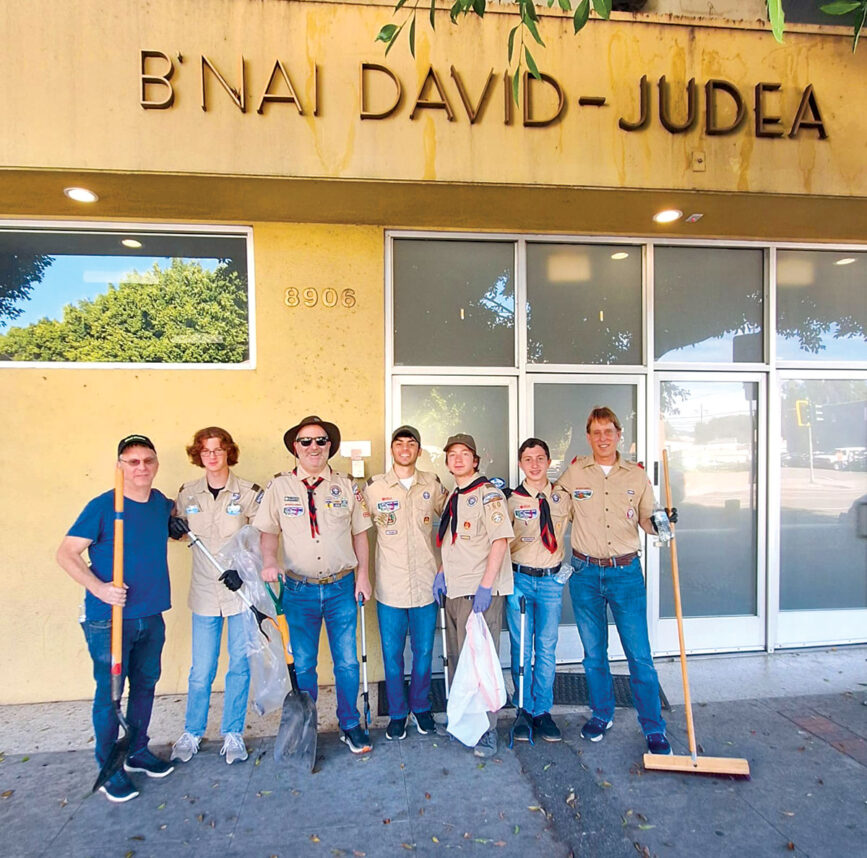
Community members Mark Treitel (far left), Hal Schloss (third from left) and Dan Schechter (far right) joined teens at the second annual Pico-Robertson neighborhood cleanup effort. Courtesy of Boaz Hepner

The second annual Pico-Robertson neighborhood cleanup was held on Oct. 19.

Organized by community leader and Journal contributor Boaz Hepner in partnership with Jewish Federation Los Angeles and South Robertson Neighborhoods Council (SORO), the Sunday morning and afternoon gathering brought together more than 120 volunteers who collected approximately 4,000 pounds of garbage.

Spread out across the Pico-Robertson area, volunteers cleaned alleyways from Beverly Drive to La Cienega; removed out-of-date posters and signs from tree and poles; and helped clear a homeless encampment of paraphernalia. Girl and boy scout troops also turned out to earn their merit badges. Meanwhile, speakers at the cleanup included L.A. City Councilmember Katy Yaroslavsky and Jewish Federation Los Angeles Chief Operating Officer Alissa Finsten.


American Jewish University (AJU) recently announced the launch of “Jewish Future 2025,” a national video fellowship calling on the community to imagine and share bold visions for the Jewish future.
The Jewish university is inviting U.S. residents—ages 18-and-over—to submit creative, high-impact 60-second videos that answer the question: “What does the perfect Jewish future look like?”

Submissions should highlight authentic hopes for a thriving Jewish life—rooted in joy, learning, spirituality, creativity, community and continuity, according to AJU leadership.

“American Jewish University is singularly focused on the future of Jewish life,” AJU President Jay Sanderson said. “This fellowship invites our community to share bold visions for what lies ahead and reflects AJU’s role as a convener, harnessing creativity and imagination to shape a vibrant Jewish future.”

A panel of judges will select three winners based on originality, creativity, clarity of vision and visual impact.

Winners will receive cash prizes of $3,600 (first place), $1,800 (second place) and $540 (third place) and will be named AJU Jewish Future Fellows. Winning videos will be shared widely across AJU’s platforms and social media.

The initiative is powered by the Bruce Geller Memorial Prize, which supports artists exploring Jewish ideas, traditions, history, and identity. Bruce and Jeannette Geller were influential Los Angeles residents whose passion for creativity and the pursuit of art defined their lives.

Submissions are now open and due Nov. 17, 2025. Winners will be announced on Dec. 15, 2025. For details, visit aju.edu/futurefellows

Oct.7 Anniversary, Pico-Robertson Cleanup, AJU Seeks Video Submissions Read More »

Table for Five: Noach

One verse, five voices. Edited by Nina Litvak and Salvador Litvak, the Accidental Talmudist

I have set My rainbow in the cloud, and it shall be for a sign of the covenant between Me and the earth.

– Gen. 9:13


Nina Litvak

Screenwriter, Co-creator of accidentaltalmudist.org

When Noah left the ark after the flood waters subsided, he faced a world of utter devastation. He must have wondered whether it was worth trying to repopulate the earth; after all the same thing might happen again. The world might become filled with wickedness leading God to send another annihilating flood. 

But then God addressed Noah’s concerns by sending a rainbow, a beautiful arching bow of heavenly light that was never before seen in the world. The rainbow’s powerful message, according to Yaakov Paley at Chabad.org is: “There will always be a righteous minority within mankind who, despite the vapors, will be ready and willing to accept the burden and beauty of arching bravely and steadily heavenwards, to touch some of heaven’s radiance from beyond, then curve gracefully back towards the earth — thus banishing the gloom from within their arc, and filling the threatening atmosphere with the glorious spectrum of colors that are manmade reflections of G-d’s truth and hope for mankind.” 

God was telling Noah and his descendants (us!) that there will always be people in the world who live by the seven colors, meaning the seven Laws of Noah given to humanity. It was a holy promise that we would never descend to pre-flood levels of universal wickedness. There will always be good people fighting the good fight. It’s a reminder to all of us to have faith in God, and it’s a promise that although things can seem dire, the bad guys will lose in the end. 


Rabbi Brett Kopin 

Founder, The Six11 Project

When God creates the celestial bodies, the Torah says that they will be used, in part, as “signs,” “otot.” After the Flood, the rainbow, which is not mentioned in the creation story, becomes the only celestial body designated as a “covenantal sign.” There are only two other specific covenantal signs in the Torah: brit milah and Shabbat. 

One intriguing connection between these three signs is their relationship to the number seven. Shabbat, of course, is the seventh day of the week. While brit milah occurs on the 8th day, many commentators explain that this is so because it follows the seven-day week. One reason is that the newborn should experience Shabbat before brit milah. The Rabbis teach that just before the appearance of the rainbow, God gave “the seven Noahide laws.” The rainbow itself is associated with seven. The common mnemonic to remember the colors is ROY-G-BIV: seven letters for seven colors. 

Seven is the number of natural order and completion. Brit milah is a personal, hidden sign. Shabbat is a sign both for people and God, a mutual expression of divine will. The rainbow is a sign for God exclusively: “I will see it and remember …” God will see the seven colors of the rainbow and remember not to disturb the natural order of things–to let the signs and seasons unfold as they were created to do – as the Torah says, “a sign of the covenant between Me and the earth.”


Rabbi Avraham Greenstein

AJRCA Professor of Hebrew

Despite the seeming simplicity of this verse, the Ramban sees profound significance in its wording and imagery. He points out that the “sign” of any covenant must by necessity be a visible reminder of that covenant. For this reason, the rainbow that signifies God’s covenant with humanity, and with all the creatures of the world, must be pervasive and impossible to miss. The rainbow must fill the sky, and it must also be visible in a puddle or a glass of water. Much like the covenant of circumcision with Abraham, this sign of the covenant with Noah must be one that is too present with us to ignore, a sign that is inescapable to the point of ubiquity. 

The Ramban further remarks on the fact the Hebrew word for rainbow is also the Hebrew word for bow. The rainbow can accordingly be viewed as an inverted instrument of war, a de-strung bow pointed heavenward away from humanity. In this conception, the rainbow acts as a signal that God has put down His arms and disabled them. God promises to never again employ a flood to destroy all of His creations. 

In return, God asks us in verses 1-7 to hold life precious: to procreate, not to take human life, and not to cause distress to animals. The rainbow is here to remind us to value life, the lives of God’s creatures and our own. God values His world and sees in it sacred potential. We must do so too.


Rabbi Elliot Dorff 

American Jewish University

As first-year law students learn, a contract involves mutual agreement and mutual consideration by two or more parties for one or more tasks to be performed. In contrast, a covenant, as in a covenant of marriage, is a relationship between two or more parties that often involves multiple duties that change over time and that are spelled out, if at all, only partially. In this verse God creates a covenant with the Earth to sustain it. As Creator, God owns the Earth, “for all the land is Mine” (Exodus 19:5) and “Mark, the heavens to their uttermost reaches belong to your God, the earth and all that is on it!” (Deuteronomy 10:14). This means that we humans are tenants on the land, and we have a fiduciary relationship with God to preserve God’s property. Like Adam and Eve, we may work the land, but we must also preserve it (Genesis 2:15). So God’s covenant with the Earth requires we who live on it to abide by God’s covenant with the Earth in doing what we can to ensure that it not be destroyed by our actions. In addition to that theological reason to preserve the environment, there is also, of course, the practical reason that if we cannot live on this Earth, nothing – literally, nothing – else matters.


Rabbi Chanan Gordon

Senior Lecturer, Gateways; International Inspiration Speaker

The Torah tells us in Parsha Noach (Genesis 9:13): “I have set My rainbow in the cloud, and it shall be for a sign of the covenant between Me and the earth.” 

At first glance, the rainbow is just a natural phenomenon — a refraction of light through water. The Torah however reframes it as something deeper: a spiritual contract. After the destruction of the world through the Flood, G-d does not just promise not to destroy the world again; He establishes a relationship built on trust. The rainbow becomes the ultimate paradox — born of storm and sunlight together. It is only visible after the darkness, a reminder that redemption does not erase pain; it transforms it. 

In Chassidus, the colors of the rainbow symbolize diversity within unity. Each color refracts from the same light, just as humanity — diverse cultures, personalities, opinions — emanates from one Source. The rainbow is Hashem’s message that difference does not threaten holiness; it completes it. 

For individuals in our generation who continuously face anxiety, uncertainty, and distraction, the rainbow serves as a reminder that light and clarity can still emerge. The covenant was not only between G-d and the generation of Noach. It is a personal promise to each of us: even when your world floods, you are not abandoned. The light is already hidden in the storm; you just need to look up. 

That is the spiritual work of today — to be rainbow-makers: to turn chaos into color, fear into faith, and isolation into covenant.

Table for Five: Noach Read More »

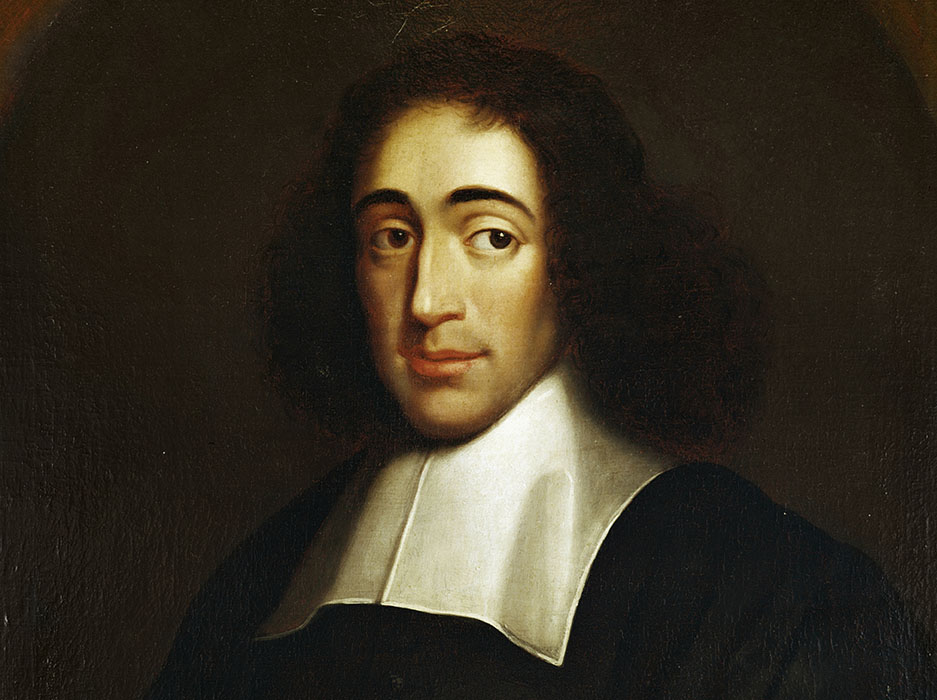
God-intoxicated and Benedicted

The man Novalis called a Gottbetrunkener Mensch,
Spinoza, whose first name means “Blessed,” and in Latin “ Benedicted”,
might not have minded if men called him “Bensch”—-
—- Grace After Meals—-for serving thoughts to which philosophers are frequently addicted.

Like Noah who, while God-intoxicated, reveals a misleading myth
seeming to record slavery, later categorized as a crime,
Baruch Spinoza is still maybe misunderstood by two thirds of his kith,
as are too many of my verses, not in Latin benedicted, but by rhyme.


Gen. 9:24-25 states:
When Noah woke up from his wine and learned what his youngest son had done to him,
he said, “Cursed be Canaan; The lowest of slaves  shall he be to his brothers.”
And he said, “Blessed be YHWH, the God of Shem; Let Canaan be a slave to them.

Bekhor Shor, a twelfth century French Tosafist from Orleans, claimed that Noah’s curse of Ham, an ancestor of Egypt, explains why the Torah refers to Egypt in verses that include the first of the Ten Commandments, Exod.20:2,  as “ a house of slaves.”

On 10/21/25 in a Torah in Motion lecture, Moshe Sokolow pointed out that the root of the Hebrew word for poet, payyetan, is probably the Greek word for poet, and not פטפט, patpat, which Jastrow identified as its root.
I suggested an alternative root for the word in Gen. 9:27, which records Noah’s poetic blessing of Japhet, the son of Noah whom rabbinic literature regards as the ancestor of Greeks:

כז  יַפְתְּ אֱלֹהִים לְיֶפֶת, וְיִשְׁכֹּן בְּאָהֳלֵי-שֵׁם; וִיהִי כְנַעַן, עֶבֶד לָמוֹ.  God enlarge Japheth, and he shall dwell in the tents of Shem; and let Canaan be their servant.

The name of Japhet may provide the world with the Greek word for poetry, deriving two consonants from this name..


Gershon Hepner is a poet who has written over 25,000 poems on subjects ranging from music to literature, politics to Torah. He grew up in England and moved to Los Angeles in 1976. Using his varied interests and experiences, he has authored dozens of papers in medical and academic journals, and authored “Legal Friction: Law, Narrative, and Identity Politics in Biblical Israel.” He can be reached at gershonhepner@gmail.com.

God-intoxicated and Benedicted Read More »

A Moment in Time: “Going Out on a Limb”

Dear all,

Yes, my heart skips a beat (perhaps two) when my kids climb higher—out on the limb. On one hand, I want them to break their limits. On the other, I don’t want them to break their bones.

I suppose every parent feels this—the powerful tension between holding on and letting go.

And while my breath catches in those moments, I know that real growth never happens when we stay on the ground. We have to allow ourselves to be vulnerable—to leave what’s familiar and explore the unknown.

We all want our kids to know that the world opens up when – in that moment in time -we dare to step beyond safety. When we go out on a limb, we don’t just find our balance—we find our strength.

Eventually (after lots of coaxing), they came back down. A scrape here. Schmutz there. My heart found the beat it had skipped …. That is until they discovered an even higher tree down the street.

With love and shalom,

Rabbi Zachary R. Shapiro

A Moment in Time: “Going Out on a Limb” Read More »

Genna Rosenberg: Being a Changemaker, the Toy-Cooking Connection and Matzo Brei

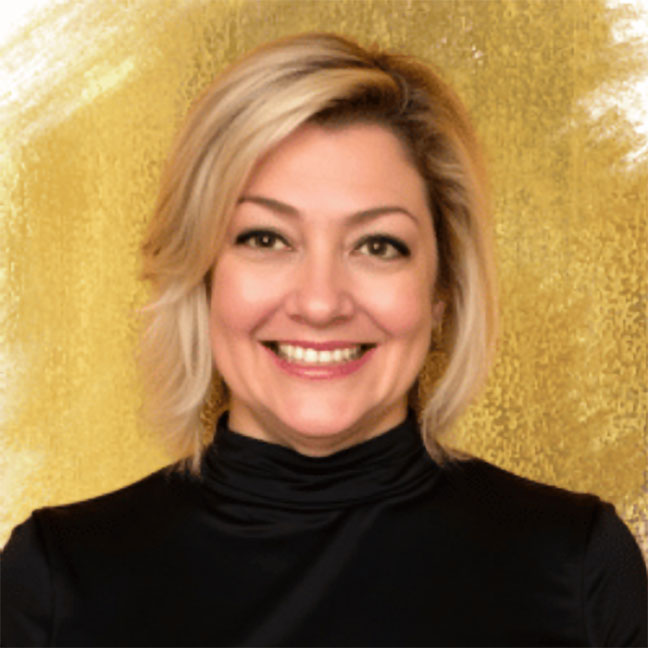
Genna Rosenberg is a 30-year toy, licensing and entertainment industry executive, focused on the intersection of social impact, consumer products and business strategy. She is also a major foodie!

A longtime Angelino transplant from NY, Rosenberg spent a lot of time in the kitchen with her mom and dad, when she was growing up. A more conservative orthodox household, they ate lots of “Jewish” food, during and beyond the holidays.

“My mother said she cooked to provide food for us, but my father used to love to cook and to really create lots of different masterpieces in the kitchen, and I really follow suit with that,” Rosenberg, who has run GennComm for the past 13 years,told the Journal. “I love to explore, I love to create new recipes and bring fabulous dishes to the table.”

Creativity serves her well in the kitchen and as a publicist and changemaker in the toy industry. Last month, Rosenberg was named 2025 Wonder Woman Catalyst for Change by a global empowerment organization: Women in Toys, Licensing & Entertainment.

Rosenberg fell into the toy industry; she was working as a publicist for an agency in the

Pico Robertson, when they started to get a lot of toy and licensing company clients.

“I thought I was gonna go into nonprofit work; I worked at the National Organization for Women in college,” she said. “But once I fell into the toy industry, I learned a different side of philanthropy, which is corporate social responsibility; it really lit me up.”

Big and small companies have opportunities to be more inclusive in hiring, product lines and advertising; break down stereotypes and/or have extra inventory to give to people and companies that need it most. And Rosenberg loves being that conduit.

“When I was a little kid, some of my earliest toys were a play tea set or a pretend kitchen or plastic food,” she said. “Then throughout my career I’ve had a lot of really fun connections with food-based toys.”

For instance, she helped launch the Girl Scout Cookie Oven, based on the Easy Bake Oven, and worked with Duff Goldman, who came out with a Duff Goldman Cake Bakery that helped kids make little fondant cakes.

“When the Cabbage Patch Kids were turning, I think, 35 years old, we had a big birthday party for them at the Toys R Us in Times Square,’ she said.  “And we had Duff Goldman come in and make a huge giant Cabbage Patch Kids cake.”

Rosenberg added, “I will say that [treats from] the Duff Goldman Cake Bakery and even the Girl Scout Cookie Oven, they tasted good.”

The toy industry also has pretend food galore!

“Compounds like Play-Doh [and others] might come with different molds, so that kids can make their pretend cakes or french fries or hamburgers,” she said.

GennComm does inventing, as well, and has six different patents on squishy toys and sensory tactile toys. They create a lot of toys with their licensing partners based on memory foam and plush. One of them is a squeezable that looks like a piece of cake.

In the video, you can see Rosenberg pull out a puzzle she has of 100 Jewish foods.

Cooking is also one of the best ways to be creative, though many people prefer to follow a recipe.

“I might look at a recipe or I might look at three or four or five different recipes for the same thing,” Rosenberg said. “Then I make it up my own way because there’s not really one way to do things.”

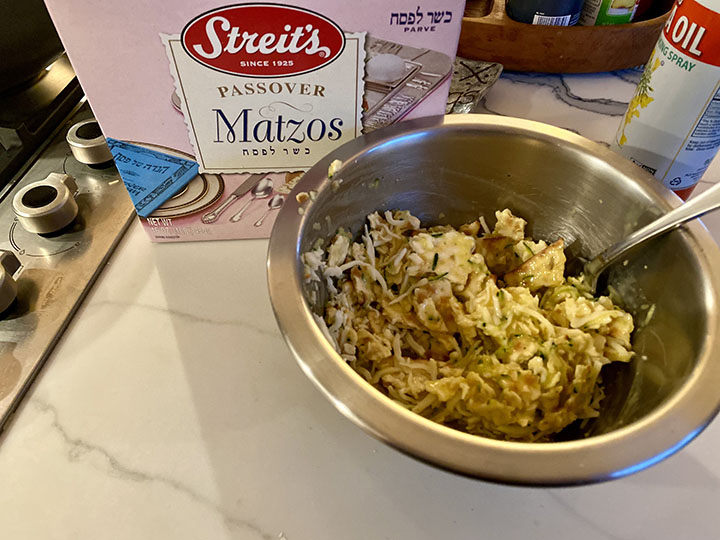
One of her favorite recipes to mix things up with is matzo brei; her recipe is below.

Learn more about Genna Rosenberg at GennComm.com and connect on LinkedIn.

For the full conversation, listen to the podcast:

Watch the interview:

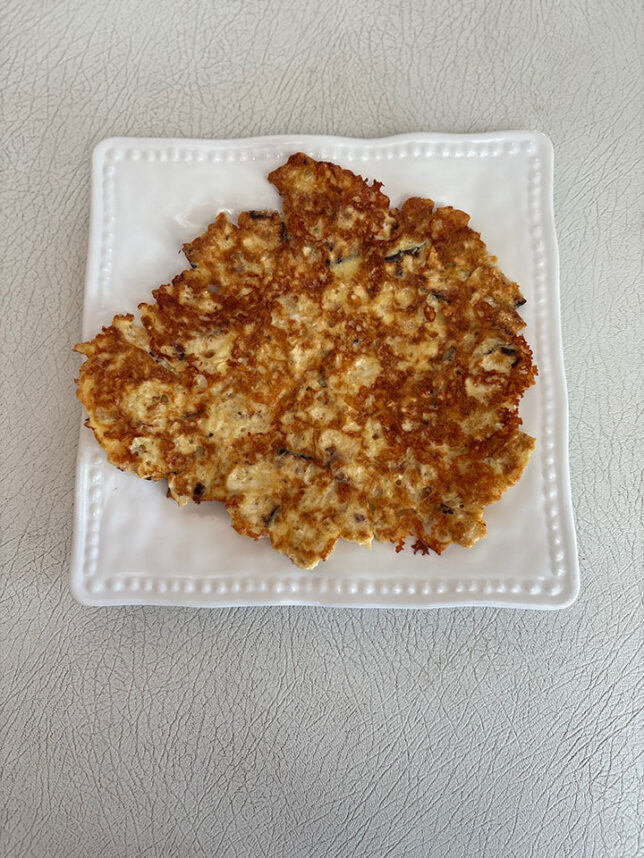
Genna’s Matzo Brei Your Way

1 serving

This recipe is a good base for you to get creative with and can easily be scaled for a crowd.

Ingredients

1 square of matzo

1 eggs (or egg beaters or 2 egg whites)

Butter or margarine, vegetable or olive oil, or even cooking spray

Optional savory: salt and pepper to taste and/or shredded zucchini (or other shredded vegetable)

Optional savory: shredded mozzarella or meat

Optional sweet: cinnamon sugar to taste and/or

Break the matzo into little pieces with a fork or your hands in a bowl, and mix it well with the beaten egg so all the matzoh gets coated. Let it sit for a few minutes to let the matzoh soften.

Add in a little salt and pepper, or you can do that after it’s cooked for flavoring if you’re going for savory, which is how I like it; or you can add a little cinnamon sugar (after it’s cooked) if you like yours sweet. My kids love adding a small handful of shredded mozzarella and shredded zucchini into the batter. It’s a great way to get veggies in and you don’t even taste them!

Cook the Matzo Brie in a frying pan over medium heat (or higher). You can either coat the bottom with a little butter or margarine, vegetable or olive oil, or even cooking spray. I grew up with my grandparents and in-laws using quite a bit of oil and making it more fried on a higher heat, but I usually just use a little olive oil to coat the bottom and it’s enough to get it crispy. Either way, make sure it’s hot enough so the oil doesn’t absorb too quickly into the mixture. Let it cook and set til it’s browned and then flip it. Sometimes if we do it pancake style we’ll move it to a big plate and then carefully flip it (so it doesn’t splatter everywhere). Since I use very little oil, sometimes I may need to add a little more for the flip side to get crispy.

If instead you’re doing it scrambled, start cooking your batter, let it set and start to brown, and then start breaking it up with the spatula and scramble it til all the egg gets cooked throughout.

Note: If you plan to sauté some chopped onion, chopped veggie or meat in it, do that as the first step with a little seasoning, and then when it’s cooked to your liking, add the Matzo Brie batter/mixture and cook as above!


Debra Eckerling is a writer for the Jewish Journal and the host of “Taste Buds with Deb.Subscribe on YouTube or your favorite podcast platform. Email Debra: tastebuds@jewishjournal.com.

Genna Rosenberg: Being a Changemaker, the Toy-Cooking Connection and Matzo Brei Read More »

Print Issue: From Pulp Fiction to Oct. 7 | October 24, 2025

CLICK HERE FOR FULLSCREEN VERSION

Print Issue: From Pulp Fiction to Oct. 7 | October 24, 2025 Read More »