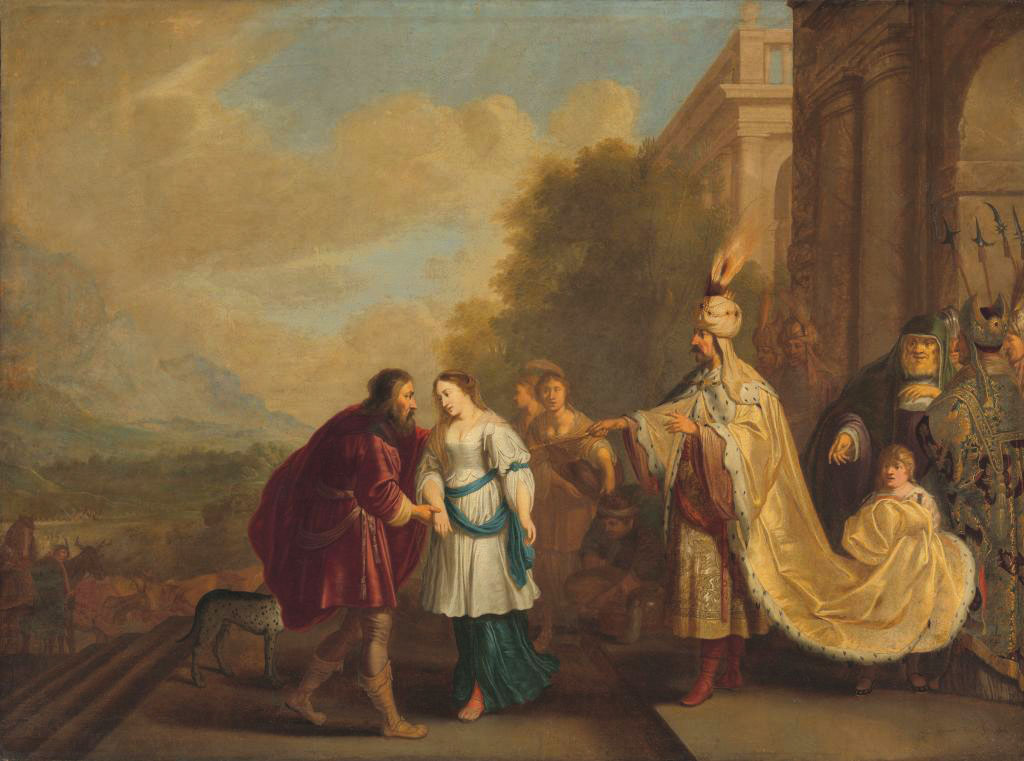
This week’s Torah portion contains a story that most of us skipped in Hebrew school — the story of Dina.
Dina goes out to “see the daughters of the land.”
Shechem,
the eponymous local prince, sees her, sleeps with her and vaye’aneha — sexually forces or humiliates her.
His soul clings to her, he loves her, and he speaks tenderly to her.
This begins a protracted negotiation, in which Jacob remains silent and his sons, Dina’s brothers, maintain their outrage.
Shechem invites Jacob and the brothers to name any amount for a bride price.
The brothers answer with guile, seeming to accept Shechem’s proposal with the proviso that he and all his male subjects undergo circumcision to become “one people” with the Israelites.
Three days after all the males of Shechem are circumcised, while they are still in pain, Simon and Levi, two of Dina’s full brothers, enter the city, confident. They kill all the men and remove Dina from the house.
Jacob’s sons appropriate the property of the slain and take the women captive. Jacob objects: “You have stirred up trouble …[with my neighbors] while I am few in number, so if they band together against me and attack me, I and my house will be destroyed.”
The sons answer: “Shall our sister be dealt with like a whore?”
The story raises many questions, particularly from Dina’s perspective.
Did she learn of her impending marriage? If so, from whom? What was it like for her in the three or four days after the rape and before the “rescue”?
How did she feel when her brothers stormed in, killing the men and taking the women who were to be her new family? Was this similar to the way she had been taken captive? What was she looking for when she “went out to see the daughters of the land”? Had she and the local women already forged the kind of friendship and alliance that the men were negotiating for?
Or could Dina have been a spy against the women? (“To see” and “to spy on” are the same verb in Hebrew.) Can we imagine her as a Mata Hari figure, conspiring with her brothers to conquer Shechem? Or did Dina’s soul cleave to Shechem’s as improbably and enduringly as his cleaved to hers?
The Torah focuses on the men’s motivations, yet these, too, are far from clear. Jacob’s political objection to his sons’ actions ignores the harm to Dina, the sons’ deception and violence, and the murder of innocents. Is Jacob cautiously protecting the clan after a traumatic loss, or has he ceded control and leadership? Is he indifferent to his daughter’s suffering, or so distraught that he becomes passive?
Are the brothers overzealous defenders of their sister’s honor (perhaps in response to Jacob’s passivity) and/or do they see an opportunity for a land grab?
On his deathbed, Jacob will condemn Simon and Levi’s excesses and bar the two tribes from owning land (Genesis 49:5-7). Is the crime that most troubles the brothers rape — or theft? The males of Dina’s family should have commanded a bride price for her in advance, and the brothers seem more interested in orchestrating revenge than in facilitating Dina’s release.
Is Shechem a rapist? It is certainly not typical of a rapist to love his victim, want to marry her, offer to pay any amount of money and undergo genital surgery to be with her. Shechem more than fulfills all the requirements later imposed on Israelites (Deuteronomy 22:28-29) who bed an unbetrothed girl without gaining permission first.
Perhaps Shechem, prince of the land, thought that Dina, visiting among the daughters of the land, was one of his subjects, and therefore legal and eligible to him.
Long before Anita Diamant’s “The Red Tent,” the ancient rabbis wondered if Dina chose — before or after the fact — to be with Shechem.
One midrash suggests that Dina was enticed by his uncircumcised body, and had to be removed from his house because she would not leave voluntarily.
Other midrashim don’t attribute sexual volition to Dina, but posit instead her extraordinary spiritual power: she would have caused Esau to repent had she been paired with him; she was Job’s second wife and healed him. Dina was indeed raped, but she inspired a rapist to repent immediately and completely.
The verb vaye’aneha — usually translated as “he raped her” — comes from the root ayin-nun-hey, which has two meanings: to answer or respond; or to force, afflict or humiliate, especially sexually.
Translating according to the first definition, it is possible to read vaye’aneha as parallel to vayidaber al lev hane’ara, he spoke to the girl tenderly (Genesis 34:2-3). This supports the interpretation that Shechem seduced Dina, rather than raped her. Similarly, it is possible to reverse the usual translation in 34:13: the brothers didn’t just answer Shechem with guile, they afflicted him with it.
It surprises me how confident people sometimes are about exactly what the Bible intends. What is meant, literally and in context, by “frontlets between your eyes” or “a man lying with a man as with a woman” or even “your neighbor?”
The Bible is laconic, allusive, ambiguous, layered.
It is not always clear to me, after years of study, which stories are cautionary tales and which are examples to be emulated.
Torah urges us: read again, review again, and don’t be so sure.
Approach with holy doubt, and humility.
Rabbi Debra Orenstein, editor of “Lifecycles 2: Jewish Women on Biblical Themes in Contemporary Life,” is spiritual leader of Makom Ohr Shalom in Tarzana. More of her writings can be found at makom.org.