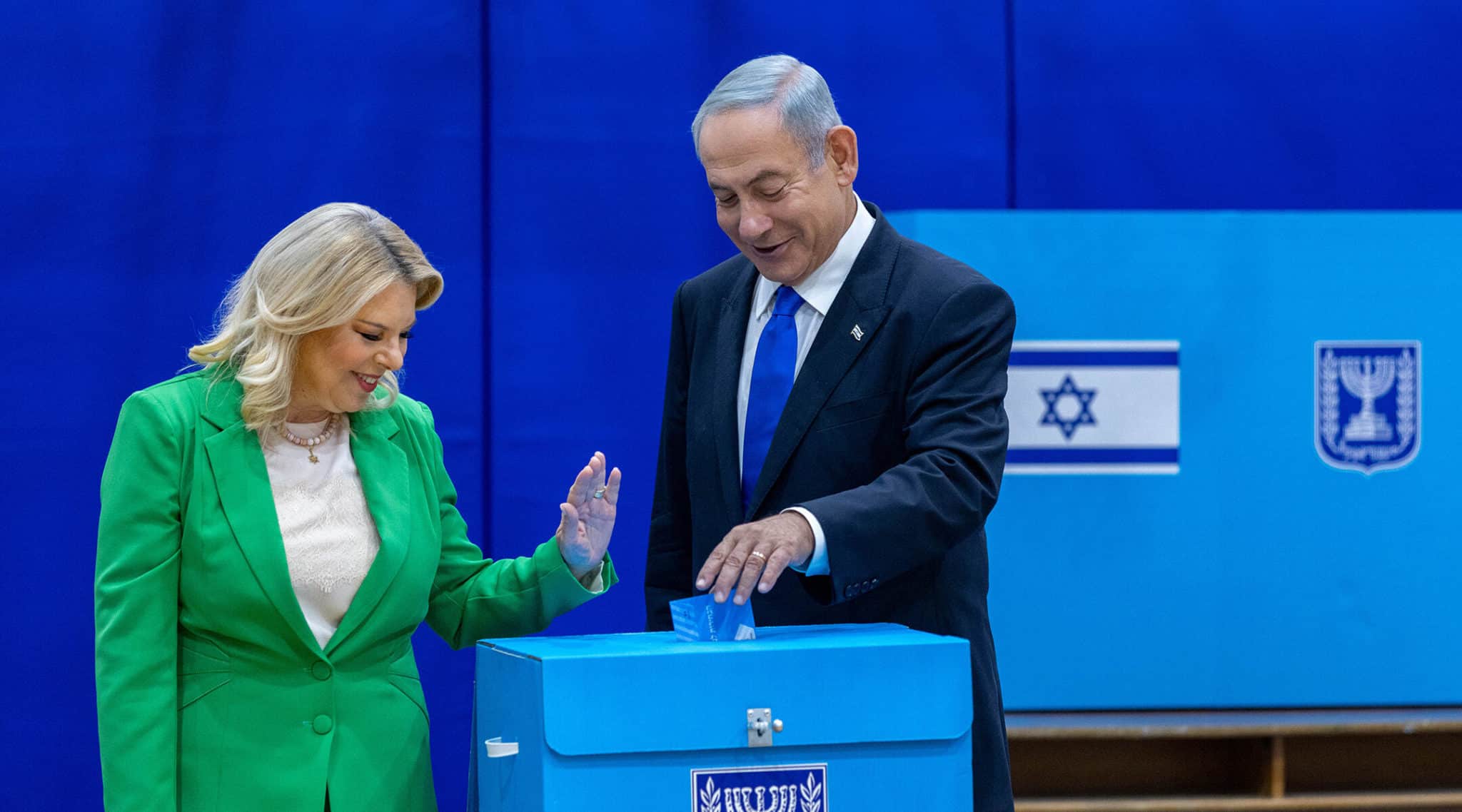
(JTA) — According to exit polls, Benjamin Netanyahu looks to have eked out a victory in Israel’s election on Tuesday, with a projected bloc of 61-62 seats, at or just above the 61 needed to form a majority in a 120-seat parliament.
Those polls, taken at voting stations by local broadcasters and released at 10 p.m. Israel time, have been known to be skewed compared to the final vote tally. Votes will likely be tallied through Tuesday night.
What is clear is that the Religious Zionism slate, a partnership between far-right lawmakers Itamar Ben-Gvir and Bezalel Smotrich, has garnered well over 10 seats, and potentially more than the 13-14 seats that pre-election polls had indicated. The Channel 13 exit poll has them earning 14 seats, while the Kan public broadcaster’s poll has them at 15.
Current Prime Minister Yair Lapid’s party, Yesh Atid, looks to have won between 22 and 24 seats, if the exit polls hold true, while Netanyahu’s Likud party looks to have earned 30-31.
“I ask to wait for the real results,” Meir Cohen, a senior member of Yesh Atid, told the Channel 12 news, according to the Times of Israel.
Netanyahu’s partnership with the Religious Zionism slate has boosted their standing — Ben-Gvir looks primed for a cabinet position, should Netanyahu’s planned coalition come to fruition — and worried Jewish leaders throughout the Diaspora. Ben-Gvir’s party, Jewish Power (Otzma Yehudit), had just barely squeaked into the Knesset, or parliament, in the last election in 2021, earning one seat. Ben-Gvir has unsettled American Jewish officials with his anti-Arab, anti-LGBTQ and other inflammatory rhetoric.
The early results show the highest voter turnout rate since 1999, at over 66%.
If the preliminary results hold, the outcome would mean a swift comeback for Netanyahu, who has only been out of the prime minister’s office 16 months. He would likely be given the first shot at forming a coalition of parties, with 45 days to do so by law. In addition to the Religious Zionism parties, Netanyahu’s coalition would include multiple other haredi Orthodox parties.
Both Lapid and Benny Gantz, the defense minister whose National Unity slate is earning 12-13 seats in exit polls, are holding out hope that Netanyahu’s bloc earns 60 or fewer seats, which could give either of them an opening to form their own coalition.