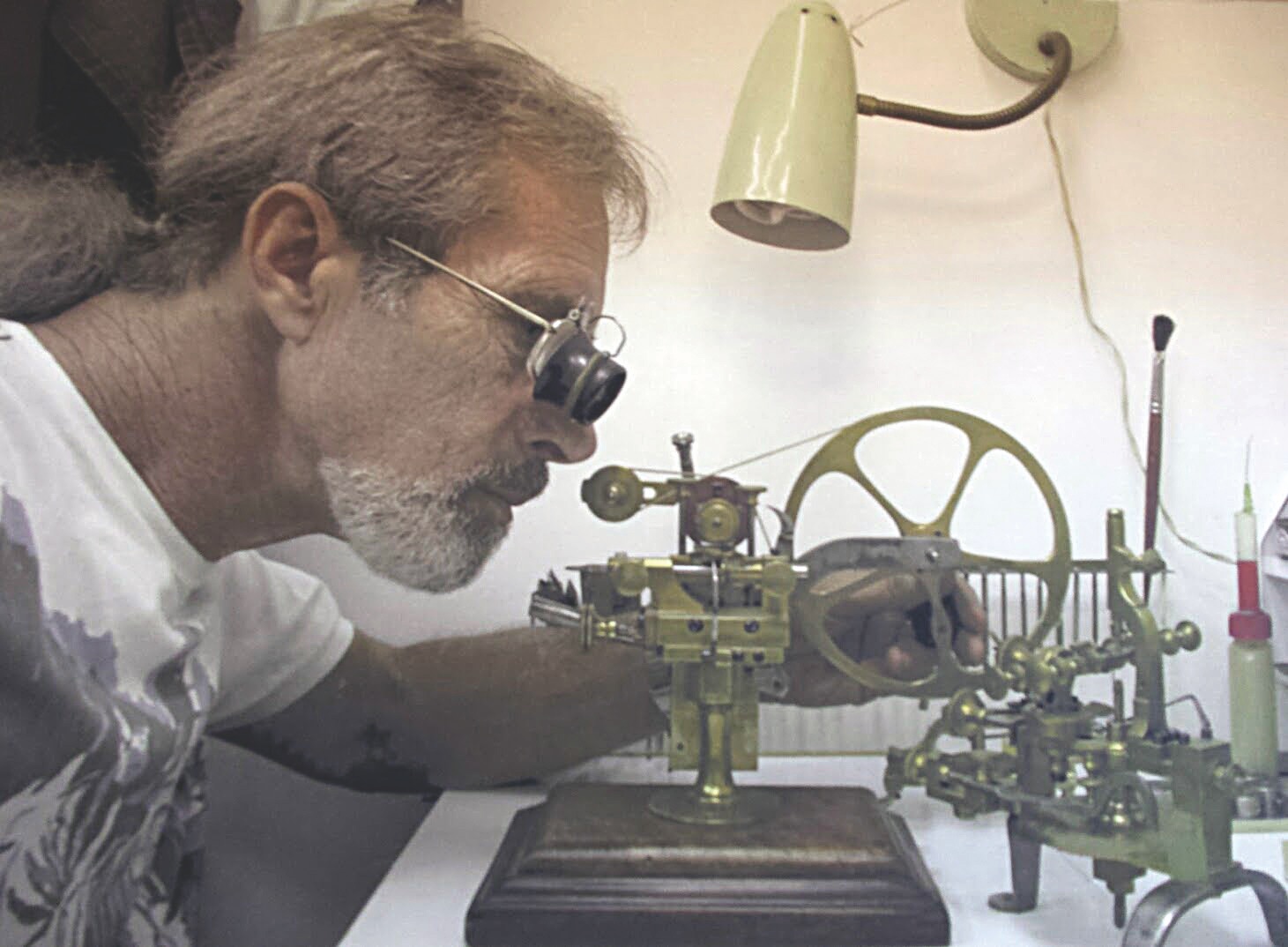
Boris Sankov holds court behind a heavily armed steel door, tucked away in a corner of the L.A. Mayer Museum of Islamic Arts in Jerusalem, where he is responsible for repairing and maintaining the museum’s vast collection of watches.
Sankov, 77, his silver-gray hair pulled back in a tight ponytail, is delighted to show off his workshop, filled with dozens of lathes and small mechanical devices. He speaks deliberately, in heavily-accented Hebrew, with Russian words thrown in.
“Did you ever see a young watchmaker?” he asks proudly, not waiting for an answer. “No one does this kind of work anymore. It’s too demanding, and you really can’t make any money. But these watches here are special.”
In addition to its collection of Islamic art, the museum is also home to one of the world’s most spectacular collections of rare watches, clocks and music boxes, most from the 18th and 19th centuries. The collection includes 55 timepieces that were made by the famous Parisian watchmaker Abraham-Louis Breguet (1747-1823).
The value of the collection is hundreds of millions of dollars. About half of the watches are on display next door, in a temperature-regulated, darkened hall, protected by state-of-the-art security systems.
“Did you ever see a young watchmaker? No one does this kind of work anymore.” — Boris Sankov
“I am the only one who is allowed to handle and wind the watches,” Sankov says. That includes the Marie Antoinette watch, valued at about $30 million.
The collection, which once belonged to David Lionel Salomons (1851-1925), the first Jewish Lord Mayor of London, was stolen in 1983 by Na’aman Diller, a notorious Israeli international antiquities thief. The collection was discovered 25 years later and nine of the 106 watches were returned. Some of the pieces were rusted or their mechanisms had been warped by humidity. Worse, Diller had dismantled most of the watches and stored their intricate, precious parts in medicine bottles, shoe boxes and other unlikely places and then scattered them across the world.
“That’s when the museum called on me,” Sankov says. “They had heard of my reputation.
“OK, I’m a schvitzer, a showoff. I know that. Look at what I have done here. These watches were made by hand hundreds of years ago, and the tools to fix them and the parts we need don’t exist anymore. So I make my own lathes, my own springs. I invent machines.”
Sankov grew up in the Soviet Union. His grandfather had been a watchmaker, his father a jeweler and his mother a doctor. “Ach, we were once a big family — my mother had eight brothers and sisters. But the war and the Nazis took them all.”
He and his immediate family survived by going into hiding. After the war, the family settled in Ukraine. His mother had been Jewish, but Sankov was not raised as a Jew and did not even know he was Jewish. He had heard anti-Semitic comments but didn’t know they were about him until one day he overheard people talking about him.
In 1972, he left for Israel. “I hated the goyim and they hated me, so it was time to go.”
In Israel, he became a gym teacher and fixed watches on the side. But it became difficult to find parts for the older watches. And, he says, few people care.
“I once fixed a clock owned by Haim Nahman Bialik [a famous Hebrew language poet]. It plays “Hatikvah” every hour. Who cares about watches and clocks anymore?” he continues. “Now, everything is automatic. It’s annoying, but, nu, what can you do? The world moves on. Actually,” he smiles, “I don’t wear a watch anymore, either. I just look at my smartphone.”
Eetta Prince-Gibson is editor-in-chief of the Israeli-based Jerusalem Report.