
fbpx

March 14, 2018

Jewish Actor Joshua Rush Plays Disney Channel’s First Gay, Jewish Teen

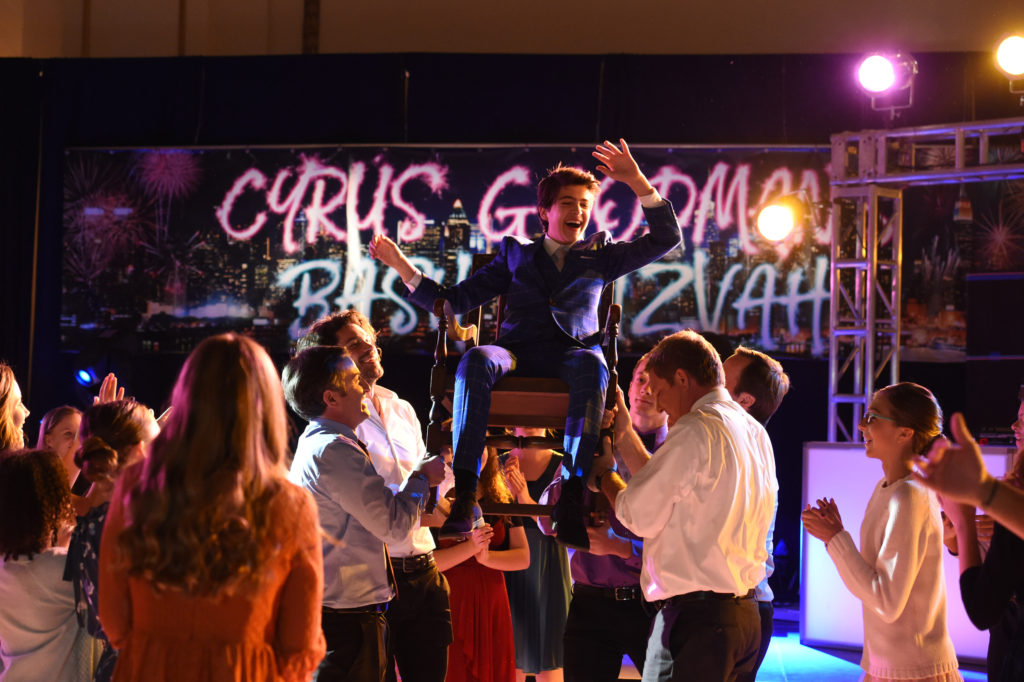
The kid-friendly Disney Channel series “Andi Mack” made history last October, when the character Cyrus Goodman revealed that he’s gay. In the show’s latest episode, Cyrus marks another significant event: his bar mitzvah.

Reciting part of his own torah portion that he’d relearned and wearing the tallit—a gift from his grandparents—that he wore at his real-life bar mitzvah, actor Joshua Rush celebrates Disney Channel’s first Jewish rite of passage.

“There are a lot of kids who have never been to a bar mitzvah and to them it’s shrouded in mystery,” Rush told the Journal. “Now they can watch it and understand our culture a little bit.”

To prepare for the scene, Rush worked with the rabbi at Congregation Kol Ami in Salt Lake City, where “Andi Mack” is filmed. Although it was his idea to use his own haftorah, which was about the commandment of Shabbat, “I definitely needed a refresher,” he said.

He did well enough to get the thumbs up from his Los Angeles synagogue’s rabbi, who sent him a congratulatory note after the episode’s premiere. But he didn’t completely pass muster with an Israeli cousin who pointed out an incorrectly pronounced vowel in the reading.

“There are a lot of kids who have never been to a bar mitzvah and to them it’s shrouded in mystery. Now they can watch it and understand our culture a little bit.”

While an extravagant party with a carnival theme follows Cyrus’ ceremony, Rush had small bar mitzvah at Kibbutz Gezer in Israel, streamed live on the Internet so friends at home could see it. While preparing for it, he “really felt connected to my Judaism in a lot of different ways,” he said. “It’s become a much more important part of my life since then.”

Born in Houston, Tex., Rush was raised in a Reform Jewish family with roots in Poland and Lithuania. His mother, a corporate video producer, and father, and artist and therapist, told him, “Being Jewish is part of our identity and it can be part of your identity if you want it to be,” he said.

Rush is currently learning conversational Hebrew and will soon make his fifth trip to Israel. His maternal grandfather was born there and he has relatives all over the country. “I love the Dead Sea and walking around the markets in Jerusalem’s Old City,” he said. “There’s so much history on every street, in every cobblestone.”

As a Jew, he’s proud to portray that part of Cyrus, and feels “empowered” to represent the gay aspect of the character. “He’s got so much depth to him, and he’s not afraid to be who he is,” Rush said. “‘Andi Mack’ has such a great message about loving yourself, loving your family and being loyal to your friends. I want to see Cyrus keep asking hard questions and figuring out who he is over the rest of this season and in season three.”

He pays no attention to the few people who’ve made negative comments about Cyrus because the response from young fans and parents has been overwhelmingly positive. One mother thanked him “for everything you’ve been doing with this character. If some of my friends had had that character [as a role model] when they were growing up, they would have been a lot better off,” she told him.

Rush, now 16, began his career as a baby model at 10 months old, and relocated to L.A. with his parents 10 years ago to pursue acting roles. He’s not sure what lies ahead for him, but he plans to attend college, likely to study political science. He stars in a self-produced current affairs series on Instagram called “News in a Rush.” “His next minute-long episode will cover the Israel-Palestine conflict.

Might a career in politics be in his future?  “[Show] business is fickle, so who knows,” he said. “I’ll take it as it comes and live every day for the moment.”

“Cyrus’ Bash Mitzvah!” is airing through March and April on Disney Channel and its digital platforms.

Jewish Actor Joshua Rush Plays Disney Channel’s First Gay, Jewish Teen Read More »
What Wisdom Do We Gain With Age?

Our society preaches that youth is something to be glorified. Just look at the advertisements we are flooded with. Ever see a middle-aged person in any? Unless it’s an ad for an anti-aging cream?

From the best-selling memoir “Tuesdays With Morrie” by Mitch Albom:

“All this emphasis on youth — I don’t buy it. … Listen, I know what a misery being young can be. So don’t tell me it’s so great. All these kids who came to me with their struggles, their strife, their feelings of inadequacy, their sense that life was miserable, so bad they wanted to kill themselves. … And in addition to all the miseries, the young are not wise. They have very little understanding about life. Who wants to live every day when you don’t know what’s going on?

“Mitch, I embrace aging. … As you grow, you learn more. If you stayed at 22, you’d always be as ignorant as you were at 22. Aging is not just decay, you know. It’s growth. It’s more than the negative that you’re going to die, it’s also the positive that you understand you’re going to die, and that you live a better life because of it.”

The Torah tells us to appreciate and respect elders: “You should rise before the elderly and honor the aged.”

The Hebrew word for elderly is zaken, an acronym for zeh shekaneh chachma — a person who has acquired wisdom. The Talmud states that the respect we owe the aged applies to Torah scholars and non-Torah scholars, Jews and non-Jews.

As physical forces abate, that which is distinctively human about us, our soul, becomes the influential drive in our lives.

What is the rationale for this respect?

In 1998, we gave great glory to then-77-year-old John Glenn, who in 1962 became the first American to orbit Earth, for repeating his flight into space; he was a member of the space shuttle Discovery’s crew. We all marveled then at the former senator from Ohio’s physical condition and bestowed upon him Western society’s highest accolade: His body still functioned like a much younger man’s.

The Torah has the exact opposite vision when it comes to respect for elders.

The Maharal explains that the respect we pay to age is specifically because the physical forces are no longer what they once were.

In youth, the body’s physicality tends to control a person. We are prey to hedonistic urges and impulses. As those physical forces abate, that which is distinctively human about us, our soul, becomes the influential drive in our lives.

Our divinely given intelligence gains control over our base instincts.

This is the wisdom we attain in old age, and why the Torah commands us to rise in respect for the elderly.

The Chasidic Rebbe of Ger made it a practice to regularly visit older people, even those who were not known for their great sage insight or devoutness. Like many people, he would often go to nursing homes.

But above and beyond the kindness involved, he had an additional intention when doing so:

“They barely have bodies left,” he said. “Their physical yearnings have long been abandoned. When I look at them, I see pure souls. And there is nothing more inspiring than spending time with pure souls!”

To appreciate the aging process, one has to live more wisely while still young.

Again, from “Tuesdays With Morrie”:

“People who are always saying, ‘I wish I were young again’ reflect unsatisfied lives. Unfulfilled lives. Lives that haven’t found any meaning. Because if you’ve found meaning in your life, you don’t want to go back. You want to go forward. You want to see more, do more.”

As the Talmud states, “For hedonistic people, the more they age, the more their minds wane. But for Torah scholars, the more they age, the more their minds become sharpened.

“Watch your thoughts. Thoughts become words, words become actions, actions become habits, and habits become who you are.”

If we don’t create good habits when we are young, if we don’t train ourselves to value wisdom when we are youthful and vigorous, if we live unsatisfied, unfulfilled lives, we significantly reduce our chances to make the most of wisdom during
old age.

By living meaningfully and wisely now, we will enhance and sharpen our life’s purpose as senior citizens.


Rabbi Boruch Leff writes at aish.com.

What Wisdom Do We Gain With Age? Read More »

As We Grow Older, Randomness Increases

This is a difficult time.

Again we seem to be challenged by events that we didn’t plan for or expect.

We have been dealt cards that change the way we see things.

Let me be honest: Some of this is very personal. It is also cumulative. I am not thinking only of the shooting in Parkland, Fla., and the horror of what families must face.

I also am thinking personally, because just a few days ago, I had to help bury another close friend.

In many of the talks and sessions associated with Jewish Sacred Aging, an online forum for the Jewish community, we look at what we call the “R” factor of life. This refers to the randomness of our lives.

We may be able to control many things in life, yet there is always that randomness factor that we don’t expect.

The impact of this, I am convinced, becomes more powerful as we get older. I think that is because we are more aware of time and the limitations that this reality places on us.

We may be able to control many things in life, yet there is always that randomness factor that we don’t expect, such as an unexpected phone call that brings news that changes things, or a random act that we never prepare for that changes lives.

How we react to these random events does determine the type pf person we become. Of that I am convinced.

Yet, there is no paradigm. Each of us is unique. Each of us reacts to these random events in our own way, based on our history. Some people may retreat into a shell, cut themselves off from life. Some may use the event to spark activism or chart a new life course.

The unknown and eternal question is, of course, “Why”?

This is the religious question.

Science and the news can explain how an event took place. The religious mind asks why.

After we know how, we immediately seek to know why. That is the hardest thing to do. Indeed, for many, until we know why, there may be little closure or comfort.

We are overwhelmed by clichés that seek to find why an event took place.

They are nice. In some measure, they bring comfort. I understand, or at least am trying to understand, that in the end, each of us must find our own answer to why.

I do know — and this is frightening — that as we get older, the randomness factor of life becomes more present; the reality that we cannot control it becomes more of a concern.

Our tradition, knowing all of this, still opts for life.

It always remains true to the overriding value of celebrating the life you have been given — and celebrating each day.

We are reminded of that by saying the “Modeh ani lifanecha” (I give thanks to you) prayer as soon as we wake up.

In the end, maybe that is all we can do, to give thanks that we have another day of life, to not let that gift be for nothing, and to remember in life and in deed those who are no longer physically here.

I know all of this, but yet …


Founder and director of jewishsacredaging.com, Rabbi Richard F. Address served for more than three decades on the staff of the Union for Reform Judaism. He began his career in Los Angeles in 1972.


As We Grow Older, Randomness Increases Read More »

DNA May Unlock Secrets of ‘SuperAgers’

Editor’s Note: Irving Kahn died at the age of 109.

It helps that Irving Kahn is wealthy enough to have full-time attendants. Also, perhaps, that he has always been a “low liver,” without flamboyant tastes, as his brown, pointy-collared shirt and brown-patterned tie attest. He goes to bed at 8 p.m., gets up at 7 a.m., takes vitamins because his attendants tell him to. (However, he drew the line at Lipitor, a statin that reduces cholesterol, when a doctor suggested it a few years back.) He wastes few gestures; as we speak, his hands remain elegantly folded on his desk.

Still, a man who at 105 never has had a life-threatening disease, who takes no cholesterol- or blood pressure-lowering medications and can give himself a clean shave each morning (not to mention a “serious sponge bath with vigorous rubbing all around”), invites certain questions.

Is there something about his habits that predisposed a long and healthy life? (He smoked for years.) Is there something about his attitude? (He thinks maybe.) Is there something about his genes? (He thinks not.) Here, he cuts me off.

A man who at 105 never has had a life-threatening disease, who takes no cholesterol- or blood pressure-lowering medications and can give himself a clean shave each morning, invites certain questions.

He is not interested in his longevity.

But scientists are. A boom in centenarians is just around the demographic bend.

The National Institute on Aging predicts their number will grow from the 37,000 counted in 1990 to as many as 4.2 million by 2050. Pharmaceutical companies and the National Institutes of Health are throwing money into longevity research.

Major medical centers have built programs to satisfy the demand for data and, eventually, drugs. Kahn agreed to have his blood drawn and answer questions for the granddaddy of these studies, the Longevity Genes Project at Albert Einstein College of Medicine in the Bronx.

The project seeks to determine whether people who live healthily into their 10th or 11th decade have something in common. If so, can it be made available to everyone else?

What have the researchers learned? Not what Kahn wanted to know, which was only whether those who live longer have higher earning power. For the rest, like how he got involved in the Einstein study, he says, “You’ll have to ask my sister.”

His older sister.

“Oy,” Sophie says.

“Oy vey,” Esther says.

“Oy veyizmir,” Sadie says.

“I thought we weren’t going to talk about our children,” Mildred says.

Early in the 20th century, Saul and Mamie Kahn — the electric-fixture salesman and his clever wife — had four children, two girls (Helen and Leonore), then two boys (Irving and Peter).

When Helen turned 100, they were thought to be the oldest quartet of siblings in the world. Helen’s sassy tongue and taste for Budweiser made her a minor celebrity on geriatric-related websites. Four years later, upon turning 100, Irving rang the bell at the New York Stock Exchange. (Like her brother Irving, Helen died at 109.)

But the family’s DNA may be even more celebrated. All four have participated in Einstein’s longevity research, begun by Dr. Nir Barzilai in 1998. For these studies, Barzilai has assembled a cohort of 540 people older than 95. Like the Kahns, all reached that milestone having never experienced the so-called big four: Cardiovascular disease, cancer, diabetes and cognitive decline.

He theorized that these “SuperAgers,” as he calls them, must have something that protects them from all four conditions.

Otherwise, when they didn’t have a heart attack, say, at 78, they’d have succumbed quickly to the next thing on their body’s inscrutable list. Instead of looking, as most genetic studies do, for pieces of DNA that correlate with the likelihood of getting diseases, Barzilai looked for the opposite: genes that correlate with the likelihood of not getting them — and thus with longevity.

The top correlate for longevity is one that requires no blood test to discover: having a SuperAger in your family already. (Although Mamie died at 64, Saul lived to 88, exceptionally long for a man born in 1876.)

But the results at the DNA level are nearly as strong. Barzilai identified, or corroborated, at least seven associative markers. The most significant is the Cholesterol Ester Transfer Protein gene, or CETP, which in one unusual form correlates with slower memory decline, lower risk for dementia, and strongly increased protection against heart disease.

Among other things, it increases the amount and size of “good” cholesterol. Only about 9 percent of control subjects have two copies (one from each parent) of the protective form of CETP, while 24 percent of the centenarians did, including all four Kahn siblings.

Other markers found more frequently among the SuperAgers include a variant of the APOE gene that protects against atherosclerosis and Alzheimer’s, a variant of the FOXO3A gene that protects against tumor formation and leukemia, and a variant of the APOC3 gene that protects against cardiovascular disease and diabetes. (This variant alone has been associated with an average life extension of four years.) Having long telomeres — regions at the ends of chromosomes that shorten as you age — is another kind of marker, acting as an instant-read longevity thermometer. There’s evidence, as well, that small stature among the SuperAgers (Irving was 5 foot 2) may reflect the influence of a protective factor seen throughout nature: Ponies live longer than horses.

This story originated at nymag.com.

DNA May Unlock Secrets of ‘SuperAgers’ Read More »

Why and How Elderly Are Our Obligation

In the Jewish tradition, there is a mitzvah from the Torah to honor the elderly.

Rashi writes that this mitzvah applies not only to wise elders but applies equally to the ignorant. The rabbis suggest that although many elderly may have forgotten much of their wisdom in their later years, this does not diminish their value:

“Be mindful of the elderly person who has forgotten his teaching for reasons that are not his fault, as it is said that the broken tablets rested with the tablets in the ark.”

Rambam states that we must honor the elderly as incontrovertible law, even if we do not consider them wise.

The rabbis believed that the elderly necessarily had wisdom that we could all learn from.

Rabbi Yose bar Yehudah of Kfar HaBavli says: “One who learns Torah from the young, to what can he be likened? To one who eats unripe grapes or drinks unfermented wine from his vat. But one who learns Torah from the old, to what can he be likened? To one who eats ripe grapes or drinks aged wine.”

We should consider deeply who we are attaining our wisdom from and how we are balancing out our perspectives. In addition to learning from the aged, the rabbis are clear that we must actively engage and support the elderly. Wise or not, this is a vulnerable population that is to be taken care of.

Sadly, in the United States today, the elderly are often neglected. Shocking statistics reveal some of the economic challenges that seniors face.

Government sources estimate hundreds of thousands suffer from abuse or neglect annually.

From 2011 to 2012, the rate of extreme poverty rose by a statistically significant amount among those 65 and older, meaning that a growing number of them were living at or below 50 percent of the poverty line. In 2012, this was $11,011 a year for an older person living alone.

The elderly are unfortunate victims of a perception based on statistics instead of reality.

Obviously, in many cities, the demands of monthly rent alone exceeds that of an annual income, even for those above the poverty line. Thus, using statistics, it appeared that in 2006 (before the recession), fewer than 1 in 10 of the elderly lived in poverty. However, more than 22 percent lived below the 150 percent poverty level (then about $13,000 a year). Even more pertinent to seniors, there are health care costs not factored in to poverty statistics. Taking these costs into consideration, even in a comparatively generous area (New York City), this more realistic poverty rate for the elderly would be 32 percent as of 2006. We must not be slaves to statistics, but should really see and understand the conditions that many of our nation’s seniors are forced to cope with in their later years.

Many of those struggling have suffered from long-term unemployment, debts, insufficient savings and inadequate Social Security support and retirement savings. This all is exacerbated by the consistent increased costs of living.

Furthermore, there are serious health risks that seniors face as they age.

Injuries and resultant fractures are responsible for thousands of serious injuries, disabilities and even deaths every year. The combination of decreased bone-mineral density and failing vision can lead to a tendency to fall.

Falls lead to bone fractures. Hip fractures are especially dreaded. They lead to disability and the necessity for institutional care.

Increased urgency for urination (often caused by diuretics and prescription
medications) can also lead to falls, as the elderly rush to get to a bathroom before they have an accident.

Health risks such as presbyopia (the inability to see near objects) and other visual problems such as macular degeneration or diabetic retinopathy make seeing and avoiding obstacles increasingly difficult.

The inability to reach one’s feet is a serious problem. Feet are vulnerable to infection. Diabetics may be at risk of losing their feet if an infection is unattended.

Something as simple as trimming one’s toenails becomes virtually impossible, or fraught with the risk of cuts and infections.

Unfortunately, the growing elderly population faces yet another threat from abuse and neglect.

As people live longer, the quality of life does not necessarily increase.

Alzheimer’s disease, dementia, Parkinson’s and other disabling conditions prevent the elderly from taking care of themselves.

Caregivers are put under tremendous strain, as their relatives/patients deal with their symptoms.

Between a greatly increased workload and their frustration, caregivers can commit abuse or neglect — physical beatings, sexual assault, allowing patients to develop bedsores by not turning them over periodically, not giving them medication in a timely fashion, or failing to clean their urine and excrement.

Government sources estimate hundreds of thousands suffer from abuse or neglect annually. No wonder elderly people diligently try to avoid going to an assisted-care facility.

We can do our part by removing throw rugs and excessive furniture, making sure that doctors regularly visit patients and that bedridden patients regularly are bathed and turned so that they do not develop bedsores.

We can ensure that Social Security is bolstered, not weakened as an entitlement. Workers pay during their careers into the fund, so they are merely receiving what they are eligible for. Since more than half of all American workers have no private pension plan, one-third have no retirement savings, and by 2033, there will be more than 77 million elderly people, society’s need to provide resources for the elderly will become even more critical.

Of the numerous ways to honor seniors, they should not merely be symbolic. We can find more ways to help in a hands-on way, to advocate for their needs in society. The great Rebbe Nachman of Breslov wrote, “Gauge a country’s prosperity by the treatment of its elders.”

This story originally appeared in The Times of Israel.


Rabbi Shmuly Yanklowitz is the author of “Jewish Ethics & Social Justice: A Guide for the 21st Century.”

Why and How Elderly Are Our Obligation Read More »

A Call to Action in Age of Trump

Let’s start by deciphering the strange punctuation that appears in the title of “(((Semitism))): Being Jewish in America in the Age of Trump” by Jonathan Weisman (St. Martin’s Press), the Washington bureau deputy editor of The New York Times. As Weisman explains, those six parentheses are a weapon of the Jew-haters who have always been with us but only recently crawled out from under their rocks.

On May 18, 2016, Weisman posted a comment on Twitter about an article he had read in The Washington Post. “Within minutes, I received a response with punctuation I had never seen before,” he explains. “Hello (((Weisman)))” wrote someone who called himself “CyberTrump.”

Weisman suspected that the “those triple parentheses must somehow denote my Jewish faith,” and he wrote back: “Care to explain?” CyberTrump responded: “What, ho, the vaunted Ashkenazi intelligence, hahaha! It’s a dog whistle, fool. Belling the cat for my fellow goyim.”

Thus did Weisman stumble across “what is known in the alt-right as ‘echoes,’ those three parentheses that practitioners of online harassment wrapped around Jewish-sounding names on social media.” A cunning plug-in device invented and used by online Jew-hunters enables them to search the internet for names of individuals that appear between triple parentheses and then launch a cyberattack against them. Weisman himself received more than 2,000 hate messages that used Nazi iconography, Holocaust denial and various anti-Semitic tropes: “the Jew as conservative fifth columnist, the Jew as moneybags financier orchestrating war for Israel, the Jew as leftist anarchist, the Jew as Wall Street profiteer, the Jew as weak and sniveling, the Jew as all-powerful.”

Weisman has drilled down into the subterranean world that he had detected, and his book explains how it reveals the existence — and the new prominence — of an anti-Semitic subculture in America. “Until the rise of Trumpism, Judaism was easy, not just for me but for millions of American Jews,” he writes. “Anti-Semitism was in the past. The ‘Jewish Question’ was little worth mentioning. And then, all at once, it was.” For that reason alone, “(((Semitism)))” is a book that every Jewish voter should read.

“Anti-Semitism was in the past. The ‘Jewish Question’ was little worth mentioning. And then, all at once, it was.” – Jonathan Weisman

To his credit, Weisman enables us to understand the coded language that is used by the latest practitioners of anti-Semitism. At a 2017 rally at the Lincoln Memorial, for example, a crowd of demonstrators took up an insistent chant: “You will not replace us!” Although Jews are nowhere mentioned, the underlying message was articulated by a speaker who led the crowd through a call-and-response: “Who controls the media, who controls the Federal Reserve, who controls Hollywood, who control Wall Street?” To which they replied: “The Jews, the Jews, the Jews.”

The question that hangs over the entire book is why the civility and consensus-building that once characterized American democracy has been eclipsed by an ugly tribalism and even deadly violence. All signs point to the 45th president. “Whether he knew it or not, Donald Trump ran the most anti-Semitic presidential campaign in modern American history,” Weisman writes. “At this point in his presidency, I would venture that he didn’t know it. But haplessness is not a defense.”

It’s a question that others have been reluctant to answer. “We have to ask ourselves, are people emboldened by the inflammatory rhetoric around them?” mused former FBI Director James Comey at an Anti-Defamation League conference in May 2017. “He didn’t answer,” Weisman writes. “He didn’t need to. Donald Trump fired him a few days later.” But David Duke, former Grand Wizard of the Ku Klux Klan, is less circumspect. “We are going to fulfill the promises of Donald Trump,” he told the reporters who covered the Charlottesville, Va., demonstration that ended in a death. “That’s what we believed in. That’s why we voted for Donald Trump.”

I hasten to say that Weisman’s compelling book is not a political screed. Indeed, he offers a rich and illuminating account of how Jewish immigrants have fared in the United States, drawing on his own family’s experiences in Georgia as examples. And he holds up America as a place where Jews have achieved success and security, even if the story is not entirely a happy one: “What became the United States would prove to be the stage for true Jewish liberation, after fits and starts, better times and worse.”

But he also insists on pointing out that American Jews are now facing new and mounting risks and stresses, both within the Jewish community and in the public square of American politics. To cite just one example, support for Israel has turned from an issue of general consensus to a point of bitter conflict. Right-wing extremists in America, for example, demonstrate how twisted it can be. “The alt-right backs the Jewish state — as a destination for the Jews they long to evict from the White Homeland,” Weisman writes. “And, hey, Israelis even kill Muslims! More power to ’em!”

The same venomous anti-Semitism has found its way into the White House under Trump. Steve Bannon famously told his then-wife that he didn’t want their girls to go to the Archer School in Los Angeles because of “the number of Jews who attend.” Bannon’s starting point, of course, was Breitbart News, which Weisman calls “a highly visible mouthpiece of the alt right.” As an example, Weisman cites an article in Breitbart that attacked the distinguished journalist and historian Anne Applebaum: “Hell hath no fury like a Polish, Jewish, American elitist scorned.” Yet when Bannon finally exited the West Wing, his departure had nothing to do with the alt-right toxin that he carried into the heart of the presidency.

Perhaps the most important lesson to be learned from “(((Semitism)))” is that American Jews now find themselves in the company of Muslims, Hispanics, African-Americans, undocumented workers and others who have become targets of hatred, starting in the gutters of the alt-right and reaching all the way to the White House. “Groups that had been maligned over centuries at different times in different regions now shared a common tormentor: the alt-right, a militant agglomeration of white nationalists, racists, anti-Semites, and America Firsters that had been waging war on the Republican establishment for some time.” The irony, of course, is that our current Republican president seems to feel entirely comfortable with his supporters in the alt-right. Or, if he finds them distasteful, he has not said so or done anything about them.

But Weisman is not just a hand-wringer, and his book is a call to action. “Something must be done,” he declares. “And now is the time.”

Weisman will appear at American Jewish University’s Whizin Center on Monday, April 16, at 7:30pm, with Amanda Susskind, regional director of the Anti-Defamation League. http://aju.edu/whizin


Jonathan Kirsch, author and publishing attorney, is the book editor of the Jewish Journal.

A Call to Action in Age of Trump Read More »

Tales of Jewish Diversity

At “United Colors of Jews — A Storytelling Event,” members of the community got an opportunity to share stories of their diverse backgrounds and to meet their “multicultural mishpacha” at The Braid in Santa Monica.

The Jan. 31 event was organized by Next @ The Braid (the Jewish Women’s Theatre’s group for young performers) and Jews of Color and supported by The Jewish Community Foundation of Los Angeles Cutting Edge grant. It was co-hosted by IKAR, the egalitarian spiritual community.

“Jewish people come from everywhere and many are descendants of parents of mixed-heritage families,” said Abbe Meryl Feder, producer of Next @ The Braid. “Current events have brought diversity to the forefront, and many people from diverse backgrounds want to share their histories.”

According to GlobalJews.org, 20 percent of the U.S. Jewish population consists of persons of Africa American, Asian, Latin, Sephardic, Mizrachi and mixed-race descent.

The event’s charismatic emcee, Joshua Silverstein, a Jewish and Black performer who refers to himself as a “He-Bro,” was the first of the evening’s eight storytellers, each of whom stood before a photo of their family and presented intimate, moving, humorous and inspiring tales from their past and their current life. Silverstein shared his own sad story of his dysfunctional relationship with his father who, ever since Silverstein adopted his Jewish wife’s two children, has never wished his son a happy Father’s Day and still hasn’t met the kids, who are now 5 and 10 years old, respectively.

“More than half of the slaves stolen from Africa came from ancient Jewish tribes, so 50% of today’s blacks are their descendants.” — Benny Lumpkins

Marissa Tiamfook Gee, the product of a Jewish mother and a half-Black/half-Chinese father from the Caribbean, told how, after her mother died when she was 10, her father encouraged her Judaism. “It turned out my mom married a nice Jewish boy after all,” said Gee, who introduced her Ghana-born husband in the audience. (She noted that, for Hannukah, he had given her a handmade tallit made from his grandmother’s African tribal cloth.)

Another speaker, Benny Lumpkins, a black Jew, stated, “More than half of the slaves stolen from Africa came from ancient Jewish tribes, so 50 percent of today’s blacks are their descendants.” He spoke regretfully of leaving his synagogue after having been made to feel “that I was a unicorn.” He affirmed to the audience, “You are my family; I am a member of your tribe.”

Negin Yamini’s story, read by Eric Green, dealt with her Iranian Jewish parents’ bitter divorce, 16 years of no contact with her father, and then re-establishing a relationship with him after her mother’s death. As it turned out, her father’s very close best friend, a fellow security guard, was a Palestinian. “Some paradoxes cannot be explained; they can only be lived,” Yamini wrote.

Meridythe Amichai spoke about how she adored her grandmother and her grandmother’s lifestyle: “By 8 [years old], I knew that I loved the life of a senior citizen.” After her grandma’s death, Meridythe felt the woman returned in the form of a dove trapped in her home’s atrium.

Courtenay Edelhart told the audience she identifies as a Black Jewish liberal feminist single mother. She spoke with gratitude of one memorable Hanukkah in Bakersfield when an unusually generous stranger provided unexpected holiday gifts for her and her children that Courtenay would otherwise not have been able to afford.

Emily Bowen Cohen’s family story was about having a Jewish mother and an Native American father. After falling in love with an Orthodox Jew and throwing herself into that life, Cohen said she began feeling physical pain for not acknowledging her Native American heritage. So, she  searched out members of her father’s side of the family and made amends. “I stopped trying to be acceptable for other people’s comfort,” Cohen said.

Ingrid Gumpert — a psychologist who is Black, Jewish, Mexican and Indian — had a unique way of describing her diverse heritage. “I’m not fragmented; I contain multitudes,” she said. She noted that diversity has always been part of her life. At the rehearsal dinner for her wedding to her Jewish husband, a mariachi band played; and at their wedding they played Louis Armstrong’s version of “Sunrise, Sunset.”

“My superpower,” Gumpert said, “is seeing the divine nugget of potential in people.”


Mark Miller is a humorist, journalist and author of the humor essay collection “500 Dates: Dispatches From the Front Lines of the Online Dating Wars.”

Tales of Jewish Diversity Read More »

‘Pomegranates’ Director Tackles Tough Issues

In the Near East, the pomegranate has a double meaning. It is the fruit symbolizing rebirth, but in Israeli slang, it means a hand grenade.

While wrestling with these conflicting meanings, the film “In the Land of Pomegranates” takes as its theme from a quote by the Swiss playwright Friedrich Durrenmatt, “This inhumane world has to become more humane. But how?”

For two hours, two groups of young men and women, one made up of Palestinians, the other Israelis, wrestle with that question.

They have been brought together in a scenic German town for a program called “Vacation From War,” living under the same roof, going on joint excursions in the lovely countryside, taking a riverboat cruise and arguing earnestly for hours on end.

“I am like a mother and all of them [Jews and Arabs] are my children.”— Hava Kohav Beller

The program started in 2002 and, as one of the organizers put it, “Our goal is not to make participants love each other. If only five people change their attitudes … that’s progress.”

Even this modest goal seems unreachable in the film, although it inadvertently clarifies why decades of peacemaking efforts have proven largely fruitless.

Most of the arguments are on the level of “Hamas is a terrorist organization,” as an Israeli participant charges, to which the Palestinian response is, “We are just trying to get back the land you took from us.”

Between debates and excursions, there are vignettes of victims on both sides. One is of an Israeli news photographer, who rides in a public bus blown up by a suicide bomber. The photographer’s post-traumatic stress leads eventually to the breakup of his marriage.

But the largely pessimistic view is brightened by a couple of episodes that bridge the conflicts. One scene shows Palestinians dancing the dabke and Israelis the horah, with both performances almost identical.

In a truly hopeful segment, a Palestinian woman from Gaza takes her severely ill son to the Wolfson Hospital in Israel, where the boy undergoes a complicated operation for free, while the grateful mother is treated with respect and dignity.

The producer, writer, director and fundraiser of “Pomegranates” is Hava Kohav Beller, whose life story is as interesting as the film itself.

Born in the German city of Frankfurt in 1932, one year before Hitler came to power, her family immigrated to Palestine when she was still an infant and settled in a kibbutz in the northern part of the country.

As an adult, she moved to New York to study music, ballet and modern dance at the Juilliard School.

Eventually, she turned to making documentary films. The first, titled “The Restless Conscience” (1992), dealt with internal German resistance to the Nazi regime between 1933 and 1945 and was nominated for an Academy Award.

In her second production, “The Burning Wall” (2002), Beller focused on dissent and opposition to the communist regime that ruled East Germany from 1949 to 1989.

Her latest production is “Pomegranates” and it speaks to Beller’s persistence, as well as the laborious task of raising money for an independent production, that each of the three documentaries has taken 10 years to complete.

Now, at 86, Beller is planning her next film, which she expects to complete when she is 96.

Asked if, as a Jew raised in Israel, she could make an objective documentary about so long and bitter a conflict, Beller answered decisively in the affirmative.

“I am like a mother and all of them [Jews and Arabs] are my children. I hug all of them and I care what happens to them,” she asserted. “We are all humans and we are all responsible for each other.”

Even with such an affirmative outlook, Beller is pessimistic about a near-term solution to the Israeli-Palestinian struggle.

“At this point, I see no ready solution,” she said. “But if the two sides keep talking to each other, maybe someday they will arrive at a way to live with each other.”

“In the Land of Pomegranates” opens March 16 at Laemmle’s Music Hall in Beverly Hills. Beller will participate in Q-and-A sessions with the audience during opening-weekend screenings.

‘Pomegranates’ Director Tackles Tough Issues Read More »

‘Itzhak’ Documentary Shows the Personal Side of Violin Virtuoso

Israeli classical violinist Itzhak Perlman is one of the most revered and celebrated musicians of our time. He is the recipient of 16 Grammy Awards, four Emmy Awards, the Presidential Medal of Freedom and Israel’s Genesis Prize.

He’s also a philanthropist, educator, observant Jew and devoted husband to Toby, his wife of 51 years, with whom he shares passions for music and the New York Mets. The new documentary “Itzhak” celebrates his genius while revealing the man behind it.

Filmed in cinema verité style over two years, it follows Perlman from his home in New York — where family photos line the elevator and autographed baseballs are displayed next to his awards — to Israel (twice) and to various engagements around the world.

Filmmaker Alison Chernick, who previously focused her lens on artists Jeff Koons, Roy Lichtenstein and Julian Schnabel, knew Perlman would be a great subject. “He is gregarious and warm and effusive with a large personality. I knew that he would be able to carry the film from start to finish without having to do talking head interviews,” she told the Journal.

Perlman initially hesitated to commit to the project but is glad he did. “[Chernick] captured pieces of our lives with a lot of honesty and accuracy,” he said in a telephone interview with his wife before a rehearsal in Florida.

“She knew what she was doing and blended into the background,” Toby said.  “We didn’t have one minute of aggravation.”

Archival and new footage of Perlman rehearsing and performing provided a built-in soundtrack and allowed Chernick to showcase the violinist’s extraordinary talent. “I want people to understand that the sound that he gets is not just the technical virtuosity,” she said. “He creates that music from all of the experiences and love and emotion that he has in his heart and it flows through his hands.”

“[Itzhak Perlman] creates that music from all of the experiences and love and emotion that he has in his heart and it flows through his hands.” — Alison Chernick

In addition to playing classical works in the film, Perlman sits in with Billy Joel at New York’s Madison Square Garden and plays the national anthem at a Mets game. “We were just at spring training and they asked me to play it again. But maybe I shouldn’t do it because every time I did, they lost the game,” Perlman said. “Maybe I’m bad luck for them.”

Perlman also plays his most requested and asked-about piece of music, John Williams’ theme to the film “Schindler’s List.” “No matter what place in the world I’m in, not necessarily in a Jewish community, it’s what they want to hear,” he said.

“When we listen to this theme, we think of the movie, we see the pictures in our mind and respond to that,” Toby added. “The music is a trigger for that, [especially] for the Jewish community.”

For Perlman, seen celebrating Shabbat in the film, his Jewish identity is paramount. “Everything else comes after that,” Toby said, applying the statement to both of them.

Although she describes herself as “culturally Jewish, not religious at all,” filmmaker Chernick said that it was helpful to have an “understanding of Shabbat and what makes a Jewish person a Jewish person” in connecting with the Perlmans. It was important to her to convey their connection to Judaism, Israel “and how much that connects to family and his value system.”

Perlman visits Israel at least once a year (he is headed there later this month) to perform, conduct and teach students in conjunction with the Perlman Music Program, which Toby founded in 1995. In the documentary, he visits his childhood neighborhood in Tel Aviv and accepts the 2016 Genesis Prize from Israeli Prime Minister Benjamin Netanyahu. Perlman donated the million dollars he received to fund arts education in Israel and disability initiatives in North America.

At age 4, Perlman contracted polio and gets around today on crutches and a motorized scooter. But travel — or as seen in the film, navigating a snowy street — can be very difficult for him. He finds that “awareness has improved, but there’s still a lack of knowledge” about access in public areas for the disabled. While well-intentioned, he believes the Americans with Disabilities Act makes matters worse by taking a one-size-fits-all approach. Putting “a couple of bars in a bathroom is not enough,” he said.

Born in 1945 to Zionist parents who had separately fled from Poland to Palestine and met there, Perlman relocated with his family to New York in 1958 so he could study at the Juilliard School. He was 17 when he met Toby, also a violinist, in a summer music program. They’ve been on the same wavelength for five decades.

“Something that always happens with us, if we listen to music, for example, we don’t have to discuss how we feel about it because we speak the same language. We think the same way,” Perlman said. “It’s understood, with no words.”

“I think it helps when you have the same values,” his wife said. “Respect is very important. I may be annoyed with my husband almost all the time but he’s the best person I know, and that sustains me through all the annoyance.” Both of them laughed at that.

Parents to five children, including a professional pianist, and grandparents to 12, one of whom plays classical cello, the Perlmans have one child’s wedding and a grandson’s bar mitzvah to look forward to this fall.

Meanwhile, after celebrating Passover in Israel, Perlman will do a concert tour this spring, including Los Angeles dates at Walt Disney Hall on May 12 and 14. He will return to play the Hollywood Bowl on Aug. 21.

“I’m not just playing the violin. I’m teaching and conducting, and that keeps my interest level high and keeps me excited,” Perlman said, satisfied with his full plate. “The most important thing is not to be jaded by what you’ve done for such a long time.”

“Itzhak” opens March 16 at Laemmle’s Royal, Playhouse 7 and Town Center 5. PBS will air it in October to coincide with National Disabilities Month.

‘Itzhak’ Documentary Shows the Personal Side of Violin Virtuoso Read More »

Celebrity Stylist Cuts the Hair of the Homeless

Clippers in hand, celebrity hairstylist Jason Schneidman trims a man’s long, disheveled locks into a neat, hipster cut before clipping his grizzly beard into presentable facial hair.

However, his latest client isn’t sitting in Schneidman’s swanky chair in a high-end Beverly Hills salon. Instead, he’s seated on an upside-down bucket and having his excess hair on the back of his neck cleaned up with a leaf blower.

That’s because the man in question is homeless, and on this Sunday morning, like so many others, Schneidman is volunteering his services at Samoshel, a Santa Monica homeless shelter that provides interim housing for around 70 men and women.

“I’m doing great,” the homeless man says when asked what he thinks of his haircut. “This guy’s amazing.”

When not giving free haircuts to the homeless, Schneidman is employed at the Beverly Hills-based Chris McMillan Salon, whose clients include late-night talk show host James Corden, musician David Foster and actor Dustin Hoffman.

“I approach them like they are people, like they are me, because I was that person, because all I needed was a helping hand.” — Jason Schneidman

Schneidman said the free haircuts, which he started doing a year ago, began by accident. One of his clients, filmmaker Stephen Kessler, was interested in filming Schneidman giving free haircuts to business people on the street who were in need of makeovers. They went into a U-Haul dealership looking for a day worker in need of a haircut, and the woman at the counter told them there was a drunken man in the alley who could use one. And so, haircuts for the homeless was born.

The now 47-year-old was able to connect with homeless people facing struggles with alcoholism and substance abuse because he had become addicted to alcohol and drugs in his late 20s when he was living in Long Beach.

Sober now for 14 years, Schneidman said cutting hair has always been his anchor, and with the support of his family and the help of an employer who paid for his rehab while he worked as his assistant, Schneidman turned his life around. He’s now a happily married father of two and lives in Venice.

To date, Schneidman has cut the hair of nearly 100 homeless people, either at a single location like Samoshel, or simply by approaching people on the street and offering his services.

“I approach them like they are people, like they are me, because I was that person, because all I needed was a helping hand,” Schneidman told the Journal.

Additionally, the self-described “twice-a-year Jew” said Judaism teaches giving back to others.

“When I got sober I was like, ‘I want to go to shul,’and it was the High Holidays, and I showed up and it was the first time I could sit and listen because my head was clear, and I was like, ‘Oh, my God, Judaism is amazing. It is like recovery. It is all about love and service.’ ”

On this particular Sunday at the Santa Monica shelter,  Schneidman’s parents, Daisy and Vic, showed up to donate supplies to the homeless.

Vic said his son’s work with the homeless brings Jewish values to life.
“It resonates with tzedakah, tikkun olam,” he said.

Schneidman, however, dismissed any notion that he’s a role model.

“I’m not a pillar of society,” he said. “I’m just a 47-year-old kid that loves life.”

Celebrity Stylist Cuts the Hair of the Homeless Read More »