fbpx

March 5, 2026

A Moment in Time: God’s Birthday

Dear all,

The kids turned six-and-a-half this week. I suppose they take after me; I’ve always marked my own half-birthday with a bit of celebration.

Still, I couldn’t help but feel wistful. Six-and-a-half means they are already halfway to their B Mitzvah at thirteen. Time moves quietly but relentlessly. It reminds me how important it is to savor each stage as it arrives—so none of it slips by unnoticed.

As we were driving in the car and debating how to celebrate the occasion, one of them suddenly asked, “When is God’s birthday?”

Before I could respond, the other declared with great confidence, “God’s birthday is every day!”

They both paused, then agreed enthusiastically: “Then we should celebrate and make it special!”

Whatever your theology may be, there is something grounding in that idea. To imagine that every day carries within it the possibility of celebration:

A birthday.

A half-birthday.

A quiet moment that reminds us to notice the life unfolding around us.

Even in a world where wars rage and uncertainty fills the headlines, there is always something—someone—a moment in time worth celebrating.

The challenge, of course, is simply to notice it.

With love and Shalom,

Rabbi Zachary R. Shapiro

A Moment in Time: God’s Birthday Read More »

A Bisl Torah — Spiritual Enslavement

In the Torah, as the Children of Israel are liberated from Egypt, they face two different kinds of freedom: Physical freedom and spiritual freedom. Physically, no longer wearing chains around their ankles. Spiritually, no longer chained to another’s psychological terror.

Rabbi Dr. Daniel Ross Goodman in his “Sabbatical Consciousness” cites Rabbi Yosef Zundel of Salant. Rabbi Salant comments on the differences between physical and spiritual slavery. Rabbi Salant notes that physical slavery is recognizable. However, he explains it may not be as easy to recognize when we are spiritually enslaved.

What constitutes spiritual enslavement? Perhaps there’s a sense of no longer knowing what you stand for. Or always following another’s path without the ability to question or permission to doubt. Forgetting or never realizing who you are or who you can become.

Spiritual enslavement is not confined to the Egypt in the Torah. Harder to recognize, similar enslavements exist all around.

May it be a season of liberation, a time in which the soul finds peace through wonder, unchained and destined to grow.

Shabbat Shalom


Rabbi Nicole Guzik is senior rabbi at Sinai Temple. She can be reached at her Facebook page at Rabbi Nicole Guzik or on Instagram @rabbiguzik. For more writings, visit Rabbi Guzik’s blog section from Sinai Temple’s website.

A Bisl Torah — Spiritual Enslavement Read More »

On That Day – A poem for Parsha Ki Tisa

Ki Tisa — When you take (Exodus 30:11–34:35)

When all of the people are counted –
All of them, not just the ones who
look like us.

When all of them have their names
scribbled in our ledger, so it’s clear
we’re in the same wilderness.

When every name benefits from the
shekels they take from our pockets.

When hospitals say come on in
and skip the paperwork.

When kindness is a word I no longer
have to use in my poems because
there is nothing else.

When the only reason they’re counting
is to make sure they have enough
for everyone.

When we have the patience to
let the man on the mountain
take all the time he needs.

When everyone is wealthy with
air and sustenance and love.

When all of this is achieved
for eternity and beyond.

On that day, what we have taken
will be given back in multitudes.

On that day, we will have finally
done something.


Rick Lupert, a poet, songleader and graphic designer, is the author of 29 books including “God Wrestler: A Poem for Every Torah Portion.” Visit him at www.JewishPoetry.net

On That Day – A poem for Parsha Ki Tisa Read More »

Purim and the Ten Commandments

Queen Esther, who is Jacob’s rose,

and purple, Mordecai,

are heroes, for they fought our foes:

their names will never die!


Oh hateful Haman, persecutor

of all the Jews in Persia:

the Queen declares you didn’t suit her––

that’s why all Jews now curse yer.


For saving Hebrews from this killer

dear Mordecai, you’re blessed:

when Esther wrote up her megillah

she said you were the best.


Were you her niece, or is it true

he took you as a wife,

although you married a non-Jew

to save all Israel’s life?


Make sure that we curse all the others,

above all Haman’s Zeresh,

for many, if they’d had their druthers,

had planned for us to perish.


What else is new? It happened then

and after, many times;

again it happened, and again––

no end to gentiles’ crimes.


Amalekites so nearly did

us in, that’s why they’re cursed,

but sad to say, if you’re a yid

you know they weren’t the worst.


Look on the bright side if you must:

one goy was good, Harvonah,

but if in goyim you put trust

remember he’s a loner.


Still Purim, which comes once a year

can soften blows, a cushion

which makes us feel that help is near––

like seconds, as in Shushan.

***********


This contrasts with  ten commandments

which Jews said they’d obey before a

realization that the laws’ enchantments

led to acceptance of the Torah


on Purim, “na’aseh,” the Hebrew word

that means “we’ll keep the law,” announced

before “nishma”, we’ll hear, the third

acceptance before in Shushan Jews pronounced


“qimu veqiblu,” “they established and accepted,”

implying Purim was the festival

in which the Ten Commandments were perfected,

 of every festival the best of all.

“qimu veqiblu,” by all Jews established and accepted.


After reporting the Ten Commandments, Exod. 24:7 states:

וַיִּקַּח֙ סֵ֣פֶר הַבְּרִ֔ית וַיִּקְרָ֖א בְּאׇזְנֵ֣י הָעָ֑ם וַיֹּ֣אמְר֔וּ כֹּ֛ל אֲשֶׁר־דִּבֶּ֥ר יְהֹוָ֖ה נַעֲשֶׂ֥ה וְנִשְׁמָֽע׃

Then he took the record of the covenant and read it aloud to the people. And they said, “All that GOD has spoken  na’aeh venishma, we will do and hear!” 

After reporting the miraculous way a hidden God protected the Jews in Shushan, preventing their genocidal destruction in Persia, Esther 9:27 states:

קִיְּמ֣וּ (וקבל) [וְקִבְּל֣וּ] הַיְּהוּדִים֩ ׀ עֲלֵיהֶ֨ם ׀ וְעַל־זַרְעָ֜ם וְעַ֨ל כׇּל־הַנִּלְוִ֤ים עֲלֵיהֶם֙ וְלֹ֣א יַעֲב֔וֹר לִהְי֣וֹת עֹשִׂ֗ים אֵ֣ת שְׁנֵ֤י הַיָּמִים֙ הָאֵ֔לֶּה כִּכְתָבָ֖ם וְכִזְמַנָּ֑ם בְּכׇל־שָׁנָ֖ה וְשָׁנָֽה׃

the Jews qimu veqiblu, undertook and irrevocably obligated, themselves and their descendants, and all who might join them, to observe these two days in the manner prescribed and at the proper time each year.  


Gershon Hepner is a poet who has written over 25,000 poems on subjects ranging from music to literature, politics to Torah. He grew up in England and moved to Los Angeles in 1976. Using his varied interests and experiences, he has authored dozens of papers in medical and academic journals, and authored “Legal Friction: Law, Narrative, and Identity Politics in Biblical Israel.” He can be reached at gershonhepner@gmail.com.

Purim and the Ten Commandments Read More »

Gavin Newsom Is No Jack Kennedy

He’s handsome, has great hair, and many say he has charisma. But when the world is burning and allies are under attack, style isn’t enough. Gavin Newsom has made clear that political ambition outweighs any obligation to moral responsibility.

Some have drawn comparisons between Newsom and a young John F. Kennedy. Charisma, charm, and style may invite such parallels—but true leadership is measured in moments of crisis, not in media appearances or applause lines.

The late Senator Lloyd Bentsen nailed it when he famously told Dan Quayle during the 1988 vice-presidential debate: “Senator, I served with Jack Kennedy. I knew Jack Kennedy. Jack Kennedy was a friend of mine. Senator, you are no Jack Kennedy.”

The same must now be said of Governor Gavin Newsom. He is no Jack Kennedy.

Kennedy understood something fundamental about leadership in a dangerous world: when democracies confront hostile regimes, moral clarity matters. When the former Soviet Union placed nuclear missiles in Cuba in 1962, Kennedy did not hedge. He didn’t adjust his message to match polling, or pander to critics. He confronted the threat directly and protected America and its allies.

Newsom’s recent comments about Israel reveal the opposite.

During a public discussion this week, he suggested the United States may need to reconsider military support for Israel. He even entertained the claim that Israel could “appropriately” be described as an “apartheid” state — language long used by those who seek to delegitimize the Jewish state altogether.

This is a remarkable turn for a politician who flew to Israel shortly after the October 7 Hamas massacre and expressed solidarity with a nation reeling from the deadliest attack on Jews since the Holocaust. Apparently, that solidarity had a short shelf life.

The timing of Newsom’s shift is impossible to ignore. Israel is currently fighting a widening war against the Iranian regime and its terrorist proxies. Tehran has spent decades arming Hamas, Hezbollah, and the Houthis — building missile arsenals aimed at Israeli cities and openly calling for Israel’s destruction.

“Death to Israel” is not a slogan shouted by fringe radicals. It has been Iran’s policy for 47 years. The United States is now directly involved alongside Israel confronting that threat. At a moment like this, American leaders should be sending a clear message: the United States stands firmly with its democratic ally. Instead, Newsom chose to question America’s support.

The political logic is clear. Polling increasingly shows large segments of Democratic primary voters holding sharply negative views of Israel. As a likely 2028 presidential contender, Newsom has chosen political expediency over integrity.

Leadership is more than following poll numbers; it requires conviction. Newsom’s comments come at a dangerous moment, as antisemitism rises across the United States. Jewish students face harassment, synagogues are threatened, and fringe rhetoric has gone mainstream. Calling Israel an “apartheid” state is not neutral commentary — it’s a weapon that isolates Israel and encourages attacks on Jews.

Leadership demands courage. Charisma is not leadership, hair is not leadership, and applause lines at book events are not leadership. Leadership means standing with democratic allies when they face existential threats — not abandoning them when it is politically convenient.

As Israel fights for its survival against Iran and its proxies, the United States should be unwavering. Instead, Gavin Newsom uses the moment to score political points.

Ambition over principle. Political gain over integrity. That is his legacy — a legacy stained in shame.


Reuven Taff is rabbi emeritus of Mosaic Law Congregation in Sacramento, CA.  His commentaries have been published in the Jewish Journal, The Sacramento Bee, The San Francisco Chronicle, Wall Street Journal, USA Today and other publications.  Contact him at rabbitaff@mosaiclaw.org.

Gavin Newsom Is No Jack Kennedy Read More »

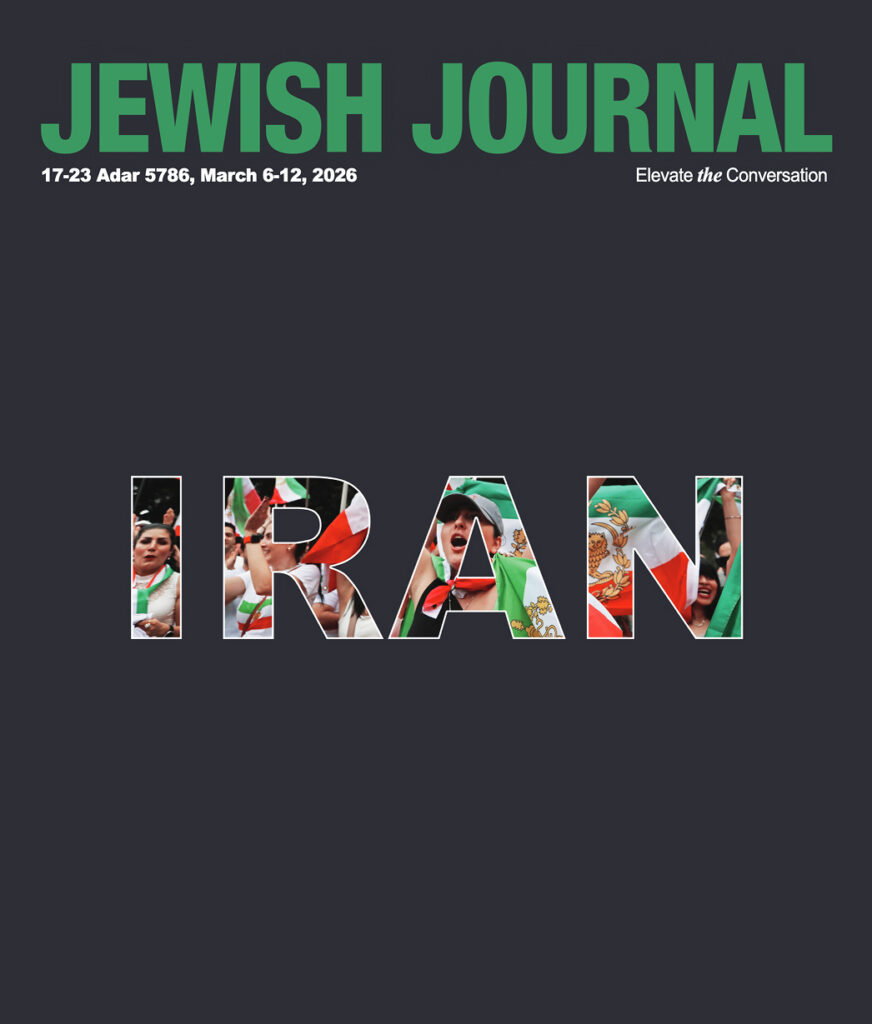
Print Issue: Iran | March 5, 2026

CLICK HERE FOR FULLSCREEN VERSION

Print Issue: Iran | March 5, 2026 Read More »

Diving, Luxury and Wild Discoveries in Central Florida on The Jet Set TV

On The Jet Set TV with Nikki Noya, I explored Central Florida in a way that showed just how diverse and unexpected this region can be — from luxury resorts to underwater adventures, from wildlife encounters to charming small towns. Watch the interview:

EPCOT dazzles. Guardians of the Galaxy: Cosmic Rewind remains one of the most exhilarating rides anywhere — a spinning, storytelling, fully immersive blast through space that reminds you why Disney sets the global bar.

WATCH on SPOTIFY:

But here’s the surprise: I didn’t just ride attractions at EPCOT. I went under them.

Scuba diving inside The Seas at EPCOT is one of the most extraordinary ways to experience Disney magic. With dive guide Kenny Dyal leading the way, I descended into the 5.7-million-gallon saltwater aquarium — gliding past sea turtles, my first-ever hammerhead shark, eagle rays, and schools of shimmering fish while park guests watched from the other side of the glass. It was serene, cinematic, and utterly surreal. One of the highlights? Sharing the best underwater selfie ever with my friend Mikkel Woodruff, and giving high-fives through the glass to excited kids on the other side — a real-life mermaid moment.

Luxury anchored the adventure at Four Seasons Resort Orlando at Walt Disney World®. Tucked within a residential setting yet minutes from the parks, the property offered a refined counterbalance to high-energy days. Think tranquil adults-only pools, elevated dining, impeccable service, and private park views that made nightly fireworks feel personal. Breakfast with Goofy? Check. Dinner on the rooftop at Capa Steakhouse? Absolutely. Every moment combined indulgence with Disney magic seamlessly.

At Top Tier by Reunion, I discovered next-level accommodations in the Vacation Home Capital of the United States. These are not typical vacation rentals — they’re expansive, design-forward properties built for gathering: private pools, home theaters, themed bunk rooms, chef kitchens, game rooms, and outdoor lounges for multigenerational travel. From bowling strikes in the private alley, swings on the golf simulator, basketball games, to a catered dinner with live music and drinks by the pool, it felt like a private resort in every sense.

From the man-made to the nature-made, Wild Florida offered a complete contrast. I climbed aboard my first-ever airboat and skimmed across the headwaters of the Everglades, wind whipping, water spraying, scanning the surface for movement. We spotted alligators sunning along the banks, native birds overhead, and the kind of untamed landscape most visitors never see. It was fast, loud, and exhilarating — pure Florida.

And just when the energy peaks, Celebration shifts the tempo. Designed with walkable streets and lakeside paths, it feels like stepping into a different rhythm. I wandered past pastel facades, paused by the water, and settled in at Columbia Restaurant for their legendary 1905 Salad — tableside, theatrical, timeless. It reminded me that Central Florida isn’t just adrenaline; it’s also ease.

From Orlando to Kissimmee, you can move from scuba diving with sharks, to luxury resort relaxation, to private vacation estates, to airboat wildlife encounters, to charming town squares — all in one seamless itinerary.

This is the Central Florida I shared on The Jet Set TV with Nikki Noya: dynamic, diverse, and far more expansive than a single headline. From the parks, to the wild, to refined stays, to the unexpected, it’s a place where you find your own treasures — and unforgettable adventures await. Watch the full segment here.

See all of Lisa’s segments on The Jet Set TV: https://lisaniver.com/the-jet-set-tv-segments/

VIDEOS: Orlando & Kissimmee, Unexpectedly Luxe:

ARTICLES about my Florida Adventures:

Experiencing Every Kind of Magic in Kissimmee https://www.wesaidgotravel.com/kissimmee/

Four Seasons Orlando: Where Luxury, Sunshine, and Storybook Magic Meet https://www.wesaidgotravel.com/four-seasons-orlando/

BORED PANDA: I Expected Crowds And Chaos In Central Florida, But What I Found Was Silence, Beauty, And Real Emotion https://www.boredpanda.com/unexpected-beauty-in-central-florida-by-lisa-niver

Diving, Luxury and Wild Discoveries in Central Florida on The Jet Set TV Read More »

In a Pickle– A Turshi Recipe

Recently, Alan and I had a very humorous discussion of the psychological divide between Ashkenazim and Sephardim on healthcare.

We always joke that Alan knows a lot of doctors and in my Sephardic family that qualifies him to dispense Advil, Aleve, Pepcid and Claritin. He is the one who takes people to urgent care, even when they protest that they are fine.

I mean, really, is there an illness that garlic can’t heal?!

About 10 years ago, my aunt Daisy suffered a heart attack. Like most women, her symptoms were fatigue, shortness of breath, nausea and throwing up. Twice, she sought advice from her doctor at the “kupat cholim” (Israeli health clinic). Twice, he recommended that she schedule an EKG, but he didn’t impress any urgency.

Thinking it was just the flu, she didn’t bother her children, suffering in silence for two weeks before being rushed to the hospital. She was in critical condition in the ICU, leaving her with irreparable damage to her heart.

Thankfully, she did recover!

Right now, she is in her apartment in Ramat Gan, suffering through the Iranian missile attacks.

The miraculous recovery of my very lovely Aunt Daisy is testament to her discipline and healthy lifestyle. She walks everywhere, she cleans her own home, she eats lots of fresh fruits and veggies and eats small, healthy, home cooked meals. I’m pretty certain that neither wine nor sugary sodas have ever passed her lips. Very, very old school. I can only dream of such virtues.

What you will find in my aunt Daisy’s home are treats to serve her many visitors. Lots of dried fruits and nuts, freshly baked baba ta’mar (crispy date-filled cookies) and ka’ak (crispy salty ring crackers flecked with black nigella seeds).

According to which fruits are in season, she will make homemade jams and preserves, sweet and sour apricot fruit leather, as well as luzina, a delectable Iraqi Jewish quince candy paste, flavored with lemon and cardamom and topped with crushed almonds.

Her refrigerator is always filled with huge jars of homemade amba (pickled mango), pickled cucumbers and golden turshi.

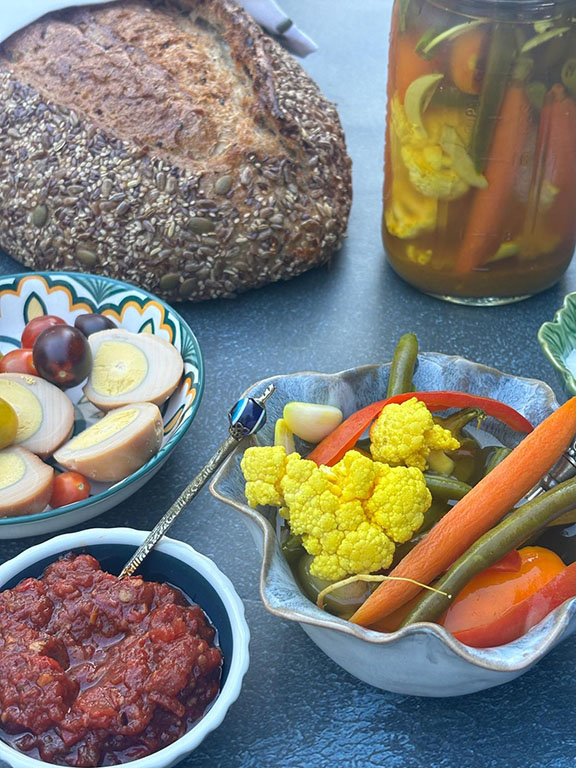
Turshi pickles are a staple of the Babylonian Jewish kitchen, featuring cauliflower florets, carrot sticks, green beans, red pepper and garlic pickled in a sweet and salty, curry and turmeric-spiced vinegar brine. Cabbage, celery and radishes are sometimes added. Also known as chakla bakla, this recipe uses a quick cooking method that leaves the vegetables with a delightful crunch.

Tangy, bright and filled with irresistible umami flavor, turshi is the perfect complement to burgers, kebabs and chicken, as well as the perfect foil for eggs and salads.

Turshi, like most pickled vegetables, also has significant health benefits, primarily as a source of antioxidants and high probiotic content that supports gut health, immunity and digestion.

As the old saying goes— an ounce of prevention is worth a pound of cure. (But Western medicine is truly miraculous!) Rachel and I love sharing healthy recipes because sometimes food can be the best medicine! We are honored to share this recipe for turshi.

Awafi! La’briut! A votre sante!

To your good health!

—Sharon

Nana Aziza’s Turshi Recipe

Pickling Juice

1 cup water

2 cups white vinegar

1 cup apple cider vinegar

1/4 cup red wine vinegar

1/4 cup sugar

2 Tbsp kosher salt

1 Tbsp curry powder

1 Tbsp turmeric

In a large pot, bring the water, vinegar, sugar, salt and spices to a boil over medium heat.

Vegetables for Pickling

1 lb cauliflower, cut into florets

1lb green beans, cut into 4 inch pieces

3 carrots, cut into long thin inch sticks

1 lb baby peppers, cut in half

10 cloves garlic, chopped

Place vegetables in clean jars. Pour cooled pickling juice over the vegetables to fill the jars.

Store in the refrigerator.

Pickled vegetables will be ready to eat in 3 days.


Sharon Gomperts and Rachel Emquies Sheff have been friends since high school. The Sephardic Spice Girls project has grown from their collaboration on events for the Sephardic Educational Center in Jerusalem. Follow them
on Instagram @sephardicspicegirls and on Facebook at Sephardic Spice SEC Food. Website sephardicspicegirls.com/full-recipes.

In a Pickle– A Turshi Recipe Read More »

Sweet Kugel Recipes for National Noodle Month

March is National Noodle Month. And nothing says Jewish comfort food like sweet noodle kugel.

Jessie-Sierra Ross is a “die-hard” kugel fan.

“This recipe is based on a very old and very old-school dairy kugel recipe that my family has been making for generations,” Ross, founder Straight to the Hips, Baby, and author of “Seasons Around the Table,” told The Journal. “Sweet, creamy and filled with my addition of dried cranberries and golden raisins, it tastes like home to me.”

Ross explained that she usually makes one extra-large lasagna tray, but you can also split this recipe between two medium lasagna pans. “Often served on Shabbat morning, family potlucks or delivered to families needing a little meal help, each bite is a cinnamon flavored burst of comfort,” she said. “Whether eaten hot, cold or somewhere in between, this is a wonderful and freezer-friendly Jewish noodle dish!”

Sweet Noodle Pudding (Kugel) with Cranberries and Golden Raisins

Yield: Serves 16 (1 extra-large lasagna pan or split between 2 medium lasagna pans)

For the Kugel:

6 large eggs

½ cup white sugar

4 Tbsp butter, melted

8 ounces farmer’s cheese

16 ounces cottage cheese

8 ounces block cream cheese, softened

1 cup sour cream

1 tsp vanilla extract

½ tsp salt

2 cups milk

½ pound medium egg noodles, cooked according to package instructions and drained

¼ cup golden raisins

¼ cup dried cranberries

For the Topping:

2 Tbsp butter, melted

¼ cup brown sugar

1. Preheat your oven to 350°F (175°C).

Prepare the Kugel:

2. In the bowl of an electric mixer, beat the eggs and white sugar together until well combined and slightly lightened in texture, about 5 minutes.

3. Melt 4 tablespoons of butter in a small saucepan or in the microwave. Set aside to cool slightly.

4. To the beaten eggs and sugar, add the farmer’s cheese, cottage cheese, sour cream, softened cream cheese, melted butter, vanilla extract and salt. Mix until smooth and well incorporated. Pour in the milk and stir to fully combine.

5. In a large mixing bowl, combine the cooked egg noodles with the dairy mixture, stirring gently to coat evenly.

6. Fold in the golden raisins and dried cranberries.

7. Pour the noodle mixture into one large lasagna pan (or two medium-sized), spreading it evenly.

Prepare the Topping:

8. In a small bowl, mix together 2 tablespoons melted butter and ¼ cup brown sugar to form a thick paste.

9. Dot the surface of the kugel with spoonfuls of the brown sugar mixture. Swirl gently with a knife to lightly marble it into the top.

Bake:

10. Cover the pan with foil and bake for 30 minutes.

11. Remove the foil and continue baking for an additional 30-40 minutes, watching carefully to prevent over-browning. You’re looking for golden, crispy edges, not blackened bits.

12. The kugel is done when the custard is fully set and the top is lightly browned.

13. Allow the kugel to rest for 20 minutes before serving.

Note: This dish is equally delicious warm, at room temperature or chilled straight from the refrigerator.


During lockdown, Faith Kramer developed a number of comfort-food kugels including a chocolate sandwich cookie kugel. The result is a rich, satisfying and surprisingly not-too-sweet dessert.

“The filled cookies – think Oreo, Hydrox or Joe-Joe’s style cookies – undergo a magical alteration and pretty much absorb the kugel batter,” Kramer, author of “52 Shabbats: Friday Night Dinners Inspired by a Global Jewish Kitchen,” told The Journal. “Kids of all ages love this recipe.”

Kramer revealed that she started out trying to use cocoa-flavored pasta as base for a chocolate noodle pudding.

“The pasta was hard to source, and the resulting kugel was disappointing,” she said. “I tried again with thin chocolate wafer style cookies; they literally disappeared in the kugel.”

Then she had the idea to use filled chocolate sandwich cookies, and that is how this kugel came to be.
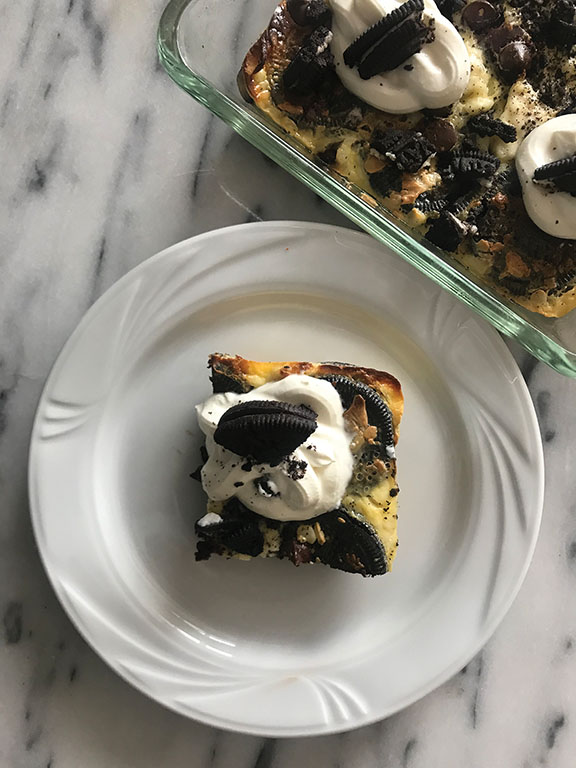
Chocolate Sandwich Cookie Kugel

Serves 12

3 Tbsp unsalted butter, melted, divided

30 chocolate sandwich cookies (or as needed to line bottom of pan) plus 6 (see note)

8 ounces cream cheese, room temperature

8 ounces sour cream, room temperature

1 cup milk

4 large eggs, beaten

1 tsp almond extract

3 Tbsp sugar

1/8 tsp salt

1/2 cup semisweet chocolate chips

1/2 cup crumbled chocolate sandwich cookies

Whipped cream or additional sour cream

1. Heat oven to 325°F.

2. Lightly brush 1 teaspoon of the melted butter inside a 9×13-inch baking pan. Line bottom of the pan with a single layer of cookies, breaking some to fill in any large gaps.

3. Mash softened cream cheese with sour cream until smooth. Add remaining butter, milk, eggs, almond extract, sugar and salt. Beat until smooth.

4. Pour mixture over cookies. Scatter chocolate chips evenly over top.

5. Place in the oven. Bake for 30 minutes. Rotate pan. Scatter cookie crumbs over top. Bake for an additional 15-25 minutes, until the custard top is firm and puffy and pulling away from the sides of the pan.

6. Let sit for 20 minutes.

7. Serve warm or at room temperature. Cut the remaining 6 cookies in half. Garnish each serving with a dollop of whipped or sour cream and half a cookie.

*Note: This recipe works with any chocolate sandwich cookie with filling. If using ones with a flavored filling, substitute vanilla extract (or other extract that compliments the filling) for the almond. It really doesn’t matter if you use generic or a brand name chocolate sandwich cookie. You can even choose a gluten-free variety, if needed.

Sweet Kugel Recipes for National Noodle Month Read More »

Table for Five: Ki Tisa

One verse, five voices. Edited by Nina Litvak and Salvador Litvak, the Accidental Talmudist

“You will not be able to
see My face,
for man shall not see
Me and live.”

– Ex. 33:20


Rabbi Yoni Dahlen

Spiritual Leader / Congregation Shaarey Zedek, Southfield Mich.

A shared trait of most religious and philosophical systems is the individual or communal journeying towards a specific lofty objective. Some religious traditions seek Truth. Others seek Wisdom, and still others seek Peace.

Judaism seeks Union.

The pulse of Jewish theology, from the Hebrew Bible to modern Jewish thought, is the resolute search for how, where and when to make Heaven and Earth touch. Our purpose, as Jews, is paradoxical by nature. We are meant to seek God’s face, to fully see and comprehend our Creator, and to also understand that “none shall see God’s face and live.”

So how do we do that? How do we find sanctity in knowing God, while avoiding getting too close to that sanctity? For me, the answer lies in the work of two great Jewish thinkers, Rabbi Abraham Joshua Heschel and the French philosopher Emmanuel Levinas. Coming from two dramatically disparate approaches, Heschel and Levinas arrive at the same conclusion:

We see God through experiencing the other. Through allowing our hearts to fully confront the heart of a friend, a neighbor, a loved one or even a stranger. To sit face to face with full vulnerability, with our guards down, knowing that doing so could easily get us hurt, and to do it anyway, because it is beautiful, because it is holy, because it is right. It is seeing the refractions of the Divine through God’s partner in creation, people, individuals, unique sparks of existence that allows us to see God and live.


Rabbi Chaim Tureff

Rav Beit Sefer at Pressman Academy and Author of “Recovery in the Torah”

Our ability to see is truly a miracle. The eyes are made up of over 2 million working parts and can distinguish between over 10 million colors. Every morning we have a blessing, Pokeach Evrym, which thanks Hashem for opening our eyes. And yet we are clearly told that we are unable to see God’s face and live. As the Sforno states, “your inability to see what you would like to see is not due to God depriving you … but is rooted in man’s inability to ‘see’ such things unless you had died first, as an eye of flesh and blood cannot ‘see’ such things.” If Hashem wanted us to see Hashem, we would be able to. But maybe that is what God is telling us. We have the things that we see and the things we don’t see. How many times do we have things right in front of us and we don’t see it? Take a moment to really look at something and you will notice beautiful intricacies. Naturally, we take for granted our sight. By not being able to see Hashem, we are left with the allure that there is something that is beyond our comprehension (quite frankly there are many things that are beyond our comprehension). Instead we are to use our faith, instincts and our proverbial third eye to really grasp those things we can’t see. By not being able to see God, it requires us to cultivate the relationship on a much deeper level.


Rabbi Bentzion Kravitz

JewsForJudaism.org

Before moving to Israel, I was asked to assist a family facing a crisis: their elderly Jewish mother, Carol, had converted to Christianity while in hospice care in Los Angeles. A caregiver, believing they were acting in her best interest, had shared the Gospel with her so that Carol could “get to heaven” before she passed. As a result, her children were left feeling angry and desperate.

When I met with Carol, she explained that she needed a “tangible God” to believe in. To help her see this from a different perspective, I used a simple analogy: I asked her to name something tangible that people crave. She chose “gold.” I noted that while gold is physical and precious, people can live their entire lives without ever possessing it.

Then I asked her what element is most essential for life. When she answered, “air,” I pointed out the irony that, although gold is heavy and glitters, it is difficult to find and unnecessary for survival. On the other hand, although air is invisible, it is essential, everywhere and easily accessible.

In fact, an invisible God “that man cannot see” is far more accessible than a tangible one. Because God isn’t confined to a physical form or a single location, God is always present, always available and closer than we realize. After considering my analogy, Carol recognized her mistake and tearfully recited the “Shema” in recognition of her one true God.


Rabbi Pinchas Winston

Thirtysix.org / Shaarnun Productions

How do you convey in 250 words that this verse is one of the most kabbalistic, alluding to hugely important insights about life in this world and the World to Come? You start by asking one very simple question: What face? Does God have a face? One of the fundamentals of fundamentals is that God is not the least bit physical, so He certainly doesn’t have a physical face. Part of the answer has to do with understanding the question. What did Moshe want when he asked God to show him His glory? He wanted access to a much higher level of Divine light than was normally humanly possible. Until that point, our awareness of God was like looking at the back of someone’s head, which doesn’t reveal definitive information about the person. But if you can see a person’s face, you not only recognize them but you can see what they are thinking and feeling. A face reveals to the outside what a person feels on the inside, which, in the case of God, meant a more profound understanding of who God is and how He works. Not only this, but if you can only see the back of a head, it means they have already passed by, and you’re seeing them go. When you can see their face, it means you can see them coming. God’s answer? “One day, but not now, because that level of light would kill you, and the world still needs a Moshe Rabbeinu.”


Mitchell Keiter

Certified Appellate Specialist, Keiter Appellate Law

Who wouldn’t want to see God’s face? And who wouldn’t want to understand the inner workings of God’s mind? But we may infer from the verse that such knowledge is incompatible with what it means to be human.

The Sages had the chance to know what God thought but actually declined. The Talmud relates the debate over the Oven of Akhnai, where Rabbi Eliezer calls on the Voice of God to resolve a dispute. Surprisingly, rather than embrace God’s expressed position, the other Sages ignore it: “When scholars dispute the Law, what business is it of yours?” [Bavli, Bava Metsia 59b.]

Their reaction actually makes sense. They had their role in studying, learning and applying Torah. If God showed the answer to every question, what would be left for humans to do? Better for us to make decisions — even imperfect ones — for ourselves, than to get all the “correct” answers straight from God. It is the process of reading, studying, discussing and growing that matters, not the simple outcome of the answer.

Now we all face this choice. AI offers to draft our essays and assignments, and promises perfection for every email. We need no longer read because Chat GPT can provide a summary. Should we thus outsource our thinking? Or will we all say and read the same thing and thereby forfeit our unique voices and interpretations? If we make this Faustian bargain, we will still exist, but will no longer “live” as we had before.

Table for Five: Ki Tisa Read More »