fbpx

March 4, 2026

The Snake, the Shepherd’s Crook, and the Eye of the Sun: Uncovering the Haggadah’s Hidden Meaning

For thousands of years, Jews have read Exodus 12:12’s explanation of God’s punishment of the slave-driving Egyptians, “… and I will bring judgment on all the gods of Egypt. I am the Lord.” But it is only recently that the full weight of that judgment has been rendered.

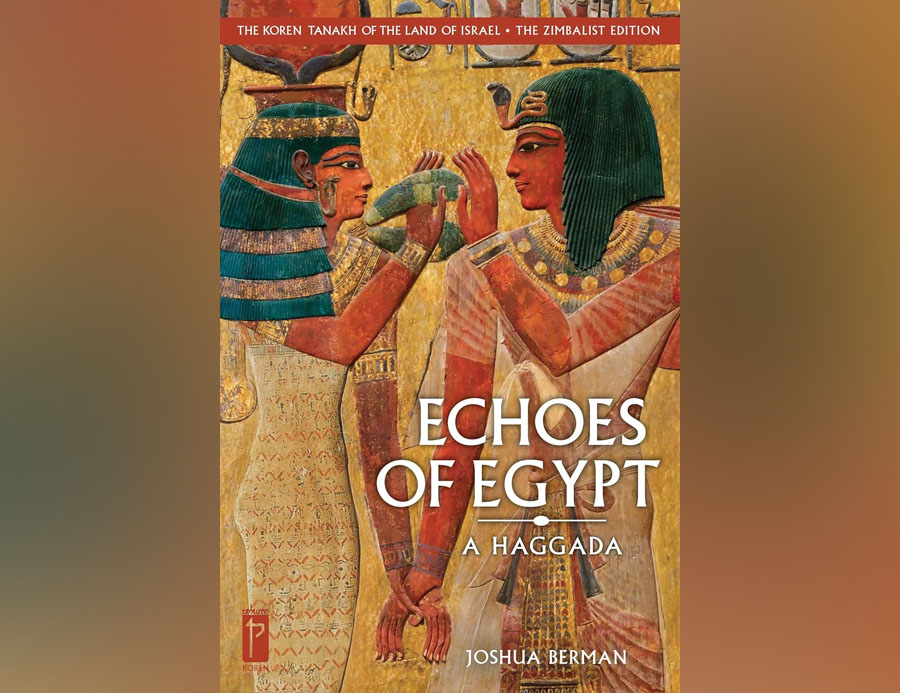
That is because modern scholars have discovered multiple ways in which a more in-depth understanding of the Exodus narrative – including its major themes, imagery, and the Ten Plagues themselves – can be gained by utilizing the knowledge of ancient Egyptian culture. As Bar Ilan University professor Joshua Berman engagingly and convincingly demonstrates in his “Echoes of Egypt” Haggadah, the process by which the Passover story took shape was as a polemic against the belief system and symbols of authority of Pharaoh and his people.

Take the shepherd’s crook, for example. Berman notes that what was in Egypt called the “heka” “represented the power, authority and responsibility of the pharaoh, who was not just a king but also, in symbolic terms, the shepherd of his people.” In countless statues and sarcophagi, “we see the pharaoh grasping the crook in his left hand, resting it upon his shoulder, a reminder of his duty to guide, protect and care for his people, just as a shepherd watches over his flock.” This lends new meaning to Moses’ staff being the stick through which plagues are wrought, undermining the physical symbol of Pharaoh’s authority. (Berman, however, does not mention an additional layer – that the image of Pharaoh-as-shepherd likely also adds political context to the ritual of the sacrifice of the paschal lamb. The Israelites brought sheep as an offering to the one true God, right under the nose of the Egyptian ruler who was purported to be his country’s protective shepherd.)

Speaking of Moses’ stick, Berman notes that at the burning bush, God has Moses turn the staff into a snake as a sign of God’s upcoming deliverance. Shortly thereafter, however, Aaron casts down the staff in front of Pharaoh and it becomes a crocodile. Why the change? “For Egyptians,” the author notes, “snakes and crocodiles were twin terrors: the apex predators of land and water. Egyptian art depicts hybrid monsters – crocodile bodies with serpent tails – and the god Horus trampling crocodiles while grasping snakes. Together they represented the totality of danger.” With these twin predators, God is demonstrating: ultimately obey Him, not the tyrannical monarch.

Then there are the Ten Plagues. In a representative example, Berman notes how “The Eye of Ra” was an emblem of the sun god’s power. When the plague of locusts blotted out the sun, covering “the eye of land,” per Exodus 10:5’s description, it “demonstrated that even the mighty Ra, the most powerful of Egypt’s gods, was powerless before the God of Israel.” (The medieval commentator Rashi, though he did not have access to modern scholarly knowledge of ancient Egyptology, mentions a tradition that Pharaoh evoked the pagan god Ra in defying Moses’ request to free the Israelites.)

Even the number of plagues holds symbolic value. Berman writes that the number nine carried symbolic weight for Egyptians, often signifying completeness or totality. “The Egyptians referred to their enemies collectively as ‘the Nine Bows,’ a term that symbolized total opposition … Pharaoh Seti I, for instance, is depicted trampling the Nine Bows, representing Egypt’s vanquished foes.” By literally one-upping Egyptians’ perception of how to quantify the forces of their enemies, God is undermining the premise of the Egyptian worldview.

And it is not only what Moses and Aaron held in their hands that counters Egyptian iconography, but the literary motif within the Exodus story of evoking God’s own mighty “hand.” As Exodus 15’s Song of the Sea states, God’s “right hand is adorned in strength … [and] smites His enemies.” Scholars have uncovered that during the time period of the Exodus, “the most ubiquitous motif of Egyptian narrative art is the pharaoh raising his right hand to shatter the heads of enemy captives.” So by the Torah emphasizing God’s own saving right arm, it shatters the perception that Pharaoh’s own has any might at all.

The mention of the Lord’s right hand is not the only anti-Pharaoh allusion in the Song of the Sea. Berman cites numerous details from the Kadesh inscriptions, which document the battle of the Pharaoh of the Exodus story against another population, the Hittites. In those summaries of the fight composed by Egyptians, a plea for divine help is answered with encouragement to move forward; the enemy chariotry, recognizing by name the divine force that attacks it, seeks to flee, amazed at the victorious king’s accomplishment. The troops offer a victory hymn that includes praise of his name and references to his strong arm, and they offer tribute to him as the source of their strength and their salvation. The Song of the Sea’s containing all of these themes as well is a poetic way of utilizing the verbiage of Pharaoh’s supposed victory against the Hittites against him, showing how Israel’s God is the one who won the decisive battle against the monarch.

Berman notes that the repercussions of the rebellion against Egypt and its ideology helped shape the United States. “‘We hold these truths to be self-evident,’ proclaims the American Declaration of Independence, ‘that all men are created equal, that they are endowed by their Creator with certain unalienable Rights, that among these are Life, Liberty, and the pursuit of Happiness.’ Although the American founding fathers regarded equality as ‘self-evident,’” Berman notes, “many civilizations throughout history did not share this view. In fact, they were based on precisely the opposite paradigm – that people are not created equal: that the human community is like a pyramid, with the privileged few perched at the top, and the feeble masses below them. And nowhere was this truer than in ancient Egypt.”

In flipping Egypt’s spiritual script, then, the concept of freedom as we know it was forged. Pharoah’s forces were no match for the Lord and the liberty He gifted to His people.


Rabbi Dr. Stuart Halpern is Senior Adviser to the Provost of Yeshiva University and Deputy Director of Y.U.’s Straus Center for Torah and Western Thought. His books include the newly released “Jewish Roots of American Liberty,” “The Promise of Liberty: A Passover Haggada,” “Esther in America,” “Gleanings: Reflections on Ruth” and “Proclaim Liberty Throughout the Land: The Hebrew Bible in the United States.”

The Snake, the Shepherd’s Crook, and the Eye of the Sun: Uncovering the Haggadah’s Hidden Meaning Read More »

The Night Watch: How Hundreds of U.S. Volunteers Support Israel Through the Night

“I’m scared,” the person types. “I can’t sleep. My whole body is shaking.”

There was a siren earlier. It’s quiet now, but the fear hasn’t left.

It is early evening in Los Angeles, before dinner, when the day has not quite ended yet.

But across the ocean in Israel, it is already the deepest part of the night, and for some, the hardest.

As renewed rocket attacks target Israel, nights have become especially heavy. Sirens may fall silent, but fear often lingers, filling the quiet hours with anxiety and isolation. In those moments, emotional support lines become a lifeline.

I am one of the volunteers who answers them.

Through SAHAR, Israel’s anonymous emotional support organization, hundreds of volunteers in the United States help sustain Israel’s nighttime emotional support lines. Because of the time difference, Israel’s deepest night hours align with evening hours in America, allowing U.S.-based volunteers to cover the overnight support shift while most Israelis sleep. We log in from kitchens, studies and living rooms, after work, before dinner and long after our own days have ended, not as therapists or experts, but as caring fellow Jews who want to make sure no one has to face distress alone at four in the morning.

This work exists all year long. Emotional distress does not wait for emergencies or headlines. During periods of relative calm, and during moments of acute crisis like the current rocket attacks, people reach out at night when silence makes everything feel heavier.

The American Night Shift

For me, as an educator and researcher in adolescent well-being, this work turns theory into something deeply real. Night after night, I meet people trying simply to hold themselves together for one more hour. Most are not looking for diagnoses or advice. They are searching for a place where they do not have to be strong, where they can finally let their guard down.

The stories are different, but the need is often the same.

A teenage girl typed quietly. She had not been invited to a gathering, and classmates had been whispering and laughing behind her back.

“I don’t want to wake anyone,” she wrote. “Everyone is asleep, and I feel invisible.” Before signing off, she added, “Thank you for staying with me.”

A young man wrote in the early hours after a painful breakup.

“It’s 3 a.m., and my thoughts won’t stop,” he said. “I keep replaying everything.” When he logged off, he left a short note: “It helps not to be alone with this.”

Another message came from someone carrying memories from earlier rounds of fighting that returned after dark.

“I manage during the day,” he wrote. “It’s the nights that undo me.”

And sometimes, the need was quieter still.

An elderly woman wrote from her apartment. Her husband had passed away the year before.

“The nights are the hardest,” she wrote. “Could you just stay online with me for a little while?”

We did not talk much. We did not need to.

Sometimes, what carries someone through the night is simply knowing that someone else is there.

One of the most moving parts of this work is realizing who sustains it. Across the United States, people with full lives, work, studies and families choose to give their evenings so that Israelis do not struggle alone in the dark. This is a form of solidarity that exists alongside philanthropy and advocacy, yet offers something uniquely intimate, presence.

We may never know each other’s names. We may never meet. Yet for those minutes, across oceans, time zones, and screens, we share something deeply human.

As long as there are nights in Israel that feel heavy, during renewed attacks and during uneasy calm, there will be a volunteer in America sitting quietly at a keyboard, ready to say, “You are not alone. I am here with you.”

Sometimes, that is enough.


Dr. Orly Danino is an educator and researcher in adolescent well-being. She develops gratitude-based resilience programs and volunteers with SAHAR, providing nighttime emotional support to Israelis from her home in Los Angeles.

The Night Watch: How Hundreds of U.S. Volunteers Support Israel Through the Night Read More »

Me Llamo Miguel

With Purim having just passed, I’ve been thinking about how Jews have been disguising ourselves over the years.

Masks and costumes are a wonderful way to celebrate the holiday, and my wife and I have fond memories of dressing up our children for Purim parades.

The tradition of Purim masquerading reminds us in part of Queen Esther concealing her Jewish identity until she declared her Jewishness to the Persian king in an effort to save her people. Skip ahead to today when an all too frequent dilemma within the Jewish community is whether to hide our Jewishness from the larger world. An observant Israeli friend has spent a great deal of time in London, but only recently, for fear for his safety, did he decide to take off his yarmulke while walking in the streets. Many other friends put their Jewish stars or hamsas inside their shirts when traveling, or even in their hometowns.

This is obviously very different from the biblical stories of concealment. Jacob wasn’t hiding his Jewishness when he pretended to be his brother in order to trick his aged father into bestowing on him Esau’s birthright.  And when Joseph hid his identity, it wasn’t because he was afraid anyone would target him if they knew he was a Jew, but instead to test whether his brothers, who had sold him into slavery, felt genuine remorse.

My wife and I just returned from Singapore, where we have been a number of times. We were well aware of the small but vibrant Jewish community there, with two synagogues, a kosher restaurant, and a community center. We felt safer there than in any other country we have visited post-Oct. 7.

At a dinner I found myself sitting next to the former long-time Singaporean Ambassador to the United States, who told me a remarkable tale. Guessing that I was Jewish, he expressed his appreciation for the contribution that Jews have made, and continue to make, to the development of his extraordinary country. With only around 2,500 Jews in a nation of more than 6 million, Jews are in our usual position of being a mere rounding error. In fact, if you Google religion in Singapore, you will find 31% Buddhist, 19% Christian, 16% Muslim, among other identified faiths, and finally .3% Other. There we are: a small part of the “Other” group!

But the Ambassador pointed out that Jews have been very well represented in Singaporean law, medicine, media, business and the like. And he traced some of this success to the “Mexicans” who came to Singapore in the mid-1960s.

When he said the word Mexicans, he put up his fingers to indicate air quotes. I had no idea what he was talking about, and my bemused expression led him to explain.

It turns out that after Singapore gained its independence in 1965, Lee Kuan Yew, its founding prime minister, set out to form a military from scratch. Who did they bring in as advisors to what became the Singapore Armed Forces? Israelis. But having broken away from Malaysia, a conservative Muslim country then and now, Singapore wasn’t anxious to publicize that the IDF was in town, so the Jewish military advisors were officially designated as Mexicans.

How was the local Malay and Chinese population fooled into thinking that Israelis were Mexicans? Ask yourself, how many white Americans can tell whether an Asian American is of Chinese, Japanese or Korean descent? In Lee Kuan Yew’s memoirs, he wrote that “They (the Israelis) looked swarthy enough” to trick the locals into believing they were Mexican.

So picture for a minute all those Israelis going around Singapore speaking Hebrew, pretending that they were speaking Spanish!

Just as the Ambassador rightfully assumed that I was Jewish without me telling him, everywhere I go these days I wonder if violent antisemites will recognize my identity.

I have always kept my Jewish star and hamsa necklaces inside my shirt, but perhaps, like Queen Esther in ancient Persia, I should reveal them now that Jews are under siege, trading safety for pride. 

If only things were so simple that, as in Singapore 60 years ago, when asked my name, I could proudly reply “Me llamo Miguel.”


Morton Schapiro served for more than 22 years as President of Northwestern University and Williams College. He taught almost 7,000 undergraduates over his more than 40 years as an economics professor.

Me Llamo Miguel Read More »

The Hope of Return

I’m an Ashkenazi Jew who has somehow cracked the code and made my way into the Persian Jewish community. My wife — and her 1,000-plus-member family — have become my own, and the hues of our home reflect corners of a faraway bazaar where Jewish Iranian life once thrived.

Being the “outsider” — or the “white” one, as the community jokingly calls me — has given me a particular gift. I’ve been allowed to listen. To learn. To sit at countless tables — dinners, lunches, late-night gatherings — and hear about the Iran that was: the nightlife, the tight-knit Jewish quarters, the rhythm of the bazaars, the ease of daily coexistence. I’ve heard about coffee shops that stayed open too late, about Muslim neighbors who were family, about a sense of permanence that felt unquestioned — until it wasn’t.

Like the children and grandchildren of Holocaust survivors, nearly every Persian-American Jew of the next generation knows the outline of their family’s exodus. They know about the Iranian Revolution. They know what was left behind. They know about HIAS and the scramble to begin again in a new land. They know their parents rebuilt from scratch.

What they often don’t fully know is the emotional texture of what was lost.

The generation that fled in 1979 made a deliberate choice. They built businesses. They filled synagogues. They created thriving Persian Jewish enclaves in the United States that preserved tradition while embracing opportunity. But in doing so, many also shielded their children from the deepest layers of trauma. Some stories were told. Others were tucked away.

Part of that silence was protective. Why pass down pain if you can instead pass down resilience? Why let your children inherit the ache of streets they may never walk again?

Another part was pragmatic. Longing for a homeland that feels permanently out of reach can consume you. Better to turn the page. Better to focus forward. Better to build a life that does not depend on what was stolen.

That mindset helps explain why many Iranian Jews have historically kept their distance from organized opposition politics. Regime change felt distant. Risky. Unlikely. Hope, in this context, was something to ration.

And yet this moment feels different.

In the turbulence unfolding inside Iran today, there is a new undercurrent in the diaspora — cautious, measured, but unmistakably hopeful. Conversations that once sounded like fantasy are now spoken aloud. Visiting childhood homes. Walking old neighborhoods. Investing in a reopened economy. Reintroducing children to the land their grandparents still dream about.

No one serious believes this transformation is imminent. Iran stands at a fragile crossroads. A stable, pluralistic future aligned with democratic values is far from guaranteed. The forces that have defined the Islamic Republic for decades will not dissolve overnight. Optimism must be disciplined by realism.

But hope itself is powerful.

For decades, the regime projected permanence. Today, that aura feels cracked. The possibility — however distant — that Iran could one day be a country where Jews live freely and visibly again, where its diaspora can return without fear, where its government reflects the aspirations of its people rather than the dictates of repression — no longer feels absurd.

This moment calls for moral imagination. For solidarity with the Iranian people demanding dignity. For sustained support of those who seek a freer future. And yes, for quiet acknowledgment that those who trafficked in extremism and terror may finally be confronting the consequences of their choices.

I think often about my mother-in-law, Mojgan, and the Tehran she describes with such clarity. I imagine boarding a plane with her one day. Walking the streets she grew up on. Seeing the stories she told me come alive in real time. Not as tourists peering into a sealed past, but as a family reclaiming something that was unjustly stripped away.

History rarely offers return. But sometimes, it offers the hope of it.


Coby Schoffman is a Los Angeles–based serial social entrepreneur and the founder of The Nation Foundation (TNF), which operates project zones across East Africa. Schoffman holds an MSc in Transnational Security from New York University and a BA in Counterterrorism and Conflict Resolution from Reichman University. The views expressed are his own and do not reflect those of any affiliated organization

The Hope of Return Read More »

Stranded by War

My husband and I are among the tens of thousands of Israelis stranded around the world. For us, it’s Bangkok. Just before we boarded our flight from Taipei to our connecting El Al flight home on Saturday night, air space around Israel was limited to rockets, missiles and fighter jets. It’s a strange thing to say, but in 55 years, I haven’t missed a war, and I do not like missing this one.

So, I must write now from our hotel room that we rebook every few days instead of from my mamad (security room). I want to be home. Israelis are desperate to return home when there is a war. But it’s a futile dream – like swimming upstream in combat gear, like running to a shelter in a dream but your legs are jelly.  The alerts bombard my phone. We are letting our people down. They are carrying the burden alone. It’s that “under the stretcher” syndrome. Soldiers fight for the honor to literally shoulder the burden – to save their comrades. Teamwork.

Civilians fight for that honor as well, but in less dramatic ways. Just being there, supporting each other, holds up that stretcher.  We, however, are in hotel rooms, using iPads and phones, watching on the sidelines as as the stretcher is proudly carried by the individuals that make up Am Yisrael.

I accept that I’m not there and am plagued by uncertainty. We are struggling on two fronts: we worry about friends and family, and we are preoccupied with our own “survival” on a trip extended beyond our control.

We evaluated our situation waiting to board in Taipei. Pop-ups with Red Alerts from news sources covered the top part of my phone screen as I tried to book a hotel and complete the Thailand entry card online. There were calls and texts to family. More calls and texts to our travel agent.

“Do we send the bags through to Tel Aviv?” we asked, with just minutes before we reached the counter. We had to get it right.

“No. Take them with you in Bangkok. Get a hotel and stay there until you hear what to do.” Unsettling.

I started a list on the plane. We need a taxi from the airport. Local money. More medicines.  We need to extend travel insurance and our phone package. We need to cancel appointments, tell our neighbors we’re not home yet. And we need to do laundry!

El Al texted us:

“You will be notified automatically about your new flight.”

I am troubled by absurd worries, the kind that only surface when life is crazy. We are waiting for rescue flights, not a resumption of service. It’s an eleven-and-a-half-hour flight. Who knows what aircraft we’ll get. Rumors alert me that rescue flights do not honor the ticket class or amenities. Will I get a cramped middle seat? We’ll deal with what is sent us.

Us. I don’t mean just my husband and me. More stranded Israelis arrive every day. We recognize each other. Breakfast is the biggest giveaway. Israelis congregate around the salad bar, the hummus, the smoked salmon and the cheese offerings. We make friends.

We chat, share reports of renewed travel and personal stories. This couple has two children serving in Gaza and one in a different area. One man will miss his next immunotherapy treatment. Families with two or three young children are running out of activities. Another has a medical appointment that took several months to get.

We know what we are missing. Reality settles in like a paralyzing drug. I look out my plate glass hotel window at the decorative night lights on the building across the street. Perpendicular lavender lights shoot up in random order. I suppose it’s beautiful, but I only see rockets streaking into the night.

We may not be under that stretcher in the way we want, but we know we are part of the people carrying it. For me, writing this is my small way of taking my turn. We contribute however we can because that is what Am Yisrael does.


Galia Miller Sprung moved to Israel from Southern California in 1970 to become a pioneer farmer and today she is a writer and editor.

Stranded by War Read More »

Tuning Up Trouble: Daniel Roher Turns a Piano Tuner into a Master Safe-Cracker

After the Academy-winning documentary “Navalny,” director Daniel Roher could have stayed comfortably in the world of nonfiction. Instead, he jumped into fiction with “Tuner,” an offbeat crime story about a piano tuner whose extraordinary sense of hearing draws the attention of professional burglars.

In the film, Leo Woodall plays Niki White, a gifted young piano tuner in New York whose heightened auditory abilities allow him to detect even the faintest mechanical sounds. His mentor, veteran tuner Harry Horowitz (Dustin Hoffman), becomes both a father figure and professional guide, while Harry’s wife Marla (Tovah Feldshuh) forms part of the small surrogate family around him. Niki’s quiet life begins to unravel when he crosses paths with a group of burglars led by Uri, played by Israeli actor Lior Raz — best known as the co-creator and star of “Fauda” — the owner of a locksmith company that secretly targets wealthy clients’ homes. Raz’s character recruits Niki for a risky scheme, using his extraordinary hearing to crack safes that others cannot.

The decision to cast Israeli actors as the film’s criminals — including Raz alongside Gil Cohen and Nissan Sakira—initially raised concerns from Hoffman, Roher recalled.

“He said, ‘Let’s make them French Canadian,’” Roher said in an interview. “I told him, ‘Dustin, do you really want me to fire these three Israeli actors? They’re already having trouble finding work because of the war.’”

At 32, Daniel Roher has already built an unusually accomplished career in documentary filmmaking. Roher first gained international attention with the political documentary “Navalny,” which follows Russian opposition leader Alexei Navalny as he investigates the poisoning attempt that nearly killed him and confronts the Kremlin operatives believed to be behind it. The gripping film won the Academy Award for Best Documentary Feature in 2023 and firmly established Roher as one of the most promising young directors in nonfiction cinema.

Before that breakthrough, Roher had already explored very different subjects in his documentaries. His 2019 film, “Once Were Brothers: Robbie Robertson and the Band,” chronicled the life of guitarist/songwriter Robbie Robertson and the rise of the legendary rock group The Band, blending archival footage with personal reflections about fame, creativity and loss. Roher has since continued to move between personal and political storytelling, including this year’s “The AI Doc: Or How I Became an Apocaloptimist,” co-directed with Charlie Tyrell. The film follows Roher as he prepares for fatherhood and explores artificial intelligence and the anxieties surrounding its rapid development.

The unusual premise of “Tuner “grew out of a real-life encounter. Roher said the idea first came to him after spending a day shadowing a friend who works as a piano tuner. Watching the meticulous process — and the extraordinary listening skills the job requires — sparked his imagination.

“I followed him around for a day and watched him work,” Roher said. “It’s a very solitary job, and it requires this incredible discipline and concentration. These people have such precise hearing that I started thinking, what else could someone like that do?”

The thought led him to an unexpected idea: what if a tuner’s extraordinary ear could be used not only to perfect a Steinway, but also to hear the subtle clicks inside a safe and uncover its combination?

Although directing an actor of Hoffman’s stature might intimidate many young filmmakers, Roher said the experience was anything but daunting.

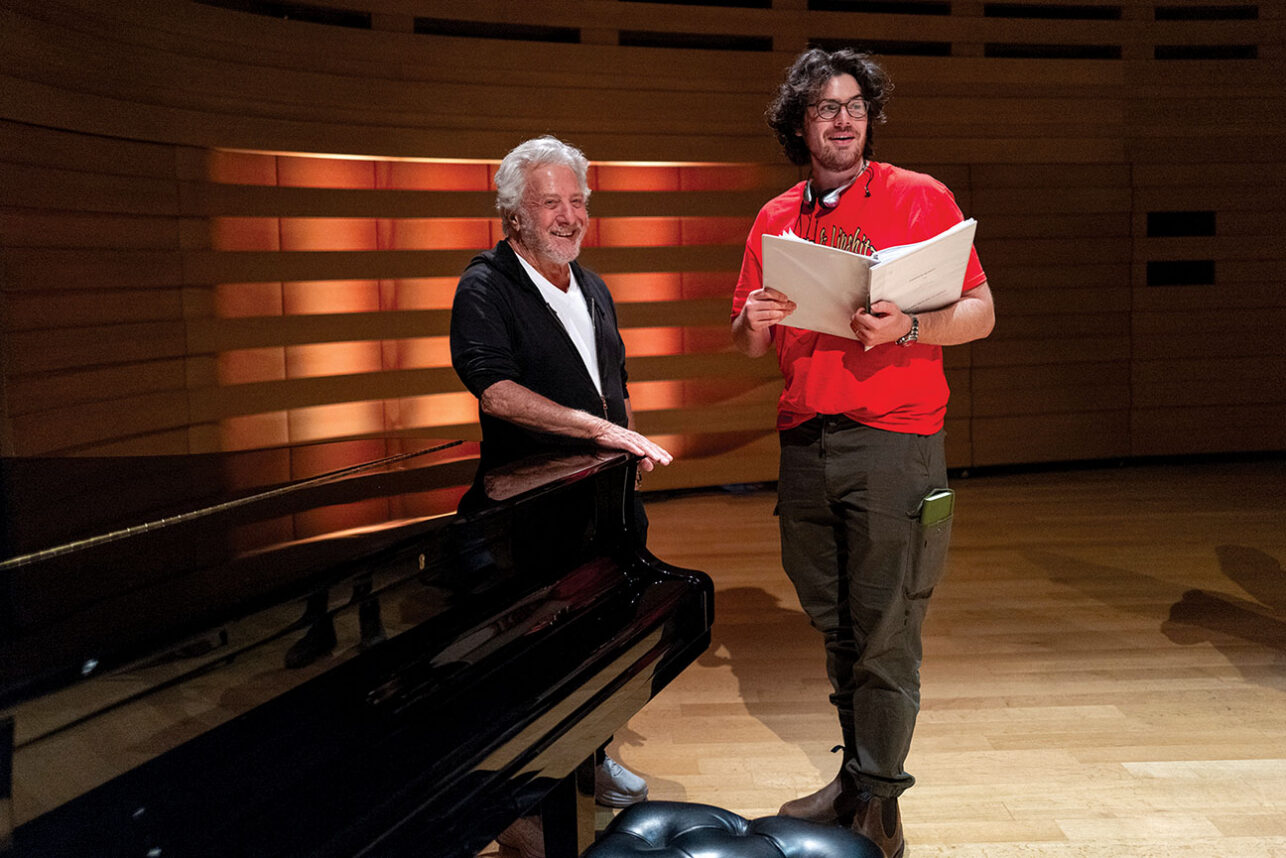
Daniel Roher with Dustin Hoffman

“It could have been intimidating, but Dustin is such a lovely, sweet and sensitive man with a great spirit,” Roher said. “He’s so passionate about making movies and loved being on set. He treated me with such kindness and respect that it wasn’t stressful at all. It felt like I’m having Grandpa or Uncle Dustin on set. I loved him very much.”

Roher was born to a Jewish family in Toronto, Canada. During our interview, he spoke about his fascination with the stories of Holocaust survivors, including those of his grandmother Bella, who had nine siblings — only three of whom survived. One settled in Canada, another in Florida, and a third in Israel.

His step-grandfather was also a Holocaust survivor, sent to Auschwitz. “I can still hear his slow Hungarian accent in my head,” Roher said. “He came to Canada with nothing and married my grandma later in life. I was a little boy then.”

He has visited his cousins in Israel a few times and maintains a close relationship with them. “My cousin, Dr. Yotam Shiner, is an extraordinary guy; he is like an angel, a remarkable person. He helped lead an initiative to treat people who don’t have access to the healthcare system. He and other doctors vaccinated undocumented people, including Palestinians.”

Another cousin, Gideon Shiner, after whom Roher named his two-year-old son, was a professor at the Technion in Haifa.

In January 2017, Roher also traveled to Auschwitz-Birkenau, a trip he will never forget.  “I didn’t want to go with a group, so I went by myself. I remember it was freezing and there was nobody there, maybe two tourists. It was a somber place, I didn’t stay too long there,” he said. “I’ve gone on a few road trips in Europe and every time I visit Poland or Germany, I feel shook. You know, these places are haunted.”

One time, he recalled, he visited a friend in Berlin, a city he loves. She suggested he borrow her bike from the cellar and go for a ride. “Once I went there, I felt all those ghosts and I said, I’ve got to get the hell out of here. I got chills.”

Roher spoke to The Journal shortly after he returned to Los Angeles from the Sundance Film Festival, where the film was well received. Still, the film’s Israeli characters sparked debate during a post-screening conversation. One audience member from Australia approached Roher with a question about his decision to make the villains Israeli. “She works on combating antisemitism in Australia, and she was very taken aback,” Roher said.

On the other hand, some accused the film of being “Zionist.” “When you put Israelis in your movie, it’s a lose-lose,” he said. “And that’s ridiculous.”

Overall, audiences and critics alike embraced the film, and Roher said he is pleased with his casting choice. “I’m really lucky I got to work with those guys,” he said, referring to the Israeli actors.  “Lior Raz is a national treasure. Gil and Nissan are amazing. I can’t wait to screen the film in Israel. I think people will have a lot of fun.”

“Tuner” is scheduled for release on May 22.

Tuning Up Trouble: Daniel Roher Turns a Piano Tuner into a Master Safe-Cracker Read More »

Love Letters to Israel

The last time I went to Carnegie Hall to see something Jewish, it didn’t go well. In October I went to hear the Israel Philharmonic but was denied entry because my pocketbook was “too big.” Security had nothing to say about the hundreds of protesters screaming, spitting, and throwing stuff at the Jews in line.

Last week, holding the tiniest bag I could find, I looked at the heavy police presence from across the street with a group who were there to see a performance of traditional Japanese arts. “Why so many cops?” one woman asked. “Well, there’s also a show about Jews and Israel,” I told her. She shook her head, “I’m so sorry you have to deal with this.”

It was the voice of a moral conscience; a voice we’ve been waiting for but rarely came. And the perfect prelude to a truly incredible evening of pride, resilience, and hope.

The New York premiere of Letters, Light and Love, sponsored by UJA-Federation of New York, featured an all-star cast who brought to life letters written about Israel across centuries by leaders and thinkers such as Maimonides, Julius Caesar, Winston Churchill, Golda Meir, Albert Einstein, and Leonard Bernstein, interwoven with powerful personal stories.

Co-produced by Sarah Sultman and Michal Noé, the letters highlight the historic link between the Jewish people and the land of Israel spanning thousands of years. “This show seeks to restore context and emotional continuity. Our story is ancient, human, complex, and still unfolding. It did not begin in 1948, and it does not end with our narrative hijacked by others,” read the beautifully designed program.

The one-night-only performance in the Stern Auditorium’s Perelman Stage was the second showing of the play, which ran in London’s West End in 2024. The idea came to Sultman, who is the co-founder of the Gesher School in London, in early November 2023, while on a solidarity mission to Israel.

While visiting a number of kibbutzim, Sultman had the idea of using letters to tell our story. “I suppose it was driven by the pervasive narrative that Jews are white colonizers from Poland,” said Sultman. “That our connection to Israel [began] in 1948. For me, Judaism and its connection to Israel are inextricably linked and always have been.”

After the trip, Sultman began working with the National Library of Israel, digging through archives and accumulating hundreds of letters. “We have a 3,000-year-old history. We have letters from across time. [We created] a performance, interwoven with music, that tells our story in a way that is educational, soulful, and moving. It’s also purposeful. It should be used as a project of regrowth in Israel.”

Woven together with beautiful music and songs, the letters form a sacred, deeply human narrative expressing Jewish unity and Israel’s enduring spirit, resilience, and purpose.

To cast the play, Sultman and Noé only wanted to include actors and musicians who are “proud of their Judaism and Zionism.” For the NYC show that included Mark Feuerstein, Noa Tishby, Julianna Margulies, Matisyahu, Debra Messing, Jonah Platt, Amy Schumer, David Schwimmer, Lawrence Bender, Emmanuelle Chriqui, David Draiman, Tovah Feldshuh, The Maccabeats, Rona Lee Shimon, and Ariel Stachel.

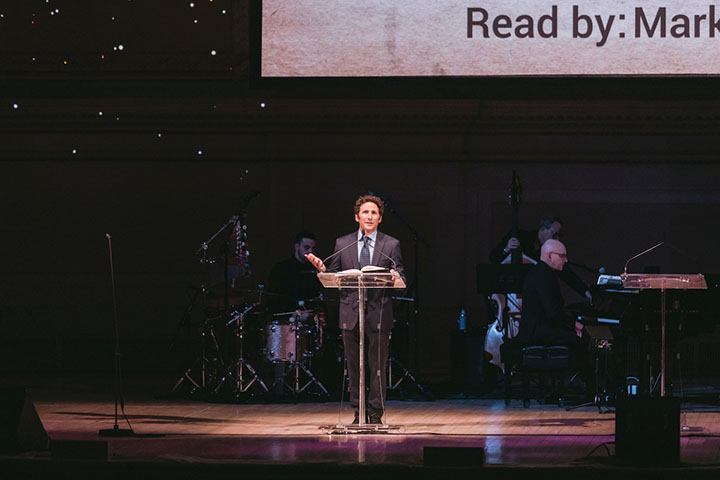
Mark Feuerstein. (C) Blake Ezra Photography 2026

Divided into three chapters—Our Journey, Our Arrival, Our Land—the show opened with the reading of a letter written by Israeli astronaut Ilan Ramon to his professor, seeking guidance on “man’s purpose in life.” It closed with excerpts from a letter written by Rabbi Lord Jonathan Sacks in 2001, telling Jews that each one is a “letter in the scroll.”

Other readings included notes written by Maimonides to Rabbi Yaphet bar Eliyahu the Judge, in the 12th century; Stephen Norman, the only grandchild of Theodor Herzl, on his first visit in the years before Israel’s statehood was declared; Esther Cailingold, who was mortally wounded defending the Jewish Quarter in Jerusalem during Israel’s war of independence; and a final letter written by Elkana Wiesel to his family, just before he fell in battle in the Gaza Strip in January 2024.

“Words have immense power,” wrote Robert Messick, the director, in the program. “Right now it feels that power is being weaponized against our community with devastating and dangerous results. But in ‘Letters, Light and Love’ we look at how that power can be used for good. How letters have been used to reach out through the darkness of fear, isolation, and hatred to dispel the shadows and to bring in the light.”

What made the evening magical was the music—our music. David Draiman singing Leonard Cohen’s “Hallelujah” and Simon & Garfunkel’s “Sound of Silence”; Cantor Azi Schwartz of Park Avenue Synagogue; the Maccabeets; “Over the Rainbow”; Matisyahu ending with “One Day.”

Only one presenter received a standing ovation: Eli Sharabi, the former resident of Kibbutz Be’eri who was kidnapped by Hamas and held in Gaza for 491 days. In an emotional speech, Sharabi thanked American Jewry for its support. Proceeds from the play will go toward rebuilding Be’eri.

“’Letters, Light, and Love’” is a celebration of not just the shared history and heritage of our people but of the beauty and resilience that we find together,” said Noé. “Throughout the centuries, when faced with hate, our response is always to focus on the light and to look forward and rebuild, and we are honored to be a conduit for people to come together and take comfort and joy in our eternal story.”

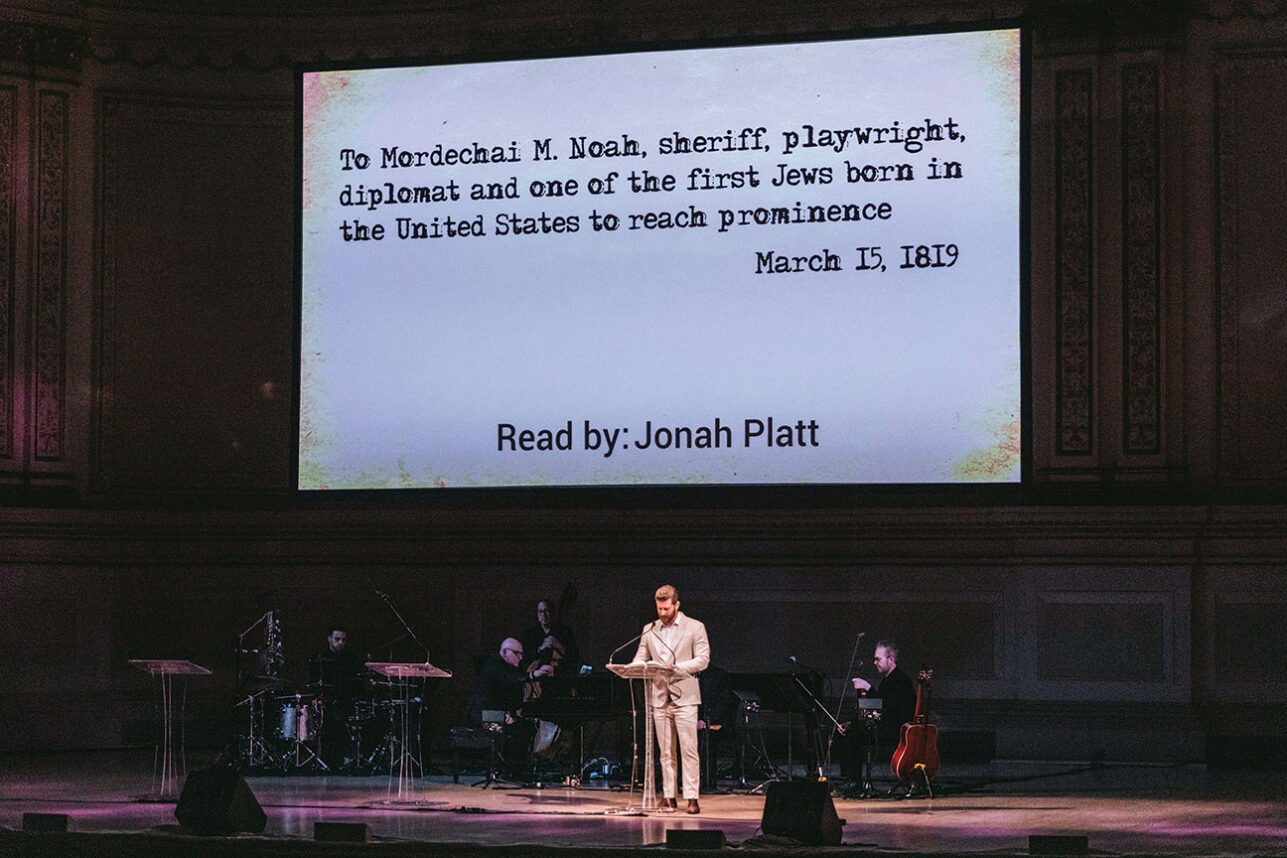
Jonah Platt. (C) Blake Ezra Photography 2026

The evening honored our creativity, non-conformity, resilience, and most important: our eternal bond with Eretz Yisrael. Looking around at the tears, laughter, and joy after two years of hell, the show was able to not just touch but nourish our souls. Because it is our souls—why we respond so powerfully to Hebrew letters, Stars of David, photos of Jerusalem—that foster the bravery and resilience needed right now.

Fittingly, the show ended with Rabbi Sacks. In December 2023, IDF soldiers serving on the front lines were given a booklet featuring a letter from his book, Radical Then, Radical Now:

“This, then, is our story, our gift to the next generation. I received it from my parents and they from theirs across great expanses of space and time. There is nothing quite like it. It changed and still challenges the moral imagination of mankind.

“I want to say to you and Jews around the world: Take it, cherish it, learn to understand and to love it. Carry it and it will carry you. And may you in turn pass it on to future generations.

“For you are a member of an eternal people, a letter in their scroll. Let their eternity live on in you.”


Karen Lehrman Bloch is editor in chief of White Rose Magazine..

Love Letters to Israel Read More »

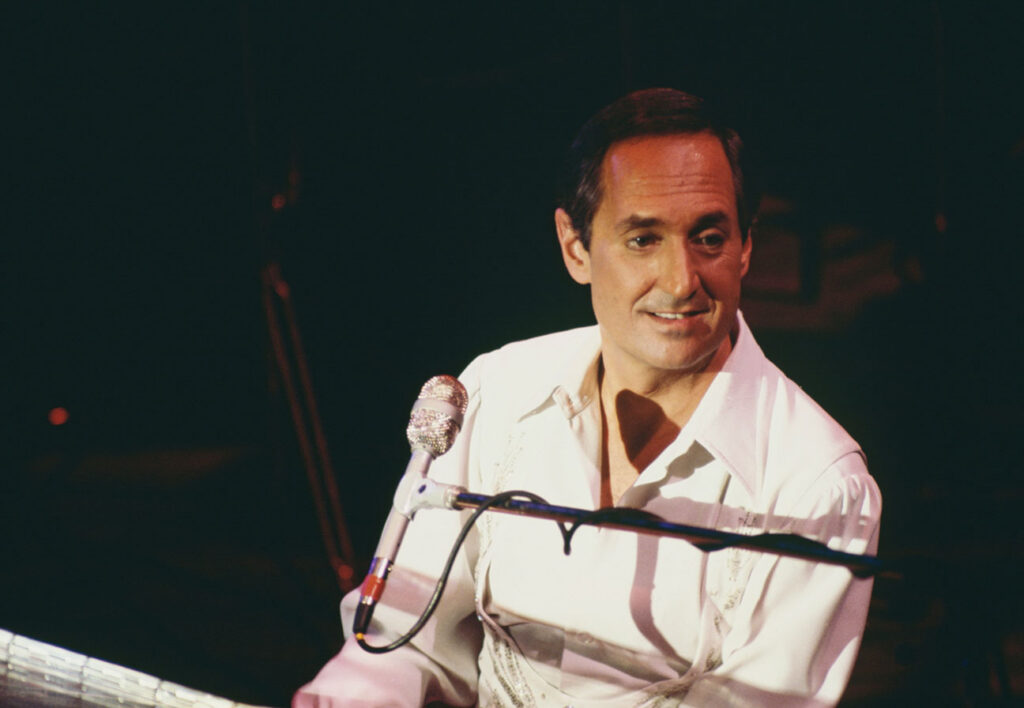
Neil Sedaka, Brooklyn-Born Hit-Maker, Dies at 86

Neil Sedaka, the Brooklynborn musical prodigy who found success with pop music— both as a hit-making songwriter and performer —  in a career that spanned from the 1950s to the 21st century, died Feb. 27 in West Hollywood. He was 86.

In the era between Elvis’ induction into the Army and the start of Beatlemania, Sedaka, with his partner, lyricist Howard Greenfield, either wrote or sang a steady production of hits. As a performer, he had a dozen top 20 Billboard hits, including “The Diary (#14, 1959), “Oh, Carol” (#9, 1959), “Stairway to Heaven” (#9, 1960), “Calendar Girl (#4, 1961), “Little Devil” (#11, 1961), “Happy Birthday, Sweet Sixteen (#6) and “Next Door to an Angel (#5, 1962). He topped the charts in 1962 with “Breaking Up Is Hard to Do.” As a composer, he co-wrote hits for Connie Francis (“Stupid Cupid,” which reached #14 in the U.S. and topped the British chart, and “Where the Boys Are,” the theme song for the movie and a #4 hit in 1958).

After the Beatles popularized the idea of a self-sufficient band that wrote its own songs, Sedaka’s clean-cut pop fell out of style. Yet Sedaka-Greenfield still managed to write hits for the Fifth Dimension (“Workin’ on a Groovy Thing” [#20, 1969], former Monkee Davy Jones’ “Rainy Jane” [#32, 1969], and Tom Jones [“Puppet Man,” #24, 1970]).

Neil Sedaka was born March 13, 1939 in Brooklyn, New York, the son of Mac and Eleanor Sedaka. His father was Sephardic and his mother Ashkenazi; Sedaka was a transliteration of the Hebrew “tzedakah.” He showed musical promise from a young age. In the second grade, his music teacher recommended he take piano lessons; by the time he was nine, he was a scholarship student at the Juilliard School. When he was 17, he was selected by Arthur Rubinstein and Jascha Heifetz to perform on New York’s classical music station, WQXR.

But the lure of pop music was too strong. He started writing pop tunes with Greenfield, his neighbor. By the time he was 19, he had his first hit with “Stupid Cupid.” In an interview with The Forward, Sedaka claimed that growing up in the heavily Jewish Brighton Beach neighborhood of Brooklyn helped shape his music. Not only his: in addition to Greenfield, other musicians from the neighborhood included Carole King, who Sedaka dated and was the subject of “Oh, Carol”; King and her co-writer, Gerry Goffin, wrote an answer song, “Oh, Neil.” Neil Diamond lived across the street. Talking to The Forward about the concentration of talent, he joked that “there must have been something in the egg cream.”

Sedaka and Greenfield rented an office in the Brill Building, where, in addition to King and Goffin, they worked beside other Jewish songwriters including Jerry Lieber and Mike Stoller, Doc Pomus and Mort Shuman, Barry Mann and Cynthia Weil, Ellie Greenwich and Jeff Barry. Pomus advised Sedaka to sign up with Jewish music publisher Don Kirshner, who felt Sedaka’s high tenor voice had potential and got him a contract at RCA Records.

By the early 1970s, Sedaka and Greenfield had ended their partnership. He moved to England and cut three albums (produced by Graham Gouldman of 10cc) which didn’t sell. Elton John, then enjoying the first flush of stardom, was a lifelong fan of Sedaka, and  released two albums on his Rocket Records. Both albums, 1974’s “Sedaka’s Back” and 1975’s “The Hungry Years,” were hits, and were certified Gold Records. Rocket released “Laughter in the Rain,” written by Greenfield and King, which returned Sedaka to the top of the charts. But his biggest hit was “Love Will Keep Us Together,” a #1 smash recorded by the Captain and Tennille (who tipped their hat to the writer by singing “Sedaka’s back” on the song’s coda).

“Bad Blood,” featuring Elton John, was another #1 hit in 1975, followed in 1976 by his remake of “Breaking Up Is Hard to Do,” this time recast as a slowed down, smoky ballad, which reached #9.

By the 1980s, Sedaka had remade himself as a middle-of-the-road balladeer. An enthusiastic and charming performer and storyteller, he remained a concert attraction. He composed a few instrumental pieces, including the symphony “Joie de Vivre” and “Manhattan Intermezzo,” a piano concerto. He returned to the pop charts with “Should’ve Never Let You Go,” on a duet with his daughter, Dara, a #19 hit.

Sedaka’s death was announced by his son, Marc. No cause of death was given. He was taken from his West Hollywood home by ambulance Friday morning. He is survived by his wife, Leba Strassberg, and their two children. The family released a statement Friday:

“Our family is devastated by the sudden passing of our beloved husband, father and grandfather, Neil Sedaka. A true rock and roll legend, an inspiration to millions, but most importantly, at least to those of us who were lucky enough to know him, an incredible human being who will be deeply missed.”

As of press time, no information on a funeral or memorial has been released.

Neil Sedaka, Brooklyn-Born Hit-Maker, Dies at 86 Read More »

Even When the Missiles Fall, We Never Forget to Dance

I am a law-abiding citizen – I even work hard to avoid parking tickets. But I am also a patriotic Israeli father by choice who has watched his kids and his friends serve hundreds of days to protect our vulnerable but remarkably resilient state. And that’s why, when, my commando son asked if he could host a “modest” Purim party with 30 or 40 of his nearest and dearest in our house, my wife and I said yes – despite the homefront command’s Iranian war limitations on people gathering together.

Imagine this megillah reading. Our readers may not have hit every right note – but they lived the Purim line to maximize fun … with your community. We had an underground reading in our house – and invited one family with six kids to bring that pure, innocent, childlike joy every holiday needs.

Let’s be clear. We live in Jerusalem. For both geographic and spiritual reasons, we have absorbed far fewer bombs than the rest of the country – I think Iranians fear the Golden Dome… or the Rock, the Mosque of Omar, more than the Iron Dome. In Tel Aviv, the regulations not to have too many people concentrated in the same Iranian target, I mean room, make sense.

At 6:15 P.M. the Purim party begins. We have heroes who have done such serious things since October 7 dressed like cavemen, like Rachel and Ross from Friends, like Azula and Zuko from Avatar. As usual, the chance of an Iranian attack looms and my son explains just where our shelter is – and where they can find the shelter next door, too. We’re a lot of people.

We read the megillah. Can you imagine what it’s like to read about a Persian prime minister seeking to destroy the Jews – as the Jewish army is finally fighting back with the American army against the Persian Jew-haters?  Can you image how every line of the megillah resonates – about the desire to destroy even the most innocent among us, about our contributions as Jews to the world, especially with these heroes-who-grew-up-in-my house: a commander from October 7 who lost his number 2 standing right next to him; an intelligence genius who has helped us outdo the evildoers; a commando whose tough service to the country began long before the Palestinian invasion of October 7.

We finish. Then, BOOM – er, the right kind of boom: all the tension so many Israelis carry day-to-day, minute-to-minute, escapes as they start to dance, dance, dance.

I am not wise enough to explain how you navigate between the bravery these kids have demonstrated, the horrors they have seen, and the sheer joy they know how to unleash. All I can tell you is:

  1. The Iranians were kind enough not to attack from the time Jerusalemites started reading megillah till way past the time any party had finished.
  2. The party my kids threw for themselves and their friends lasted deep into the night – and was so pure, so exuberant, it became clear that it takes a taste of death to consume healthy heapings of life… l’chaim!
  3. The message to one another, because they really weren’t being political or performative or historically-minded at that moment was clear: We will not stop dancing!
  4. And that is this generation’s secret to our mind-boggling success after the blows we sustained on October 7. Am Yisrael Chai – the Jewish People don’t Just live, we don’t just recreate and improve on past traumas, but even when the missiles fall, we never forget to dance.

The writer is an American presidential historian and Zionist activist born in Queens, living in Jerusalem. Last year he published, To Resist the Academic Intifada: Letters to My Students on Defending the Zionist Dream and The Essential Guide to October 7th and its Aftermath. His latest E-book, The Essential Guide to Zionism, Anti-Zionism, Antisemitism and Jew-hatred was just published and can be downloaded on the website of JPPI – the Jewish People Policy Institute.

Even When the Missiles Fall, We Never Forget to Dance Read More »

Letter to the UC Board of Regents on Fighting Antisemitism

Dear Chair and Members of the University of California Board of Regents,

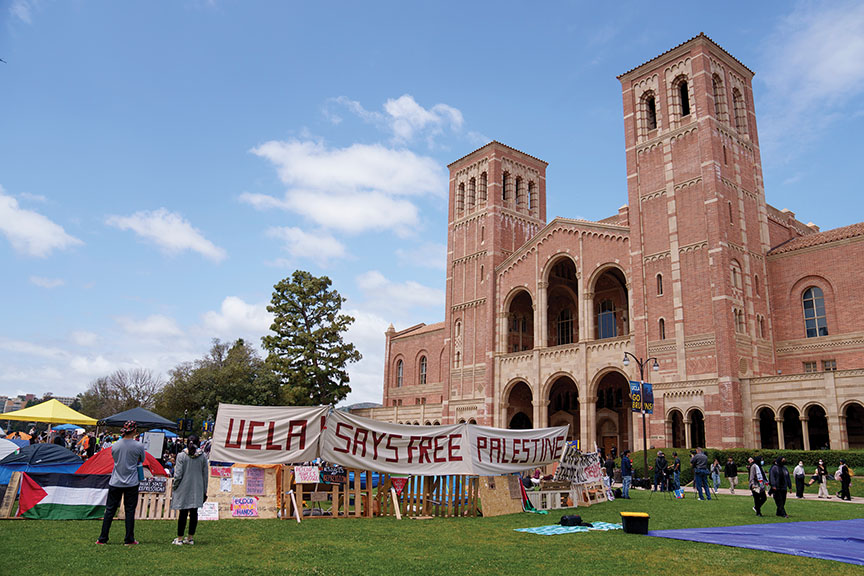
We write as current and former UC faculty, many of us in STEM fields and professional schools, in response to the release of When Faculty Take Sides: How Academic Infrastructure Drives Antisemitism at the University of California. UC is admired worldwide for rigorous teaching, original research, and open inquiry anchored in scholarly standards rather than political advocacy. That reputation depends on a simple but essential boundary: individual faculty are free to speak as citizens, but UC’s academic authority, resources, and UC-branded platforms must not be used to advance organized political advocacy as institutional practice.

The report finds that UC has not consistently enforced this boundary. In practice, political advocacy has been carried into UC’s academic life through courses, academic-unit communications, and UC-branded programming — and the result has been hostile or exclusionary conditions for some students. In the cases documented in the report, those harms fall disproportionately on Jewish students and others labeled “Zionist” or “pro-Israel,” but the underlying problem is institutional: UC academic authority is being used in ways that make political agendas appear to carry the University’s official endorsement.

Looking across UCLA, UC Berkeley, and UC Santa Cruz, the report shows the same pattern repeating: faculty influence concentrated in key unit roles; academic units using their websites, listservs, social media, and events to push one-sided messaging; new campus-branded academic initiatives that amplify that programming; and classrooms being used to steer students toward political activity.

For the Regents, the implications are not abstract. UC’s crisis cannot be resolved by treating it solely as a matter of episodic student conduct or generalized “climate.” The report describes a governance-related breakdown: UC lacks clear systemwide operational rules and consistent enforcement that distinguish protected individual faculty speech from institutional academic-unit action, and that prevent misuse of UC authority and resources inside core academic functions.

This breakdown also harms the University itself. It undermines UC’s academic mission, damages UC’s reputation as a leading research institution, and increases exposure to federal scrutiny and potential funding consequences — risks that fall disproportionately on research-intensive STEM departments and the broader UC research enterprise. When the public sees UC-branded academic units operating as political actors, confidence in UC’s scholarly standards and institutional integrity erodes. When regulators see inconsistent enforcement of rules that govern instruction, resource use, and institutional neutrality, the stakes become not just reputational but financial.

We therefore urge the Regents to act now. Enforce UC’s existing rules — and strengthen them where needed — to stop faculty and academic units from using UC authority, resources, and UC-branded platforms to advance political advocacy as institutional practice. The point is not to restrict anyone’s private speech. It is to restore a clear, enforceable boundary: UC academic units should educate and conduct research, not operate as political actors. The report lays out specific Regents-level actions to make that boundary real across all campuses, with consistent oversight and consequences when it is violated. We also respectfully request that the Regents take up the report and its recommendations for discussion at the Regents’ March meeting.

The Regents’ leadership is essential to protect UC’s academic mission and instructional integrity, safeguard equal access to UC’s educational programs for all students, and restore public confidence that UC’s academic units operate as scholarly institutions rather than political actors.

Respectfully,

Professors Judea Pearl (UCLA) and Ilan Benjamin (UCSC) along with 366 Current & Emeritus UC Faculty and Staff 

Letter to the UC Board of Regents on Fighting Antisemitism Read More »