For thousands of years, Jews have read Exodus 12:12’s explanation of God’s punishment of the slave-driving Egyptians, “… and I will bring judgment on all the gods of Egypt. I am the Lord.” But it is only recently that the full weight of that judgment has been rendered.
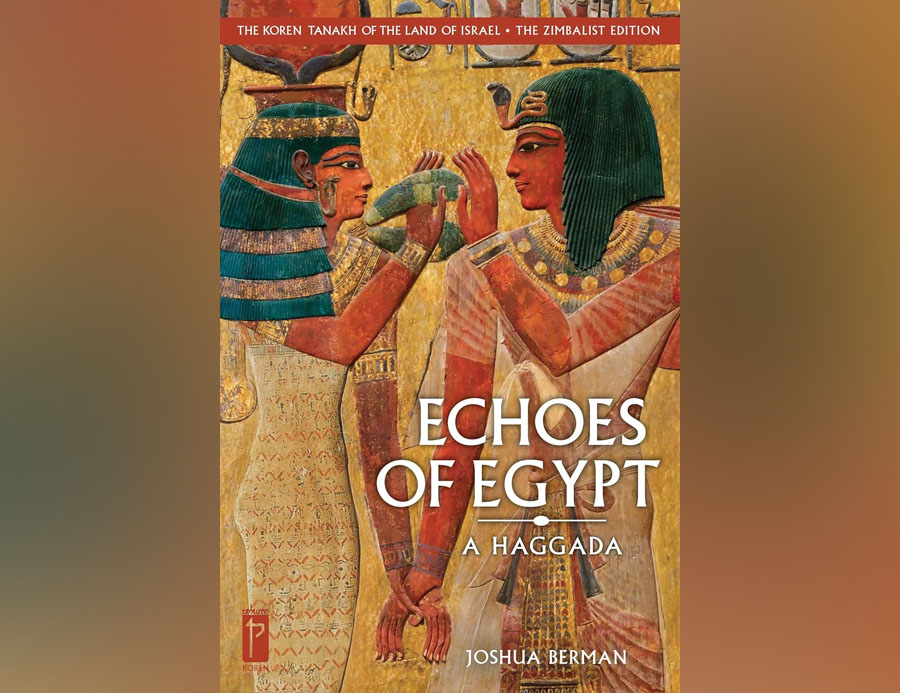
That is because modern scholars have discovered multiple ways in which a more in-depth understanding of the Exodus narrative – including its major themes, imagery, and the Ten Plagues themselves – can be gained by utilizing the knowledge of ancient Egyptian culture. As Bar Ilan University professor Joshua Berman engagingly and convincingly demonstrates in his “Echoes of Egypt” Haggadah, the process by which the Passover story took shape was as a polemic against the belief system and symbols of authority of Pharaoh and his people.
Take the shepherd’s crook, for example. Berman notes that what was in Egypt called the “heka” “represented the power, authority and responsibility of the pharaoh, who was not just a king but also, in symbolic terms, the shepherd of his people.” In countless statues and sarcophagi, “we see the pharaoh grasping the crook in his left hand, resting it upon his shoulder, a reminder of his duty to guide, protect and care for his people, just as a shepherd watches over his flock.” This lends new meaning to Moses’ staff being the stick through which plagues are wrought, undermining the physical symbol of Pharaoh’s authority. (Berman, however, does not mention an additional layer – that the image of Pharaoh-as-shepherd likely also adds political context to the ritual of the sacrifice of the paschal lamb. The Israelites brought sheep as an offering to the one true God, right under the nose of the Egyptian ruler who was purported to be his country’s protective shepherd.)
Speaking of Moses’ stick, Berman notes that at the burning bush, God has Moses turn the staff into a snake as a sign of God’s upcoming deliverance. Shortly thereafter, however, Aaron casts down the staff in front of Pharaoh and it becomes a crocodile. Why the change? “For Egyptians,” the author notes, “snakes and crocodiles were twin terrors: the apex predators of land and water. Egyptian art depicts hybrid monsters – crocodile bodies with serpent tails – and the god Horus trampling crocodiles while grasping snakes. Together they represented the totality of danger.” With these twin predators, God is demonstrating: ultimately obey Him, not the tyrannical monarch.
Then there are the Ten Plagues. In a representative example, Berman notes how “The Eye of Ra” was an emblem of the sun god’s power. When the plague of locusts blotted out the sun, covering “the eye of land,” per Exodus 10:5’s description, it “demonstrated that even the mighty Ra, the most powerful of Egypt’s gods, was powerless before the God of Israel.” (The medieval commentator Rashi, though he did not have access to modern scholarly knowledge of ancient Egyptology, mentions a tradition that Pharaoh evoked the pagan god Ra in defying Moses’ request to free the Israelites.)
Even the number of plagues holds symbolic value. Berman writes that the number nine carried symbolic weight for Egyptians, often signifying completeness or totality. “The Egyptians referred to their enemies collectively as ‘the Nine Bows,’ a term that symbolized total opposition … Pharaoh Seti I, for instance, is depicted trampling the Nine Bows, representing Egypt’s vanquished foes.” By literally one-upping Egyptians’ perception of how to quantify the forces of their enemies, God is undermining the premise of the Egyptian worldview.
And it is not only what Moses and Aaron held in their hands that counters Egyptian iconography, but the literary motif within the Exodus story of evoking God’s own mighty “hand.” As Exodus 15’s Song of the Sea states, God’s “right hand is adorned in strength … [and] smites His enemies.” Scholars have uncovered that during the time period of the Exodus, “the most ubiquitous motif of Egyptian narrative art is the pharaoh raising his right hand to shatter the heads of enemy captives.” So by the Torah emphasizing God’s own saving right arm, it shatters the perception that Pharaoh’s own has any might at all.
The mention of the Lord’s right hand is not the only anti-Pharaoh allusion in the Song of the Sea. Berman cites numerous details from the Kadesh inscriptions, which document the battle of the Pharaoh of the Exodus story against another population, the Hittites. In those summaries of the fight composed by Egyptians, a plea for divine help is answered with encouragement to move forward; the enemy chariotry, recognizing by name the divine force that attacks it, seeks to flee, amazed at the victorious king’s accomplishment. The troops offer a victory hymn that includes praise of his name and references to his strong arm, and they offer tribute to him as the source of their strength and their salvation. The Song of the Sea’s containing all of these themes as well is a poetic way of utilizing the verbiage of Pharaoh’s supposed victory against the Hittites against him, showing how Israel’s God is the one who won the decisive battle against the monarch.
Berman notes that the repercussions of the rebellion against Egypt and its ideology helped shape the United States. “‘We hold these truths to be self-evident,’ proclaims the American Declaration of Independence, ‘that all men are created equal, that they are endowed by their Creator with certain unalienable Rights, that among these are Life, Liberty, and the pursuit of Happiness.’ Although the American founding fathers regarded equality as ‘self-evident,’” Berman notes, “many civilizations throughout history did not share this view. In fact, they were based on precisely the opposite paradigm – that people are not created equal: that the human community is like a pyramid, with the privileged few perched at the top, and the feeble masses below them. And nowhere was this truer than in ancient Egypt.”
In flipping Egypt’s spiritual script, then, the concept of freedom as we know it was forged. Pharoah’s forces were no match for the Lord and the liberty He gifted to His people.
Rabbi Dr. Stuart Halpern is Senior Adviser to the Provost of Yeshiva University and Deputy Director of Y.U.’s Straus Center for Torah and Western Thought. His books include the newly released “Jewish Roots of American Liberty,” “The Promise of Liberty: A Passover Haggada,” “Esther in America,” “Gleanings: Reflections on Ruth” and “Proclaim Liberty Throughout the Land: The Hebrew Bible in the United States.”