fbpx

April 30, 2025

Death in the Valley: Two Israelis Murdered Saturday in San Fernando Valley

The LAPD is investigating the homicides of two Israeli men found dead in their residences on Saturday in what appear to be unrelated incidents.

Police were called to a home on the 22200 block of De La Osa Street in Woodland Hills just before 1 a.m. on Saturday, April 26. There, they discovered the body of 47-year-old Alexander Modebadze. The Israeli businessman moved to the U.S. 15 years ago and, according to neighbors, had been living in the house for the past couple of years.

He was found badly beaten, with severe head trauma, and was pronounced dead at the scene.

According to the Los Angeles Police Department, the attack was premeditated and staged to look like a robbery. Eyewitnesses told police they saw a group of people entering the house before fleeing the scene. Officers collected evidence and reviewed surveillance footage, along with forensic material, in an attempt to identify the suspects and determine the motive.

“We found very unusual signs at the scene that indicate murder,” said detectives from the Valley Police. “We believe that the fact that there were people in the house who fled shortly before the body was found suggests that the incident was criminal, and we are working to locate the suspects involved.”

Three suspects were arrested a few hours later and identified as Georgian nationals: Pata Kochiashvili (38), Zaza Outarashvili (46), and Basiki Kutsishvili (52). According to the LAPD, the three broke into Modebadze’s home, held him captive for hours, beat him severely, and caused his death from head trauma. They then fled with stolen property.

The arrests were made with the assistance of the FBI. Kochiashvili was apprehended in the Van Nuys neighborhood, while Outarashvili and Kutsishvili were arrested together in nearby Glendale. Each is being held on $2 million bail.

Witnesses reported seeing several suspicious individuals enter the home late at night and leave shortly after. Neighbors described Modebadze as a sociable man with no known public disputes.

Later that day, at 2:30 p.m., police were called to an apartment on the 12600 block of Riverside Drive in Valley Village, to conduct a welfare check after relatives were unable to reach the resident. Upon arrival, they found the body of businessman Menashe “Manny” Hidra, the brother of Nitzan Prison Warden Moshe Hidhra in Israel.

Police have not disclosed the nature of his injuries, and it is not yet confirmed whether a firearm or knife was used.

There is no apparent connection between the two incidents.

This is an ongoing story. Follow here for updates.

Death in the Valley: Two Israelis Murdered Saturday in San Fernando Valley Read More »

Amen. Selah.

This week, we observed Israel’s most poignant national juxtaposition: Yom HaZikaron, Israel’s Memorial Day, immediately followed by Yom HaAtzmaut, Israel’s Independence Day. The first is a solemn day of communal mourning and reflection honoring the lives of fallen soldiers and victims of terror. Each year, the nation comes to a powerful standstill during the two-minute piercing siren, a moment that unites Israelis in shared grief. And then, with hardly a pause, the country shifts – from heartbreak to celebration – honoring Israel’s independence and enduring resilience.

The transition from grief to joy can feel jarring. But the deliberate sequencing offers a compelling life lesson rooted in Jewish tradition: we reflect before we rejoice, giving deeper meaning and importance to both.

In today’s hyperintense and often chaotic world, we rarely give ourselves permission to pause. We rush through our days, weeks, and years, often failing to mark our achievements and milestones with intentionality. In her book, “The Amen Effect,” Rabbi Sharon Brous emphasizes the value of acknowledging and affirming others, highlights the need for fostering community and belonging, and encourages us to seek out moments of meaning. Her ideas resonate with the themes of remembrance and celebration; “Amen” in Hebrew means “certainty” or “so be it,” an affirmation of our faith and an expression of agreement with a statement, prayer, or blessing.

Several years ago, I saw the power of intentional pauses for reflection came alive during a visit to Havaya Arts, a Jewish specialty camp launched through Foundation for Jewish Camp’s Specialty Camps Incubator. Under the shade of a majestic oak in Redlands, California, chanichim (campers) and madrichim (counselors) engaged in a daily practice called Selah – a pause at the beginning and end of each day and session. Like the uncertain exact meaning of the Hebrew word often found in Psalms, Selah at camp offered moments of sacred interlude – a break for reflection, connection, and even “selah-bration.”

Watching young people take turns expressing themselves and supporting each other in those moments of pause made a lasting impression on me.  It underscored the profound impact of creating a space for communal reflection. Just as Selah provided a time and place for individual and collective processing at camp, the reflective nature of Yom HaZikaron serves a similar purpose for the Israeli people – a day to collectively process loss before moving toward hope.

In our liturgy, Amen and Selah sometimes appear together. It’s not accidental. By doing so, our words gain additional emphasis and amplification. Following a moment of contemplation and reflection (Selah), we acknowledge and affirm life and community (Amen). This rhythm of pause and affirmation mirrors Israel’s national consciousness during these holidays.

After 15 years leading Foundation for Jewish Camp, I recently stepped down from the day-to-day intensity of the CEO role. The past five-plus years – navigating and stewarding the field through the pandemic, California’s destructive wildfires, and the continuing trauma since Oct. 7 – have been all-consuming. With both of our children now living in Israel, our first grandson approaching a year-and-a-half, and another on the way, b’sha’ah tovah, my wife and I need the flexibility to spend more time there.

This transition has offered me my own Selah – a time to reflect, to process, and to give thanks.  

From my unique vantage point, I have witnessed firsthand the profound impact of Jewish camps across North America. More than places of summer joy, these camps are incubators of Jewish identity, belonging, and leadership. They are the heart and soul of our Jewish future.

These past two months of reflection have filled me with admiration and gratitude for the inspired and tireless work of our many talented camp professionals and dedicated lay leaders, and the generosity of programmatic funders and individual donors. I am proud of all we have accomplished together – raised $250 million since 2010, invested in initiatives to improve mental health, make camps more accessible, and expand capacity, and reached a record-breaking 190,000 participants in Summer 2024 – a true testament to the strength and vitality of this essential field.

The intentional pairing of these two days represents the ultimate example of Selah and Amen; we pause, and then we affirm.

This week, as we commemorated Yom HaZikaron on Wednesday and celebrated Yom HaAtzmaut on Thursday, we witnessed – yet again – how Israel transforms mourning into hope, darkness into light, and memory into mission.  The intentional pairing of these two days represents the ultimate example of Selah and Amen; we pause, and then we affirm.

May we each continue to find meaning in our moments of pause, appreciation in our milestones, and strength in the communities we build together. As Israel reminds us, resilience grows not from forgetting the past, but from honoring it as we step forward into the future.

Amen. Selah.


Jeremy J. Fingerman recently concluded a 15-year tenure as CEO for Foundation for Jewish Camp and now serves as FJC’s Senior Advisor.

Amen. Selah. Read More »

What Can We Say When Silence Is the Only True Response?

This is the sermon I gave in the Krakow synagogue to a congregation mostly of teens in Poland for March of the Living, who walked the previous day from Auschwitz to Birkenau. 

Shhhh.  Shhhhhh.

In the Torah portion we read this Shabbat, when Aaron’s sons die, the Torah gives us two words — vayidom Aharon.  And Aaron was silent. 

Silence is the only true response.  It contains everything, all the pain, the memories, the possibilities that cannot be said in words.  Aaron expresses the deepest response to tragedy.  What we have seen, all of us, the stories we have heard and the anguish we have only barely imagined, defies words.  If we were to be faithful we would be silent.

But if we are silent we cannot tell their stories.  And they have to be told.  Because although many of you are in your teens, let me confirm something you already know.  Each year of life is a year of loss.  Each year you live is a year that you recognize — oh. They never got to this age, to that age.  They never reached 21, or 30, or 50.  I’ve spent my whole life reading about the Holocaust and I never knew what it was to not reach my age until I reached it in life.  Every year you live, your recognition of their loss will grow.  Bless you for being here so you can understand that. 

I want you to remember not only the faces of the victims, the desperation in the eyes and the hunger, both physical and spiritual, but the faces of the perpetrators.  When I saw those faces I remembered what was said about Charles Dickens, that he disliked a certain look on the face of a man when he looked down on another man. Hating that look, the mix of swagger and power and false pride and cruelty, that is what we have to keep in mind as we move through this world. The eyes of the victim, the smirk of the perpetrator. 

We take three lessons from these camps.  The first is that we must keep telling their stories.  Again and again and again, even if it is in the ears of a tired and reluctant world.  We owe them that — they must not be forgotten.  Remember, in the echoing silence, that you are a voice for each man and woman and child. 

Second, that as they died as Jews, we live as Jews.  We do not turn our backs on the tradition that cost them their lives and for so many, gave ultimate meaning while they lived.  The tradition that led people to light candles in the camps. We owe a debt to our people and our past.   Remember that in the cattle car you saw at Auschwitz there is a pair of tefillin.  They are there because a man arriving in Auschwitz tried to go back on the train to get his tefillin and died for it.  And his child, who survived, insisted on putting tefillin there as a memorial to his father.  Remember the love for tradition that led the father to go back, and the child’s love that led him to remember. 

We also owe a debt to the present and the future of our people. That’s why we pray for the hostages, why we were moved when we saw Agam Berger play the violin yesterday and why we are Zionists. 

Third, we can never turn our backs on others in the world who suffer. We leave here as witnesses but also as shlichim, messengers.  Our voices are deepened by the knowledge of what human beings can do to one another and our responsibility to combat that evil. The world needs your voice. 

I said before that in the face of the Shoah silence was the only true response.  But since we must speak, we repeat the testimony of those in the camp.  When they liberated Theresienstadt, they tore up the floorboards of the camp.  There they found under the children’s barracks poems and drawings and reports.  These inmates were your age, and younger.  They had suffered unspeakably, and most of them died.  The majority of the drawings and poems are anonymous forever.  Here is a poem that was written by a child.  I don’t know how old that child was, boy or girl, but I know that from the hell of Theresienstadt, here are their words:

BIRDSONG

He doesn’t know the world at all

Who stays in his nest and doesn’t go out.

He doesn’t know what birds know best

Nor what I want to sing about,

That the world is full of loveliness.

When dewdrops sparkle in the grass

And earth’s aflood with morning light,

A blackbird sings upon a bush

To greet the dawning after night.

Then I know how fine it is to live.

Hey, try to open up your heart

To beauty; go to the woods someday

And weave a wreath of memory there.

Then if the tears obscure your way

You’ll know how wonderful it is

To be alive.

If the memories people shared brought you to tears, you will hear the message: Having seen humiliation, we prize dignity.  Having seen cruelty, we hold on to decency.  Having seen a place designed for death, we cherish life.   

Beyond that, there is silence.   


David Wolpe is the Max Webb Emeritus Rabbi of Sinai Temple.

What Can We Say When Silence Is the Only True Response? Read More »

I Can’t Remember 1200 Names

Should I be here? I’m not sure. Yet I follow our guide, Rita, from burned house to burned house in Kibbutz Nir Oz. The kibbutz where one out of every four residents was either murdered or kidnapped to Gaza on Oct. 7. Like the Bibas family. And like Oded Lifschitz, Rita’s father-in-law. 

 I am stepping into houses where people were slaughtered. What in the world am I doing here, trespassing, however respectfully, on their horrors? 

I’m here because I need to remember them, as individuals. I used to remember every terrorist attack, read about every victim. How can we do that when 1,200 were murdered in one day? 

I’m with a tour of Otef Yisrael (I don’t use “Gaza Envelope”) run by the nonprofit Israel Defense and Security Forum. Although Otef settlements are closed to the public, as they should be, we have permission to spend over an hour walking the grounds of Kibbutz Nir Oz. Once the security team opens their yellow steel gates, you are a guest in their home. 

We step over the door frame, careful not to trip over broken steel frames and electrical wires. We duck here and there to avoid metal infrastructure rods hanging from the ceiling or a broken chair, a sofa or the remains of Oded’s piano. Rita holds up pre-Hamas pictures of the house. “Over there is the piano Oded loved to play,” she says. I look behind me. I see an odd-shaped metal skeletal something. That was a piano?

Steel support beams are twisted sculptures, rusted or blackened. A maze to be navigated. I want to touch them and the ashes on the windowsills. Pieces of cement walls are strewn around like an artist’s final touch. But I don’t. They are sacred. 

I take a here and now moment in front of the Bibas family home. A white rocking horse rests against a tree. Overturned flowerpots, the familiar posters of the once-anonymous, normal family that lived there. Their pergola is untouched. A large poster of Shiri and Kfir is placed on a lounge chair. Children’s plastic chairs are stacked up. 

Rita brings the victims to life with their stories, their hobbies, their loves. Then they are gone: 

“He was murdered in the safe room.” 

And we see his spattered blood on the floor and walls. 

“This one was kidnapped to Gaza and murdered there.” 

She repeats these phrases. She is living her trauma as the words pour out, steady and powerful. A recording, yet live. Her face tightens, muscles scrunching with the weight of her words that reverberate around blackened, cracked walls.

“Kidnapped on Oct. 7.”

“Murdered on Oct. 7.” 

Her soul is screaming: 

“Do you get it? They are dead! We lost 25% of our kibbutz.” 

But she isn’t screaming. The tone is dead level.  And I’m trying to get it. I’ve been trying to get it for 18 months. 

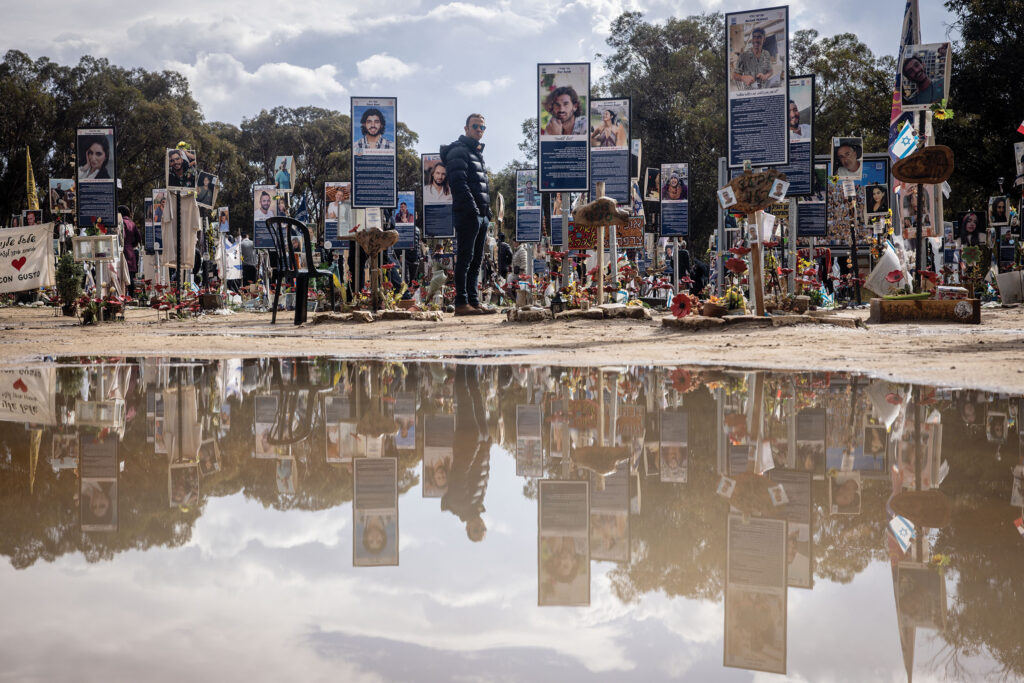
And I’ve also been trying to get the enormity of the loss suffered at the Nova festival, our next stop. I stand on the spot where a family friend and 17 others were burned alive when Nukhba terrorists fired an RPG at the ambulance where they had taken refuge. I find her poster. Then I weave my way among the posts displaying more pictures and stories of the victims. Some posts are encircled by a low perimeter fence, creating a space for personal items like flowers, memorial candles and Israeli flags. I can’t read, comprehend and internalize over 370 stories of these individuals who must be remembered. As a people, we are trying. The site has over 7,000 visitors daily. We need to feel their lives, not the loss.

Soon it will be Memorial Day. We have ceremonies for fallen soldiers and, since 1998, a separate one for civilian victims of terror. Now, do we add one for the victims of Oct. 7? Does it matter? I just need to connect.

I won’t remember all the names. But I have touched the earth where they lived, danced and died. The dust and ashes have touched my skin. Sometimes this is the best we can do to keep memories alive.


Galia Miller Sprung moved to Israel from Southern California in 1970 to become a pioneer farmer and today she is a writer and editor. 

I Can’t Remember 1200 Names Read More »

Trumponomics

The story goes that President Truman assembled a team of economists to advise him. Each of them argued that “on the one hand” the government should do this, while “on the other hand” they should do something different. A frustrated Truman finally shouted in desperation: “Find me a one-armed economist!”

It is certainly the case that economists, on occasion, aren’t all that clear about the best policies. But many of us agree on a lot more than you may imagine. Here are some timely examples:

Tariffs are almost always bad. Sure, they might be strategically applied where trade imbalances arise from unfair practices, but the manner in which the Trump administration is going about instituting arbitrary tariffs on friends and foes alike is, to put it mildly, misguided. It will undoubtedly lead to higher prices, lower employment, and slower growth. Economists have understood for centuries that protectionism is harmful for everyone — including the workers and industries it purportedly is trying to help.

Governments can be inefficient and bloated. There are too many absurd regulations, and too many employees who spend more time holding back economic activity than facilitating it. But the “chainsaw” approach we have been witnessing jeopardizes both economic growth and our safety. I suspect that I am among a sizable number of economists who would support, say, a carefully considered 10% reduction in force — rather than the wholesale layoffs we have been seeing. And doesn’t basic human decency demand a modicum of empathy for those affected?

There is a point beyond which federal and other taxes are so high that they create significant labor disincentives. However, as a rule of thumb, if your take-home pay is close to half of your gross pay, you are unlikely to either work less or to move to a lower-tax state or country. For the richest Americans residing in high-tax states (the top tax rate in California, for example, is 12.3%), they are around that right now. Continuing the Trump tax breaks from 2017 (which lowered the maximum tax rate from 39.6% to 37%) isn’t a terrible idea, but to further reduce marginal tax rates for the most affluent would be unfair and inefficient.

The independence of the Federal Reserve Board is a cornerstone of our economy. While presidents have sought to intimidate the Fed into doing their bidding, Fed chairs have typically acted beyond politics. Chairman Jerome Powell has done a remarkable job navigating inflationary pressures and keeping us out of a recession. Should President Trump follow through on his threats to remove him, the recent chaos in financial markets will pale by comparison. 

For 75 years, the partnership between the federal government and research universities has fostered economic prosperity, while enabling us to live longer and healthier lives. Schools spend a great deal of money to build and maintain laboratory spaces — around 60 cents for each dollar of a government research grant. But the government intends to cap its administrative contribution at just 15 cents per dollar, a level that would severely limit future investments in science facilities. If the intention is to undermine growth and innovation, this is an excellent start. 

Imposing the Trump administration’s will on colleges and universities by withholding federal funds is a highly problematic proposition. I have been appalled by the way many institutions handled protests that clearly manifested Jew-hatred, and I have long lamented the “woke” mentality prevalent in certain academic disciplines that has served to impede the pursuit of knowledge while stifling genuine debate. But I can’t think of a single economist who would agree that shutting down research labs and threatening student financial aid is the solution. What’s more, President Trump has for decades made his distrust of “elite” higher education well known. To justify his actions in the name of “protecting the Jews” places us in an all-too-familiar scapegoat role. 

The president likes to remind us that he graduated from the University of Pennsylvania’s fabled Wharton School. I taught there and know how exceptional their students are. They ask incisive questions and seek out the truth. President Trump has apparently forgotten much of what he studied at Wharton. Maimonides, the most extraordinary mind in Jewish history, extolled the virtues of lifelong learning. 

 It may be time for our president to go back to school.


Morton Schapiro served for more than 22 years as President of Northwestern University and Williams College, where he was also Professor of Economics.

Trumponomics Read More »

Why Preserving Medicaid Is a Jewish Value

My Biblical namesake Miriam contracted a horrible illness known as tzara’at, often translated as “leprosy,” which modern commentators believe was a skin rash with a spiritual component requiring ritual purification. There’s no record she needed to show her health insurance card before being offered support, both from her brothers Aaron and Moses and from the entire community, who waited out her isolation period of seven days. 

Throughout our sacred texts, there are other instances of people getting sick and then healed, such as in 2 Kings when Naaman, a powerful Syrian general, also has the same terrible tzara’at. He seeks out Elisha the prophet who doesn’t meet him in person but sends a medical plan: bathe seven times in the Jordan. Naaman is at first offended — but finally complies and is healed. In this example Naaman is a foreigner and a military enemy, yet the Jewish prophet still finds compassion and offers him medical advice.

Much later we have Maimonides (1138–1204), known as the Rambam. He was a rabbi, philosopher and court physician to Sultan Saladin in Egypt. Rambam saw providing medical care as a commanded obligation, and using Talmudic reasoning, wrote that if you can restore a person’s health and don’t do so, you are in fact violating Jewish law.

At this point, you might be saying to yourself, very interesting, Michelle, but what do these three examples of Jewish history have to with me, my family and my community? 

Well right now we are facing down a dark cloud of uncertainty over the future of Medicaid, our national health insurance program for the poor, elderly and disabled. 

The current House budget calls for cutting a staggering $880 billion over the next 10 years, and the only way to accomplish that goal would be to make deep cuts in our Medicaid program, which is a joint federal and state program. In California, the program is called Medi-Cal.

Medi-Cal covers 14.5 million Californians, including 39% of all births statewide, includes 2.3 million seniors and people with disabilities, many of whom receive In-Home Supportive Services (IHSS) which provides for caregivers in their homes instead of being forced into nursing homes, which are far more expensive and less desirable. 

Medi-Cal is also the health insurance for 3.4 million working Californians whose employers don’t offer health insurance in such industries as agriculture and restaurants.

As the Executive Director of the nonprofit JLA Trust which helps hundreds of people with disabilities keep their government benefits through affordable special needs trustee services, and as the mother of a 30-year-old-son with severe disabilities, I know firsthand the primacy of preserving Medicaid, and why is this is a front-burner issue for our Jewish community. As Rabbi Richard Address of Jewish Sacred Aging has written, “We have written and spoken about the fact that the issue of health care, in all its ramifications, is now THE social justice issue for our generation.“

There’s Irene, a 82-year-old frail Jewish woman who uses a wheelchair. Her daily IHSS worker ensures that she is eating, able to take showers and can stay in her beloved home, with its many memories and items collected over a lifetime.

For Sam, a 40-year-old man with Type 1 diabetes, Medi-Cal pays for his ongoing care, including an insulin pump and monitoring devices.

And for Debbie, 50, who is blind in one eye and has chronic pain conditions, her Medi-Cal health insurance is the only way she can see the specialists she depends on, along with her prescription medications.

Nationally, for those one in five people enrolled in Medicare who also receive Medicaid, any cuts will reduce their ability to access healthcare, including prescription drugs. Medicaid covers the monthly premiums for Part B of Medicare and covers out-of-pocket expenses, such as co-pays and deductibles. Medicaid also covers important health-related costs not covered by Medicare, such as transportation to medical appointments, medical equipment like mobilized wheelchairs, dental, vision, and hearing benefits.

As Moses said to Hashem many years ago, “Please God, heal her (Miriam), I beseech you” we now need to speak out as one voice and ensure the continued healing of the most vulnerable among us.


Michelle K. Wolf is a parent disability advocate and the Founding Executive Director of JLA Trust & Services https://jlatrust.org/

Why Preserving Medicaid Is a Jewish Value Read More »

The Times They Are a-Changing

Now that Ukraine and China are back in the headlines, American public and media attention has drifted further away from the war in Gaza. President Trump is certainly not ignoring the Middle East: his representatives have begun negotiations with Iran over that country’s nuclear program, the U.S. military has accelerated its aerial attacks on the Houthi terrorists, and the Justice Department has mounted an aggressive effort to crack down on antisemitism on our college campuses. 

But the war between Israel and Hamas is no longer at the front of political and public debate, so there has been less attention paid to how American voters’ feelings toward Israel may have changed since Hamas’ invasion almost a year-and-a-half ago. We know that progressive anger toward both Trump and Joe Biden has intensified since the Oct. 7 attacks. We know that attitudes about the war have increasingly divided along partisan lines. But how has public opinion here changed toward the Jewish state since the war began?

The Pew Research Center, the most reliable polling source in this country on international matters, has provided an updated snapshot of what the American people think about our long-time Middle Eastern ally. The picture is a decidedly unsettling one.

For the first time ever, more Americans now hold a negative opinion of Israel than a positive one. Their new poll showed that 53% of voters here think unfavorably of the Jewish state, a marked increase from the 42% who held negative attitudes since their last survey on this topic was taken before the war began. Feelings toward Prime Minister Benjamin Netanyahu are even worse, as a majority of Americans (52%) have little or no confidence in Netanyahu to “do the right thing regarding world affairs,” while only 32% voice confidence in him.

It should not be surprising that there is a marked partisan skew to these numbers. More than two-thirds of Democratic respondents expressed their disapproval of Israel (69%), while only 37% of Republicans shared that negative opinion. Democrats were especially virulent in their disapproval of Netanyahu, as only 15 percent support the prime minister. A slim majority of Republicans (51%) express confidence in Netanyahu. This implies that the shift might be temporary and could be reversed when Israel selects a new leader.

But the more surprising results are those broken down by age. There has been clear evidence for some time that young people have been less supportive of Israel than their parents and grandparents. But the Gaza war has complicated the generational divide. While Republicans under 50 are less committed in their support for Israel than older members of the GOP, the breakdown among Democrats is even more troublesome. 

Younger and older Democrats alike have turned more negative toward Israel over this period, but negative views among younger Democrats have grown by 9 points, compared with a 23-point increase among older Democrats. This suggests that the historical memories of Israel’s past that have historically buoyed the Jewish state’s approval ratings among those who recall the Six Day War and the Yom Kippur War no longer carry the same impact with that older generation.

Over the years, Israel’s growing economic and military supremacy have given pause to many progressives who have come to see the Middle East’s one-time brave and stalwart underdog resisting the surrounding Arab nations now instead as an oppressor of its Palestinian neighbors. But those attitudes have been most prevalent among those too young to have experienced Israel’s struggles to survive. The fact that so many older Democrats have become more disillusioned with Israel raises troubling questions about the Jewish state’s long-term political support in this country.

The fact that so many older Democrats have become more disillusioned with Israel raises troubling questions about the Jewish state’s long-term political support in this country.

The war in Gaza will end at some point, either with Hamas’ elimination or a grudging and temporary settlement. But until now, many of us had assumed that Israel would regain its standing in the eyes of the American voters once the fighting had stopped. These poll numbers suggest otherwise. They force us to confront the possibility that Israel’s reputational restoration will require not just time but a considerable amount of work.


Dan Schnur is the U.S. Politics Editor for the Jewish Journal. He teaches courses in politics, communications, and leadership at UC Berkeley, USC and Pepperdine. He hosts the monthly webinar “The Dan Schnur Political Report” for the Los Angeles World Affairs Council & Town Hall. Follow Dan’s work at www.danschnurpolitics.com.

The Times They Are a-Changing Read More »

Light from Within

When the sun begins to dip toward the western horizon on Friday afternoon, I close my phone and computer with a sense of satisfaction. For the next 25 hours I will ignore the outside world of work, commerce, news, social media, texts, and WhatsApp messages. Instead, I will focus on my inside world of connecting to my Jewish soul.

Dressed in my Shabbat clothes, I walk to the dining room and stand in front of the console table nestled next to the window. My candles await.

Fridays are hectic days, filled with physical tasks: shopping, cooking, cleaning, setting the table with an elegant tablecloth and fresh flowers. Tasks now complete, I take a moment to focus on this transition from the mundane to the sacred. I strike the match, lighting one candle, then two, moving on to three and four. When the heat comes closer, too close, I shake out the match and strike a second for candles five and six. 

Like my mother, grandmother, and an unbroken line of female ancestors before them, I wave my hands toward me three times in a circular motion before reciting the blessing. No one knows exactly why this custom evolved or what it means, but I read somewhere that we are waving our inner soul energy back to its source, after pursuing externalities for the last six days. I love this idea.  

Two of the six candles are for the mitzvah of welcoming Shabbat; the other four are for each of my children. When all six candles are lit, I inhale deeply, filling my lungs and spirit with the first moments of serenity and holiness of the seventh day. Lighting my candles with intention helps set this tone in my home. I hope it also spreads a little of the same light throughout the Jewish world. Two candles stand in tall, modern, hammered metal candlesticks; the other four candles nest in small matching gleaming holders. I leave my shutters open so that passersby can see the candlelight from the street. Later, I’ll stand outside to enjoy the same view: light from within.  

I don’t pray formally as often as I ought to, so I especially cherish these moments of welcoming Shabbat. I do not rush through my blessings. This light of Shabbat was built into the foundation of the universe, and I believe that it can counter the darkness of worry, of pain, of conflict, of trivialities. What a powerful idea to think about when we embrace the light.

Looking at the swaying little flames, I thank God for this gift of Shabbat — a word that means “cease.” If I didn’t keep Shabbat, would I ever stop for a full day, setting my material and ego concerns aside? Would I ever prioritize time to press the spiritual reset button? I also thank God for my wealth of blessings, and pray for the physical, spiritual, and emotional health of my family. I say the full names of my husband, our children, their spouses, and our fourteen grandchildren. This is, thank God, a lot of names, so this doubles as a brain exercise. Saying their names, I summon each bright, cherished face in my mind’s eye, every one a source of light, every one a blessing. I pray for an end to the suffering of our people, and for God to hasten the promised final redemption, when the entire world will know peace.

Finally, I pray for my continued strength to try to bring light into the world, not just on Shabbat but every day through the words I think, speak, and write. I pray for health to take care of my family, because even though the kids are raising families of their own, they still need me and I need them. My husband and I need each other too. I ask for continued vitality to create and to achieve.

For another moment I gaze at the candles, absorbing their gift, and begin 25 hours of renewal.


Judy Gruen is the author of “Bylines and Blessings,” “The Skeptic and the Rabbi,” and other books. She is also a book editor and writing coach.  

Light from Within Read More »

I’m Not Sure I Want to Grow Older as a Jew in LA. Here’s Why.

I worry about growing older in America, a land I love, but where rampant individualism runs over altruism like a convertible over roadkill on Route 66. 

If the uniquely American focus on fattening oneself up as materialistically and emotionally as possible (can devoted followers be counted as taxable dependents?) wasn’t bad enough, the Kryptonite to growth, also known as social media, seems poised to ensure a new generation that will set record lows in basic empathy and human connection. Combine one part solitary social media addict with one part desensitized-to-violence video game fiend, and the result is categorically someone whom I worry will cut off my benefits in 30 years when I am a senior.

But now, the remaining one-third of my visceral concern over growing older in this country has been whittled down to both a county and a religious affiliation/ethnicity: I’m not only worried about aging in my beloved America; I am also viscerally afraid of growing older as a Jew in Los Angeles.  

Perhaps it all began with the introduction of an ethnic studies course for high school students in California that Governor Gavin Newsom signed into law in 2021. As an Iranian refugee, I would normally appreciate the subject matter, if it were nuanced. But in the hands of radical leftist activists disguised as educators, ethnic studies invariably paints Jews as privileged white oppressors and unforgivable colonizers. Not exactly the kind of people who deserve free speech, dignity, and basic humanity. Just ask older students on college campuses who have physically assaulted their Jewish peers or prevented them from accessing certain spaces.

By 2030, students in this once-golden state won’t be able to graduate high school without having been enrolled in a course that explicitly dehumanizes Jews. 

Let’s see: That leaves me with roughly five years to either underwrite a $1 billion social media campaign that helps California teens see my humanity and learn my true history (anyone willing to loan me $1 billion?), or pack some suitcases, kiss my state of refuge goodbye, and resettle in a state whose next generation will be friendlier to Jews. Having left my life in antisemitic, post-revolutionary Iran behind, I prefer to have only escaped home once, rather than twice. 

I asked Dillon Hosier, CEO of the LA-based nonprofit ICAN (Israeli-American Civic Action Network), one simple question: Will the current ethnic studies requirement make Jews in this city less safe?

“Any ethnic studies curriculum will make Jews, and all Americans, less safe,” said Hosier, who is not Jewish. “Ethnic studies is not well understood by the average Californian. Most believe it is an area of study focused on the histories and cultures of diverse communities. It is not.” 

Hosier continued, “Ethnic studies is extremist, anti-American, activist, fake scholarship promoting concepts like ‘transformative resistance’ and ‘radical healing.’ The public should not subsidize or promote this kind of education.”

Something tells me the “transformative resistance” activists have in mind is the kind that transforms California into a state with significantly fewer hated “white” Jews. 

I can imagine it easily: a nice, 18-year-old Californian graduates high school in 2030 with repeatedly ingrained messages that Jews are privileged power-holders who are inherently incapable of co-existing with people of color (perhaps the KKK can teach our youth that Jews are not, in fact, white). By the time he graduates college in 2034, he is so aligned with anti-Israel campus movements that he will join a separate graduation ceremony that Zionists (Jews) will not be allowed to join, even if their skin is the color of sun-kissed dates or their families date back 2,700 years to the Middle East. 

By 2038, he is establishing himself in a career as a devoted educator. He is extremely devoted to silencing Jewish voices because he continues to believe that these voices belong to heartless people who use their power to brutalize others.  

By 2038, he is establishing himself in a career as a devoted educator. He is extremely devoted to silencing Jewish voices because he continues to believe that these voices belong to heartless people who use their power to brutalize others. 

He will never forget the “truth” he was taught back in high school about the real history of “white Israelis” versus brown, victimized Palestinians. Sometime after attending another passionate anti-Israel rally, he will decide to pause his work as an educator to run for local office.

It’s not hard to imagine. This weekend alone, the local LA teacher’s union, which counts 35,000 public educators as members, is co-sponsoring a major rally against ICE and deportations. There’s nothing inherently wrong in that, except for the fact that at least four other co-sponsoring organizations have “Palestine” in their name, glorify Hamas, and publicly advocate for the end of the Jewish state. 

The rally is devoted to the generally venerable idea of “community self-defense.” Ironically, a 2023 Hate Crime Report released by the Los Angeles County Commission on Human Relations revealed that 83% of religion-motivated hate crimes here targeted Jews. Given the co-sponsors, guess who doesn’t exactly feel comfortable joining this weekend’s protest?

For years, the LA teachers’ union has been virulently anti-Israel, promoting boycotts and even kicking Jewish teachers out of union meetings for expressing their concern. I can’t imagine being a dedicated Jewish public educator in LA with such a blatantly antisemitic, propagandistic union to “represent” me. 

It’s also vital to note that between 2022 and 2023, crimes against Jews in Los Angeles rose 91%. And that was mostly before Oct. 7 and its horrifyingly hateful aftermath. Yet starting in 2030, you won’t be able to graduate high school in California without completing an ethnic studies course that will actually promote more hate and violence against Jews. 

Not surprisingly, all of this highlights the vital necessity for Jewish day schools, and affordable ones, at that. 

There is the matter of mandatory education. And then, there’s the matter of a general and generational sentiment among younger Americans, especially those in Southern California, that there can and never will be anything redeeming about Jews and Israelis. Case in point: Coachella 2025. 

Much has already been written on how an obscure Irish band played on stage against a giant, brightly lit backdrop that read, “F— Israel, Free Palestine.” The audience erupted into frenzied cheers and adoration. Nineteen months ago, the world witnessed the largest music festival massacre in history. At Coachella 2025, the victims of that massacre were blamed for their own murder. 

The subject of an entire generation’s uneducated and bitter sentiments toward Jews and the Jewish state is best saved for a separate column (or many). But if you are a Jew in America, and particularly in Southern California, you are a fool if you minimize this year’s Coachella music festival as anything but a watershed moment. 

As Jewish singer-songwriter Peter Himmelman wrote on Facebook, “It was raucous, euphoric — and deeply disturbing. First and foremost, these men are professional performers. They know exactly how to grab an audience’s attention. They’re savvy provocateurs who understand what a naive, young, ill-informed crowd wants: tribal affiliation, seduction, powerful bass lines, and the optics of morality — without the burden of paying the price for holding real moral values.”

Himmelman continued, “They didn’t come to challenge the audience. They came to flatter them. They handed them a chant, a cause, and the Jews — a familiar enemy that crops up in the world’s dark imagination every 70 to 100 years. It had all the elements of a movement, minus the need to think.”

I believe that every Jewish ticket holder at Coachella has a right to demand a refund.

Will jubilant crowds at music festivals across America now cheer uproariously against Israel? Probably. Will California’s mandatory ethnic studies curriculum serve as a model for other states? It’s likely. 

What is true, beyond a doubt, is that Hamas and its supporters, which include many locals here, will be thrilled if Jews are motivated to leave a city en masse. 

Between future indoctrinated students, activists, voters, elected officials, educators, administrators, colleges, unions, artists, employers, influencers, doctors (see: Australia), and many others, the choice to move elsewhere may have already been made for us. 

Will I leave LA? That all depends on whether LA will leave me.


Tabby Refael is an award-winning writer, speaker and weekly columnist for The Jewish Journal of Greater Los Angeles. Follow her on X and Instagram @TabbyRefael.


I’m Not Sure I Want to Grow Older as a Jew in LA. Here’s Why. Read More »