fbpx

December 12, 2024

The Mule Was Our Idea – A poem for Parsha Vayishlach

These are the sons of Tziv’on: Ayah and Anah. It was Anah who discovered how to breed mules in the desert, when he was tending the donkeys for his father Tziv’on. ~ Genesis 36:24

So much innovation has come from the desert.
First, we taught horses and donkeys to love each other
and mules came along, our first system of

transporting goods from place to place.
We made the desert bloom, too. Where once
there was sand, now there are forests.

I still put coins in the blue tin to make more trees
sprout from the heat. Sometimes I get a piece of paper
in America telling me what I did.

We didn’t stop there. Rummikub is ours too.
I know my wife is especially appreciative of that
The Intel chip came from our desert! The one that was

the patriarch of every chip in every computer
we’ve ever used to do all the computing things we do.
It was the Jacob of chips. Maybe the Tziv’on too.

We’ve got advances in medicine, mathematics
and economics – essential contributions that
help power every aspect of our civilization

whose names are so uninteresting
I wouldn’t dare put them in a poem, but
trust me, you’re using them right now.

They’re making your life better.
So quit with all the hate, oh descendants of Edom
and anyone else who harbors a grudge

for reasons no one can really explain.
If you treat us nice we may just upgrade your kitchen –
all smart appliances of course –

It all started with a mule, the original
crossover vehicle, fantastic fuel efficiency!
We’ve got so many ideas left to share.


Rick Lupert, a poet, songleader and graphic designer, is the author of 28 books including “God Wrestler: A Poem for Every Torah Portion.” Visit him at www.JewishPoetry.net

The Mule Was Our Idea – A poem for Parsha Vayishlach Read More »

A Bisl Torah~Protecting Others

We can name many things of which we are worried or scared.

Very few of us have the foresight to admit that we might be afraid of ourselves: What we might say or do if placed in a precarious situation where we don’t necessarily trust our own judgment or response.

The Torah explains that Jacob sends messengers ahead of him to meet his brother Esav, a long-awaited reunion with the sibling with whom he’s had a fraught relationship. While one might assume the messengers were sent to take Esav’s temperature, the midrash gives us a different lens. Midrash Rabbah says that Jacob sent messengers ahead both because he was afraid that he would be killed but also because he was afraid that he might kill. Jacob needed a buffer between him and his brother to prevent himself from doing something he might regret.

This teaches us a poignant lesson: To create boundaries and fences not only to protect ourselves from others but to protect others from ourselves. The Torah is our guide to the intricacy of our souls: The goodness we offer and the less righteous qualities we try to improve. In our efforts to repair ourselves, may we learn how to protect those we love in the process.

Shabbat Shalom


Rabbi Nicole Guzik is senior rabbi at Sinai Temple. She can be reached at her Facebook page at Rabbi Nicole Guzik or on Instagram @rabbiguzik. For more writings, visit Rabbi Guzik’s blog section from Sinai Temple’s website.

A Bisl Torah~Protecting Others Read More »

Problematic Pursuit of Perfection

If less than perfect is what we
have come to give complete respect,
when perfect comes we will not see
in it a reason to reject
the less than perfect we have grown
to love because we’re used to it:
with perfect we will pick a bone,
and it will take a mental hit.

We all grow so attached to many
mistakes and errors over time,
we don’t believe that there is any
point in the correction paradigm.
Correction of a grave mistake
arouses in us total terror;
we fear our confidence to shake,
and therefore learn to live with error.


I recalled this poem on 12/3/12 after reading Bekhor Shor’s explanation of Esau’s appearance even while emerging from the womb.  Gen 25:25

וַיֵּצֵ֤א הָרִאשׁוֹן֙ אַדְמוֹנִ֔י כֻּלּ֖וֹ כְּאַדֶּ֣רֶת שֵׂעָ֑ר וַיִּקְרְא֥וּ שְׁמ֖וֹ עֵשָֽׂו׃

The first one emerged red, like a hairy mantle all over; so they named him Esau.

Behkor Shor, a 12th century French Tosafist who lived in Orleans, states that the name of Esau, the twin brother of Jacob, implies “parfait,” in other words that Esau was physically perfect as soon as he was born.

This might explain why Bekhor Shor’s great predecessor, Rashi, explains that everybody who saw him called him Esau, thinking he was perfect even though Jewish tradition teaches us that he was an ancestor of the greatest enemies of the Jews, the Romans, who destroyed the second Temple.

Rashi described Esau as having emerged from the womb fully formed, with facial and pubic hair;  I take advantage however of my poetic license to suggest that Bekhor Shor’s translation of Esau’s name as parfait may have suggested that Esau’s unusual newborn appearance  anticipated a sad fact: Jacob’s descendants would be the victims of Esau’s descendants,  who would claim that what they worshipped – the fully formed male body – was closer to perfection than the invisible entity that Jacob’s descendants worshipped. This claim is supported: the midrash compares Esau to an animal which misleadingly claims to be kosher because it has cloven hoofs, as might a pig, although the animal is unkosher because it does not chew its cud.

Of course, the adjective תָּ֔ם to describe Jacob in Gen 25:27 may mean “perfect,” a meaning that that not only applies to all sacrificial offerings, which must be תָּמִ֣ים, but is a condition for which, according to Deut.18:13: all Israelites should strive to achieve:

תָּמִ֣ים תִּֽהְיֶ֔ה עִ֖ם יְהֹוָ֥ה אֱלֹהֶֽיךָ׃

You must be perfect with your God who is YHWH.


Gershon Hepner is a poet who has written over 25,000 poems on subjects ranging from music to literature, politics to Torah. He grew up in England and moved to Los Angeles in 1976. Using his varied interests and experiences, he has authored dozens of papers in medical and academic journals, and authored “Legal Friction: Law, Narrative, and Identity Politics in Biblical Israel.” He can be reached at gershonhepner@gmail.com.

Problematic Pursuit of Perfection Read More »

“So Far Gone”: Depth of Antisemitism Meets Hope of Jewish Education

I didn’t expect to talk about the alarming rise in antisemitism when I joined friends and community members at the 2024 Jewish Educator Awards luncheon on Tuesday, a project of the Milken Family Foundation in partnership with Builders of Jewish Education (BJE) that has been honoring educators since 1990.

Indeed I was looking for a break from the bad news, and the Educator Awards luncheon always delivers. First, it honors the unsung heroes of our community— the teachers in Jewish day schools. And second, it brings the community together by honoring educators from across the denominations, from Reform to Ultra-Orthodox. (I don’t know of any other event where they all get to break bread together.)

But as upbeat as the luncheon was, I was interrupted by whispers of a troubling development at another educational conference—this one the National Association of Independent Schools (NAIS) People of Color Conference that took place last week in Denver. Evidently, several speakers used their time to accuse Israel of genocide and used extreme, biased anti-Israel rhetoric, including downplaying the Hamas terror attack on Oct. 7, 2023.

In a letter to the president of NAIS, the leaders of four major Jewish groups– ADL (the Anti-Defamation League), American Jewish Committee (AJC), Jewish Federations of North America and Prizmah: Center for Jewish Day Schools—“expressed concern that Jewish students and faculty attending the NAIS People of Color Conference were subjected to a hostile environment of extremely biased anti-Israel and antisemitic remarks time and again by multiple speakers, and had no choice but to watch as their peers applauded those tropes.”

Given what we’ve seen this past year, this “extreme bias” should not shock us. Still, it’s astonishing to think that a conference that billed itself as “Meeting the Moment: Anchoring and Enriching Our Education Futures,” would so normalize antisemitism and impoverish rather than “enrich” education.

“It’s so far gone,” was the succinct reaction of an educator who sat at my table, commenting on this latest low point.

And yet, as the luncheon progressed, I found myself connecting a few dots. I thought of the enormous resources the Jewish community has brought to the fight against antisemitism, and how it often feels as if we’re pushing water uphill. We should never shrink from the fight, of course, but it’s still disheartening to see that the more we fight, the worse things seem to get.

What I saw at the luncheon was a different kind of fight—fighting by teaching. A Jewish education is not a set of talking points one reads on an activist pamphlet on a college campus. It is years of learning and integrating the knowledge and wisdom that have sustained our people for millennia.

Whether they realized it or not, the Jewish Educator Awards were demonstrating an antidote to antisemitism—nurturing Jewish students who could represent their people with pride based on knowledge of their story and their tradition.

As Milken Head of School Sarah Shulkind notes in her thoughtful Journal essay, incidents like the blatantly anti-Israel and antisemitic remarks at the NAIS conference are not just bad for Jews—they’re bad for all students and faculty. Instead of instilling open-mindedness and curiosity, they push indoctrination. It’s not only “abhorrent Jew hate [that] was normalized,” she writes, it was “educational malpractice [that] was on display.”

In other words, “so far gone” is not just a cautionary tale for Jews; it’s also a cautionary tale for American education.

“Where, in our classrooms, can you still find respectful debate on substantial issues of principle?” Shulkind asks. “When did education become about repetition of the teacher’s belief, the sorting of everything into binaries good/evil, oppressor/oppressed, victim/aggressor?”

The ancient Talmudic tradition of Jewish learning has taught us to evaluate texts from many different viewpoints. The Talmud itself is a 600-year conversation among the Sages debating the biggest to the smallest issues. A day school education is our last modern link to that wisdom tradition.

How ironic that the theme of the NAIS conference— “Meeting the Moment: Anchoring and Enriching Our Education Futures”—was more appropriate to the luncheon I attended.

“So Far Gone”: Depth of Antisemitism Meets Hope of Jewish Education Read More »

A Moment in Time: “You Are Key”

Dear all,

Our piano has a broken key. It’s just one key out of 88. It really shouldn’t make a difference, right? Theoretically, I should just be able to compensate by playing other notes, or the same note in another octave.

But it doesn’t work that way.

Each key adds a unique sound, soul, and impression.

It doesn’t work that way in life either. No matter how big and impressive and important those around us might present themselves, we each have a unique opportunity to add our soul-print in to the world.

Dear friends, you are key. You are key to participating in the world’s symphony. You are key to composing the word’s future.

Do not shy away from your moment in time to play your note with love. Because if you don’t play it – no one else will!

(And if you can recommend a good piano tuner/ repair person, let us know!)

With love and shalom,

Rabbi Zach Shapiro

A Moment in Time: “You Are Key” Read More »

Educational Malpractice and Antisemitism Resurgence in our Schools

Ted and Nancy Sizer, giants in educational thought and practice, famously wrote The Students are Watching: Schools and the Moral Contract which inextricably links what happens in our classrooms with what happens in our society. With a 2024 lens, the most compelling chapter is “Grappling,” which lays out the core educational value of wrestling with complex intellectual and moral dilemmas.

What would the Sizers say if they could hear the reductionist way schools have handled unfolding events inthe Middle East? The Sizers, like any educator acting on the best practices of teaching and learning, would question even the definition of it as an Israeli-Palestinian conflict. Anyone who studied with the Sizers can imagine them asking, “Is that really the best way to define it? What about Iran? Other world powers? Is it actually a proxy war? Is it a global conflict or an intensely local, personal one? When did this conflict really begin and what are the forces that fueled it?”

Yet, read the headlines out of K-12 schools, and questions of this nature are absent, or worse, condemned. Increasingly, informing (or misinforming) and coercing have replaced grappling and wrestling, at least insofar as the world’s only Jewish state is concerned.

Last January, we saw the Department of Education’s Office for Civil Rights announce a Title VI investigation of the Oakland Unified School District following the exodus of Jewish families as lesson plans on Gaza asked elementary school students to “draw Zionist bullies” and other lectures that villainized Jews. In August 2024, the United Teachers Union of Los Angeles discussed at their Leadership Conference how to teach students what and how to think about “Zionists,” and how teachers can navigate around rules to send students to attend pro-Palestinian rallies. In November 2024, a lawsuit was filed on behalf of several Jewish students against Sequoia Unified High School District for alleged antisemitism on high school campuses after, among other things, the ethnic studies curriculum depicted Jews as controlling puppeteers, and students were asked to extrapolate on the ways Israel’s existence is illegal.

What happened to everything educational researchers, the Sizers amongst them, have proven over decades to be best practices in education? What happened to Piaget’s constructivist learning theory that states “children actively build understanding by exploring their environment as ‘little scientists,’ rather than passively absorbing information.”? What happened to Chimamanda Ngozi Adichie’s “the danger of a single story?” To the value of dissecting multiple narratives? What about elevating divergent voices like those of educators Pedro Noguera and Rick Hess’s A Search for Common Ground: Conversations About the Toughest Questions in K–12 Education?

Where, in our classrooms, can you still find respectful debate on substantial issues of principle? When did education become about repetition of the teacher’s belief, the sorting of everything into binaries good/evil, oppressor/oppressed, victim/aggressor? How have we allowed our classrooms to be co-opted as single-sided political platforms with a hyper focus on “the evil of Zionism?”

The chasmic distance between Sizer, Piaget, and Noguera and our current educational context was revealed this past weekend, when the keynote speaker at the National Association of Independent Schools (NAIS) People of Color Conference (PoCC) spewed tropes of Jew hate and normalized antisemitism in its most pernicious form. When this speaker offered her political, biased, factually inaccurate critique of Zionism, many in the room of roughly 7,000 educators from the nation’s most elite, renowned schools erupted in applause. When the closing speaker joined in the demonization of Zionists, those same teachers and leaders in attendance gave her a standing ovation. (Except, of course, the Jewish attendees, who in the words of a student, “felt so targeted, so unsafe, that we tucked our Magen Davids in our shirts and walked out as those around us glared and whispered.”). Abhorrent Jew hate was normalized, and educational malpractice was on display.

And, it wasn’t only unchecked lead speakers; tropes of antisemitism were woven into the fabric of small group settings and individual interactions. When Jewish students reported to the NAIS staff that their lead speaker, supposedly selected to discuss climate change, spent his time denouncing the powerful international oppressors, lauding encampments and encouraging attendees to “return the land to the indigenous people by any means necessary,” they were told they were overreacting, and they must have misunderstood. Did their Iranian Jewish teacher also “misunderstand,” when one of the facilitators of the Middle Eastern Affinity Group asked him to leave the WhatsApp group because his presence (read: his belief in Israel’s right to exist) was making others feel unsafe? Did their black Jewish teacher also “overreact” when, after spending hours in advance of the conference communicating with NAIS to ensure the experience was safe and meaningful for her students, and after giving feedback about the damaging impact of the horrifying keynote, asked NAIS to vet the closing speaker’s presentation (flagging the closing speaker’s recent post that read, ”Jewish safety on campus should not come at the expense of Palestinian freedom.”)? Did a Milken Community School senior“ overreact” or “misunderstand” when he was made to answer for all Jews everywhere by a student in a red keffiyeh, or when the mere mention of the word “Israel” elicited hisses and threatening stares?

On what grounds does any educational conference encourage teachers and students to take sides in highly contested foreign political or religious conflicts? NAIS seeks, as it states, values “championing inclusivity: affirming the rights of every individual to belong and flourish.” This value also (ostensibly) applies to Jewish Americans, 85% of whom according to the AJC 2024 survey believe it is important for the U.S. to support Israel in the aftermath of October 7.

Yet, if you listened to the keynote speaker of the conference, you would hear remarks containing untruths which are frequently used by well-known antisemitic figures to simplify the conflict to persuade others to undermine the State of Israel, which is by definition ancient and modern-day antisemitism. For instance, her use of the term “genocide” is factually inaccurate and offensive, particularly when the written charter of Hamas is to eliminate Jews. She rationalized Hamas’ terror attack, which included intentional brutal murder, rape, and assault of women and children alike, some of whom were the relatives and friends of Jewish attendees in the audience.

What you wouldn’t hear was the keynote speaker denouncing Hamas as a terrorist organization, a clear designation in both national and international circles. You also would not hear anything about how Hamas has spent two decades preparing for an attack on innocent civilians, instead of spending the time to build up Gaza’s infrastructure. In fact, there were no historical perspectives about the complexities of the Israel-Palestinian conflict including that Israelis are indigenous to the land. These omissions are common practices to undermine Israel and grow Jew Hate. These omissions are also, regardless of the content, poor educational practice.

In the immediate aftermath of the troubling keynote, when Milken faculty reached out to NAIS, the response was that the leadership of NAIS was “blindsided” by the keynote speech. Even if this is true, (and mere cursory look online would make this difficult to believe) why was the speaker allowed to continue once she began to echo easily recognized tropes of antizionism, which has been officially recognized by the United States as synonymous with antisemitism? If it had been anti-Black hate or transphobia, would NAIS have allowed the presenter to continue? Unlikely. The message in this and so many of our educational settings, is clear: diversity, inclusion and belonging for every population except one: The Jews (even if, of course, American Jews, like Israelis, are often people of color).

Worse, even after many voiced outrage, the malpractice continued, as the same agenda was propagated by the closing speaker, who, like the keynote, was slated to talk about a completely different topic and, in a bait and switch, similarly advocated that Israel’s self defense was illegitimate and should be dismantled. She describes the “death of martyrs,” the rubble and the killing, the loss and devastation in Gaza and “And yet,” she muses, ”amidst the genocide, our Palestinians are lovingly, stubbornly focused on preservation” and then her impassioned call to action (which the crowd goes wild for) “and if they are not giving up, who are we to give up? It raises the question, what is the role of teachers, what is the role of teachers in this midst?”

What is the role of teachers? What is the role of supposedly the nation’s best teachers in the nation’s best schools? How about teaching students to think for themselves, to understand that every situation, and particularly complex geo-political ones, require serious study, deep consideration, not pithy, demonizing slogans? How about machloket (constructive debate) instead of preaching and proselytizing Truth? How about curriculum design and innovative pedagogy that birth classrooms that inspire curiosity instead of certainty? How about modelling that othering one marginalized group to elevate another won’t build inclusive, democratic communities; it never has in the whole history of the world and it never will.

Ted and Nancy Sizer were crystal clear that the very health of our democratic, civil society relies on sound educational practice. Educator Linda Darling-Hammond echoes this in her claim that educating for democracy “means that we educate people in a way that ensures they can think independently, that they can use information, knowledge, and technology, among other things, to draw their own conclusions.”

The crisis in the Middle East is seemingly intractable. Antisemitism is having a resurgence. K-12 teachers and leaders certainly cannot control complex, geo-political conflict or age-old hate; however, we can hold ourselves to a standard of educational practice that will insist our students grapple responsibly with the thorny intellectual, moral dilemmas of the world they will inherit.

Two thousand years ago, Rabbi Hillel, living in the Land of Israel, famously asked: “If I am not for myself, who will be for me? And when I am for myself alone, what am I? And if not now, when?” For everyone committed to education, not indoctrination, the answer must be: I will stand up and speak out: for myself, for our students, and for our shared humanity. There is no time to waste.


Dr. Sarah Shulkind is Head of School at Milken Community School.

Educational Malpractice and Antisemitism Resurgence in our Schools Read More »

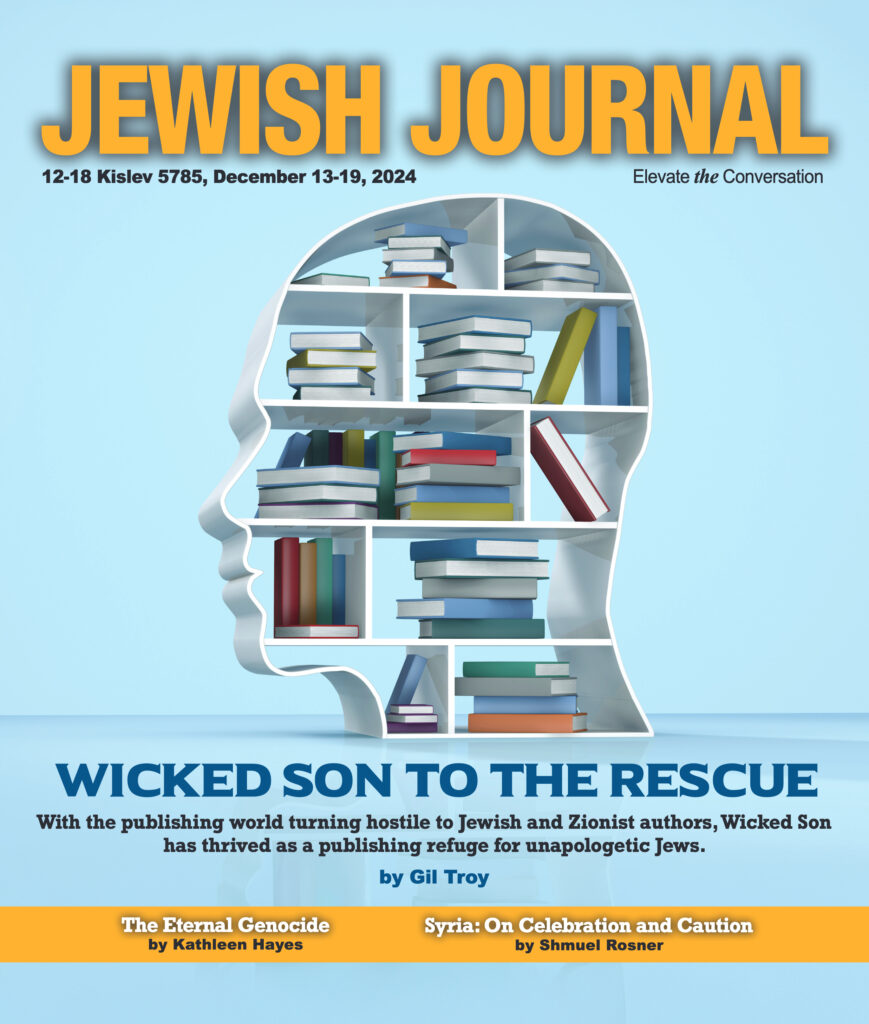
Print Issue: Wicked Son to the Rescue | Dec 13, 2024

CLICK HERE FOR FULLSCREEN VERSION

Print Issue: Wicked Son to the Rescue | Dec 13, 2024 Read More »

Soapstone and Stories: Uncovering Winnipeg’s Artistic and Cultural Heart

Every visit to Winnipeg brings new surprises, and my most recent trip was a revelation of culture, nature, and history. I crafted a soapstone polar bear with Frederick Spence at The Forks, where his teachings added meaning and depth to every stroke. At GATHER, nestled within The Leaf, I enjoyed a dinner surrounded by lush greenery, making it hard to believe I was still in Winnipeg. My visit to the Canadian Museum for Human Rights was a powerful experience, moving from darkness to light in a journey of hope and resilience. I returned to the stunning Qaumajuq at the Winnipeg Art Gallery, explored the rich ecosystems of FortWhyte Alive, and dived into The Forks’ history on a Parks Canada tour.
The iconic Fort Garry Hotel offered the perfect blend of elegance and history as I explored Winnipeg’s historic rivers on a waterway tour. And then, I headed north with Churchill Wild on a wildlife safari—a true highlight of my adventure! Having first journeyed to Nanuk Lodge in 2018, where I saw polar bears and even wolves, this time I ventured to Seal River to witness the unforgettable combination of polar bears and beluga whales. Each visit only deepens my love for this part of Canada. Next time, I’m hoping to check out Niverville—who knows, maybe they’ll let me be honorary mayor for a day!
I had the most amazing experience learning soapstone carving from Frederick Spence at The Forks. Frederick, who was born and raised in Peguis First Nation, shared his incredible journey of reclaiming his identity and culture through art after overcoming significant life challenges. His guidance made the process of soapstone carving not just accessible but deeply fulfilling.
With Frederick’s help, I carefully selected my stone and sketched out a polar bear design. Using tools similar to wood carving, I was surprised by how easily the soapstone responded to the rasps. Each step was filled with joy as I watched the polar bear slowly emerge from the stone. I felt so fortunate to have such a generous and talented instructor who made this experience truly special. This workshop was more than just learning a new skill; it was about connecting with the art and the artist’s story. A meaningful highlight of my time in Winnipeg was the opportunity to work with such a skilled craftsman.
I had the most magical evening at GATHER in Winnipeg, right before heading off to see the polar bears! The restaurant is nestled within the stunning glass tower of The Leaf—a year-round tropical paradise in the Botanical Gardens at Assiniboine Park. Opened in December 2022, this architectural marvel houses an array of plants from over 100 countries, creating a vibrant, lush environment that feels like a summer escape, even in the depths of winter. The Botanical Gardens are a part of the expanded Assiniboine Park Zoo, which has been delighting visitors since 1904. From its early days as a simple animal exhibit, the zoo has evolved into one of Canada’s most impressive urban parks. The new building, with its innovative design, offers Winnipeggers and visitors alike a breathtaking, year-round experience. Exploring the tropical gardens, complete with butterflies and exotic plants, was the perfect way to spend a summer evening before our polar bear adventure. Winnipeg never ceases to amaze with its blend of history, nature, and cutting-edge design! In 2018, on my first visit to Winnipeg, I interviewed Dr. Stephen Petersen, head of conservation and research at Leatherdale International Polar Bear Conservation Centre and wrote about the zoo for Ms. Magazine.
Visiting the Canadian Museum for Human Rights in Winnipeg was an unforgettable experience. Opened on September 20, 2014, this museum is the first in the world solely dedicated to exploring human rights. It invites us all to reflect on our shared humanity through concepts like Ubuntu, Shalom, Aloha, and Ahimsa. As the museum celebrates its 10th anniversary this year, its messages of kindness, generosity, and human dignity are more relevant than ever. One of the most striking features is the journey from darkness to light, symbolized by the stunning alabaster “Hall of Hope.” This space, crafted from alabaster known for its healing properties, represents the transition from oppression to hope, inviting visitors to contemplate the possibility of healing and reconciliation. The entire museum’s design echoes this theme—you enter by walking down into the museum, descending into darkness, and as you explore, you ascend the alabaster ramp towards the light. This thoughtful progression mirrors the journey from despair to optimism and from injustice to understanding. The museum also showcases powerful exhibits like the red dress installation, which honors missing and murdered Indigenous women, and the Hall of Nations, which emphasizes the strength in diversity. The basalt rock garden, made from ancient fossils, and the clay beadwork project—10,000 beads created by Rebecca Belmore, symbolizing community and the potential for reconciliation—are equally impactful. The museum’s origins are deeply tied to the vision of the Asper family, particularly Israel Asper, who believed that Winnipeg needed a space to foster understanding and human rights. Their dream became a reality, creating a place where light literally and figuratively shines through, reminding us that even in the darkest times, there is hope. Visiting the Canadian Museum for Human Rights was a humbling experience that left me with a deep sense of the importance of protecting and promoting human rights. If you’re in Winnipeg, this is an absolute must-visit!
Qaumajuq at Winnipeg Art Gallery: A Must-See in Winnipeg! I was so excited to return to the Winnipeg Art Gallery (WAG) to experience Qaumajuq, the world’s only Inuit Art Centre, which opened in 2021. This stunning gallery is home to over 14,000 pieces of Inuit art, representing the rich cultural heritage of Inuit communities across Canada. The collection is a true celebration of the diverse voices and traditions of these communities, offering a deep and meaningful connection to the North. One of the highlights is the incredible three-story visible vault—a breathtaking glass enclosure that allows you to see thousands of pieces from the collection. I had the chance to tour this vault back in 2018, and it’s even more impressive now that it’s part of this expansive gallery. Don’t miss the opportunity to explore the rooftop sculpture garden with its stunning views and thoughtfully curated pieces. The WAG also offers fantastic children’s programming, making it a wonderful destination for families. And of course, the gift shop is a must-visit, filled with unique items that reflect the beauty and craftsmanship of Inuit art. I couldn’t resist buying a beautiful silver heart necklace and matching earrings by Jadeon Rathgeber from Turtle Island. The shop is full of treasures created by so many talented artists—buying earrings as souvenirs has always been my favorite way to keep the memories of my travels alive! Qaumajuq is not just a gallery—it’s a journey into the heart of Inuit culture, offering a space for reflection, learning, and connection. Whether you’re an art lover or simply curious about the North, this is a place you won’t want to miss when in Winnipeg!
Exploring the beauty of FortWhyte Alive, home to a thriving herd of 40 bison, including about a dozen adorable babies born each year! The lakes here were actually formed from old mining pits—now transformed into stunning water features. It’s gorgeous to see and even better to experience by biking, hiking, or kayaking through this beautiful area. Such a treat to be surrounded by nature in Winnipeg!
Sylvie from Parks Canada took me on a tour of The Forks and it was such an eye-opening experience! This historic site has over 6,000 years of history, rooted in Treaty 1 territory and the homeland of many Indigenous peoples.A few highlights from the tour:
  • Learned about the devastating 1950 spring river flood, where the Red River overflowed, and people were canoeing in the streets! The Legislative Building was underwater, and the Floodway was later built to manage snowmelt from Lake Winnipeg.
  • Discovered that The Forks Market used to be horse stables, and the arches are a nod to that history.
  • The tallgrass prairie here is home to bees and monarch butterflies—the latter now endangered because they only eat milkweed, which is disappearing with the loss of prairie. Less than 1% of this vital ecosystem remains worldwide. Planting native gardens can help protect these species!
  • The Oodena Celebration Circle is the heart of the city—a place where people gather for drumming, powwows, and sharing knowledge. Such a powerful connection to the past and present.
  • The Forks has long been a landmark, where the Red and Assiniboine Rivers meet. This “superhighway” was crucial during the fur trade era, with furs transported from Canada to Europe. The Hudson’s Bay Company, North America’s oldest company, played a significant role here. So much history packed into this place, from the battles of the fur trade to the resilience of the Métis Nation. The shadows cast on the stone paths mark 450 million years of geological history, showing tools that shaped the prairies. An unforgettable journey through time.
Had an incredible time on the waterways tour, experiencing Winnipeg’s rich history from a whole new perspective! Gliding along the Red and Assiniboine Rivers, I got to see historic sites, beautiful old buildings, stunning churches, and fascinating museums—all from the water. The Forks, where these two rivers meet, has been a gathering place and a hub of trade for over 6,000 years. Indigenous peoples, fur traders, and settlers all converged at this confluence, making it a landmark of cultural exchange and history. Exploring the city from this vantage point really brings its past to life.
Staying at the historic Fort Garry Hotel in Winnipeg was an unforgettable experience, blending timeless elegance with a deep sense of history. This iconic hotel, which opened its doors in 1913, was built by the Grand Trunk Pacific Railway and quickly became a symbol of Winnipeg’s golden era. Designed in the Château-style, similar to Canada’s other grand railway hotels, Fort Garry stands as a National Historic Site and a testament to the city’s prosperous past. Located just a short walk from Union Station, the hotel played a crucial role during the peak of rail travel, providing luxury accommodations to travelers from all over the world. Its central location also makes it the perfect base for exploring Winnipeg, with easy access to The Forks, where the Red and Assiniboine rivers meet—a site rich in history and culture. The architecture of Fort Garry is breathtaking, from the grand lobby to the opulent guest rooms, each echoing the stories of the past. Over the years, it has welcomed many notable guests, including Queen Elizabeth II and Louis Armstrong, adding to its storied legacy. You can relax at Ten Spa, a modern oasis within this historic gem, or at The Palm Lounge with live jazz. Fort Garry is not just a place to stay—it’s a living piece of Winnipeg’s history, offering a unique and luxurious experience that connects you to the city’s vibrant past.
Grateful for my recent visit to Winnipeg! From the breathtaking Forks, where the rivers converge, to the inspiring Nurses of the First World War statue, every moment was a delight. I loved carving at the soapstone workshop, spotting bison at FortWhyte, and exploring Qaumajuq at the Winnipeg Art Gallery. The waterways tour and Parks Canada walking tour of the Forks area added such richness to my experience! I loved my stay at the charming Fort Garry Hotel, my return visit to the impactful Canadian Museum for Human Rights, and being inspired by the iconic 007 statue honoring Sir William Samuel Stephenson—known as “Intrepid” and a real-life inspiration for James Bond! I LOVED my incredible Churchill Wildlife walking safari adventure with polar bears and beluga whales—what an unforgettable journey in Canada! Next time, I hope to check out Niverville—maybe they’ll let me be mayor for a day (or even an hour)!    READ MORE: Birds, Bears, and Belugas Safari with Churchill Wild Seal River Lodge 2024 Walking with Polar Bears and Wolves at Nanuk Polar Bear Lodge 2018  

Soapstone and Stories: Uncovering Winnipeg’s Artistic and Cultural Heart Read More »

Sephardic Torah from the Holy Land | Rav Messas & Electric Menorahs

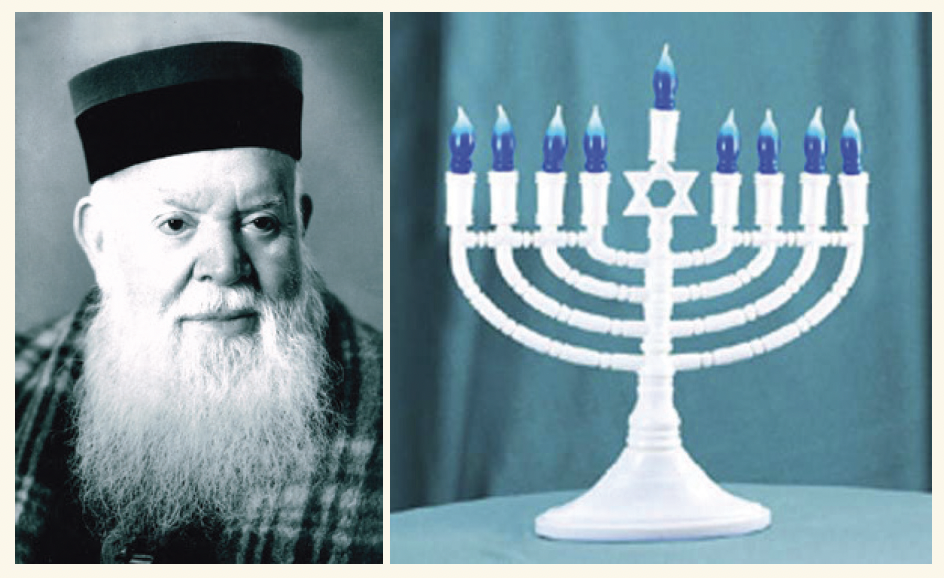
Is it halakhically permitted to recite L’Hadlik Ner (Shel) Hanukkah To Kindle the Hanukkah Light – over an electric menorah?

In his book Mayim Hayim, Rabbi Yosef Messas not only permits the use of an electric menorah, but writes that it’s arguably the finest way to fulfill the mitzvah of lighting the Hanukkah lights.

Born in Meknes, Morocco, Rabbi Messas was one of the 20th century’s outstanding Sephardic halakhic authorities. He served as the Chief Rabbi of Tlemcen, Algeria, and the Chief Rabbinic Judge (Dayan) in Meknes. In 1964 he made Aliyah, and in 1968 became the Chief Sephardic Rabbi of Haifa, a position he held until his passing in 1974.

“There are three pillars in formulating halakhic rulings,” wrote Rabbi Messas. “Din (Law/Halakha), Sekhel (Intellect/Common Sense), Zman (Time/Context).” A halakhic decisor must know halakha, apply common sense, with full awareness of the era and context of the ruling.

Rabbi Messas’s ruling on electric menorahs is a perfect example of his application of these pillars:

  1. “If it’s about the finest wicks, the halakha says all wicks are permitted, even those which do not produce good light. The ‘wicks’ of electricity are copper wires, which we know will produce excellent light.”
  1. “If you are concerned that the miracle was with olive oil, halakha in Ashkenazi communities already moved away from that by permitting wax candles, stating that ‘wax candles produce clear light like that of oil.’ On Hanukkah, we seek lamps/wicks that are as bright and clear as possible, so that when we place it in the window to publicize the miracle, the lights will be clear and visible. Is there any light more bright and clear than electricity?”

In his book Ner Mitzvah, Rabbi Messas furthers his case and writes that there is nothing intrinsically sacred about olive oil. It was simply the finest light-producing oil of its day – the “electricity” of then. “If there would have been electricity back then, then of course they would have kindled the Temple Menorah with electricity. When the Third Temple will be built, the Temple Menorah will surely be electric” writes Rabbi Messas.

Sure, it somehow feels more “authentic” to kindle the Hanukkah lights with olive oil. Today it’s easier, especially with the pre-fab olive oil in glass. But this ruling makes electric menorahs halakhically permitted for those who prefer to use them.

Furthermore, there are many who mistakenly leave the menorah lit and “step out for a while” or go to sleep. Not a year goes by without a fire in a home on Hanukkah, including the tragic death of a mother and three kids in Brooklyn a few years ago. Homes, and lives, can be saved by applying Rabbi Messas’s ruling.

Din, Sekhel, Zman – an enlightening halakhic philosophy that shines as bright as the Hanukkah lights – oil, candles, and especially electric.

Shabbat Shalom


Rabbi Daniel Bouskila is the international director of the Sephardic Educational Center.

Sephardic Torah from the Holy Land | Rav Messas & Electric Menorahs Read More »

Branching Out for Hanukkah

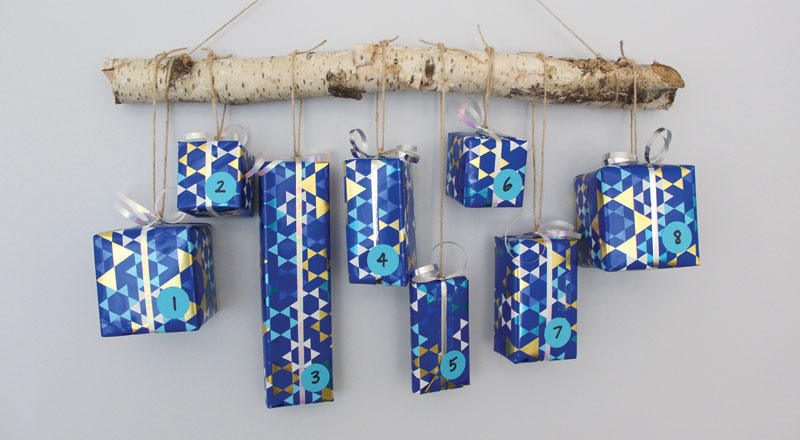
How much do we love Hanukkah? Let us count the ways with this festive Hanukkah countdown branch. Eight little wrapped boxes hang from a branch, and each night of Hanukkah one of the gifts gets to be opened. It’s true what they say — good things do come in small packages.

What you’ll need:

8 small boxes with gifts inside
Wrapping paper
Tape
Ribbon
Branch, about 18 inches
String

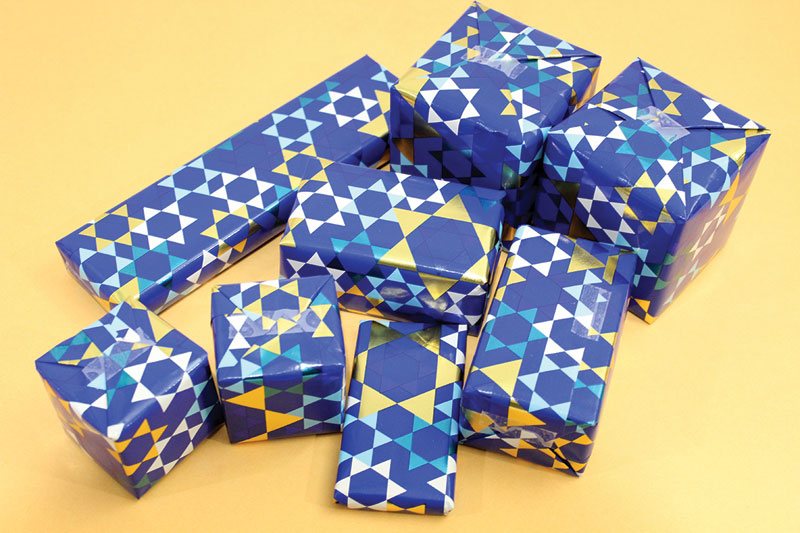
1. Gather eight small gift boxes. I bought these at the Container Store, but you can also look in your closets and repurpose any packaging you may find. 

2. Place a gift in each box, and wrap the boxes. 

3. Tie a ribbon vertically around each gift box. The ribbon is more than decorative — it will hold the string that is tied to the branch. 

4. Find a branch that is about 18 inches. You can cut one from your yard or purchase one from the crafts store. You can also use a dowel, long ruler or even a hanger. Tie a piece of string to each end for hanging.

5. Tie a piece of string around the ribbon on each box. Then hang the gift boxes on the branch with the string, spacing them out evenly. 

6. Write a number on each box from one to eight. You can write directly on the package, or write the numbers on paper and glue the numbers to the box. 


Jonathan Fong is the author of “Flowers That Wow” and “Parties That Wow,” and host of “Style With a Smile” on YouTube. You can see more of his do-it-yourself projects at jonathanfongstyle.com.

Branching Out for Hanukkah Read More »