fbpx

December 12, 2024

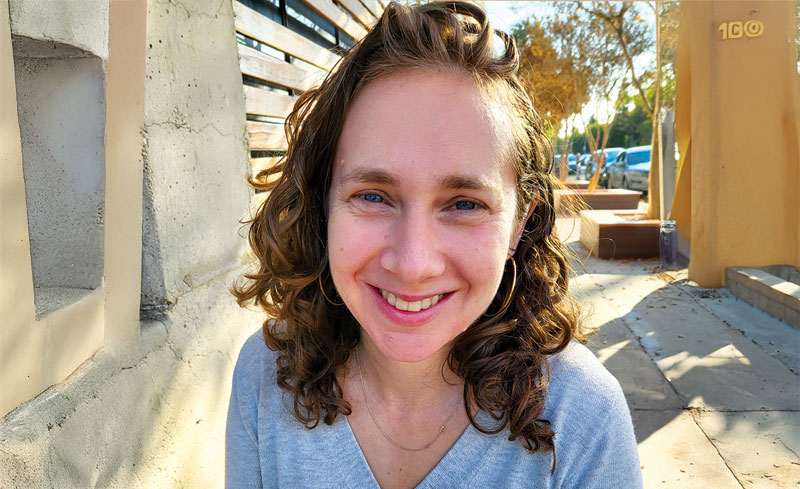
For Rabbi Myra Meskin, Camp Is Life

“Camp,” Rabbi Myra Meskin said, “is, and always has been, my primary interest.” For the associate director of the Maas Center for Jewish Journeys at American Jewish University, and the leader of the Ziering Brandeis Camp Institute (BCI), “it was the impetus for taking this job.” Over coffee at a Pico Boulevard restaurant, Rabbi Meskin smiled often while talking about her San Fernando Valley childhood. “I had so many wonderful influences in my upbringing Jewishly,” she said. “Adat Ari El was a big part of it, and the USY [United Synagogue Youth] chapter there was wonderful for me.” 

The biggest thing was Camp Ramah. “I grew up there.” She first attended Camp Ramah when she was two years old, when her parents agreed “this is a family vacation we can afford,” and sent Myra and her five-year-old sister. For 10 straight summers, Myra Meskin returned to Ramah, first as a camper, then a counselor and a rosh edah (unit leader). “It was everything,” she said. “Camp was formative for me. I completely fell in love with it. Camp made me feel I could be fully myself.”

For 10 straight summers, Myra Meskin returned to Ramah, first as a camper, then a counselor and a rosh edah (unit leader). “It was everything,” she said. “Camp was formative for me. I completely fell in love with it. Camp made me feel I could be fully myself.”

It’s a feeling that stays with her today “You are in an environment, you are with people 24/7,” Rabbi Meskin said. “No place to hide. Sometimes that’s a difficult thing. Sometimes it forces you to be a more authentic version of yourself. I was pretty shy, a reserved sort of kid. I still play my cards a little close.”

Rabbi Meskin attended Adat Ari El, then Milken Community High School. The Meskins landed at Adat Ari El because an uncle married a woman who grew up at Adat Ari El. “It was a beautiful gift to be raised with my cousins,” the rabbi smiled. “It made us very close.”

While her sister made aliyah in 2008, Rabbi Meskin, the mother of two young daughters, has been focused in another area. “Camp always was my dream,” she says. “I thought I could find a job in Jewish camping. It’s entirely fulfilling. The only problem is it’s only in the summer, and you sort of toil, like 10 months of the year. You are waiting and waiting.”

What does she do in the other three seasons? This is where the “Intro to Judaism” and “Marriage for Life” classes come in.  And while she described the September-to-January “Intro to Judaism” as “super fun,” Rabbi Meskin quickly turned the conversation back to her first love.  “There is what-to-do for camp during the year, and the more time you can spend on it in the fall, the better my recruitment is in the spring.”

The historic Brandeis Camp Institute, known for decades as BCI, is for young Jewish adults, 18-29. The rabbi said the market is saturated with activities for this demographic. “We share a property with Camp Alonim down Peppertree Lane,” Rabbi Meskin said. “They have the kiddos, and we have the young adults. They are inspired by a lot of the same values.”

She leads two BCI camps: the Legacy program, which lasts for 26 days and was established in the 1940s by the legendary Shlomo Bardin, and a similar, 10-day program for college students. For the latter, “BCI can provide that grounding in rediscovery as they are emerging into adults,” the rabbi said.

It has been 13 years since Rabbi Meskin last attended BCI as a participant. “The group that attends today are a little more spiritual seekers, not necessarily more religious,” she said. “I think people used to come because they were Jewish. They would come because they wanted to do something Jewish for their summer.”

Today, she said, “it’s a little bit of a harder sell because it is a lot of time to give up. Unfortunately, people are a little bit more skeptical of religious environments.” What caused the change? “Generationally, we had a boom,” said Rabbi Meskin. “I grew up at a wonderfully vibrant time. Adat Ari El is really thriving. USY was huge.”

With all of the attitudinal changes, she is proud “camp has stayed strong throughout the shifts in Jewish culture. I associated camp with a lot of joy,” said the rabbi said. “I love to be outside. Definitely like radical amazement as a kid. That idea really spoke to me.”

Camp always involved singing and dancing, “which were easily linked to joy for me. All of this came naturally to me. I was set up well to enjoy it – through my parents and my schooling.”

She described her parents as “somewhat unique. They were very committed to the idea that if they were going to send us to a Jewish day school, anything happening there should also be happening in our house. We did all the to-dos but we weren’t strict with the don’t-dos.”

When people would ask her if she wanted to be a rabbi, she said no. She didn’t see examples of female rabbis she admired. “The first generation of females were so strong and comfortable in a man’s environment, but that’s not me. I want to feel comfortable off the bat.” Rabbi Meskin always felt very feminine. She didn’t want to hide that, “which I feel the first generation of females had to do to feel they could fit in.”

She hadn’t yet met female rabbis she wanted to emulate. But further exposure of attending BCI, a year at the Pardes Institute and living in New York changed her mind. She would be ordained at American Jewish University’s Ziegler School of Rabbinic Studies.


Fast Takes with Rabbi Meskin

Jewish Journal: What is a longshot you dream of achieving?

Rabbi Meskin: Leading a kids camp or larger enterprise.

J.J.: Your favorite childhood experience?

RM: Camp Ramah was a big part of it.

J.J.  How would you like to change the world?

RM: I think I am doing it.

For Rabbi Myra Meskin, Camp Is Life Read More »
Just Kindness

I remember the first time I received a text message asking me to pray on behalf of a boy named Daniel, whose name I have changed to protect his family’s privacy. Daniel was battling a serious illness and though I did not know him, I prayed each day for him and his family, who live in Los Angeles. 

I prayed for Daniel every morning and before I fell asleep at night. I prayed for him as soon as I recited a blessing and lit Shabbat candles each Friday night. For months, Jewish communities around the world recited prayers, including Tehillim (Psalms) and performed mitzvot in honor of his recovery. 

Tragically, Daniel passed away last year. I spoke with those who knew this special boy and his family, and they attested that Daniel always strived to be happy, resilient, and connected to G-d, even during his illness. In short, Daniel was like a ray of light; a rainbow bursting forth with energy and joy. 

In a Jewish community as warm and supportive as the one we are blessed to know in West Los Angeles, no family celebrates a joyful milestone alone. Conversely, no family should struggle with illness or grief alone. I want to tell the story of a community that offered Daniel and his family a world of love and support.

Daniel was admitted to Children’s Hospital Los Angeles (CHLA), where staff and volunteers from Chai Lifeline and Chabad of Greater Los Feliz offered tremendous support to him and his family. 

Chai Lifeline is a remarkable nonprofit that offers emotional support to Jewish families experiencing illness, whether a sick parent or a child, or loss, according to Malka Lipovenko, director of volunteers. The organization offers programs and services to support the whole family, including meals at hospitals or at home and gifts and activities, and it is all provided free of charge. The beauty of Chai Lifeline is that it anticipates a family’s needs before they arrive at a hospital. Daniel’s mother told me that she “didn’t even have the words” to describe her gratitude for Chai Lifeline. 

A Home Away from Home

Jewish organizations that support families battling illness have a special place in my heart. Their staff truly hold families’ hands in ways that they need through their journey — discreetly and lovingly.  

The staff at Chabad of Greater Los Feliz, which is a five-minute walk from CHLA, also went above and beyond to help Daniel and his family feel more comfortable whenever possible, closer to home. 

This Chabad house, run by director Rabbi Leibel Korf and his wife, Dvonye, hosted a grand opening of its newly-renovated center on Dec. 8, and it utilizes its vicinity to CHLA to help many Jewish families whose children are hospitalized there. The renovated Chabad house also includes an apartment with two rooms and a lounge area that is available to those who need to stay close to the hospital, whether during Shabbat or the rest of the week. Friends of Mendy and Hadassah Spalter and Daniel and Rachel Benmoshe sponsored two bedrooms in the new hospitality area, one in the memory of the Spalters’ late daughter, Chaya, and the other in the memory of Benmoshes’ late son, Avraham, who both stayed at CHLA.

Chabad of Greater Los Feliz offers company to patients and families at CHLA, and also provides homemade food and Shabbat meals, and prayer services (this is particularly vital for parents and relatives who wish to stay with their children at CHLA over Shabbat). 

Friends of Mendy and Hadassah Spalter (left) and Daniel and Rachel Benmoshe sponsored two bedrooms in the new hospitality area at Chabad of Greater Los Feliz.
Photo courtesy of Chabad of Greater Los Feliz.

With regard to Daniel’s parents, Rabbi Mendy Ceitlin, assistant rabbi at Chabad of Greater Los Feliz, told me that he viewed Chabad’s role as “just a way to be there in support of the family.” Giving is second-nature to Chabad, and Rabbi Ceitlin recalled the time he brought a box of chocolates to a sick child at CHLA and watched his eyes as they lit up. “From then on, he called me ‘The Chocolate Rabbi,’” Ceitlin remembered fondly.

“From then on, he called me ‘The Chocolate Rabbi,’” Ceitlin remembered fondly.

In general, Rabbi Ceitlin and other devoted staff at Chabad of Greater Los Feliz “try to offer anything to families [at CHLA] that they miss while being away from home,” he said. What a profoundly beautiful endeavor, and a very Jewish one, at that. Whether through visitations, breakfasts, meals, or even coffee runs, this special Chabad house “tries to be there for whatever families need,” noted Rabbi Ceitlin. 

“Chabad was amazing,” said Daniel’s mother. “They brought gifts and visited every day. They were always looking for ways to make him happy. You can’t imagine the comfort they brought, and without any judgment. It was just kindness.”

“Chabad was amazing. They brought gifts and visited every day. They were always looking for ways to make him happy. You can’t imagine the comfort they brought, and without any judgment. It was just kindness.”

Rabbi Ceitlin spoke with an air of modesty that made it seem as though he and others at Chabad didn’t think twice about devoting themselves to Jewish patients and their families at CHLA. In my experience, the best “mitzvah-doers” are the ones who offer extraordinary help, but never demand the credit they indubitably deserve. 

Though I pray that we may always be blessed with health, sharp mental faculties, and skilled and intuitive medical professionals, it’s still comforting to know that there are those in our wonderful Jewish community who will always reach out with a hand, a hug, a warm meal, or even a small box of chocolates.


Tabby Refael is an award-winning writer, speaker and weekly columnist for The Jewish Journal of Greater Los Angeles. Follow her on X and Instagram @TabbyRefael.

Just Kindness Read More »