fbpx

October 15, 2024

Chosen Links by Boaz – Ep 7: Fact Checkers – Guardians of Truth

Do you care if the information you’re seeing is accurate? Does it bother you that social media algorithms, and media bias, have gotten more extreme than ever before?

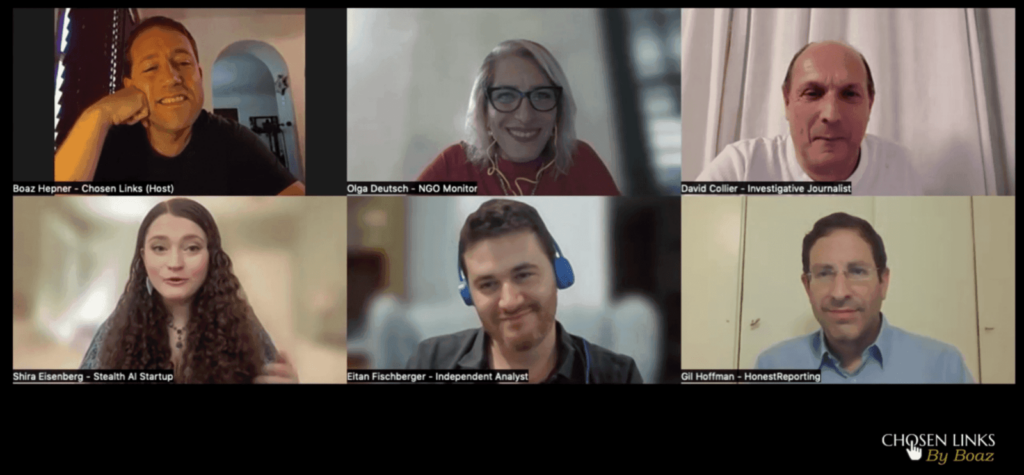
I sat down with 5 amazing minds in the sphere of fact checking. Eitan Fischberger, David Collier, Shira Eisenberg, Olga Israel of NGO Monitor, and Gil Hoffman of HonestReporting told stories, analyzed Wikipedia, gave tips on how to navigate misinformation, and so much more. Well worth the watch or listen!

Chosen Links by Boaz – Ep 7: Fact Checkers – Guardians of Truth Read More »

Jewish Institutions Must Do Better When It Comes to Jewish Students

A few weeks ago, the Anti-Defamation League (ADL) sent out a “Campus Crisis Alert” featuring the “persistent and pervasive” antisemitism” at Sarah Lawrence College where I teach, focusing in particular on my experiences. The alert came as a surprise as I had not been contacted by the ADL, but I was nevertheless extremely glad my story was being widely shared. It is good for the world to see that students have tried to cancel me for being a Zionist who believes in Israel’s right to self-defense and to simply exist.

Hatred toward Jews and Israel is rampant on our nation’s colleges and university campuses and has taken many forms. In this case, a group of students calling themselves the “Divestment Coalition” had launched a cancellation campaign to prospective students in my courses by messaging them directly and libeling me as “a professor with a pattern of unrepentant racist, misogynistic, and reactionary behavior” who is “a staunch advocate of Israel’s right to self-defense even when it includes the murder of tens of thousands of Palestinian civilians.”

This “coalition” attempted to organize a boycott of my classes and campus public speaking events. These students disrupted other students to the point that many were afraid to take my classes. On public social media posts, the boycotters referred to my work as “racist, misogynistic, and genocidal rhetoric.” Unsurprisingly, the school presumably supports and endorses these student actions and sentiments because it has not publicly responded to any of the recent vile and illiberal behaviors.

The school did not condemn the students’ overt antisemitism despite the president asserting last year that “there is not, nor can there be, any place for antisemitism or hate speech of any kind on our campus.” Sarah Lawrence also failed to respond to the fact that boycotts are completely antithetical to the school’s mission of a broad liberal education where diverse views are embraced with curiosity and empathy. Nor did the school address the fact that disruptions of teaching run directly against the school’s stated rules.

While I’m grateful for the efforts of the ADL and others for bringing attention to the deeply antisemitic environment at Sarah Lawrence and on other collegiate campuses, what I find most missing from these efforts is follow-up on the ground for the far too many bad situations that Jewish students and communities have been confronting for a year now.

Many Jewish organizations claim to support Jewish students via task forces, initiatives, public position taking and social media work, and fundraising drives in response to the Oct. 7th massacre and the antisemitic responses that have emerged since this tragedy. But many students tell me that they see little real action on the ground, where it matters to them, and that it is needed in their immediate circumstances

Certainly there are instances where Jewish students have been supported by the ADL and others. But based on meeting with scores of Jewish students on many college and university campuses around the country, and seeing my own troubles connecting with organizations who could help me in my own campus fight against antisemitism, I believe that our Jewish organizations are often overly focused on fundraising and virtue signaling and are not spending enough time listening to students and understanding their needs. The desire to help may be there, but when it comes down to it, in many cases our organizations are simply not working in the trenches and on the ground with students.

In some cases, students feel that organizations are talking over them and using them as examples of a need but then failing to meet them on college campuses; these organizations rarely offer the real support to students who need safe spaces, legal advice, media training and the affirmation that they are part of a bigger community.

In March of 2024, the American Jewish Committee (AJC) and Hillel International, for instance, announced that they will expand their partnership to counter antisemitism on campus with new “work aim[ing] to more deeply engage college and university administrators on responding to antisemitism.” Other organizations have announced that they have similar initiatives, and maybe this is happening to some degree, but so far, the students who I try to help nationwide have seen no or minimal offers of concrete help. In reality, students from around the country regularly report to me that they feel overlooked, marginalized, and have needs that have been ignored by administrators and college presidents. Devastatingly, these students often have faces of despair and disbelief when I tell them that Jewish organizations are mobilizing to support them as they witness behaviors like that of the new president of Columbia who said nothing about the safety of Jewish students but instead apologized to pro-Palestinian students who were “hurt” by NYPD encampment sweeps.

Data from three annual surveys of Jewish students across the nation—well-conducted by Professor Eitan Hersh and the Jim Joseph Foundation—capture just how difficult life has been for Jewish college students since Oct. 7. Growing numbers of Jewish students hide their Jewish identity to fit in on campus. They widely report that people judge them negatively for participating in Jewish activities, and that they pay a social cost for supporting the existence of Israel as a Jewish state.

The data reveal that Jewish organizational programs focused on the Israel-Hamas war were not particularly popular with Jewish students. In my countless discussions, I learned that Jewish students do not want to talk about the war; they want to feel safe and supported. The Jim Joseph Foundation studies confirmed the finding that Jewish students who did attend Jewish programming on campus participated primarily in Shabbat/holiday or social events.

In my countless discussions, I learned that Jewish students do not want to talk about the war; they want to feel safe and supported.

A recent, large event in New York that featured French philosopher Bernard Henri-Levi and students from three east coast campuses confirmed that they all feel very isolated and perceive a deep lack of support from the Jewish organizational world. The students emphatically told the audience that no one is paying attention to them. They also declared that when community groups and foundations want to talk about how to counter outbreaks of hate on the campus, Jewish students should be in the room and part of the discussion.

The harsh truth is, as I have written previously, that embattled Jewish students need “localized responses,” which have been to date “remarkably weak, poorly coordinated, and ineffective.” What is needed is “on-the-ground tactical training for Jewish student activists and leaders.” This “strategy has been neglected and is something that must be corrected if the Jewish community is going to push back against this madness and protect college students.” Jewish community centers, local Federation offices and organizations, and synagogues must reach out to let students know that they are there for them. Local institutions can open their doors to provide safe spaces, meals and places to celebrate holidays and simply offer social support and a place to rest.

My personal experience with the lack of communal support is illustrative and all too common. The bottom line: I have been given absolutely no meaningful support by any Jewish groups in my fight at Sarah Lawrence College, no support to push back the deep antisemitism present, and I have seen no support offered to scared and exhausted Jewish students.

And to be clear: Not only were these organizations not proactive, but also I directly asked for help from a number of Jewish institutions and have been ignored. Fortunately, I have tenure, and I can express my thoughts about Israel as I have academic freedom; I will ride out this mess but it will continue to hurt. As I live in New York, I have support networks. In contrast, these days so many Jewish faculty and students are feeling threatened, unsupported and need help especially as the hate and vitriol started up immediately as our campuses reopened this fall.

Jewish students want and need on-the-ground support, real legal and practical guidance, and proof that they are not alone. The ample elite chatter and position-taking is insufficient.  We as a community need to listen to Jewish students to ensure that their views and needs are central to our meetings, events and actions. Jewish organizations and their resources must be on the ground and help students on their terms and with their needs, which will vary based on schools and particular circumstances. In short, the time for action exclusively via press releases, conferences and briefings, and lobbying is over; Jewish organizations and the larger Jewish community must be physically present and walk arm in arm with the brave students on their campuses to help them push back against hate and violence.


Samuel J. Abrams is a professor of politics at Sarah Lawrence College and a senior fellow at the American Enterprise Institute. 

Jewish Institutions Must Do Better When It Comes to Jewish Students Read More »

Of Prayers and Grape Leaves

The preparation, research and publication of this article was made possible by a grant from the Memorial Foundation for Jewish Culture.

My grandmother Nana Aziza  had a generous heart and a nurturing spirit. She lived her life recreating the warmth and beauty of her ancestral home in the South of Iraq. She and my Baghdadi grandfather had infinite love and patience for all their grandchildren and their lives were dedicated to transmitting tradition. This week, Rachel and I are honored to share our column with my cousin Sarah Sassoon, poet and children’s book author. 

—Sharon 

When I met Sarah many years ago, I instantly named her “Smart Girl.” She has become my friend and I love connecting with her when I visit Jerusalem. 

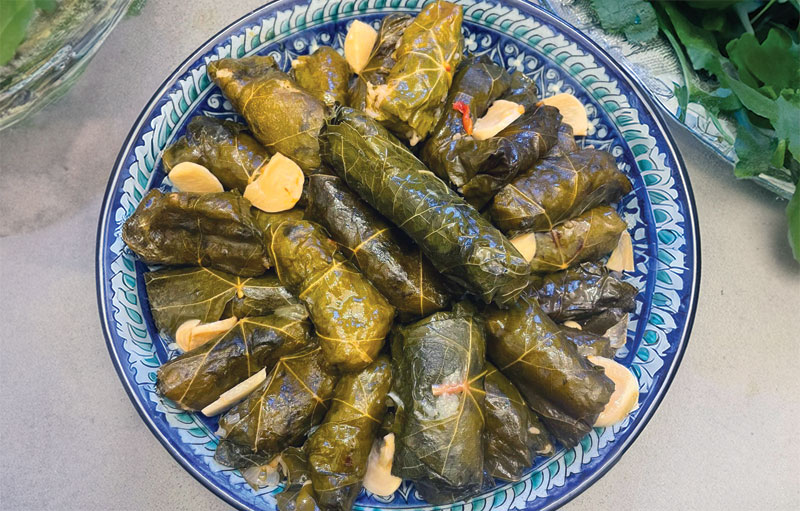
Stuffed vegetables are a common dish for Sukkot and Simchat Torah, a hallmark of the harvest. Stuffed grape leaves are especially resonant, since they resemble the rolled scrolls of the Torah. —Rachel

Stuffed vegetables are a common dish for Sukkot and Simchat Torah, a hallmark of the harvest. Stuffed grape leaves are especially resonant, since they resemble the rolled scrolls of the Torah.


What are rolled grapevine leaves called in Judeo-Arabic?

I realize I don’t know what my Iraqi grandmother called them. 

I am on a quest for her voice. I believe it can be found in the foods that she cooked. So here I am, under the beating sun, picking fresh vine leaves from a lush arbor laced with long tendrils, heavy with green and purple grapes.

This Jerusalem community garden is an act of defiance. Cartoonish greedy developers cannot build on land with fruit trees. So there are many trees here — crab apple, pomegranate, apricot, plum, lemon and lime. The wild artichokes are in bloom. I stretch for fresh grape leaves. Protective leaves, army green leaves. 

The air is full of the sounds of morning bird song, honking cars and children wearing backpacks, skipping to school. We are in a war. The only reason that the roads are busy, that children can skip to school and that I can pick grape leaves, is our army.

Here in Israel, many of our fathers, husbands, sons and daughters are serving, including my son. We are in the days of awe, reflection, inner questioning. Why do they hate us? Who do I hate? What is stuck inside me, besides my breath?

I pick leaves the size of my palm. I search for bigger leaves the size of my son’s hands.

I pick the leaves and think, My son is protecting us when my job as a mother is to protect him.

The last time I made rolled vine leaves, my son was between his rounds in Gaza, sick with fever and sprawled on the couch.

Blanch the leaves like rough, hard truth in boiling water with a bit of salt, watch them change from uniform green to camouflage fatigues. I freeze half the batch of leaves and brine the rest.

I sit at my dining table with four Iraqi and Sephardic Jewish cookbooks and debate the ingredients. Which will taste like my grandmother’s vine leaves? I end up creating my own version. Vegetarian with pine nuts. I crinkle my nose, remembering that my grandmother mostly made hers with ground beef. I strive to recover her flavors, yet I am already digressing/transgressing her memory.

I seek harmony. I form the base sauce with moon-shaped slices of lemon and tomato and garlic in my largest deep frying pan. I admire the colors, the circles of wholeness.

My grandmother learned to roll her leaves with her mother, in the small southern village of Al Uzair in Iraq, where Ezra the Scribe is buried. They would have sat at a low table, takht on wooden benches, with aunts who were visiting, cousins, and close friends. I sit alone. The Babylonian Jewish world of my grandmother has disappeared.

I chop onions, parsley, fresh mint picked from the garden. I add fresh diced lemon. I soak the rice in water for ten minutes. I rinse and pour out the water, over and over again. It feels like I am rinsing more than rice. Something is filling up, emptying and filling up again inside of me. 

Alone, I sit and pack the vine leaves, veins side up. I feel my grandmother next to me.

I want to make it taste like my grandmother’s food. I want my children to know her. Know how she prayed for me, for them, as she rolled her hopes into vine leaves. 

In Iraqi Jewish culture, you do not talk about bad or sad things. No death, no sickness, no expulsions. Instead of dwelling on sad memories, my grandmother packaged grapevines like suitcases of blessings, an abundance of suitcases in contrast to the lone bag they were allotted when they left Iraq. For herself, my grandfather and their five children. Their single passport stamped “No Return.” 

She always described Iraq as the Garden of Eden, not as the country that expelled 120,000 Jews. Like she only knew plenty in her life, instead of frozen bank accounts and dispossession. 

As I research, I realize that she wrapped her story in vine leaves, kubbeh balls, sambusek and endless simmering stews. She fed me her story. Once upon a time, in 1917, a third of Baghdad was Jewish. Today, only three Jews live in Baghdad. 

By not telling me, she illustrated everything that was important, what you cook now, whom you feed now. You cannot hide feelings from a child, or the source of the food. Rolling the vine leaves I learn everything that she wanted to protect me and my children from, especially homelessness, rootlessness.  

We are building our sukkah of metal poles and fabric walls on the Astroturf that is my boys’ soccer field. The roof is a mix of bamboo and palm, spaced so we can see the stars. The sides of the entrance are decorated with welcoming palm fronds, just like my father decorated our sukkah in Sydney. The symbol of a Baghdadi sukkah. 

Every Sukkot, I wonder if and how they built sukkahs in the Ma’abarot, the refugee camps where my grandparents and almost a million Middle Eastern refugees were placed in Israel, alongside European Holocaust survivors. What is the meaning of a temporary festive booth when you live in a tent that is meant to be temporary, but isn’t.

The immigrants worried about food, my father’s cousin tells me. Nothing else mattered, not even religion. He was five years old when he left Al Uzair in 1951.

Today in Jerusalem, my husband, my children and I build our sukkah with a view of the stars. It’s a temporary structure built with faith and deep gratitude that we do not live in a tent. Gratitude that my grandparents and my father worked hard to not look back with tears but to build forward. 

Over the seven festive days, the green fronds of the sukkah will fade to a dried ochre color. This year, I am dreading the last day of Shemini Atzeret, the eighth day when we don’t have to sit in the sukkah. Simchat Torah, the day that we celebrate the Torah, is the day that we failed to protect ourselves. The day that my son donned his uniform. The day that my husband raced him to his base, even though we don’t drive on festivals, even though there were sirens blaring as thousands of rockets fell. I could not protect him from going to war.

Grapevine leaves are the perfect festive food. A food that requires the luxury of time. Time has a new meaning with this war.

I fold the blanched vine leaves carefully, over the rice, pine nuts, onion, parsley and mint mixture. Pack them like small parcels of safety. I whisper words, hum psalms, so each vine leaf becomes a package of prayer. — Protect my son. He is in the North. 

I am scared of the tomato sauce. From experience, I know how difficult it is to achieve the delicate balance of lemony sweet and sour, joy and fear, light and darkness. The fragile line between life and death.

I am nervous to cook the beautifully rolled leaves set in the pan on top of the tomato, lemon, garlic base. I dart between the books trying to figure out which will taste the most like my grandmothers. None is right. One is too tomatoey. One too sweet. I feel like I’m on my own as I mix the juice of 2 lemons, 2 cups of vegetable broth, and a touch of date syrup. I doubt my grandmother used vegetable broth, but I knew it would add the exact nuanced rich flavor, like hers. 

Why am I so sad? Because I love my son, and I have let him go to war. Because I can’t wrap him up anymore. I have sent him into the line of fire for our people. 

So much is alone now. I concentrate on remembering the exact taste of lemon and tomato, the taste of our love and sorrow.

I pour the sauce over the leaves and cover it with a big lid that almost fits the giant mouth of the pan. Slowly, I bring the pan to the boil, and pray. I try the sauce. I add more salt. I try it again, pulling a grape vine out this time to cut through. The leaf is tough, not cooked through.

I pray as the rolls of vine leaves simmer that the leaves soften. I pray that my son is safe in body and spirit.

And I feel whole, as I turn the stove off. Did the antioxidant properties of the vine leaf help fight my depression? Or is it because I have rolled hopes, dreams and ideals, incorporating my grandmother’s story of not looking back? I have rebelled against the narratives of hate and despair. 

I attend the funeral of a fallen soldier. Tal Dror was killed by an Iraqi drone in the North. I am sorry I could not protect you, his mother says. His father says, I love this country. I am not angry at anyone. The aunt says, Sorry Tal. Sorry for what was asked of him. The military funeral service ends with a prayer of forgiveness that the rabbi chants on all our behalf. We weep. We confess how sorry we are to our youth whom we cannot protect. Who must protect us.

G-d knows I don’t know what the future holds. My husband reminds me I am not G-d. 

I have learned the preparation time of rolled grape vine leaves extends beyond the cooking. The flavors need to settle overnight. It is like making wine. A grape destiny of patience, process and care. This is the method of Iraqi Jewish cooking. One of the deepest secrets my grandmother’s hands teach me. To cook takes time, like growing a child.

The ceramic plate full of rolled vine leaves is now empty. Now it’s entered a deeper place. A memory. More than stuffed grape leaves. The Middle Eastern Jewish story of love and resilience. 

When I revisit the arbor of vines, I learn from the Moroccan gardener that Iraqi rolled grapevines are called Yabragh. I hear the word Yifrach, which in Hebrew means to blossom, bloom. In Arabic, it’s pronounced I’frah and means joy and happiness. 

May our divine walls of protection last. May the divine ceiling which stops hundreds of Iranian rockets hold. May our hostages be freed. May our children be safe. May he come home—In’shallah, let it be G-d’s will. 

Yabragh – Iraqi Jewish Rolled Vine Leaves Recipe

30-50 grape leaves, fresh or store bought

Base:
4 large Roma tomatoes, sliced into rounds
2 lemons with rind, sliced into rounds
6-8 garlic cloves, sliced

Filling:
2 cups of basmati rice, soaked for 10 minutes, rinsed and drained
3 medium onions, finely chopped
1 large bunch mint
1 large bunch Italian parsley
2 medium lemons, peeled, seeded and chopped
2 cups roasted pine nuts or 1 lb ground beef or lamb
4 large Roma tomatoes, finely chopped
1/2 cup extra-virgin olive oil
1 tsp salt
1/2 tsp pepper 

Sauce:
1/2 cup fresh lemon juice
2 Tbsp tomato paste
1 Tbsp date syrup or sugar, to taste
2 cups vegetable stock or water
1/3 cup extra virgin olive oil
1 1/2 tsp salt 

In a medium pot, blanch fresh grape leaves, in boiling water with salt for about 1-2 minutes. Then plunge into cold water and drain.

Place the tomato slices and lemon rounds and pieces of garlic in a large deep frying pan, making sure the bottom is well covered. 

In a large bowl, combine the rice, onions, mint, parsley, lemon, pine nuts or meat, tomato, olive oil, salt and pepper. 

Place the open vine leaf with the vein side up. Depending on the size of the leaf, place a tablespoon or a teaspoon of stuffing in the middle, then fold the edges and roll until the end. Place rolled vine on the base. Pack the rolls tightly, until the pan is full. Then start the next layer. 

In a medium bowl, combine the lemon juice, tomato paste, date syrup, stock, olive oil and salt. Then pour over vine rolls, ensuring all are covered with liquid.

Bring to a boil, then cover and simmer for 30-45 minutes or more, until the liquid is absorbed. Add more salted water, if needed. 

Allow rolls to sit until slightly cooled. Remove the rolls from the pan, reserving the base ingredients to use as decoration. Notes

The flavors deepen overnight, so best eaten the next day. 

Serve warm or at room temperature.

Store leftovers in a tightly container in the refrigerator.


Sarah Sassoon is an Australian born, Iraqi Jewish writer, poet, and educator. She is the author of the award winning picture book, “Shoham’s Bangle” and “This is Not a Cholent.” Her poetry micro chapbook, “This is Why We Don’t Look Back,” was awarded the Harbor Review Jewish Women’s Poetry prize. She is an editorial advisor for Distinctions: A Sephardi and Mizrahi Journal. She is also the co-author of the “The In-Between,” a literary dialogue about identity and belonging published by Verlagshaus Berlin. She lives in Jerusalem with her husband and four boys. Visit www.sarahsassoon.com

Of Prayers and Grape Leaves Read More »

Table for Five: Sukkot

One verse, five voices. Edited by Nina Litvak and Salvador Litvak, the Accidental Talmudist

And you shall take for yourselves on the first day, the fruit of the hadar tree, date palm fronds, a branch of a braided tree, and willows of the brook, and you shall rejoice before the Lord your God for a seven day period.

– Lev. 23:40


Rabbi Eva Robbins
Co-Rabbi, Nvay Shalom & Faculty, AJRCA

It is just a few days since we left the most intense Holy Day, Yom Kippur, having lived in the land of our souls, shrouded in the depth of the most painful emotions such as guilt and shame, remorse and repentance, pleading for forgiveness and crying for compassion. The climactic moment of Neilah, walking through the gates leaving 40 days of sustained self-examination, we now enter the only holiday that commands us to be joyous, “You shall rejoice before Adonai, your G-d.” Yom Simchateynu, also known as Sukkot, literally meaning booths, we relive our ancestors’ travels in the desert, residing in temporary dwellings while harvesting their produce, the gift of sustenance. Sukkot, the original Thanksgiving Holy Day which inspired the pilgrims to create our own most satisfying holiday in America, surrounding a splendid table of delicious food amidst friends and family, calls on completely different emotions, happiness and gratitude, going from our inner landscape to the outdoors, to G-d’s glorious Creation, sitting beneath sun, moon and stars surrounded by temporary walls, a fragile home for seven days reminding us that materiality is ephemeral and faith and hope reside within our sacred relationship with the Holy One. We take these four symbols, also Kabbalistic symbols of our body (spine, heart, eyes and mouth), hold them and shake them in six directions, aligning our physical and spiritual being with Creation while blessing G-d who took us out of Egypt so we could be partners in sustaining, honoring and protecting our most precious world.


Rabbi Elazar Bergman
Author of the forthcoming “The Daven Better Handbook”

Our Sages point out that these four species of tree parallel four broad types of Jew. The hadar tree produces a deliciously scented fruit. These would be people well-versed in Torah who do good works. Dates are fruit sans scent. These are people who know much Torah, but are somewhat short on good works. The braided myrtle smells wonderful, but gives no fruit. These folks do mitzvahs and chessed for individuals and the community. However, they’re not a primary source of Torah information. Willows have nothing for the tongue or nose. They seem to bring nothing to the table. 

Lesson number one: To rejoice before HaShem, we have to unite with all our fellow Jews. If we don’t unite voluntarily, Hamans, Hitlers, Hamas and Hezbollah will goad us to do so. 

What do you do with these four united denizens of the arboretum when you’ve taken them? You wave them to the Four Winds, and up and down. This is your acknowledgement of HaShem’s control over all natural phenomena. Simultaneously, it is thanks for the gifts He sends you from the four corners of the world, and for rain from above and dew from below. 

Lesson number two: All that occurs is Divinely orchestrated harmony. (Since this is far from obvious, we need the reminder. That this is so needs more words than those allotted here.) 

Lesson number three: A mitzvah impacts and teaches lessons on different planes, simultaneously.


Rabbi Chaim Tureff
Rav Beit Sefer at Pressman Academy and author of “Recovery in the Torah”

I knew someone who took a hammer and hit themself in the leg because they were angry about something completely unrelated. This was a tell-tale sign of mental illness and someone who needed help. Unfortunately, they refused to get the help they needed and their wife and family have suffered because of it. This parsha about Sukkot brings me right to this incident and the lack of achdut (unity) that we have experienced over the millennia as the Jewish people. The midrash in Vayikra Rabbah explains this parsha as an allusion about different types of Jews. The etrog to a Jew with Torah and good deeds, the date palm as a Jew who has Torah but no good deeds, the myrtle to a Jew with good deeds but no Torah and finally, the willow as a Jew without good deeds or Torah. And yet, God wants us to bring them all together to shake as each has a place and needs one another. The Jewish people have continued to resist the consistent achdut that is needed to bring Shalom. The Kotzker Rebbe said, “achdut [brotherhood] prevents Jewish communal tragedy and disaster; not the other way around.” Our lack of unity is similar to the person who hits themself when they are frustrated. The body is connected, and hurting one part ultimately injures the entire body. May we go back to the unity at Sinai where we were, K’eash Echad BiLev Echad (like one person with one heart).


Gilla Nissan
Teacher of Jewish Mysticism, author of “Meditations with the Hebrew Letters: A Guide for the Modern Seeker”

Shaking the Four Kinds in the Sukkah 

What a lovely Biblical ritual to follow, especially in this technological era. One of my sweetest childhood memories is being in my grandparents’ sukkah, covered with eucalyptus branches, taking in the divine aroma of a sukka-shalom. Torah text is very close to the earth and her fruits. A large part of the teaching is very ritualistic, very shamanic, very sensual. The Hebrew word adama/soil is everywhere witnessing our b’rit with God. Judaism became more mental after we were expelled and disconnected from our land, and stayed pretty barren until we were brought back to “work” her. She longed for our consciousness. We longed for what was promised to us. It’s a love story. 

Thus, rabbinical Judaism is a fraction. Our never-ending 3,500-year-old story we call Judaism is not a religion. The Hebrew word dat / religion doesn’t appear in Torah. The correct word, da’at / to know, does appear often and means higher knowledge. That is what Moses delivered or channeled and that is what Judaism is all about: A story with 70 faces revealed or hidden as needed, while we travel in this world fulfilling the mission of our soul. On Sukkot we shake the Four Kinds to all directions to create a protection from any negative forces, and to allow the new light of the new year to descend upon us.


Rabbi Rebecca Schatz
Associate Rabbi, Temple Beth Am

Driving down Pico Blvd. in early September, I passed a store that had a sukkah. Before I could notice the sign that they were selling sukkot, I felt my body, and heart, have an anxious and visceral reaction. Sukkot this year, both the holiday and the fragile home, will be difficult for me. When traveling to Israel in November of 2023, the kibbutzim that we visited were still set up with sukkot. Homes destroyed, lives destroyed, sukkot standing strong. And isn’t that the opposite of what a sukkah should do? Shouldn’t it be so fragile that the elements could take it down? Yes, but these were human “elements.” 

Sukkot, in Kibbutz Kfar Azza, stood and some had lulavim and etrogim on their tables. This verse is haunting this year: We should take these pieces of natural earth into our hands and rejoice. To take these minim, species, we must remove them from their life source. No longer receiving water or nutrients, we have all experienced the short life of a lulav and etrog. And yet, the verse teaches us to recognize life in these withering branches and use them as symbols of our joy. 

So maybe Sukkot is more important this year. We will dwell in brittle homes, hold onto quickly drying and dying species and command ourselves in joy. Recognizing life’s ability to shift, to end, to wither. May this year be one where we focus and celebrate the fragility of life while grasping onto that which brings us joy now.


Table for Five: Sukkot Read More »

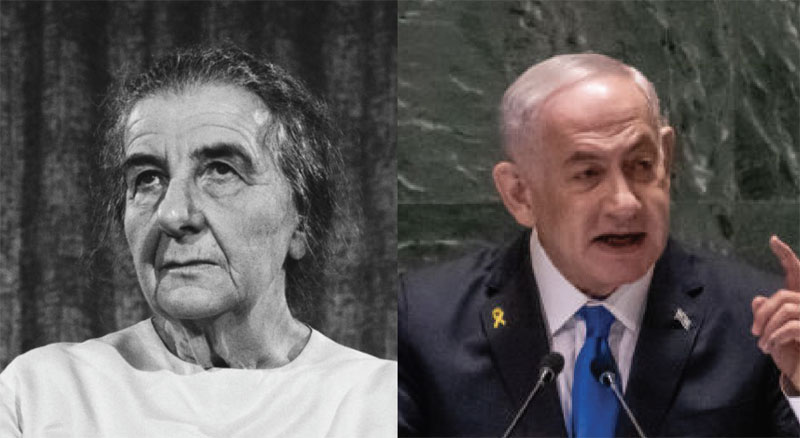
Left: Golda Meier ( Evening Standard/Hulton Archive/Getty Images) / Right: Benjamin Netenyahu (Stephanie Keith/Getty Images)

Rosner’s Domain | Defying America: 1973 to 2024

Some Americans are undergoing a period of introspection, recognizing that something about the U.S. Middle East policy isn’t working. Part of this is reflected in their frustration with Israeli Prime Minister Benjamin Netanyahu. President Biden tried to avoid having conversations with Netanyahu and was almost forced into having one such talk. He has also spoken unfavorably about Netanyahu, as Bob Woodward reports in his new book. No one should fall off a chair because of these revelations. With Biden, Netanyahu completes a full series: Four presidents were in power during Netanyahu’s long tenure as the Prime Minister of Israel – Clinton, Obama, Trump, and Biden – and all four have spoken ill of him at one time or another. If Kamala Harris is elected in November, one might safely bet that a fifth president would be added to the series. 

Netanyahu was not elected to befriend American presidents; he was elected to safeguard Israeli interests. Clearly, in a friendly situation, it’s sometimes easier to safeguard these interests. Conversely, safeguarding friendship sometimes requires compromising on interests. It’s up to the PM to decide when it’s better to insist on something he deems crucial, at the cost of an eroding friendship, and when it’s better to be flexible, and avoid straining the relationship. In the war so far, he has been more flexible than it appears (thus, the full attack in Lebanon came very late). He also clashed with the US in several cases where it indeed seemed appropriate to do so (example: his insistence that Israel must enter Rafah).

Why do many American officials seem frustrated? For two main reasons. The first – because the war is risky and it is a distraction for the administration. The U.S. wants it to end while Israel does not want it to end too soon. That’s a cyclical phenomenon in U.S.-Israel relations. In the 1973 Yom Kippur War, after the encirclement of Egypt’s Third Army, Israel was forced by the U.S. to back down. You’ve achieved enough — was the claim. Henry Kissinger did not want an excessive defeat of Anwar Sadat’s Egypt. He did not want to witness the fall of a pro-American Egyptian regime. In hindsight, he probably was right. Israel stopped in a place that allowed progress to ceasefire talks, and subsequently, peace talks. But this, as mentioned, is what we know in hindsight. The alternative path, continuing the fight until IDF forces entered Cairo and Damascus, was not tested.

Americans today want what they wanted during the siege of the Third Army. They believe that Israel has done its part; they believe it’s time to end the war. This is peculiar in two ways. First, Egypt was an ally; Hezbollah, Hamas, and Iran are not. It’s not entirely clear why the U.S. wants the war to stop when Israel might be progressing toward defeating some of these forces (not Iran, but maybe the other two). Perhaps U.S. officials assume that Israel cannot achieve a full victory. Perhaps they surmise – that’s a defensible position – that the cost of continuing the war in blood and regional stability would be too high. 

The second thing the U.S. wants is a vision for a “day after” that includes several staples of American policy (Palestinian Authority control over Gaza, pushing forward the two-state solution, etc.). On this matter, they’ve been at odds with Israel almost from day one of the campaign. And it’s not at all certain their stance is the more valid stance.

Some of the officials recognize that something in their policy isn’t working. In Gaza, no agreement was reached, few hostages were released, and no arrangement was made for the day after. In Lebanon, a year of negotiations yielded no result and war broke out. In Iran, not enough deterrence was achieved, neither toward the Iranians, who insisted on attacking, nor toward Israel, which insists on responding. In The New York Times, Ezra Klein wrote a piece titled “How Biden’s Middle East Policy Collapsed.” It was an illuminating piece that leads to an interview with journalist Franklin Foer, who wrote a lengthy article in The Atlantic, also testifying to the administration’s failure. And there were several others, in various newspapers, saying the same thing in different ways.

Where did the administration fail? Let’s try to summarize a long explanationby relying on one key sentence in Klein’s article: “Like many Americans,” Klein wrote, “my frame of reference after Oct. 7 was Sept. 11, when America was attacked, when civilians were killed by an adversary who wanted to provoke us into a destructive response.”

Herein lies the reason of failure. The frame of reference of Americans like Klein, and like some government officials, is misplaced. Oct. 7 was not Sept. 11. Israel is not a superpower like America. Lebanon is not as distant as Afghanistan. Without belitlling the severity of the Sept. 11 blow, without questioning the need for the U.S. to react forcefully to the Al-Qaeda attack, the attempt to present that event as a relevant framework for Israel today shows the difficulty Americans have in understanding Israel’s true situation.

Sept. 11 was an act of lethal provocation, intended to undermine the strength of the world’s strongest empire. Oct. 7 was a move aimed at starting a chain-reaction whose end goal was total destruction. Al-Qaeda did not have the power to threaten the U.S. with annihilation. In contrast, Israel’s enemies have the power to pose a threat of complete destruction. And they have such intentions, as newly released documents revealed this week. So after Oct. 7 Israel had no choice but to fight for its life. It is not a “War of Revival” as Netanyahu pompously proposed, but it is a war of survival, in the most basic sense of the term.

Sept. 11 was an act of lethal provocation, intended to undermine the strength of the world’s strongest empire. Oct. 7 was a move aimed at starting a chain-reaction whose end goal was total destruction. 

American officials see a short-term goal: to stop the bloodshed, to stabilize the region. 

Israel sees a long-term goal: Oct. 7 taught us that a short-term calm, if not accompanied by a significant change in the regional balance of power, is a long-term threat.

Much of what the American officials say is valid. It’s unclear how Israel comes out of the war, who will manage Gaza, how calm will be maintained in Lebanon without the need for an Israeli occupation, how Israel will avoid a long-term entanglement that ends with an inability to decisively conclude the fighting. The Americans suspect – understandably –  that Netanyahu does not want to talk about “day after” plans because these would complicate his political situation. Netanyahu suspects — understandably — that the Americans are ready to bet on Israel’s future security for the sake of achieving quiet. This is why Israel must insist on acting even in the face of American opposition. This is why Israel must make sure to identify the boundary of American patience. Just as Golda Meir did in the weeks after the encirclement of Egypt’s Third Army.

There were debates back then, too. Defense Minister Moshe Dayan (as Amiram Ezov writes in his book about the final days of the 1973 war) wanted to conclude with a resounding victory, amid Kissinger’s pressure. Dayan wanted to extend the war a few more days to bring the Third Army to its knees. And this was after Israel had already strained the relations with the U.S. quite a bit, as researcher Hagai Zoref describes in his article titled “Golda Meir Against Kissinger.” 

The Israeli government, Tzoref wrote, “gave the IDF all the political backing needed to complete the territorial and tactical achievements on the southern front, preventing the retreat Israel was required to perform in the face of heavy international pressure, mainly American, which would have led to the forfeiture of these achievements. To achieve this, Golda Meir and her ministers managed a policy of risk management that significantly worsened the relations with the United States.”

It’s worth revisiting this article, because it teaches that not much has changed since 1973. “The main issue on the agenda,” wrote Tzoref, “was the growing rift between Golda Meir and Kissinger. The prime minister’s statements already expressed a personal disdain and a loss of trust towards the American. ‘He is not modest, he thinks his intelligence will suffice to solve everything,’ she said.” As then, so now, “the factor that most influenced the conduct of the Israeli leadership at that time was thus the need for risk management – defying the American government while taking into account the extent of Israel’s ability to push back.”

Golda pushed back — and stoped pushing back at the right time. Now Netanyahu is doing the same thing. Time will tell if he also recognized the right time to stop.


Shmuel Rosner is senior political editor. For more analysis of Israeli and international politics, visit Rosner’s Domain at jewishjournal.com/rosnersdomain.

Rosner’s Domain | Defying America: 1973 to 2024 Read More »

The War for October 7

Early in the war, I noticed a disturbing trend in how anti-Zionist activists and even mainstream news sources were explaining the “context” of the Israeli-Palestinian conflict. Again and again, the War of Independence was missing from the record. 

Vox wrote the following: “In 1947, [the British] left the fate of Palestine up to the newly formed United Nations, who voted to divide Palestine into a Jewish state and an Arab state. Soon, Zionist forces and militias began to forcibly expel hundreds of thousands of Palestinians from their land to establish the state of Israel.”

In truth, no history of the conflict is complete without mentioning the War of Independence. It was a massive, bloody multi-front war that reshaped the region. What could possibly justify leaving it out? 

I now know that this is a common anti-Zionist tactic. The narrative of the Nakba — the idea that Israel was founded through the violent expropriation of Palestinian land and mass ethnic cleansing, relies on the suppression of the memory of the War of Independence. 

If we delete the war, we are left with a story of the Palestinians as innocent victims of Jewish land-theft.

When we include the war, we see that the Palestinians were not victims of ethnic cleansing, but rather were refugees of a genocidal war against Israel that they not only started, but enthusiastically participated in.

When we include the war, we see that the Palestinians were not victims of ethnic cleansing, but rather were refugees of a genocidal war against Israel that they not only started, but enthusiastically participated in. 

Those same activists are now attempting to do the same thing with the current war, obscuring Hamas’ massacres from the record in order to engineer a fabricated picture of unprovoked Israeli aggression against Gaza.

Far-left news sites, anti-Zionist influencers, and far-left NGOs were quick to plant their flags into the memory of Oct. 7, claiming it as (in the words of Drop Site News), “the one-year anniversary of the launch of Israel’s genocidal assault on Gaza.” Meanwhile, protestors filled the streets around the world — a year to the day after the most deadly attack on Jews since the Holocaust — to denounce Israel’s “genocide” and call for the end of the world’s only Jewish state. 

The same real-time historical revision is at work for the war in the north. Writing in Time Magazine, Jewish Voice for Peace Director Stefanie Fox blamed Israel for the current conflict in Lebanon, writing: “Israel is escalating the violence, engulfing the entire region in a war of aggression.”

But wasn’t it actually Hezbollah who decided to escalate the violence by joining in on Hamas’ attack on Oct. 8? And how can Israel’s response be called “a war of aggression” after absorbing unprovoked rocket attacks from Hezbollah for an entire year?

Alas, such realities don’t exist for Fox, and she’s hoping they won’t exist for the readers of Time Magazine either.

In my last column, I discussed why I saw the date-ification of Oct. 7 — the decision to reference Hamas’ invasion by the date on which it occurred — as problematic. My arguments, briefly summarized, was as follows: by referring constantly to “Oct. 7,” we give the impression that the attack began and ended in a day, when it was actually the opening salvo of a multifront attritional war on Israel’s existence. 

Today, I want to recant that column. There is a war being waged for the memory of Oct. 7. 

On one side are activists who want to whitewash Hamas’ crimes and even erase them from public memory for the purpose of delegitimizing and weakening Israel. They will scream in the streets to drown out all mention of those who were murdered on Oct. 7. They will tear down any poster of a hostage. On the other side it’s only us — us Jews — fighting an uphill battle for the right to mourn our dead and advocate for our living. 

This is not a fight we can afford to back away from.


Matthew Schultz is a Jewish Journal columnist and rabbinical student at Hebrew College. He is the author of the essay collection “What Came Before” (Tupelo, 2020) and lives in Boston and Jerusalem.  

The War for October 7 Read More »

Because I Am a Jew

When the embassy representative asked my mother why she wished to leave Belarus, she did not say, “Because I dream of living in Manhattan,” or “Because I want to become successful.” She said, “Because I am a Jew.” My brother, who was seven months old then, bounced idly on her lap. It was he, many years later, who went to Israel before any of us, he who stumbled into a Jerusalem yeshiva and changed his life. 

Since Oct. 7, I have returned to the series of decisions that brought me to Orthodox Judaism, as though disentangling a mass of interconnected choices could ease the pain of this past year. If I had remained fixed in my secular life, the foolish logic goes, if I had continued to move with the current of my non-Jewish peers, then maybe the part of my soul that mourns with my people would have been quieter. In other words, if I had never discovered what being a Jew actually means, then maybe it could have been easier to be a Jew now. As Anthony Patch laments in F. Scott Fitzgerald’s “The Beautiful and Damned,” I could have “[gone] on shining as a brilliantly meaningless figure in a meaningless world,” wholly removed from the most crucial facet of my identity. 

Of course, this is utterly untrue. Jews everywhere, from all different walks of life, are hurting with our brothers and sisters in Israel. This is not a war that is being fought in a tiny, distant Middle Eastern country. This is a war that we carry with us in London and New York and Sydney. But what an Orthodox life offers is the security of fellowship, the assuaging promise that I will not have to compromise my belief in the Jewish people’s right to statehood in their ancestral homeland. As a student at Yeshiva University, I do not worry about being physically assaulted for admitting that I am a Jew. I do not fear opening a discussion forum to see my classmate posting threats of murder and rape. The homogeneity of my community protects me from the very nightmare my parents glimpsed in Minsk. 

A few days ago, I was speaking to a friend of mine who is also a ba’al teshuva. We were tiptoeing into the memories of our pasts, remembering those times we helped our non-Jewish friends decorate their Christmas trees and how we felt a little flutter in our chests when our public schools plugged electric menorahs into the wall. “We’re lucky that we made it out in time,” she joked. I laughed, but the words stuck with me. We did make it out in time. This is not to undermine the necessity and beauty of interfaith dialogues and the importance of working alongside people with whom you disagree. Yet in a very real sense, my friend and I were lucky enough to exit a world that would have asked us to straddle contradictions or enter free fall. We were lucky enough to access the full spectrum of the Jewish experience, to usher ourselves into a reality where Judaism shines brightly without any diminution of its light. 

In his 1944 essay “Halakhic Man,” Rabbi Joseph B. Soloveitchik writes, “When halakhic man approaches reality, he comes with his Torah, given to him from Sinai, in hand.” It is this Torah that I have turned to countless times since Oct. 7, it is this Torah that has carried me and so many others through. The minutiae of my days is governed by a sense of order and responsibility that has kept me grounded throughout this year; at the most fundamental level, mitzvot have anchored me. My friends and I return home from school each weekend for Shabbat, and those 25 hours without reading the news are a luxury that cannot be praised enough. And when this dark, interminable night stretches out as far as our eyes can see, we mumble sleepily through the morning prayers. “Blessed are You, our G-d,” we say, “King of the Universe, who girds Israel with strength.” We wake up, and we remember.

The minutiae of my days is governed by a sense of order and responsibility that has kept me grounded throughout this year; at the most fundamental level, mitzvot have anchored me. 

Had I never opened myself up to Orthodoxy, my life would have been easier in many ways. But it is falsehood which is easy and truth, as grueling as it is, which is worthwhile. Because I am a Jew, I am grateful for the effort behind the pursuit of a noble life, and the richness of the freedom I am allowed to earn. Because I am a Jew, I am grateful for a community that does not ask me to leave any part of myself at the door. What would remain, I wonder, if I had to make that choice today? I can only hope, with the sharpness of hindsight, that I would walk toward the life I lead now, because I am a Jew.


Rebecca Guzman is a Straus Scholar at Stern College for Women.

Because I Am a Jew Read More »

Communication War: Unity or Diversity?

Two roads have diverged in the communication war between the Jews and our enemies. And I am no longer certain which should be the road less traveled. (Thank you for the inspiration, Robert Frost.)

Should we aim for unity or diversity?

In the beginning of August, I fell into this conundrum at a workshop organized by the Jewish National Fund (JNF) for Jewish organizations to collaborate on strategies for the next semester’s actions on college campuses. While observing the sentiments of the participants in this meeting, the importance of the community choosing which road they will pursue emerged with what I now believe is urgency. 

Road One: Can Jews create a wide extensive, seriously collaborative culture, coordinating with one another, believing it is the only way to win this communication battle?

Or,

Road Two: Do we assume or, even better, do we know that the Jewish world is too fragmented to ever create a wide, extensive collaboration? Instead, do we just evolve this communication effort with smaller funding coalitions, leaving the battle up to individual organizations, each one acting on its own creative spirit? Competing with one another through a Startup Nation entrepreneurial culture? 

In attendance were leaders of major national organizations and smaller campus groups. The issue at hand is among our most important. Knowing how the organized Jewish world functions (and dysfunctions), I told the JNF that I intended to conduct a Zoom interview with every participant prior to the event. I wanted to get to know them personally and learn firsthand what they think is happening on campuses. It was quite an education. The interviewees first told me the valiant efforts they are struggling to implement in this fraught environment, the countless hours and weekends required, the volunteer recruitment needs, and their interactions with the administrations. 

But then the conversations veered off into a topic I hoped would not come up during a time that I believe demands unity and participation at the highest levels, as well as the grassroots. 

I found that many organizations would not be sending their top people. Why? They had some concerns. “Who is JNF to be doing this?” they asked. “Why are they jumping in to organize this collaboration?” “We’re the ones who organize collaborations. It’s our role.” “We’re the central organization in this effort, not the JNF.” “We’ve already held a collaboration. What will be different about this one?” 

Here we are in an existential Jewish battle, and we’re concerning ourselves with who is cooking the kugel and couscous that brings everyone to the table.

Here we are in an existential Jewish battle, and we’re concerning ourselves with who is cooking the kugel and couscous that brings everyone to the table.

It’s not as if JNF, one of the largest, most highly funded and extensive Jewish organizations in America, doesn’t have the credentials. But I expected all this. My strategy was to allow the participants to get all their resistances out on the Zoom, so they could enter the retreat with an open mind. I explained the reasoning behind JNF’s plan and emphasized that they understand this was an urgent issue demanding a wide collaboration. And no one else had stepped forward to do it in a strategic and creative way, focused on communication ideas. 

Isn’t this what a good Jewish organization should be doing? 

The day of the retreat arrived. About 15 organizations showed up, some represented by several people. There were maybe two CEOs among them. There were a few students and some JNF staff members. There were also 10 JNF donors. Having planned breakout groups, I brought in five facilitators, all communication professionals, each one a serious Jew and Zionist, from the Global Jewish Communication Alliance (JCA), which I helped to form shortly after Oct. 7. Altogether, there were about 45 people in the room. 

Some organizational participants came in very open. Others were not so open. It was clear from their body language and the looks on their faces. We are a very transparent people. 

Day One, a day of collaborative strategy and idea creation, went very well. Jews are excellent at strategy and creativity. I believe it’s in our genes and something we all share.  Having taught university classes on team creativity, I knew I could bring them together to collaborate on idea creation. 

It was Day Two when our noncollaborative natures surfaced: Implementation Day. This was planned to bring us all together, to begin collaborating on how we would work as a team, a coordinated army to defeat our communication war enemies. This was a challenge 

Several of the organizations again insisted that this was their “territory.” Also, the legitimate confessions of how overwhelmed the staff members of many of these organizations are and their inability to take on yet another responsibility — collaboration — surfaced. Each was focused on their organization’s individual missions and actions and had little time or energy to see a bigger collaborative picture. Several thought collaboration meant a WhatsApp group, keeping each other informed of what they are doing, and asking for best-practice help when needed. 

Hearing all this firsthand raised several questions.

Can we win if we are not all coordinated on this battlefield, like any “army” should be? 

Are we carrying out this critical communication mission — that we are currently losing — like kids playing video games? 

Working individually, were the participants missing the forest for the trees? 

Or, 

Is noncollaboration the only realistic and perhaps even the more vibrant strategy? 

Should we accept our balkanization, unleash it to create a thousand different initiatives, watch many of them fail while the best rise to the top? 

Would the best rise to the top, or would the best-funded ones — and maybe not the most excellent ones — take the lead? 

These questions beg a bigger underlying, unstated issue that has dogged Jews since biblical times: Unity. 

Is there such a thing as Jewish unity in the first place?

Maybe we don’t need unity in normal times — whatever those are — but one can argue that it is necessary during periods of crisis, such as what we are facing today The present is not like thousands of years ago, or even like the Holocaust. Technology has presented us with a new, more challenging landscape where information, if you can call it that, spreads in minutes, gathering believers. Without unity, can we fight to win in this new environment? And with such a fragmented digital landscape, is unity just a pipedream?

Without unity, can we fight to win in this new environment? And with such a fragmented digital landscape, is unity just a pipedream?

Does this inability, or difficulty to ally with one another extend beyond our political, ideological and religious differences? 

It’s possible we relish this internal disunity and feed it, because it gives us a more significant identity inside the segmented tribal box.

 It could be that we are at our best when we have an internal Jewish opposition to rally against. Maybe this disunity is slowly destroying us, or is it nourishing us in some strange way?  

You could argue it’s the silver lining that leads so many of us into Torah, looking for answers and then finding the different interpretations as our weapon to justify our very separate positions.

 Is it fortunate or unfortunate that disunity has become as much a part of our culture as reciting “Next Year in Jerusalem”? 

Maybe two Jews, three opinions, isn’t so funny anymore — or is it an asset?  Maybe the inability to collaborate in this communication war is about something else altogether. Maybe it’s about the donors. 

Is it fueled by a donor-centric culture? 

Donors make the existence of all these organizations and efforts possible. What is their role in whether we collaborate or don’t? Were many of the organizations in the room that day ultimately playing to their donors — who weren’t even in that room? Is the expectation of their donors that they are funding the ultimate organization for the ultimate victory in this Communication War? Do their professionals feel they have to deliver upon that expectation to their donors? Will an organization be able to raise more money if it is known to be the organization in the lead?

Or was it that the organizational CEOs weren’t present, and their representatives felt they couldn’t make a collaborative move without the CEO approval?  

More to consider:

Can limited organizational coalitions, a few of which have formed, actually pull off this victory, with their bureaucratic, board member, benefactor and donor governance procedures? (Especially when there are multiple legacy organizations in the coalition, each having to return to their approval committees or benefactors in order to move an idea forward.) In a communication war, where split-second timing is of the essence, can the hired professionals of these organizations make a unilateral important decision without an encumbered organizational process kicking in? 

Or should we take a page from the startup world, filled with fast-moving, nimble, flexible, risk-taking younger people and headed by creative visionaries, rather than their investors? Will the investor/donors of the Jewish organizational world fund an entrepreneurial group with the tens of millions that are needed to begin competing against our opposition? And give them the freedom to make decisions and act?  

Can foundations, who are already pumping millions of dollars into ad agencies, win this communication war for us? Or are they trusting ad agencies to apply their professional skills at marketing, when many of them have no knowledge or passion for Israel and Jewish life? 

Perhaps the donors and the CEOs don’t understand enough about communication and its importance to be making these decisions. They are not communication professionals. Communication has never been a funding priority in the Jewish world. Foundations always lumped communication training into a feckless bucket known as “capacity building.” But since Oct. 7 we have realized how adept our enemies are at communication. They understand its power, and they are using it to win the sympathies of a young global population, including Jews (many of whom are graduates of Day Schools, Jewish camps and Birthright programs). There is no denying its primacy. 

But one thing the donors do understand is that they are the ones who have the power to make change, to create a direction. The donors are listened to at the highest professional levels. They are the ones who fund and make it happen — especially the mega donors. They will make the decisions about which road we take.

 If it is the road of wide collaboration, they are the only ones who can strong-arm the community into this. If it is the road of entrepreneurial startups, they will be its investors, giving it life. But as the enablers of the Jewish world, can enough of them find unity to forge a path? The creation of Birthright 20 years ago was because several donors forced the decision to make it happen, leading to the largest and most successful initiative in Jewish life at the time. 

Whichever road they choose to travel regarding the communication war, both roads will hold a lurking danger, ready to pounce: The bully, the bully participant, the bully exec, the bully donor. The bully is the one person or organization who believes they have the absolute answer to the communication challenge. There is no such thing as only one idea. So whether it is across the board collaboration or the coalition, there is always a need to think together, to explore, to question, to evolve an idea as a team. 

Either way will require something difficult for the Jewish organizational world: Culture change. Change the culture and place communication in a priority position. Consciously choose the path of either collaboration or individual entrepreneurship. Culture change is difficult because it does exactly what it says; it is the way things are thought about and done. It is deep work.  Oct. 7 was the first of the harsh realities forcing the Jewish world to see itself differently, and create change. We can no longer thrive based on yesterday’s organizational culture. Again, the only ones who can force it are the donors, because they make Jewish organizational life possible.

Oct. 7 was the first of the harsh realities forcing the Jewish world to see itself differently, and create change. We can no longer thrive based on yesterday’s organizational culture.  

Let’s look at an example. As of now, a slew of organizations have staked out their territories with high school students: 

If we aim for the first, collaborative road, it’s worth asking: Are they coordinating with one another? Have they all sat in a room together? Are they duplicating services — and money expenditures? Are they all needed to do the job? Have they discussed what their bottom lines are to determine if they have been successful? Are they sharing information and data? 

But if we aim for the entrepreneurial road, we must ask: Are they competing? Will their competition raise the level of service and create fewer, but more excellent, powerful organizations? Which ones will survive to do the real job? Will it be the excellent ones, or the ones that a donor favors for some reason and keeps going? 

Hello, donors. Do you think this is a problem?  Or is it just fine to continue this way? What, if anything, should happen here? Either way, we need a culture shift. If it’s collaboration, we need to make sure it happens. If it’s the entrepreneurial direction, we need to make sure it is funded, so these organizations don’t have to deplete their energies fundraising. 

And if it’s a combination of both, that also must be put on the table.

The JNF retreat woke me up to a reality beyond the binary of two roads. Previously, I thought that research, strategies, ideas and plans were the whole communication battle against our enemies. Now I realize the other half is the culture change to understand the roads we Jews are traveling. Without delving into these roads and assessing their potential for major communal impact, we’ll have no clarity of battlefield culture.  And no matter what plans everyone is evolving, we won’t see victory.


Gary Wexler is the Chair of the Global Jewish Communication Alliance, formed when 60 communication professionals, all serious Jews and Zionists, in the U.S., Canada, U.K. and Israel, stepped forward after reading articles he wrote in the Jewish Journal last November. He was honored several years ago at the National Library of Israel with the creation of the Gary Wexler Archive of Jewish marketing materials he created.

Communication War: Unity or Diversity? Read More »

Satirical Semite: Vital Statistics

Statistics can be complicated. There are numbers I like, including 09-06-36 (my bank sort code), 613 (Torah commandments), 36-24-30 (my other “sorting” code, although 34-24-32 is all good. 40-50-60, less so). However, just when I felt confident in my numbers, I made the mistake of discussing statistics with AI.

ChatGPT can be a cold mistress, unemotional and distanced, just like my last girlfriend. I’ve given ChatGPT she/her pronouns for a more feminine feel, although slightly woke through her pronounification.

In the decades-long quest to find my soulmate, I wanted to check the odds. My basic criteria are someone who is Jewish, an English speaker, willing to live in Los Angeles, close to prime, healthy childbearing age, and open to marrying someone with my current income level. On the last criteria at least, that would be someone living in 1965. Nevertheless I couldn’t stop, like Kanye with a microphone when he starts sharing his theories of Jewish domination. It would however be great if this Jew could dominate in the aforementioned field.

“Dear Chat GPT”, I asked, “How many single women are there in the world who are English speakers between the ages of 32 and 40?” She went on to explain her working model – Global Population of Women Aged 32-40, English-Speaking Population and Marital Status (Single Women). “The rough estimate”, she explained, is “75 million and 120 million globally”. So far, so good.

Next it was time to start getting specific; “How many of those are Jewish?” This was more risky, but essential nevertheless. Her criteria were “Jewish Population”, “Jewish Women Aged 32-40” and “Single Jewish Women.” Her global estimates for single Jewish women were 1.1 to 1.2 million, of whom 20-30% are single, but only 150,000 to 300,000 are English speakers. I was starting to get nervous.

I’ll preface the next question with a defense mechanism and justification. After 20+ years of working with actresses and models, 15 years on-and-off living in L.A. and generally being around beautiful people … well, that’s the justification.

“How many of those are attractive by Western standards?” was my question. She began judging with the criteria of “Subjectivity of Attractiveness,” which differs between cultures and decades.

There were subtle changes in beauty standards between Mae West in the 1930s, Bridget Bardot in the 1960s, marked visual diversity within the 1990s supermodel era of Cindy Crawford and Kate Moss, Beyonce’s Bootyliciousness of 2001, and so on. Nevertheless, our Language Learning Model fairly concluded that “assuming that 10-20% of these women might be considered attractive by common Western beauty standards, this would suggest a range of 15,000 to 60,000 women globally.”

Here’s where we start nearing the potential disaster zone. “Of those, how many would be prepared to live in Los Angeles?” was my next question. “A range of 750 to 6,000 women globally” was her emotionless response.

Now for the personal self-induced kick-in-the-teeth which is at least tied in with my IRS tax return. “Of those, how many would be willing to marry a man who is earning less than $100,000 a year?” The punchline was “22 to 360 women.” And finally, since I am not a mathematician by trade, I wanted to know how those 22 people fit into an approximation of the phrase “one in a million.” “For every 360 million people on the planet,” she continued, “one person fits the criteria.” So the best case odds for finding my wife are 1 in 360 million, and the best case — based on 360 potential candidates compared to the global population of 360 million – is literally one in a million. Phew. At least there’s a chance.

The good news, at least from a Jewish perspective, we also believe in the possibility of miracles. One God and one miracle are the only statistics I need right now.

The good news is that by Jewish standards, we believe in Hashem, whilst ChatGPT is probably a nonbeliever. I asked “is ChatGPT an atheist, or do you have a religious proclivity?” to which she did the Artificial Intelligence version of evading an answer. The good news, at least from a Jewish perspective, we also believe in the possibility of miracles. One God and one miracle are the only statistics I need right now.


Marcus J Freed is the author of “The Kabbalah Sutras.” www.marcusjfreed.com and on Instagram @marcusjfreed. 

Satirical Semite: Vital Statistics Read More »

Learning Not to Feel Sorry for Myself

On Rosh Hashanah, as I sat in the childcare room with my 2-year-old and 4-year-old daughters, watching them fight over a toy, I thought, “This is how I’m going to spend my holiday?”

I wanted to be in synagogue downstairs, listening to the beautiful singing and fervent praying, ensuring I properly repented and was going to earn myself a good year ahead. 

But childcare was only for children ages 3 and up – which is the standard at most synagogues — and so, I was stuck. Anytime I left for a few minutes to try to pray with everyone else, my 2-year-old would come running after me, yelling “Mommy!” and being disruptive until I could haul my 7-month-pregnant self up the stairs to chase after her.

“Happy Rosh Hashanah, Kylie!” I thought, as I held my heavy belly and sighed.

When my daughters found some kids to play with, I finally got a chance to step into the hallway and say the silent prayer, the Amidah. During this elongated version of the prayer, I decided to shift my attitude.

“You are exactly where you need to be right now,” I told myself. “Spending time with your children is what you are doing this Rosh Hashanah.”

At this moment, I accepted where I was in life. I stopped trying to live in the past and be the person I was before I had children. I may have been able to daven all day then, but I couldn’t now. I knew that if I didn’t change my perspective, I would continue to be miserable.   

I had to stop feeling sorry for myself.

Before I started learning Judaism, I’d always felt sorry for myself and like a perpetual victim. I thought, “Woe is me,” no matter what the situation. Everything was everybody else’s fault but never mine.

On Rosh Hashanah, as I sat in the childcare room with my 2-year-old and 4-year-old daughters, watching them fight over a toy, I thought, “This is how I’m going to spend my holiday?”

If a boy broke my heart, he was a jerk; I couldn’t have possibly picked the wrong guy who was obviously going to treat me like that. If I didn’t do well in school, it was because I wasn’t born smart. It had nothing to do with my failure to study enough. The list could go on and on. There was always something new – some excuse why I wasn’t where I was supposed to be in life. I never accepted my reality.

Discovering Judaism changed that for me. If things weren’t going my way, I could say, “This is what God wants. What lesson is He trying to teach me?” 

I looked at my past and thought, “God was steering me the right way the entire time. He led me to the beautiful place I’m in today.” I went from disempowered to empowered, from victim to victor. 

I’m not always able to stay in the positive. On Rosh Hashanah, I went back into my negative, old way of thinking for a bit. I could still acknowledge that I was in a tough position – taking care of little children, while pregnant, for hours on end on a hot day is not easy – but I didn’t have to ruminate on it. I could say to myself, “You’re so strong. You’re doing a fantastic job” and then move on.

And so, I did exactly that. I then sat down with my daughters as they laughed through the entertainment, a delightful puppet show featuring a dragon and a princess and Merlin the Wizard. Seeing their smiles made the entire day worth it. 

I hope to carry this positive attitude with me into the New Year, and to always see the big picture as opposed to getting caught up in the tiny details. I hope to always be able to channel my inner strength and see that I’m exactly where I need to be. And I hope that I can continue to acknowledge through the good – and the bad – that God is always on my side. No matter what.


Kylie Ora Lobell is an award-winning writer and Community Editor of the Jewish Journal. You can find Kylie on X @KylieOraLobell or Instagram @KylieOraWriter.

Learning Not to Feel Sorry for Myself Read More »